Without insurance, routine dental X-rays often fall in the $30 to $250 range, depending on the image type, while advanced 3D scans can run from $361 to $879. For most patients, that cost is best viewed as an investment in catching problems early, before they turn into pain, visible damage, or much more expensive treatment.
Your interest in the cost of dental X-rays without insurance likely stems from a practical reason. Maybe you've been told you need X-rays at your next visit, maybe you're comparing offices in Katy, or maybe you're trying to avoid getting surprised by a bill.
That's reasonable. Dental costs feel more stressful when you're paying out of pocket.
The part many patients don't realize is that X-rays aren't just a line item. They help your dentist find what a mirror and visual exam can't show, including decay between teeth, bone loss, infections near the root, impacted teeth, and jaw issues that can affect both your oral health and your smile.
Why Dental X-Rays Are a Smart Investment in Your Smile

You come in for a checkup because something feels a little off when you bite on the right side. Nothing dramatic. No swelling, no broken tooth, no pain that kept you up at night. In that situation, the question I hear from Katy patients all the time is simple: do I really need the X-ray if I'm paying out of pocket?
Often, yes.
The reason is clinical, not administrative. A visual exam shows the surfaces of your teeth and gums. An X-ray shows the areas where expensive trouble often starts first: between teeth, under old fillings, around roots, and in the supporting bone. If the goal is to protect your smile and avoid bigger bills later, diagnosis is usually the smartest place to spend money.
I tell patients to judge X-rays by the decision they help us make. A small cavity found early may be treated with a simple filling. Bone loss identified before teeth loosen gives us a chance to slow gum disease. An infection spotted near the root before facial swelling starts can prevent a much harder, more costly visit later.
That is the true value.
In Katy, that matters because many patients are balancing family budgets, long commutes, and busy schedules. Delaying an image can feel like saving money in the moment. What I see in practice is that delay often shifts a manageable problem into a more urgent one, especially with cracked teeth, deep decay, and silent gum disease. The diagnostic step is what gives you options while the problem is still small.
There is also a practical quality-of-life side to this. Early treatment usually preserves more natural tooth structure, keeps care simpler, and lowers the chance that a tooth changes color, shape, or stability. If appearance matters to you, and for many patients it does, timely imaging supports that too.
At Grand Parkway Smiles, the goal is not to order images automatically. The goal is to take the right image for the reason in front of us, so you are paying for useful information. If you want to understand why one visit calls for a basic digital image and another may call for a 3D scan, this guide on digital X-rays versus CBCT and when each is used explains the difference clearly.
A simple rule helps here: the lower-cost visit is usually the one where the problem is found early.
For patients in Katy paying without insurance, that perspective matters. X-rays are part of the investment in keeping treatment smaller, more predictable, and easier on your budget over time.
Understanding the Price Tag on Different Dental X-Rays
A patient in Katy might come in expecting a simple exam and then hear that one X-ray costs much less than another. The difference usually comes down to how much information the image gives us and what decision it helps us make.
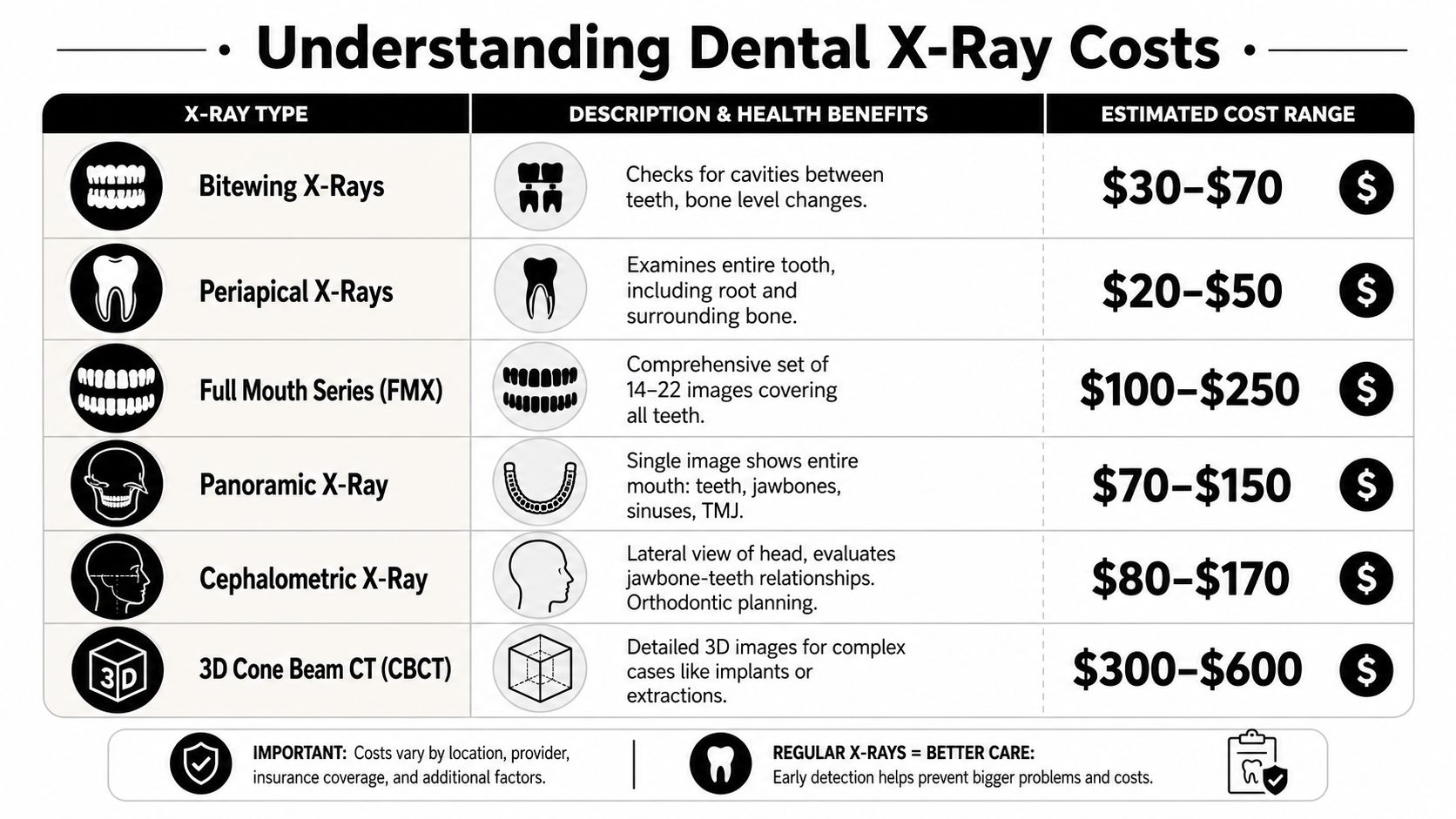
Across the United States, dental X-rays without insurance typically cost between $30 and $750. Bitewing X-rays average $52 to $120, full-mouth series range from $175 to $428, and cone beam CT scans range from $361 to $879 based on Mira's dental X-ray cost overview.
In practice, I encourage patients to judge the fee by the diagnostic value, not only by the line item. A lower-cost image is appropriate when it answers the question well. A higher-cost scan can still save money if it prevents a missed fracture, a failed extraction plan, or treatment that starts without a clear diagnosis.
Bitewing X-rays
Bitewings are the routine images many patients know best. They show the areas between back teeth and help identify early decay, existing filling problems, and bone level changes that are easy to miss during a visual exam alone.
These are often the best value in preventive care because they can catch a small problem while treatment is still straightforward. For uninsured patients comparing prices, Aflac's overview of uninsured dental costs notes that bitewing X-rays range from $52 to $120, periapical and occlusal views range from $42 to $103 with averages around $55, and a full-mouth series ranges from $175 to $428 with an average of $226.
Periapical and occlusal X-rays
Periapical and occlusal images are more targeted. If a patient points to one tooth and says, "This is the one that hurts," this is often the type of image that gives the answer.
A periapical X-ray shows the full tooth, including the root and surrounding bone. That makes it useful for checking infection, root damage, abscesses, and changes around a tooth that may look fairly normal above the gumline.
Panoramic and full-mouth series
A panoramic X-ray gives a wider view of the jaws, sinuses, tooth position, and impacted teeth. A full-mouth series takes a more detailed look at all teeth and supporting structures using multiple images.
The right choice depends on the clinical goal. In Katy, a patient with wisdom tooth pressure, orthodontic concerns, or a history of several dental problems may benefit from the broader or more detailed view because it reduces guesswork and helps us plan treatment in the right order.
3D CBCT scans
A cone beam CT scan provides a three-dimensional view that standard 2D images cannot match. Dentists use it for implant planning, complex extractions, root anatomy, jawbone evaluation, and other cases where precision matters.
This scan costs more because it answers more complex questions. If you want a clearer explanation of when a basic digital image is enough and when 3D imaging adds real value, this guide comparing digital X-rays and CBCT for diagnosis and treatment planning explains it well.
For dental teams trying to understand the business side of imaging fees and coding, this guide for dental practice owners gives useful background.
A good question to ask is simple: what problem is this image helping us confirm, rule out, or plan for? That answer usually tells you whether the investment makes sense.
What Factors Influence the Final Cost of Your X-Rays
A patient in Katy might call two offices asking the same question and hear two very different prices. That usually does not mean one office is overcharging. It means the visit, the type of image, and the reason for taking it are different.
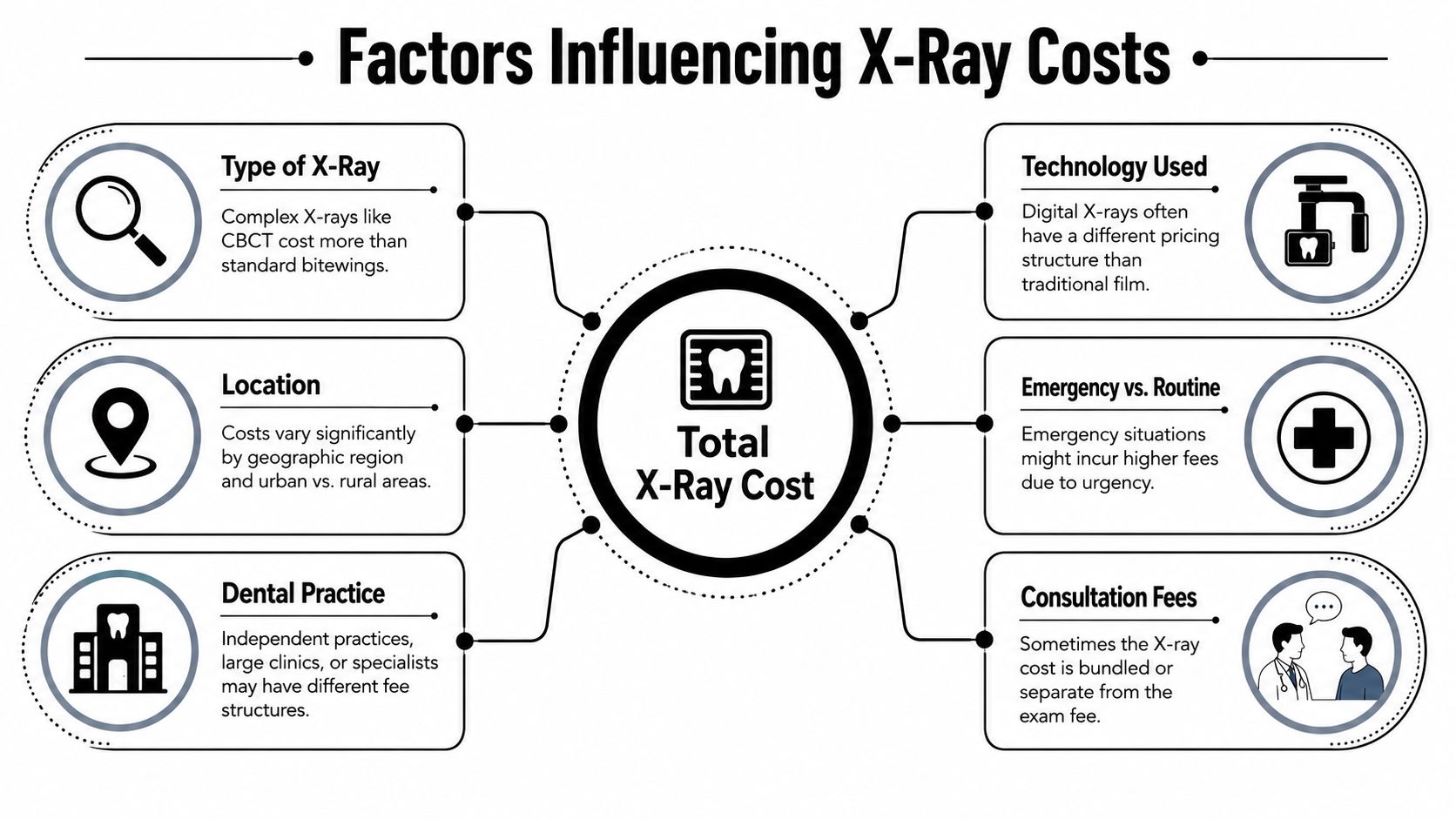
Location affects what offices have to charge
Katy patients are shopping in a large metro area, not a small rural market. Rent, staffing, compliance, and imaging equipment all cost more around Houston, and those overhead costs show up in fees.
That local context matters more than a national average. A quote that seems higher than what you saw online may still be normal for this area, especially in a practice that invests in newer digital systems and keeps imaging in-house for faster diagnosis.
The clinical question changes the fee
A quick image to check one painful tooth costs less than imaging used to plan an implant, evaluate bone levels, or investigate a problem that is not obvious on an exam. The more detail we need, the more time, equipment, and interpretation are involved.
That is also why I encourage patients to judge value, not just the line-item price. If the right image helps catch an infection early, confirm a cracked tooth, or prevent a failed treatment plan, it can save far more than it costs.
Newer technology can raise the price and improve the answer
Digital imaging is fast and useful for routine care. Three-dimensional imaging costs more because it gives a much clearer view for complex cases, especially surgical planning, root position, or implant placement.
For patients, the practical question is simple. Are you paying for extra imaging that changes treatment decisions, or for imaging that adds little to the visit? A good office should explain that clearly.
Packaging and visit type often create the biggest surprise
Many uninsured patients ask for the price of "X-rays" and are quoted one number, then learn the actual appointment includes an exam, a diagnostic review, or a consultation fee. That is common in private practice because images are often part of a larger diagnostic visit, not a standalone service.
Ask these questions before you book:
- What images are included in the quoted fee?
- Is this price for X-rays only, or for an exam and X-rays together?
- Is the quote for a new-patient visit, a limited emergency exam, or a specialist consult?
- Will the dentist review the images with me during the same visit?
If you are paying out of pocket, this matters. A higher upfront quote can still be the better investment if it includes the exam, diagnosis, and a treatment plan instead of only the images. Patients who want more ways to compare self-pay options can review this guide on how to get dental care without insurance.
Behind the scenes, offices also differ in how they code, package, and bill diagnostic services. If you're curious how the billing side works behind the scenes, this guide for dental practice owners offers a useful look at how practices structure claims, coding, and administrative workflows. Patients don't need to know coding, but it helps explain why one Katy office may quote a simple image fee while another quotes the full diagnostic visit.
Smart Ways to Make Dental X-Rays More Affordable
If you're uninsured, the goal isn't to avoid diagnostics. It's to get the right diagnostics at the best value.
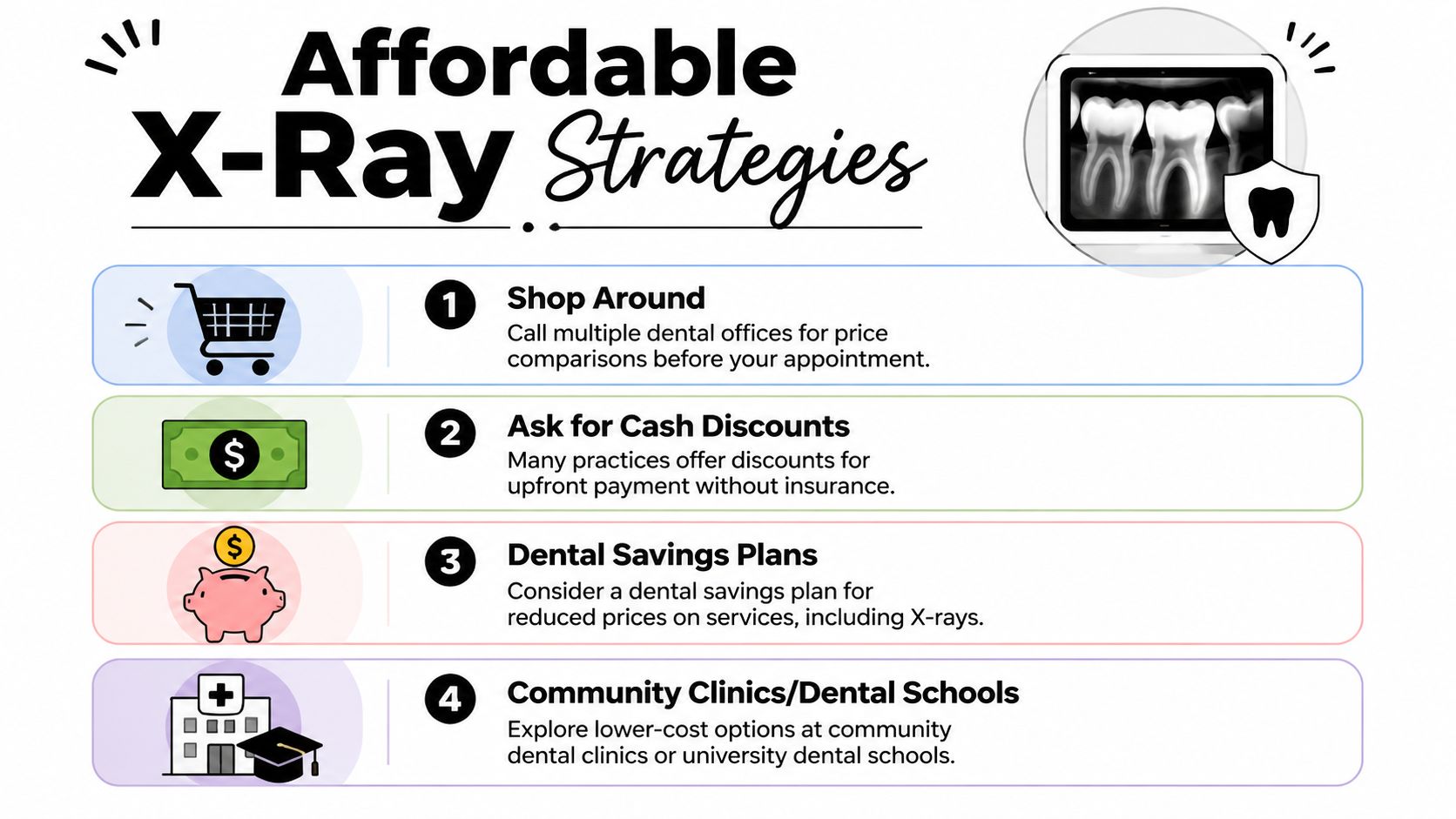
Compare total visit cost, not just the X-ray line
Calling around helps, but ask the office for the full out-of-pocket estimate. A low advertised image fee doesn't help if the actual appointment requires a separate exam or consultation fee.
The most useful question is, "What would I likely pay for the visit you think I need?" That gives you a realistic comparison.
Check community clinics and dental schools
Lower-cost options do exist, especially for preventive imaging. According to CareCredit's dental X-ray cost guide, community health centers and dental schools can offer significantly reduced rates, sometimes as low as $15 for a full set of dental X-rays for children.
That can be a strong option when budget is the main barrier. The trade-off is convenience. Scheduling can take longer, and some families prefer the continuity of staying with one office for exams, treatment, and follow-up.
Ask about cash discounts and savings plans
Many practices have options for uninsured patients, but you need to ask directly. Some offer reduced pricing for same-day payment. Others provide in-house savings plans that can lower the cost of preventive visits and make future care easier to budget.
A savings plan is often the most practical fit for patients who want regular care in one office rather than shopping around every time they need an exam, cleaning, or X-ray. If you're weighing broader healthcare costs too, this article on navigating doctor visits without insurance gives a helpful framework for asking the right financial questions before any appointment.
Bring recent X-rays if you have them
This step gets overlooked. If you've had recent dental images taken elsewhere, ask whether they can be transferred. Your new dentist may still need updated imaging, but sometimes existing records reduce duplication.
For patients trying to stay consistent with preventive care, this guide on getting dental care without insurance is a useful starting point.
Skipping an unnecessary duplicate image can save money. Skipping a necessary diagnostic image usually doesn't.
Affordable Care and Advanced Imaging in Katy TX
Local context matters. Katy patients aren't just comparing a national average. They're balancing the circumstances of a fast-growing Houston-area market, family budgets, commute times, and the need to get clear answers quickly.
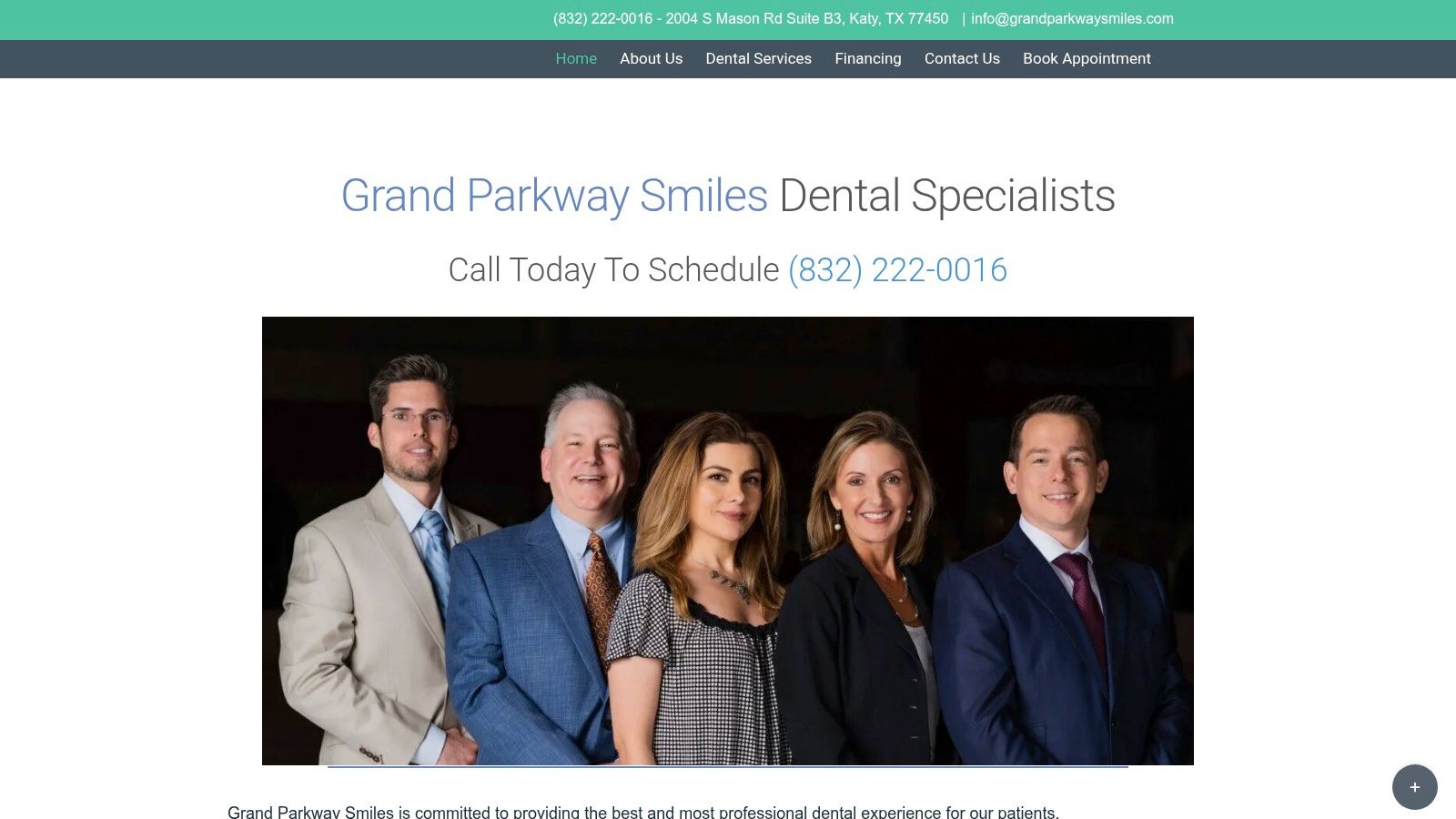
In practical terms, the best value usually comes from matching the imaging to the problem. A routine cavity check doesn't need the same scan as implant planning or an impacted tooth evaluation. When the office uses advanced digital systems and 3D imaging appropriately, patients get better diagnostic detail without paying for more than the situation requires.
For families in Katy, that's especially important. Convenience matters, but so does having access to a broad range of care under one roof when a simple exam turns into something more involved, such as root canal therapy, oral surgery, or planning to restore a damaged smile.
A good uninsured care option also needs cost structure, not just technology. That's where in-house savings plans can help. They don't replace insurance in every situation, but they often make preventive care, exams, and imaging more manageable for patients who want predictable out-of-pocket costs and ongoing care in one location.
What works well for uninsured patients locally
- Choose offices that explain why a specific image is needed
- Ask whether digital and 3D imaging are both available
- Look for savings plans if you expect ongoing care
- Prioritize continuity if your treatment may involve more than one procedure
Don't Let Cost Stop You From Protecting Your Health
If you've been delaying care because you don't have insurance, the key point is simple. X-rays aren't just about finding a number you can afford. They're about protecting your teeth, gums, jaw health, and the appearance of your smile before a hidden issue becomes obvious.
The cost of dental X-rays without insurance can vary a lot. Routine images may be relatively modest, while advanced 3D scans cost more. Geography, technology, and bundled visit fees all influence the final number, especially in a metro area like Katy.
What helps most is asking better questions up front, comparing total visit costs, and using lower-cost pathways when needed. If you're worried about the broader financial side of treatment, resources on making informed choices about medical debt can help you think through payment decisions carefully.
The right time to diagnose a dental problem is before it hurts, spreads, or changes your smile.
A short conversation about fees today is usually easier than dealing with an emergency later.
If you're in Katy or the greater Houston area and want straightforward answers about imaging, treatment options, and payment choices, Grand Parkway Smiles can help you understand what you need, what you don't, and how to protect your health without guessing about the cost.