Before we get into the details of the root canal procedure itself, let's talk about why it's often the very best option on the table for your smile and health. For many people, the words "root canal" bring up feelings of anxiety, but the reality is that this modern treatment is designed to rescue your natural tooth, keep your smile whole, and end painful symptoms.
Understanding the why—the incredible benefits for your dental health and appearance—is the first step toward feeling confident and comfortable with your treatment plan.
Why a Root Canal Is Your Best Bet for Saving a Tooth
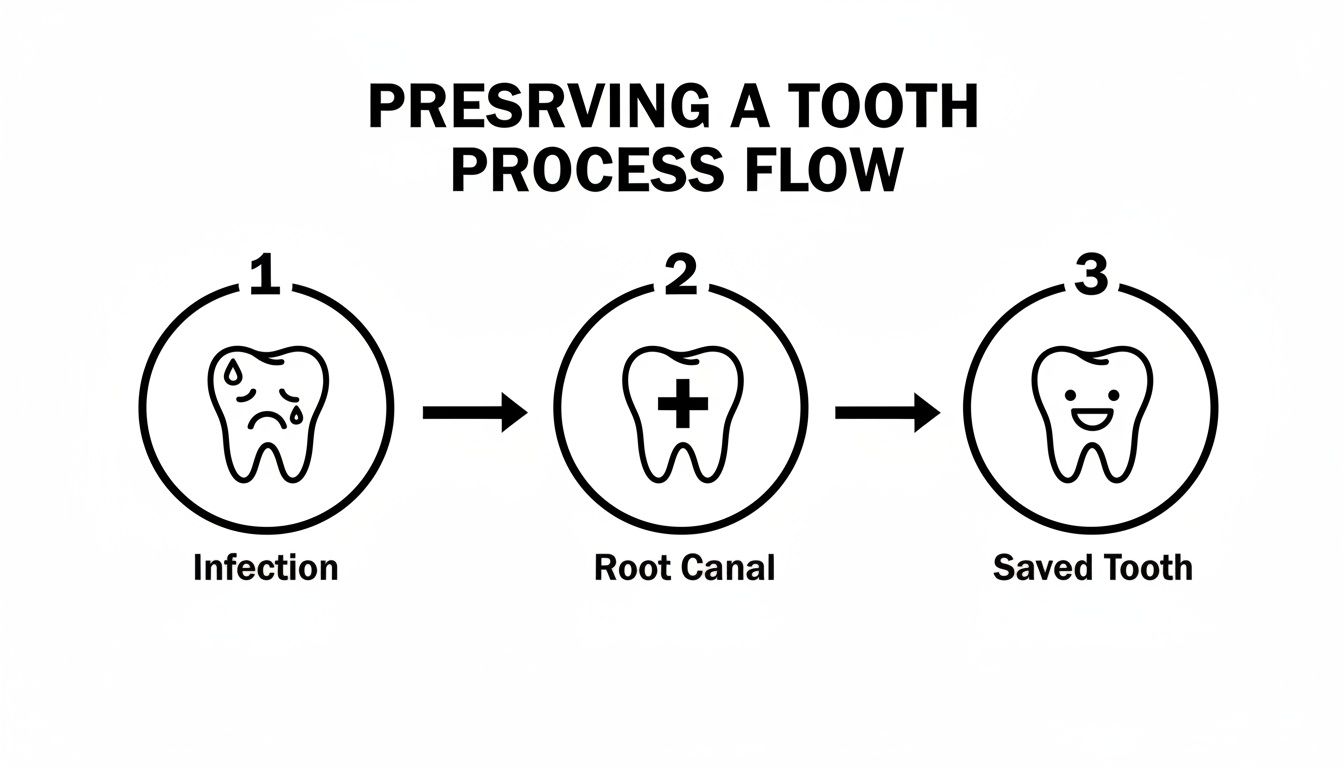
Let’s be honest: when you hear "root canal," your mind probably jumps straight to pain. But what if I told you the procedure is actually meant to relieve the severe pain caused by a deep tooth infection and save your smile from the consequences of tooth loss?
That throbbing, sensitivity, and pressure you might be feeling comes from an infection inside the soft tissue of your tooth, called the pulp. If we don’t address it, it can lead to a painful abscess, damage to your jawbone, and ultimately, losing the tooth. Choosing a root canal is a proactive way to stop the pain, eliminate infection, and protect your long-term dental health and the beauty of your smile.
The Real-World Benefits for Your Smile and Health
A root canal does so much more than just end a toothache. It provides some critical long-term advantages for your overall health and the appearance of your smile. When you save your natural tooth, you're making a smart investment in yourself and preserving the natural beauty of your smile.
Here’s what that really means for you:
- Preserving Your Natural Smile: Keeping your own tooth is a big deal for aesthetics and function. It helps maintain the natural alignment of your jaw and stops neighboring teeth from shifting out of place, which can ruin your bite and the look of your smile down the road.
- Maintaining Natural Chewing Function: There’s nothing quite like your natural teeth for chewing efficiently and speaking clearly. Saving a tooth with a root canal means you can continue to eat the foods you love without the learning curve or adjustments that come with artificial teeth.
- Avoiding More Costly and Complex Procedures: What’s the alternative to a root canal? Usually, it's removing the tooth completely. That leaves a gap that can affect your appearance and often needs a more expensive and complex fix, like a dental bridge or implant, to restore both function and aesthetics.
Deciding between saving a tooth and removing it is a significant choice with lasting consequences for your appearance and oral health. To help you understand the long-term differences, we've put together a simple comparison.
Root Canal vs Tooth Extraction Long-Term Impact on Your Smile
| Factor | Root Canal Therapy | Tooth Extraction |
|---|---|---|
| Natural Tooth | Preserves your original tooth structure, maintaining your natural smile. | The entire tooth is permanently removed, leaving a gap. |
| Jawbone Health | The natural root continues to stimulate the jawbone, preventing bone loss and preserving your facial structure. | The jawbone in the empty space begins to shrink and recede over time, which can affect your appearance. |
| Neighboring Teeth | Keeps adjacent teeth from shifting out of position, protecting your bite and alignment. | Adjacent teeth may drift into the gap, causing alignment issues and a crooked smile. |
| Function | Restores normal biting and chewing ability, allowing you to eat with confidence. | Creates a gap that can make chewing difficult and may require a replacement for full function. |
| Aesthetics | Maintains your natural smile with a seamless, color-matched crown. | Leaves a visible gap unless replaced by a more complex and costly bridge or implant. |
| Future Treatment | Typically a one-and-done procedure with a final crown, providing a lasting solution. | Often leads to more complex and costly future treatments (implant, bridge) to fill the gap and restore your smile. |
As you can see, while extraction might seem like a simpler fix, a root canal is focused on preservation, which benefits your overall oral health and the appearance of your smile for years to come.
A Modern Solution, Not an Old-Fashioned Problem
It’s easy to take for granted that we can even save a badly infected tooth. Not too long ago, pulling the tooth was the only real option, often with negative consequences for a person's smile and confidence. The acceptance of root canal therapy as a safe and effective treatment was a huge leap forward in dentistry.
Before the mid-20th century, both dentists and patients were skeptical. But thanks to pioneers like Louis Grossman, often called the father of modern endodontics, the world was shown that saving a tooth was a far better path than extraction. You can read more about this fascinating dental evolution and its history.
A root canal isn't about enduring pain; it's about ending it. The real discomfort comes from the infection itself, not the modern, gentle procedure designed to save your tooth and your smile.
Ultimately, choosing a root canal is a decision to protect your long-term health and appearance. It stops an infection from spreading, which could otherwise lead to serious issues like jawbone loss. By saving your tooth, you preserve your smile's structure, keep your natural bite, and shield yourself from a cascade of future dental complications.
A Patient's Walkthrough of a Modern Root Canal
The words "root canal" can sound pretty scary, but we find that understanding what the procedure actually involves can replace that uncertainty with confidence. A modern root canal is a precise, surprisingly comfortable, and highly successful treatment designed to save your natural tooth and, most importantly, get you out of pain.
Let's walk through the entire process, from start to finish, so you know exactly what to expect. This isn't about enduring a problem; it's about getting a solution that restores a damaged tooth to a healthy, functional, and beautiful part of your smile.
Accurate Diagnosis with Advanced Imaging
Your journey starts with a pinpoint-accurate diagnosis. Gone are the days of relying only on standard 2D X-rays. Today, we often use 3D imaging, specifically Cone Beam Computed Tomography (CBCT), to get a complete picture. This tech gives us a detailed, three-dimensional map of your tooth, its roots, and the bone around it.
This crystal-clear view lets us:
- See the exact number and shape of your root canals.
- Spot complex anatomy, like unusually curved or hidden canals.
- Pinpoint the precise location and extent of an infection with incredible accuracy.
This level of detail is a game-changer for planning your treatment. It means we know exactly what we’re up against before we even begin, leading to a more efficient procedure and a healthier, long-lasting result for your tooth.
Ensuring Your Complete Comfort
Let's bust the biggest myth right now: a root canal is not painful. The procedure is designed to relieve the pain of an infected tooth. The first and most critical step is making sure the area is profoundly numb using a local anesthetic. We will not start until you and we are confident the tooth is completely numb.
For patients who feel nervous or just have a tough time sitting still, sedation dentistry is a fantastic option. Here at Grand Parkway Smiles, we offer various levels of sedation, from mild oral sedatives to IV sedation for deep relaxation. Our goal is simple: to make sure you have a stress-free and comfortable experience while we work to restore your tooth's health.
Creating a Clean and Safe Workspace
Once you're completely numb and relaxed, we need to isolate the tooth. We do this by placing a thin sheet of latex or a similar material, called a rubber dam, over your tooth. A small clamp gently holds it in place, so only the tooth we're treating is exposed.
This simple tool is incredibly important for a few key reasons:
- Keeps the area dry: Your saliva is full of bacteria, and keeping it away from the open tooth is essential to prevent contamination and ensure a successful outcome.
- Keeps you safe: It creates a barrier that prevents you from swallowing or inhaling any of the tiny instruments or materials we use.
- Improves our view: It gives us a clean, clear field to perform the detailed work required to save your tooth.
Think of it as creating a sterile operating field, just like in any other medical procedure. It’s a vital part of ensuring a successful, infection-free result and a healthy tooth.
Accessing and Cleaning the Canals
With the tooth isolated, we make a tiny opening on the chewing surface (for a back tooth) or on the back side (for a front tooth). This access opening is just large enough for us to reach the pulp chamber and root canals inside.
This is where technology has truly transformed the experience. We now use incredibly flexible files made from a nickel-titanium (NiTi) alloy—a massive leap forward from the old, rigid stainless-steel files. The flexibility of NiTi files lets them navigate the natural curves of your canals gently and efficiently, removing the infected pulp tissue without stressing the tooth's structure.
The evolution of root canal tools has been remarkable. Modern instrumentation began a significant shift with the introduction of X-rays in 1896, which allowed dentists to finally see the internal tooth structure. However, the most profound leap came in 1990 with Nickel-Titanium (NiTi) files, which transformed how canals are cleaned due to their amazing flexibility and fracture resistance. For patients at Grand Parkway Smiles in Katy, Texas, these advancements mean root canal therapy is performed with modern precision instruments and advanced imaging like 3D scans. Explore the evolution of root canal techniques on Stonecreekdentaltx.com to see how far we've come.
After we remove the infected pulp, we thoroughly flush the canals with antimicrobial solutions to disinfect them and wash away any remaining debris.
The goal of cleaning and shaping is twofold: to remove all infected material from within the tooth and to prepare the canals for a perfect seal that will prevent any future infection, ensuring the tooth's long-term health.
Filling and Sealing the Tooth
Once the canals are spotlessly clean and dry, they have to be filled to keep bacteria from ever getting back in. The gold standard for this is a rubber-like substance called gutta-percha.
We heat the gutta-percha and carefully pack it into the canals with a special sealer cement. This creates a dense, complete seal from the very tip of the root to the top of the canal. This "obturation" process fills the space where the pulp used to be, sealing off the tooth’s interior for good to prevent reinfection.
Finally, we’ll place a temporary filling in the access opening to protect the tooth while it heals, one step closer to a fully restored smile.
The Final Step: Protecting Your Tooth and Your Smile
A root canal saves your tooth from infection, but it can leave the tooth a bit more brittle than before. The pulp that was removed provided hydration, and the access opening can weaken the tooth's overall structure.
That’s why the final step is absolutely critical for the long-term success of your tooth: placing a permanent restoration. This is usually a dental crown. A crown acts like a helmet, covering the entire tooth to restore its strength, shape, and beautiful appearance. It allows you to chew normally again and protects the underlying tooth from fracturing. With this final step, your once-infected tooth is fully restored and ready to be a healthy, functional, and beautiful part of your smile for years to come.
Your Guide to a Smooth Root Canal: Prep and Recovery
A successful root canal isn't just about what happens in the dental chair. A great experience starts with a little prep work before you arrive and continues with some simple care after you head home. Knowing what to do can make all the difference, helping you feel less anxious and promoting a quick, comfortable recovery.
Think of it as teamwork—with a bit of planning on your end and our expertise at the office, we can ensure the entire process is as smooth as possible, getting you back to smiling confidently in no time.

Part of that prep work involves getting your paperwork in order. Taking a few minutes to complete your medical intake forms before your visit gives us a full picture of your health. This helps us provide the safest, most effective care designed just for you.
Before Your Appointment: Setting Yourself Up for Success
Walking into your appointment feeling calm and prepared is our goal. A few simple steps can make your procedure feel much more routine and stress-free.
First, let's talk about food. We recommend eating a good, healthy meal a couple of hours before you come in. Your mouth will be numb for a while afterward, so having a meal beforehand means you won't have to worry about being hungry when you can't chew comfortably.
Next, be sure to follow any specific instructions we’ve given you. This might include:
- Taking Medication: If we prescribed an antibiotic or an anti-inflammatory, please take it exactly as directed. This helps get ahead of any potential infection or swelling.
- Finding a Ride: This is a big one. If you're opting for sedation, you must have someone drive you home. You won’t be in any condition to drive safely.
- Dressing for Comfort: You'll be with us for a little while, so wear something comfortable and loose-fitting.
After the Procedure: The First 24 Hours
Once the root canal is done, the focus shifts to a smooth recovery and protecting your newly saved tooth. The first 24 hours are the most important for healing. You’ll leave our office with the area still numb, and that feeling will last for a few hours.
A friendly but important warning: Be very careful not to chew on the treated side of your mouth until the numbness is completely gone. It’s incredibly easy to bite your cheek or tongue without realizing it.
As the anesthetic wears off, it's totally normal to feel some tenderness in your jaw or around the tooth itself. This is usually mild and can be easily handled with over-the-counter pain relievers like ibuprofen. We'll give you specific advice on what to take to ensure your comfort.
What to Eat (and What to Avoid)
For the first few days, your tooth needs you to go easy on it. Sticking to a soft-food diet helps prevent any unnecessary pressure on the healing area and protects your investment.
Here are some go-to options:
- Smoothies, yogurt, and milkshakes
- Lukewarm soups and broths
- Scrambled eggs
- Mashed potatoes
- Applesauce and pudding
Definitely avoid anything hard, sticky, or crunchy. Think nuts, hard candy, and popcorn. As you start to feel better, you can slowly work your way back to your regular diet. For a deeper dive, check out our guide on how to prepare for a root canal and what to expect.
Keeping It Clean and When to Give Us a Call
Good oral hygiene is crucial for healing and keeping your smile healthy. You can and should brush and floss your other teeth normally.
Just be gentle when brushing around the treated tooth. A warm saltwater rinse (about 1/2 teaspoon of salt in a glass of warm water) two or three times a day can also do wonders to keep the area clean and soothe inflammation.
Most people bounce back from a root canal with no problems at all. However, don't hesitate to call our office if you notice any of the following:
- Serious pain that isn't getting better with medication.
- Swelling inside or outside your mouth that seems to be getting worse.
- Signs of an allergic reaction to medication, like a rash or hives.
- If your temporary filling or crown feels loose or comes out.
- Your bite feels "off" or uneven after the numbness wears off.
Following these tips for prep and recovery is the best way to protect your newly saved tooth and ensure your comfort as you heal.
Of all the procedures in dentistry, root canals probably have the worst reputation. Thanks to old stories and movie exaggerations, just hearing the words can make people nervous. But the reality of a modern root canal is a world away from those scary myths.
Let's clear the air and look at what the procedure is actually like today. You’ll see that it's a comfortable, highly successful treatment designed to save your tooth, restore your health, and preserve your smile.
Myth 1: Root Canals Are Excruciatingly Painful
This is the biggest misconception out there, and it’s one we’re happy to put to rest. The idea of a painful root canal comes from a time long before modern anesthetics and refined dental techniques. Today, the experience is completely different.
Honestly, getting a root canal should feel about the same as having a cavity filled. We use effective local anesthetics to make sure the tooth and the entire area around it are completely numb. In fact, the procedure is what relieves the intense pain caused by the infected tooth—it doesn't cause it.
The main goal of a root canal is to get you out of pain. We perform the procedure with powerful anesthesia to ensure you are comfortable from start to finish while we save your tooth.
This fear isn’t totally unfounded—it stems from the early days of dentistry. The first modern root canal was done way back in 1838, and it wasn’t until anesthesia became common after 1846 that patient comfort dramatically improved. We’ve had over 180 years to perfect this treatment, making it one of the most reliable and comfortable in our practice.
If you're still feeling anxious, our article on whether root canal treatment is painful offers even more detail and reassurance.
Myth 2: It’s Better to Just Pull the Tooth
While pulling a tooth might sound like a simpler solution, saving your natural tooth is almost always the better long-term strategy for your overall health and the appearance of your smile. An extraction can set off a chain reaction of other dental problems.
When you lose a tooth, it can lead to:
- Shifting Teeth: The neighboring teeth will start to drift into the empty space, which can mess up your bite and create a crooked, uneven smile.
- Bone Loss: Your jawbone needs the tooth root to stay strong. Without it, the bone in that area starts to shrink, which can weaken adjacent teeth and even change the shape of your face over time.
- More Expensive Replacements: To restore your bite and smile, you'll likely need a dental implant or a bridge. These are fantastic solutions, but they are more complex and costly than saving the beautiful tooth you already have.
Myth 3: Root Canals Cause Other Illnesses
You might have stumbled across some scary claims online that try to link root canals to other diseases in the body. This myth comes from poorly designed research from almost a hundred years ago that has been repeatedly and thoroughly debunked.
Every major medical and dental organization, including the American Association of Endodontists, confirms there is no valid scientific evidence connecting root canal therapy to any other illness. A root canal removes a harmful infection from your body, which actually protects your overall health by stopping bacteria from spreading.
Understanding the High Success Rates of Root Canals
Now, let's talk about the best part. When performed by an experienced dentist and properly restored with a crown, root canal therapy is one of the most predictable and successful procedures we do, with fantastic long-term benefits for your smile.
The success rates for root canals are consistently high, often exceeding 95%. That means the vast majority of teeth that receive this treatment go on to last a lifetime with no further trouble, functioning and looking just like your other natural teeth.
A successful outcome really comes down to three key things:
- Thorough Cleaning: Making sure every bit of the infected tissue is removed and the inside of the tooth is completely disinfected.
- A Perfect Seal: The cleaned-out canals are filled with a rubber-like, biocompatible material to seal them off from any future bacteria.
- A Solid Restoration: The final step is placing a durable, natural-looking dental crown on top. This protects the treated tooth from breaking and restores its full strength, function, and appearance.
Once you see past the myths, it’s clear that a root canal is a safe, effective way to keep your natural smile healthy, beautiful, and strong for years to come.
The Grand Parkway Smiles Approach to Root Canal Therapy
Understanding the technical steps of a root canal is one thing, but knowing you're in the right hands makes all the difference. At Grand Parkway Smiles, we've built our entire process around patient comfort, using advanced technology to make your care as seamless and stress-free as possible. We truly believe getting a root canal should be a straightforward experience that ends your pain and restores your health and smile.
From the moment you call us to the day you walk out with your final beautiful restoration, our goal is to provide a complete, convenient, and positive experience—all right here under one roof.

A Commitment to Your Comfort
We know that dental anxiety is a real and powerful feeling, and we take it very seriously. Your comfort is our absolute top priority. That's why we don't just offer the standard solutions; we provide a full range of sedation options designed to meet you where you are, so you can receive the care you need to keep your smile healthy.
Many of our patients find local anesthetic is all they need. But if you need a little extra help to feel at ease, we have you covered.
Our patient comfort options include:
- Oral Sedation: A simple pill taken before your procedure helps you relax and feel completely calm.
- Nitrous Oxide: Often called "laughing gas," this provides a gentle, relaxing sensation that wears off quickly, allowing you to drive home after your visit.
- IV Sedation: For patients with significant anxiety, this offers a deeper state of relaxation. You can rest comfortably through the entire appointment, often with little to no memory of the procedure itself.
Our focus on pain and anxiety management ensures that even the most nervous patients can get the essential care they need to protect their oral health and maintain their beautiful smiles.
Advanced Technology for Pinpoint Accuracy
A successful root canal is a game of millimeters. That's why we've invested in advanced technology that ensures every procedure is as precise and effective as it can be. This isn’t about having flashy gadgets; it’s about getting better, more predictable results that protect your tooth for a lifetime.
We use 3D imaging (CBCT) to create a detailed map of your tooth’s unique anatomy. This lets us see everything—including unusual curves or tiny, hidden canals that a traditional X-ray might miss. When it's time for your final crown, our digital scanners create a perfect-fitting, aesthetically pleasing restoration without the goopy, messy impressions of the past.
By combining our team’s expertise with state-of-the-art technology, we deliver a root canal experience that is not only comfortable but also built for long-term success, preserving both the health and beauty of your smile.
Convenient Care When You Need It Most
A severe toothache is an emergency, and it shouldn't have to wait. We offer same-day emergency appointments to get you out of pain and on the road to recovery as fast as possible.
Because we handle everything in-house—from the initial diagnosis and treatment to crafting your final, beautiful crown—you won’t be shuffled between different offices. It all happens right here.
We also understand that financial concerns shouldn't be a barrier to your health and confidence. Our team is dedicated to helping you find a solution that works for you. We help by:
- Accepting most PPO insurance plans.
- Offering in-house savings plans for patients without insurance.
- Providing flexible financing solutions to fit your budget.
At Grand Parkway Smiles in Katy, we merge compassionate, patient-first care with the best of modern dentistry. We're here to completely change how you think about getting a root canal.
Common Questions About Root Canal Treatment
We find that even after walking through the steps, patients still have some very valid questions. It's completely normal, and we believe having clear, honest answers is the best way to feel comfortable and confident about your treatment.
Let's go over a few of the questions we hear most often at our practice.
How Long Will I Be in the Chair?
This is one of the first things everyone wants to know. For most root canals, you can expect one or two appointments, with each visit lasting about 90 minutes.
The exact time really depends on the tooth we're working on. A front tooth, for instance, usually has just one straight root canal, making the process much faster. A molar in the back of your mouth is a different story; it can have several canals, some of which might be curved and harder to access, which naturally takes a bit more time.
If the infection is particularly stubborn or has formed an abscess, we might schedule two visits. The first appointment is dedicated to cleaning everything out and placing a medicated filling to let the area calm down. On your second visit, we'll finish the job by permanently sealing the tooth. Our priority is always getting it done right, not just fast, to ensure a healthy foundation for your restored tooth.
Is a Crown Always Necessary After a Root Canal?
In almost every case, yes. A good way to think about it is that the root canal saves the tooth, and the crown protects that investment and restores its beauty for years to come.
During a root canal, we remove the inner pulp—the nerve and blood supply. While this is what gets rid of the infection, it also means the tooth no longer has its internal source of hydration. Over time, it can become brittle and much more likely to fracture.
A crown acts like a protective helmet for the treated tooth. It covers it completely, absorbing the force of your bite and restoring its original strength and natural appearance. Without a crown, a tooth that has had a root canal is at a much higher risk of breaking, which could mean losing the tooth after all.
Placing a custom-matched crown is the crucial final step that allows your tooth to function normally and blend seamlessly with your smile for the long haul. It's about protecting your health and your appearance.
Is Getting a Root Canal Painful?
Let’s clear up the biggest myth right away: the modern root canal procedure is not painful. That old reputation comes from a time before today's advanced anesthetics and techniques. The pain people associate with root canals is actually the pain from the infection before the procedure.
Today, we have incredibly effective local anesthetics that completely numb the tooth and all the surrounding tissue. We won't start until we are certain you are profoundly numb and comfortable. In fact, our patients often say the experience feels a lot like getting a simple filling.
The entire point of a root canal is to relieve the intense pain caused by a deep tooth infection. That throbbing, aching, and pressure are what we're here to fix. Most people feel a huge sense of relief almost as soon as the procedure is over.
What Is the Alternative to a Root Canal?
The only real alternative to a root canal is having the tooth extracted. While pulling the tooth will definitely solve the infection, it almost always creates a new set of problems for your health and your smile down the road.
When you lose a tooth, the neighboring teeth naturally start to shift and tilt into the empty space. This change can throw off your bite, make it harder to keep your teeth clean, and ultimately affect the look of your smile.
To fix that new gap, you'd be looking at more complex and often more expensive solutions like a dental implant or a bridge. While those are great options, saving your natural tooth is almost always the simplest, healthiest, and most cost-effective path forward to maintain a complete and beautiful smile.
Ready to put your tooth pain behind you and restore your smile's health and appearance? The expert team at Grand Parkway Smiles is here to provide comfortable, state-of-the-art root canal therapy. Contact us today to schedule your consultation at https://dentistkatytx.com.