When you lose teeth, it impacts far more than just your ability to chew. It can change the way you talk, how you feel about your smile, and even the very structure of your face. Dentures are a long-standing, effective solution designed to bring back both form and function, restoring your comfort, health, and confidence.
Think of them simply as a set of replacement teeth attached to a gum-colored base. This base is precisely molded to fit right over your gums, bringing your smile back to life while also providing crucial support for your lips and cheeks, improving both your appearance and oral health.
How Dentures Restore Your Smile and Dental Health
The Mechanics of a Secure Fit
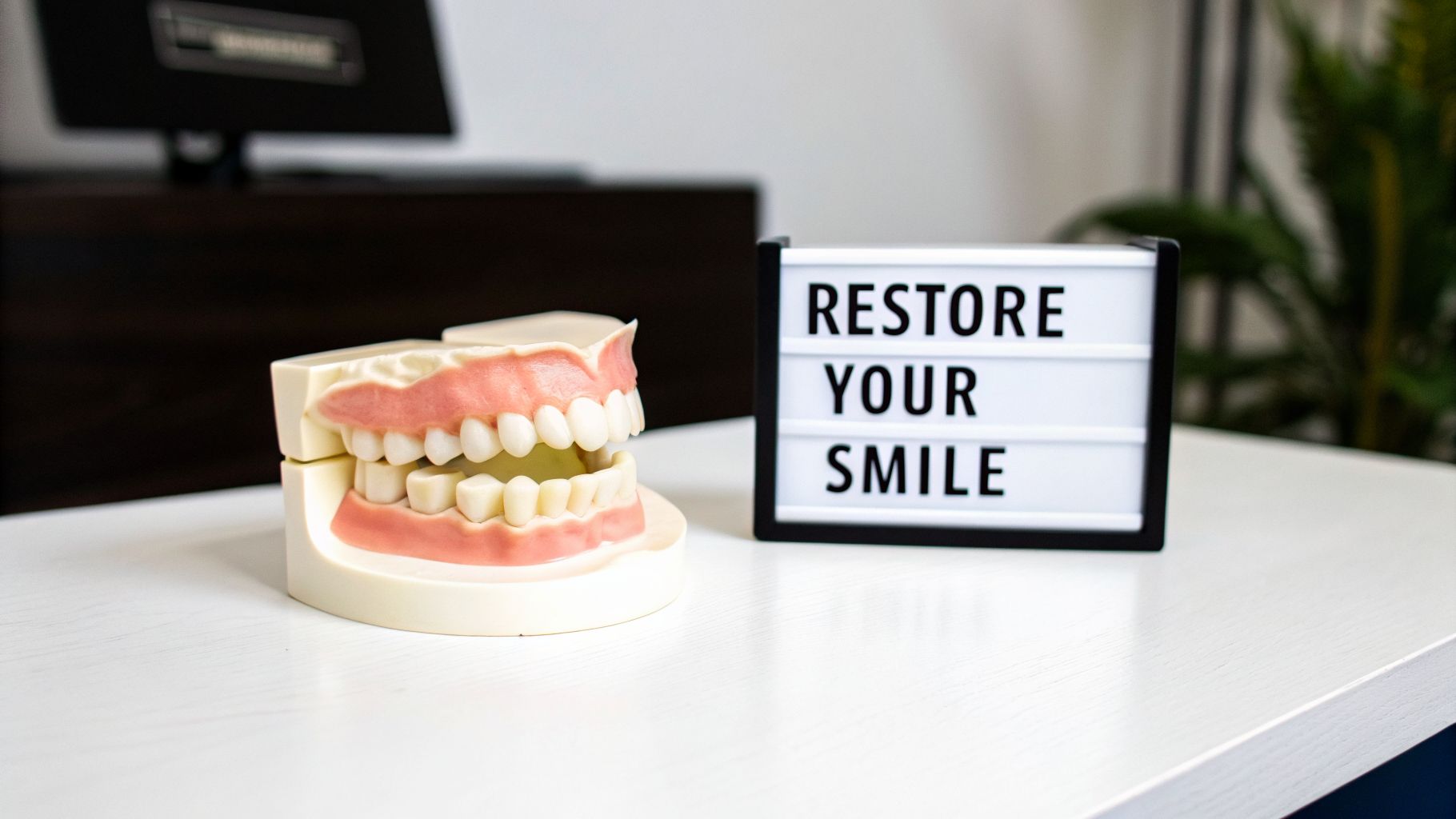
Understanding how dentures stay in place is actually pretty straightforward. An upper denture works a lot like a suction cup. It forms a natural, secure seal with the roof of your mouth (your palate), and this large surface area provides excellent retention that holds it firmly in place, allowing you to speak and eat with confidence.
A lower denture, on the other hand, is a different story. Since the lower jaw doesn’t have a palate to create suction, it relies on something else entirely: the masterful control of your tongue and cheek muscles. Over time, you learn to use these muscles to hold the lower denture steady, balancing it on the bony ridge of your jaw to restore function.
To give you a quick overview, here’s how the mechanics and benefits break down for each type of denture.
Denture Mechanics and Benefits at a Glance
| Denture Type | Primary Mechanism of Action | Key Benefit |
|---|---|---|
| Upper Denture | Natural suction against the palate (roof of the mouth). | High stability for confident speaking and eating. |
| Lower Denture | Relies on muscle control from the tongue and cheeks to stay balanced on the jaw ridge. | Restores function in an area with less natural retention. |
This table highlights the core principles, but the real-world impact goes much deeper, improving your appearance and health almost immediately.
Immediate Benefits for Your Appearance and Health
The effect of wearing dentures goes far beyond just filling the gaps in your smile. They offer several immediate and significant benefits that improve both how you look and your overall health.
- Restored Facial Support: Without teeth, the muscles in your face can begin to sag, leading to a sunken or aged look. Dentures provide support from the inside, restoring volume to your cheeks and lips for a fuller, more youthful profile.
- Improved Speech Clarity: Missing teeth can make it tough to pronounce certain words, sometimes causing a lisp or whistle. Dentures give your tongue the structure it needs to form sounds correctly, helping you speak clearly again.
- Enhanced Chewing Function: While they may not have the full power of natural teeth, dentures allow you to properly chew a much wider variety of foods. This can significantly improve your nutrition and your enjoyment of meals.
Dentures are designed for long-term use, but they don’t last forever. Studies show their average longevity is around 10.1 years, with upper dentures often lasting a bit longer than lower ones. It's also quite common for patients to need minor adjustments; about 20% of patients will need a tune-up within the first few years to address sore spots or changes in fit as the mouth settles. Discover more insights about denture longevity
Choosing the Right Denture for Your Smile
Deciding how to replace missing teeth is a big deal. It’s a choice that touches everything from your appearance and confidence to simply enjoying a meal. Not all dentures are the same—they’re crafted to solve different problems and fit different lifestyles. Figuring out these differences is your first step toward getting your smile back in a way that feels both secure and natural.
The right path forward really starts with your specific situation. Are you missing just a few teeth, or do you need to replace an entire arch? Answering that question is what guides us toward the best type of denture for you, whether it's a full or partial set.
Full Dentures for a Complete Smile Restoration
When every tooth in your upper or lower jaw is gone, a full denture is often the go-to solution. It's a full arch of new, lifelike teeth set into a pink, gum-colored acrylic base. We meticulously shape this base to fit right over your gums, bringing back the look and feel of a complete, healthy smile.
An upper denture usually has great stability because it covers the roof of your mouth (the palate), which creates a natural suction to hold it in place. The lower denture is a bit different. It sits on the gum ridge, and you'll learn to use your tongue and cheek muscles to keep it steady. It takes a little practice, but most people get the hang of it quickly. A full denture can completely transform your smile, support your facial muscles to prevent that "sunken-in" look, and restore your ability to chew and speak clearly.
Partial Dentures to Fill the Gaps
If you have some healthy teeth remaining, then a partial denture is a fantastic choice. Instead of replacing a whole row of teeth, a partial is designed to fill in only the spaces where teeth are missing. It’s made of replacement teeth on a gum-colored base, often with a lightweight metal or flexible framework holding it all together.
This framework has tiny clasps that gently hook onto your existing teeth for support. Using your natural teeth as anchors keeps the partial denture secure and helps spread out the pressure from chewing, which protects your remaining teeth from extra stress. The final result is a seamless fix that blends right in with your natural smile. You can see more examples and learn about the different types of dentures available at Grand Parkway Smiles to get a better idea.
Implant-Retained Dentures for Superior Stability
For anyone looking for the absolute best in stability and confidence, implant-retained dentures are a game-changer. This solution combines the benefits of traditional dentures with the security of modern dental implants. Rather than just resting on your gums, these dentures are anchored directly to your jawbone with a few strategically placed implants.
Think of it like a snap-button system. The denture has special fittings on its underside that “snap” securely onto the implants, locking it down. This completely eliminates any slipping or shifting while you talk, laugh, or eat.
This solid connection offers some incredible advantages for your oral health and daily life:
- Enhanced Chewing Power: Because the denture is connected to your jawbone, you can chew with much more force—almost like you have your natural teeth back. This allows for better nutrition and a wider diet.
- Improved Confidence: You can go about your day without ever worrying that your denture might come loose. Eat what you want and laugh without a second thought.
- Jawbone Preservation: Dental implants actually stimulate the jawbone, which signals your body to keep it strong. This helps prevent the bone loss that normally happens after you lose teeth, preserving your facial structure for years to come.
Knowing the real-world differences between full, partial, and implant-retained dentures helps you have a much better conversation with your dentist. It puts you in the driver's seat, ready to pick the solution that truly fits your goals for a comfortable, healthy, and beautiful smile.
Your Journey to a Custom-Fitted Smile
Thinking about getting dentures can feel like a big step, but knowing what the process involves can make all the difference. The path to your new smile is a careful, collaborative journey between you and our dental team, with the goal of creating a perfect fit, total comfort, and a look you'll love.
Every detail is personalized just for you. From the exact shade of the teeth to how they line up with your bite, we consider everything to make sure your new smile looks completely natural and functions just right. Your feedback is crucial at every stage, making you a key part of the process.
The Initial Consultation and Impressions
It all starts with an initial consultation. This is our chance to sit down, discuss what you're hoping for with your new smile, go over your dental history, and talk about your overall health. We'll answer all your questions and map out a clear plan. Once we land on the right type of denture for you, the first real step is taking precise dental impressions.
Think of this as creating a 3D blueprint of your mouth. We use a soft, flexible material in a tray that captures every little detail of your gums and any teeth you still have. These impressions are the exact mold from which your custom denture will be made. A perfect impression is the foundation for a perfect fit, comfort, and function.
The Crucial Wax Try-In Appointment
After the lab gets your impressions, they'll create a wax try-in model. This is one of the most important appointments because it's where you get a real preview of your new smile. The lab sets the prosthetic teeth in pink wax, creating a working prototype of your final denture.
This is your chance to give it a test drive and tell us what you think. We’ll be looking for your feedback on a few key things:
- Tooth Shade and Color: Do the teeth look natural and complement your skin tone?
- Tooth Size and Shape: Are the teeth a good size and shape for your face?
- Alignment and Bite: Does it feel comfortable and even when you close your mouth?
- Overall Appearance: Most importantly, are you happy with the way your new smile looks?
If anything feels or looks off, we can adjust the wax model right there in the chair until it's exactly what you want. Your final approval is what tells us we're ready for the last step.
This visual shows how each stage of the fitting process builds on the last, making sure your final denture is a perfect match.
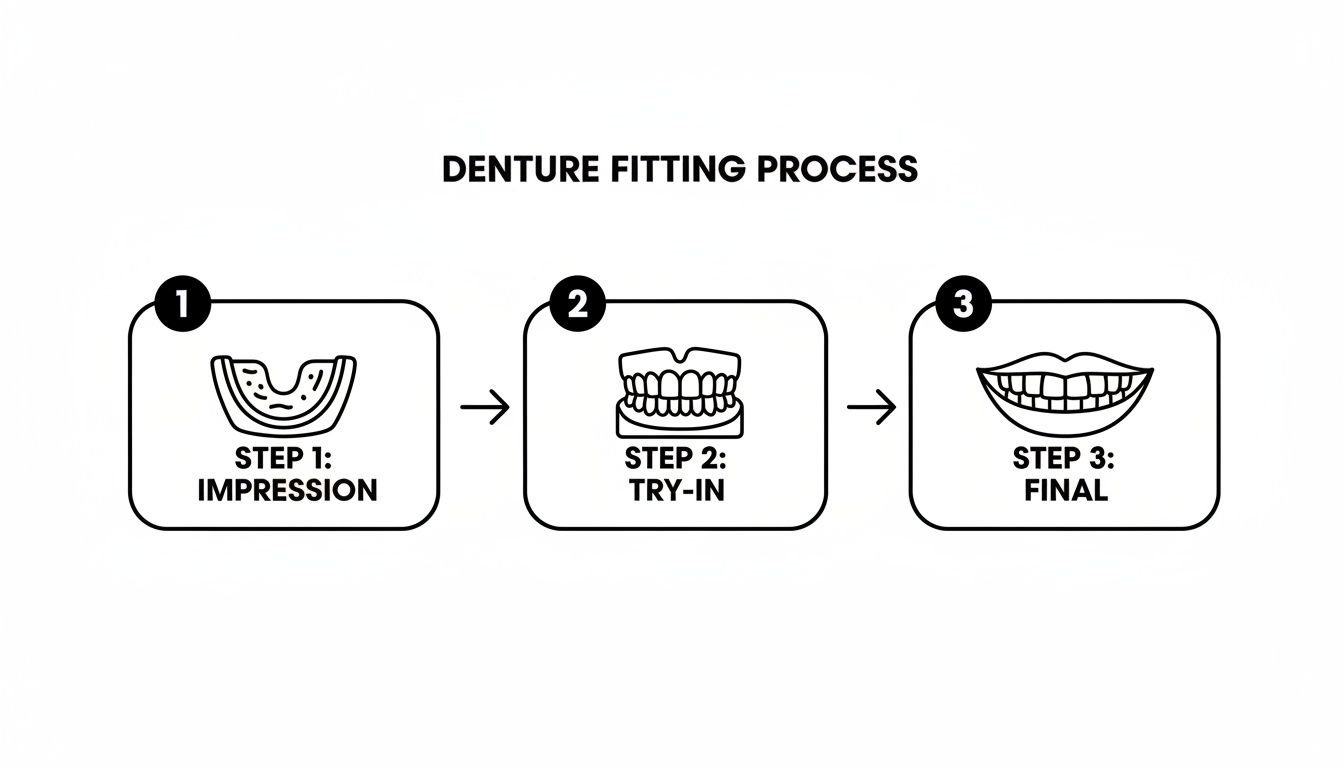
From the first impression to the final smile, it's a step-by-step process designed for a custom outcome.
The Final Fitting and Your New Smile
Once you give the green light on the wax try-in, the dental lab gets to work crafting your final, permanent denture. When it’s ready, you’ll come in for the final fitting. We’ll place the denture, check the fit, test your bite one last time, and make any tiny adjustments needed to make it perfectly comfortable.
Complete dentures made in a professional setting are built to last, with a weighted mean lifespan of 10.1 years. Upper dentures often last longer than lower ones because the palate provides better natural suction. The high satisfaction rates from patients line up with what we see clinically—most people consider their dentures a huge success.
We also know that feeling comfortable during these appointments is a big deal. That's why some dental practices are investing in new ways to improve patient comfort and satisfaction in the chair.
You’ll walk out of this appointment with your brand-new smile and all the instructions you need to take care of it. This entire journey is more than just a dental procedure; it’s a partnership focused on bringing back your confidence and improving your quality of life. For a closer look at what to expect, you might want to read our detailed guide on getting dentures at Grand Parkway Smiles.
Living Confidently with Your New Dentures

Getting used to your new smile takes a little time, and that's perfectly normal. Think of it like breaking in a new pair of shoes—there’s an adjustment period. Daily life with dentures is all about building a few new, simple habits that will keep you comfortable, confident, and ensure your mouth stays healthy for the long haul.
In the first few weeks, you might notice some minor soreness or a feeling of fullness in your mouth. This is just your tongue and cheek muscles getting acquainted with your new prosthetic. The great news is that most people adapt very quickly, and before you know it, your dentures will feel like they've always been there.
Mastering Eating and Speaking
Eating and speaking will probably be the two biggest things you'll adjust to. When you first start, we recommend sticking to soft foods that don't require a lot of chewing—think mashed potatoes, yogurt, soups, and well-cooked veggies. This gives you a chance to get used to the feeling of biting without putting too much strain on your gums.
Once you feel more confident, you can slowly start working firmer foods back into your diet. Here’s a pro tip: cut your food into small, easy-to-manage pieces and try to chew on both sides of your mouth at the same time. This simple trick helps balance the pressure, keeping your denture stable and preventing it from tilting.
Speaking can also feel a bit different at first. You might notice a slight lisp or that certain words sound funny, but don't worry, this is temporary. A fantastic way to speed up the process is to read a book or the newspaper out loud to yourself. It might feel silly, but it’s an effective way to retrain your tongue and lips to form sounds clearly with the denture in place.
Your Guide to Proper Denture Hygiene
Keeping your dentures clean isn't just about appearances; it's absolutely critical for your overall oral health. Good hygiene prevents bacteria from building up, which is the culprit behind gum irritation, bad breath, and potential infections. Taking care of your gums is just as important as taking care of the denture itself.
Here’s a simple routine to keep everything in top shape:
- Rinse After Meals: Whenever you can, take your dentures out after eating and give them a quick rinse under cool water. This washes away any food particles before they can become a problem.
- Brush Dentures Daily: Use a soft-bristled denture brush and a non-abrasive denture cleaner. Never use regular toothpaste, as it's too abrasive and can create tiny scratches on the denture's surface. A gentle brushing removes plaque and stubborn stains.
- Clean Your Mouth: Don't forget your gums! After removing your dentures, gently brush your gums, tongue, and the roof of your mouth with a soft toothbrush. This helps remove plaque and stimulates circulation in the tissue.
One of the most important things you can do for your oral health is to give your gums a rest. We always tell our patients to remove their dentures every night before bed. This allows your gum tissues to recover from the pressure of wearing the prosthetic all day.
To make things even easier, here's a simple checklist to follow every day.
Daily Denture Care Checklist
| Action | Why It Is Important | Frequency |
|---|---|---|
| Rinse after meals | Removes food particles to prevent buildup and irritation. | After every meal |
| Brush dentures | Removes plaque, food, and stains to prevent bad breath and infection. | Once a day |
| Clean your gums | Removes plaque and stimulates circulation in your oral tissues. | Morning and Night |
| Soak dentures overnight | Keeps them hydrated and clean, preventing warping and bacterial growth. | Every night |
Following this checklist will help make proper hygiene second nature.
Storing Your Dentures and Using Adhesives
When you do take your dentures out for the night, they need to be stored properly. If they dry out, the acrylic can warp, which would ruin that perfect custom fit we worked so hard to achieve. Always keep them fully submerged in a glass of water or a dedicated denture-soaking solution.
What about adhesives? They can offer extra security, but they shouldn't be a substitute for a well-fitting denture. If your dentures are made correctly, you may not need adhesive at all. Some people, however, like to use a small amount for added peace of mind, especially with a lower denture which can be trickier to keep stable.
If you decide to use one, just a few small dots on the underside of the denture is all you need. If you find yourself needing more and more adhesive to hold your dentures in place, that's a clear signal that it's time to see your dentist. It likely means your dentures need a simple adjustment or a reline.
Weighing Your Tooth Replacement Options
Deciding how to replace missing teeth is a big step toward getting your confidence and dental health back. To make the best choice for you, it helps to see the full picture—the pros and cons of every path available. While traditional dentures have been a trusted solution for a long time, it's worth comparing them honestly with modern options like dental implants.
This comparison will help you match the right solution to your budget, lifestyle, and health goals. For many people, dentures are an excellent choice that brings back a great-looking smile and the simple joy of eating comfortably again.
The Clear Advantages of Traditional Dentures
One of the biggest benefits of traditional dentures is that they are a non-invasive treatment. Unlike dental implants that require surgery to place posts into the jawbone, getting fitted for dentures doesn't involve any surgical procedures. This makes them a great option for people who aren't good candidates for surgery or would simply rather avoid it.
Another huge plus is how quickly you can get your new smile. The process of getting custom-fitted dentures is usually much faster than the timeline for dental implants, which can take several months from start to finish. In many cases, you can have a beautiful, functional new set of teeth in just a few weeks.
Finally, dentures are often the most affordable way to replace a full set of missing teeth. Their cost-effectiveness makes a restored smile accessible to more people, offering an immediate and significant improvement in quality of life.
Understanding the Potential Downsides
While dentures have plenty of upsides, it’s good to be realistic about their limitations, too. One of the most common hurdles is the learning curve, especially with a lower denture. It rests on a smaller ridge and doesn't have the natural suction an upper denture does, so it takes more muscle control from your tongue and cheeks to keep it stable. Getting the hang of it just takes a bit of time and practice.
Long-term jawbone health is another critical point to consider. When teeth are gone, the jawbone doesn't get the stimulation it needs from chewing, which can cause gradual bone loss. Because traditional dentures just rest on the gums, they don't stop this from happening. Over the years, this can change the shape of your jaw, making the dentures feel loose and requiring adjustments or a replacement.
Lastly, the bite force with a traditional denture isn’t quite as strong as what you have with natural teeth or implants. They work wonderfully for a wide variety of foods, but you might still need to steer clear of anything particularly hard or sticky.
Comparing Dentures and Dental Implants
This is where the difference between dentures and implant-supported options really becomes clear. Dental implants are small posts surgically placed into the jawbone, where they fuse with the bone in a process called osseointegration. This creates an incredibly strong and stable anchor for a crown, a bridge, or a full denture.
The difference in long-term performance is significant. While dentures rely on biomechanical retention, their limits are clear when compared to implants. Studies show that implant-supported overdentures have a survival rate of 93.3%, dwarfing the 66.7% long-term success of removable dentures. Despite the high success of implants, millions of Americans still rely on traditional dentures, with a projected 42.46 million people in the U.S. wearing them by 2025. You can find more denture statistics and comparisons at Impressions Dental.
It’s this rock-solid stability that makes implant-supported options a premium alternative. Here’s a quick look at how they stack up:
- Stability: Implants are anchored directly to your jaw, so there’s no slipping or movement.
- Bite Force: They restore nearly 100% of your natural chewing power, improving nutrition.
- Bone Health: Implants act like natural tooth roots, stimulating the jawbone to prevent bone loss and preserve your facial structure.
Ultimately, choosing between traditional dentures and an implant solution comes down to what's most important to you. If your main goals are a fast, affordable, and non-invasive way to bring back your smile, traditional dentures are an outstanding choice. But if you’re looking for maximum stability, long-term jaw health, and the freedom to eat anything without a second thought, investing in an implant-supported solution could be the perfect path for you.
Your Denture Questions Answered
Stepping into the world of tooth replacement can definitely bring up a lot of questions. As you think about getting your smile back, it’s completely normal to wonder about the adjustment period, how dentures might change your looks, and the real-world details of cost and how long they last. We’ve put this section together to give you clear, straightforward answers to the questions we hear most often, helping you feel confident and informed on your journey.
Knowing what to expect is a huge part of making dentures work for you—not just in your mouth, but in your day-to-day life. When you're well-informed, the transition is almost always smoother and more successful.
How Long Does It Take To Get Used To New Dentures?
This is one of the first things people ask, and the truth is, the timeline is a little different for everyone. Most patients find they’re feeling comfortable with their new dentures within a few weeks. At first, you might have some minor soreness, or it could feel like your mouth is a bit full. This is a totally normal part of the process as your tongue and cheek muscles learn to coordinate with your new teeth.
To help get you there faster, we often recommend a few simple exercises. Try reading a book or newspaper out loud; it's a great way to help your tongue adapt to forming words around your new smile. When you start eating, stick with soft foods cut into small pieces. This lets you get the hang of chewing without putting too much strain on your gums.
Your follow-up appointments are a critical part of this phase. These visits allow us to make small, precise adjustments to get rid of any sore spots and perfect the fit. It’s all about making your transition as smooth and comfortable as we can.
Just remember to be a little patient with yourself. Your brain and muscles are learning a new skill, and before you know it, wearing your dentures will feel completely natural.
Will Dentures Change My Facial Appearance?
Yes, and almost always for the better. It’s easy to underestimate the impact tooth loss has on your face. When teeth are gone, the jawbone isn't getting the stimulation it needs, and the muscles around your mouth can start to sag. This loss of support is what creates that sunken, prematurely aged look.
Dentures work directly against this by giving back that crucial support to your lips and cheeks. By filling the space where your natural teeth used to be, they lift your facial tissues, can smooth out wrinkles around the mouth, and help create a fuller, more youthful profile. The difference can be pretty striking, sometimes taking years off a person's appearance.
A well-made denture is carefully crafted to complement your natural facial structure. We look at the shape of your face, your skin tone, and your features to design a smile that isn't just beautiful but looks like it belongs to you. In that sense, dentures do a lot more than just replace teeth—they can revitalize your whole look.
What Is The Cost and Does Insurance Help Cover It?
Let's talk about the investment. The cost of dentures varies quite a bit because it really depends on what you need. The final price is shaped by the type of denture you choose—whether it’s a full, partial, or implant-retained denture—and the quality of the materials we use to make it. For instance, an implant-retained denture has a different cost than a traditional full denture because of the surgical steps involved.
During your first consultation with us, we’ll lay everything out with a completely transparent cost breakdown for your specific treatment plan. We want you to have all the details you need to make a decision that feels right, with no surprises down the road.
Many dental insurance plans do offer partial or even full coverage for dentures, since they're seen as a necessary restorative procedure for your health. Our team has a lot of experience working with insurance providers and will gladly help you figure out your policy and get the most out of your benefits. For any remaining costs, we can discuss flexible financing options to make investing in your health and smile an achievable goal.
How Often Should I Replace My Dentures?
While today's dentures are built to be tough, they aren't a permanent fix. On average, you should plan on replacing your dentures every 5 to 10 years. The reason for this usually isn't that the denture itself has worn out, but because your mouth continues to change over time.
Your jawbone and gums naturally and gradually reshape themselves throughout your life. This process, called resorption, can eventually cause a denture that once fit perfectly to become loose. A loose fit can lead to a few issues that tell you it’s time for a replacement.
Here are the key signs that you might need a new set:
- Slipping or Shifting: If your dentures often move around when you talk or eat, the fit just isn't secure anymore.
- Clicking Sounds: Audible clicking noises when you chew or speak are a classic sign of a poor fit.
- Discomfort or Sore Spots: A denture that fits well should be comfortable. If you’re getting persistent sore spots, you need an adjustment or a replacement.
- Noticeable Wear: If the teeth on the denture look worn down, it can affect your bite and how well you can chew.
This is why regular dental check-ups are so important. We can keep an eye on these changes, assess the fit of your dentures and the health of your gums, and let you know when a simple reline can tighten things up or when a full replacement is the best way to protect your oral health.
Restoring your smile is one of the best investments you can make in your health and confidence. At Grand Parkway Smiles, our expert team is here to guide you through every step, from answering your first questions to delivering a final result you'll absolutely love. Schedule a consultation with our Katy, TX dental team today to explore your options and start your journey back to a confident, functional smile.