A patient sits through the consultation, nods at the right moments, says the treatment plan makes sense, and even asks about timing. Then the call to schedule never comes. A week later, your team learns what really happened. The patient wasn't rejecting the dentistry. They were stuck between fear, cost, and uncertainty about what life would look like after treatment.
That moment is where patient education materials either do their job or fall short.
In dentistry, especially with implants, cosmetic treatment, root canals, sedation, and full-mouth reconstruction, patients rarely say no because they don't care about their teeth. They hesitate because they don't fully understand the health benefit, the appearance outcome, the process, the recovery, or the financial path. If your materials answer those questions clearly, you build trust. If they don't, even excellent clinical recommendations can feel too risky to accept.
Why Patient Education Is Your Most Valuable Tool
A treatment plan for a single filling usually doesn't need much explanation. A treatment plan for dental implants or full-mouth reconstruction is different. Patients are weighing function, appearance, time, discomfort, healing, and money all at once. If your explanation lives only in the consultation room, much of it will be forgotten by the time the patient gets home.
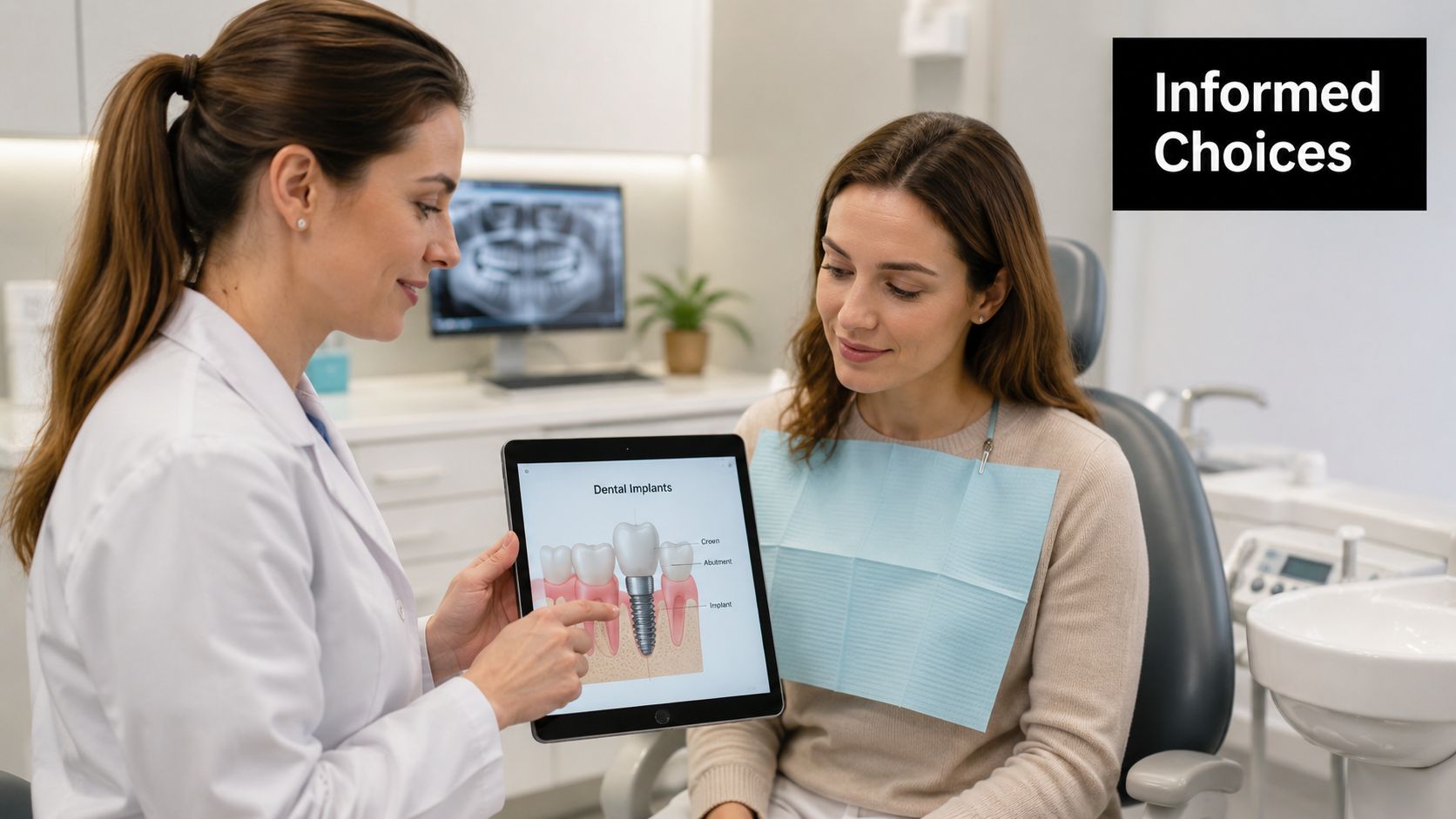
That's why strong patient education materials are more than handouts. They are the bridge between clinical advice and patient confidence. They help a patient understand not only what you recommend, but why it matters for chewing, speech, comfort, and smile appearance.
What hesitation usually sounds like
Patients often don't say, “I didn't understand the case presentation.” They say things like:
- “I want to think about it.” Often this means they need clearer explanation.
- “I'm worried it's too much.” That can mean too much surgery, too much recovery, or too much cost.
- “I'm not sure I'm ready.” This usually signals unresolved questions, not lack of need.
- “Can I just wait?” Patients may not understand the consequence of delay for oral health or appearance.
A well-built education system helps your team respond before those doubts harden into inaction.
Practical rule: If a patient needs to make a significant decision at home, they need something clear to take home with them.
Why this matters clinically and commercially
Digital patient education materials can improve outcomes when patients use them, but adoption remains a barrier. Evidence on portal-based education shows improved outcomes overall, while low utilization limits impact, which means access alone isn't enough and practices need active follow-up and distribution strategies, as noted in this discussion of digital patient education through portals.
For a dental practice, that lesson is simple. Good materials don't sit in a folder. Staff place them in the patient journey on purpose.
When patients understand how an implant can restore bite stability, protect appearance, and support daily comfort, acceptance gets easier. When they understand what sedation feels like, fear drops. When they know what to expect after treatment, they're less likely to panic, delay, or disappear.
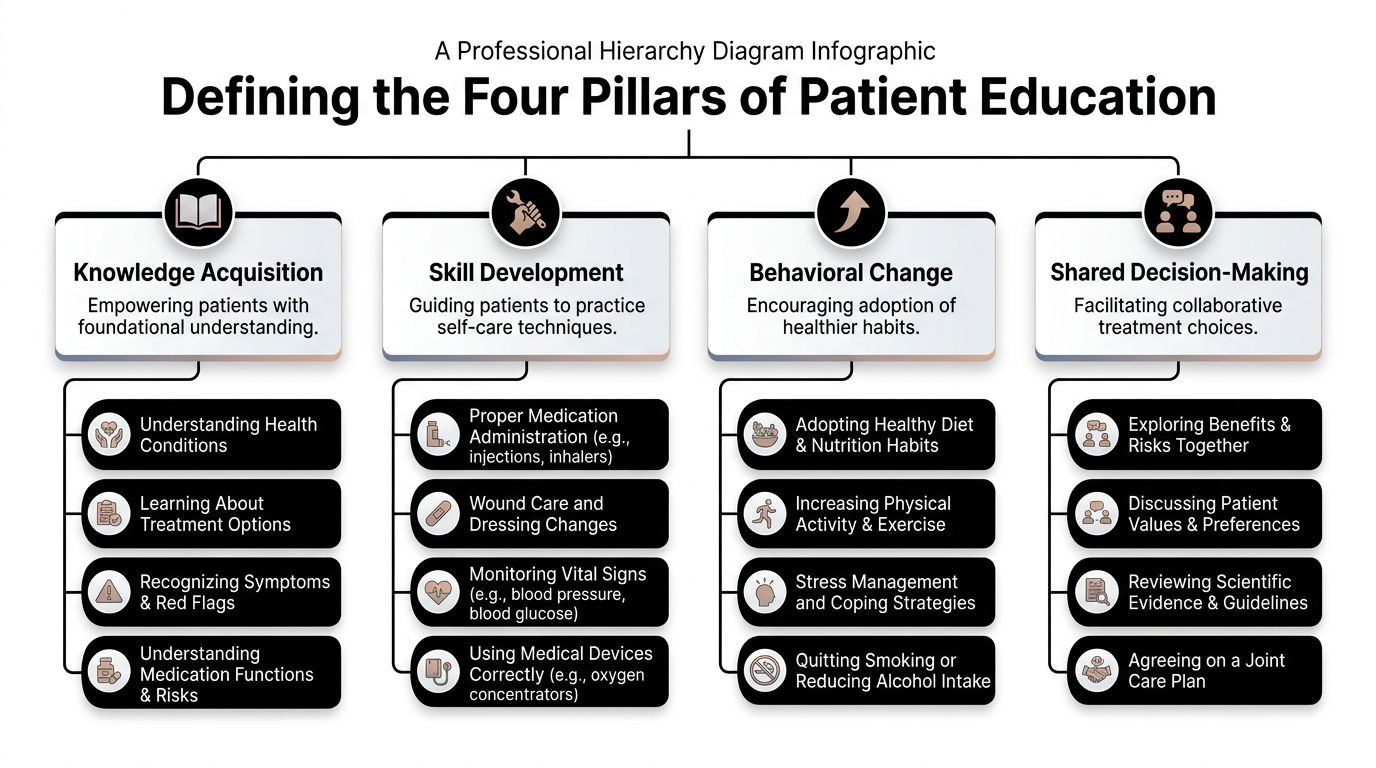
Defining the Four Pillars of Patient Education
A practice that relies on one brochure is leaving too much to chance. Patients learn in different ways. Some need something to read. Others need visuals. Some need a short video they can replay with a spouse. Others need a tool that lets them interact with instructions or timelines.
Print materials
Printed materials still matter because patients remember written information better than spoken information. They're especially useful for aftercare, home instructions, and reminders about warning signs.
Research also shows that printed patient education materials vary by condition type. They work better for symptomatic conditions, but they're less effective on their own for asymptomatic conditions, which is one reason practices should offer information in more than one format, as explained in this summary of printed materials, symptom-driven engagement, and recall.
Best dental use: A post-op sheet after wisdom tooth removal or implant placement that tells the patient what swelling, bleeding, diet changes, and medication timing may look like.
Digital materials
Digital materials include portal messages, web pages, emailed guides, and mobile-friendly care instructions. Their strength is convenience. Patients can open them at work, at home, or in the parking lot before an appointment.
In dentistry, digital works well when a patient is comparing treatment options or trying to revisit a recommendation after the visit. A page that explains crowns versus implants, or dentures versus implant-supported options, can reduce confusion before a case acceptance call.
Best dental use: A treatment page sent after a consultation that explains how a missing tooth affects chewing, adjacent teeth, and smile appearance.
Video materials
Video helps when the procedure is hard to imagine. Many patients don't understand dental implants because they can't visualize placement, healing, and the final restoration. A short video can show the sequence in a way that spoken explanation often can't.
Multimedia materials such as videos, animations, and interactive mobile tools offer higher engagement and can be distributed widely without physical proximity. The same evidence also points to a structured development process, including needs assessment with 6 to 10 former patients or focus groups and testing with both patients and professionals, as described in this review of multimedia patient education materials.
Best dental use: A short implant video that shows how the implant supports function, preserves facial harmony, and replaces a visible gap with a natural-looking tooth.
Interactive materials
Interactive education asks the patient to do something. That changes how they process information. It may be a checklist, a recovery tracker, a consent explainer with expandable sections, or an Invisalign app prompt that reinforces wear habits.
This format is especially valuable when the treatment requires patient participation. Oral hygiene around implants, aligner compliance, and diet instructions after surgery all improve when the material is behavior-focused.
Best dental use: A recovery checklist that lets a patient track medications, soft-food progress, and follow-up questions after full-mouth reconstruction.
| Pillar | What it does best | Strong dental example |
|---|---|---|
| Supports recall at home | Post-op implant instructions | |
| Digital | Makes information easy to revisit | Mobile-friendly treatment summary |
| Video | Explains complex procedures visually | All-on-4 overview |
| Interactive | Encourages action and follow-through | Recovery or aligner tracking tool |
Best Practices for Creating Clear and Accessible Materials
Most dental handouts fail in the same way. They are technically accurate, but they sound like they were written for another dentist. Patients don't need less information. They need information they can absorb when they're anxious, distracted, or worried about their smile.
Write for the patient in front of you
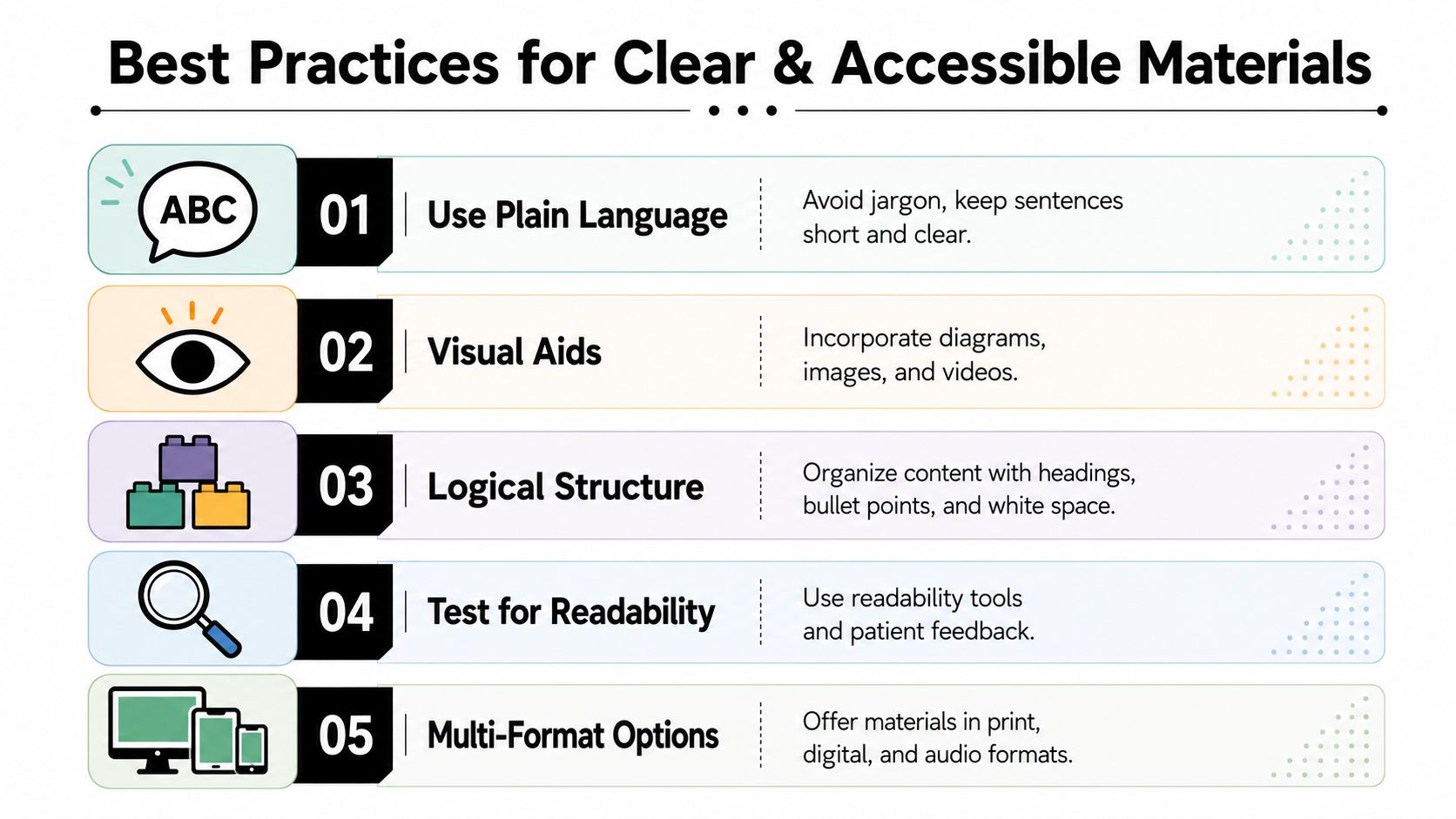
High-quality patient education materials should be written at a 6th to 8th grade reading level, with 6th grade serving as a reasonable benchmark. A conversational style is more engaging than short, choppy writing, and materials should be reviewed periodically with patient feedback and clinician review, according to the Patient Education Material Manual.
That matters in dentistry because fear makes comprehension worse. A patient who is worried about losing teeth, dealing with pain, or changing appearance won't process dense clinical language well.
Here's the difference:
Before: “Osseointegration is required prior to definitive prosthetic loading.”
After: “Your implant needs time to bond with the bone before we place the final tooth.”
Before: “Postoperative edema and transient discomfort are anticipated.”
After: “Swelling and soreness are normal after treatment, and we'll show you how to manage both.”
A patient should never need a dictionary to understand how a procedure protects their oral health or improves their smile.
Build for scanning, not studying
People don't read dental instructions like novels. They scan for the part they care about most. That means your materials should be easy to move through quickly.
Use these habits:
- Put the main point first. Start with the purpose. “This guide explains how implants replace missing teeth and what healing looks like.”
- Break up the page. Use short sections, bullets, and white space.
- Lead with actions. “Eat soft foods.” “Call us if bleeding continues.” “Wear your aligners as directed.”
- Show, don't just tell. Diagrams, before-and-after visuals, and labeled illustrations reduce confusion.
Clear writing tells the patient what matters, what to expect, and what to do next.
Use multiple formats and review them regularly
A handout can't carry the whole communication load. Pair print with digital, and use video when the topic is procedural or emotional. If your team is building visual education, this expert guide to video learning is useful for thinking through structure, flow, and clarity.
It also helps to train staff to translate jargon consistently. A practical example is this plain-language explanation of what dentists are really saying, which reflects how much easier care feels when clinical terms are turned into patient-friendly language.
A good quality-control loop is simple:
- Draft in plain language
- Have a clinician verify accuracy
- Let real patients review for clarity
- Update when protocols, technology, or wording changes
Putting Education into Practice with Clinical Examples
A useful education packet doesn't start with the procedure. It starts with the patient's worry. In dentistry, fear usually falls into one of five categories: pain, appearance, safety, recovery, or cost. Your materials should answer the concern that's driving hesitation.
The implant patient who worries about looks and chewing
A patient missing a front tooth often asks about appearance first, even when function is also suffering. An effective implant packet for that patient should explain how the replacement supports the look of the smile, restores everyday confidence, and helps with biting and speech.
For complex restorative cases, the reliability message matters too. Materials for full-mouth reconstruction can state that the All-on-4 technique has a 98.8% success rate, compared with a 96.9% global success rate for general dental implants, based on this review of All-on-4 and implant success rates.
A strong packet for this patient includes:
- A smile-focused explanation of how treatment restores visible tooth structure and facial confidence
- A step-by-step timeline from consultation to healing to final restoration
- A simple visual showing implant placement and final tooth support
- A home discussion page written for the spouse or family member who will help with the decision
The full-mouth reconstruction patient who fears a life disruption
This patient often isn't asking, “Does it work?” They're asking, “What will my life look like while this is happening?” Educational materials should address meals, speaking, work schedules, temporary restorations, healing, and the expected appearance changes along the way.
The more transformative the treatment, the more patients need a roadmap, not a brochure.
For these cases, avoid vague reassurance. Be direct. Explain what function may improve, what esthetic goals are realistic, and how the treatment supports long-term oral health when teeth are failing, missing, or painful.
The root canal patient who expects pain
Root canal education should correct the mental picture many patients already have. They may imagine severe pain, long appointments, and a difficult recovery. Good materials focus on relief, not drama.
That packet should include:
- What a root canal treats in plain terms
- How it helps save the natural tooth
- What numbness, soreness, and aftercare may feel like
- Why delaying can worsen infection, pain, or structural damage
This is one area where a one-page “what to expect today” guide can calm patients more effectively than a long general article.
The parent choosing care for a child
Parents usually want two things at the same time. They want effective treatment, and they want to know their child won't be frightened. Pediatric education materials should speak to both.
Use friendly language, visuals, and a short sequence of what the child will see, hear, and feel. A waiting-room handout for parents can explain preventive visits, sealants, fillings, and behavior guidance without sounding clinical or cold.
The sedation patient who needs reassurance
Sedation materials should answer practical fears. Will I remember anything? Can I drive? What if I'm anxious? What if I've had a bad dental experience before?
The best format here is layered communication:
| Patient concern | What the material should explain |
|---|---|
| Fear of pain | How comfort is managed during treatment |
| Fear of being out of control | What level of awareness to expect |
| Fear of recovery | What happens the rest of the day |
| Fear of embarrassment | That anxiety is common and manageable |
When education is customized this way, case acceptance improves because the patient feels understood, not managed.
Addressing the Financial Questions Patients Have
Many practices treat financial conversations as separate from patient education. That's a mistake. If a patient understands the health and appearance benefits of implants but doesn't understand how to pay for them, the education process is incomplete.
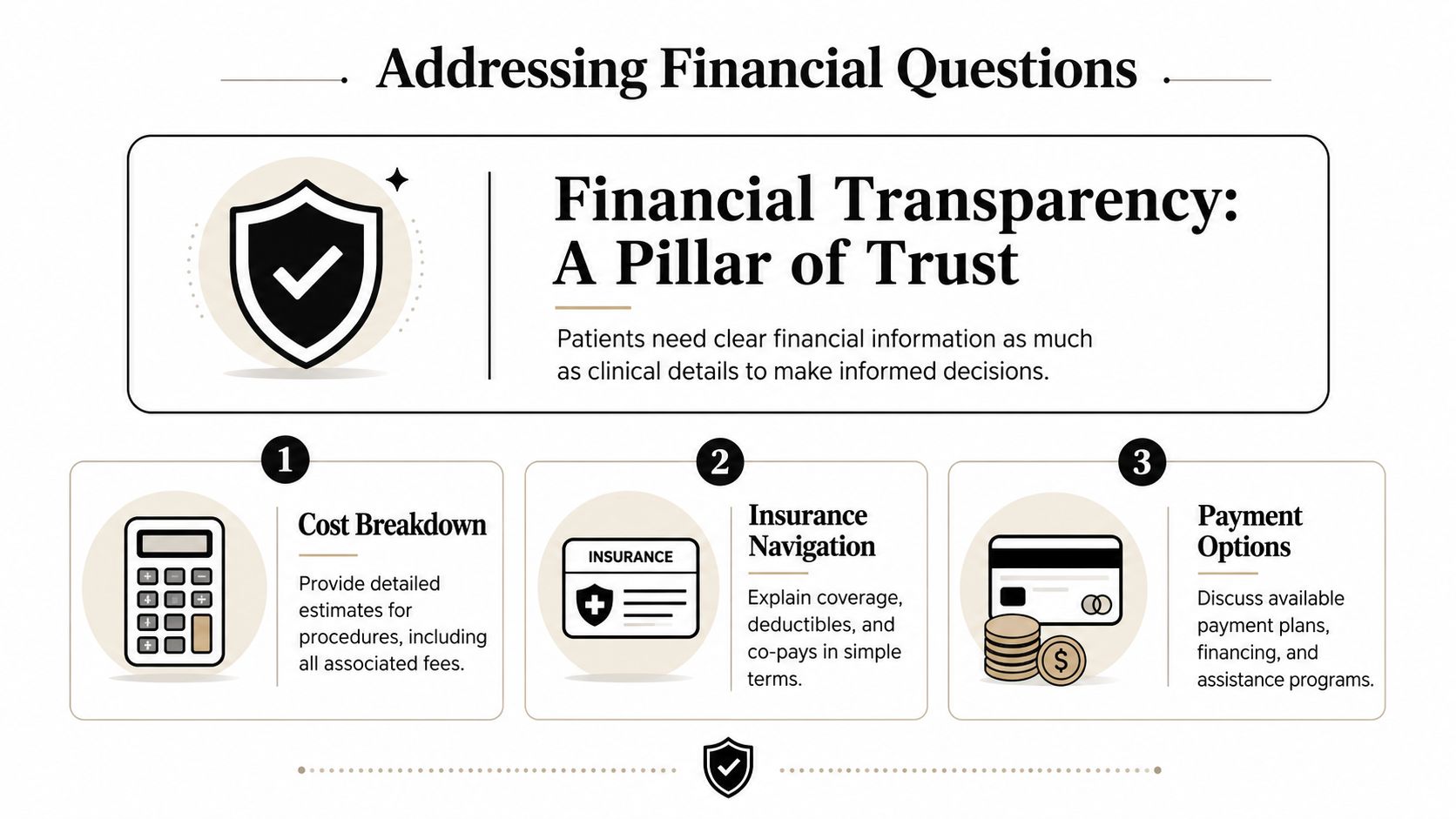
A significant content gap exists around financial support. In one white paper, 44% of healthcare professionals identified a lack of information on financial resources and 47% identified a lack of guidance on support services, with materials often failing to explain payment plans, insurance, or financing for high-cost care, according to the LUNGevity white paper on unmet education needs.
Why money belongs in the education packet
For high-value dentistry, patients are making a life decision, not a retail purchase. They need to understand what treatment costs, what alternatives exist, what parts insurance may help with, and what payment paths are available.
If you leave that conversation to a rushed handoff at checkout, patients may hear numbers but miss context. They may also feel embarrassed to ask questions. A written financial explainer gives them privacy, control, and time to think.
What your materials should cover
A practical financial guide should include:
- Estimated treatment phases so patients know whether costs are tied to surgery, temporaries, final restorations, or follow-up care
- Insurance basics in plain language including common terms patients struggle with
- Available payment paths such as in-house arrangements or third-party financing when offered
- What to ask before starting including timing, deposits, and whether phased treatment is possible
- Who to contact for help so the patient doesn't feel stranded after the consult
A useful model for that discussion is this patient-friendly explanation of dental insurance and financing options.
Financial transparency is part of informed consent. Patients can't make a confident decision if the clinical path is clear but the payment path is blurry.
When a patient feels respected enough to receive both treatment education and financial education, trust deepens. That trust often matters as much as the treatment plan itself.
Smart Distribution and Measuring Your Impact
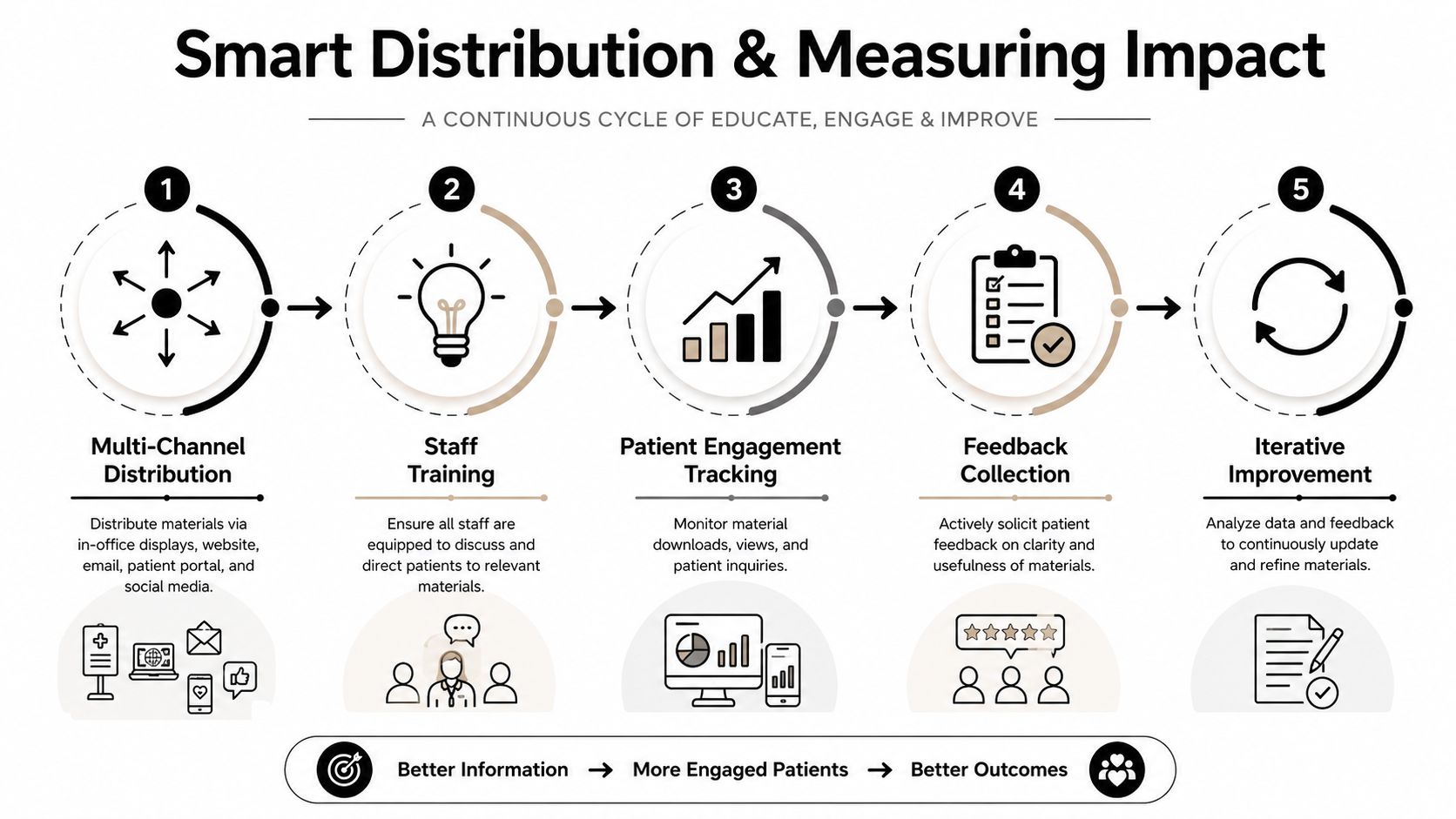
Even excellent patient education materials fail if patients never open them. A printed packet left on the front desk helps no one. A portal resource that no one mentions will often sit untouched. Distribution needs intent, timing, and repetition.
Match the material to the patient journey
Think in touchpoints, not files.
Before the consultation, the website can introduce procedures such as implants, sedation, or full-mouth reconstruction in plain language. During the consultation, the clinician can use a visual aid or short video to support the diagnosis and recommendation. After the visit, the patient should leave with print instructions and receive digital follow-up that reinforces the plan at home.
A practical sequence might look like this:
- Initial inquiry with a service page focused on health, function, and smile appearance
- Consult appointment with chairside visuals and written summary
- Same-day follow-up email with a procedure video or FAQ
- Pre-op reminder with behavior-focused instructions
- Post-op support with printed and digital recovery guidance
If you email PDFs or video guides, file size matters because patients may ignore attachments that load slowly or bounce back. Teams sending image-heavy materials may find these expert tips for email attachments helpful for making resources easier to deliver.
Don't measure education by revenue alone
Revenue matters, but it's a lagging signal. Stronger indicators appear earlier if your team looks for them.
Track things like:
- Case acceptance patterns after a revised education packet is introduced
- Questions patients ask repeatedly because those reveal what your materials still don't answer
- Post-op confusion calls which often expose unclear instructions
- Patient feedback on what felt helpful, reassuring, or hard to understand
- Staff consistency in how materials are used during handoffs
Digital education through portals can improve outcomes, but low utilization limits effectiveness, which is why active distribution matters more than passive availability. The point isn't just to create resources. It's to ensure patients engage with them.
Train the team, not just the patient
Education works best when the whole office uses the same language. The doctor, assistant, treatment coordinator, and front desk should all know when to hand off which piece and how to explain its purpose in one sentence.
That consistency reduces friction. It also makes the practice feel organized, calm, and trustworthy.
Making Patient Clarity a Cornerstone of Your Practice
Patient education materials aren't a side project. They are part of clinical care. They help patients understand why treatment matters, how it can restore health and appearance, what recovery looks like, and how to move forward without feeling pressured or confused.
In a dental office, clarity changes behavior. Patients are more likely to follow through when instructions are readable, when videos make procedures feel less mysterious, and when financial information is explained with the same care as the diagnosis. That isn't just good communication. It is good dentistry.
Many of the same principles show up in broader discussions of collaborative healthcare and patient-centered care. Patients respond when they feel informed, respected, and involved in the decision.
Start small. Pull out one of your current handouts. Read it as if you were a nervous patient who is tired, worried about money, and afraid of looking worse before you look better. If the page doesn't answer that patient's real questions in plain language, revise it.
That single exercise can improve trust faster than most practices expect.
If you want a dental team that combines advanced treatment with clear, compassionate communication, Grand Parkway Smiles offers complete care for families and adults in Katy and the greater Houston area, including implants, All-on-4, full-mouth reconstruction, root canals, pediatric dentistry, emergency visits, and sedation options with flexible payment support.