
You probably don't think about oral surgery until something forces the issue, a wisdom tooth starts throbbing during a trip, a front tooth breaks in a fall, or your jaw keeps clicking every morning until chewing feels different. At that point, the question usually isn't a textbook definition. It's whether your problem still belongs in routine dental care or whether it's time for a specialist who works deeper in the bones, joints, soft tissue, and facial structures that shape how you eat, speak, and look.
Oral and maxillofacial surgery is the specialty that handles that crossover point. The Royal College of Surgeons describes it as a bridge between medicine and dentistry Royal College of Surgeons, and that's the simplest way to think about it. If a general dentist is focused on keeping teeth healthy, an oral and maxillofacial surgeon steps in when the problem is bigger than a tooth and involves jaw position, facial trauma, bone, nerves, infection, or reconstruction that changes function and appearance.
Practical rule: if treatment needs surgery on bone, deep tissue, or complex facial anatomy, the case has probably crossed into oral and maxillofacial surgery.
Why the Specialty Is Broader Than You Think
A patient may come in expecting a simple dental fix, then learn the problem sits deeper, inside the jawbone, the joints, or the soft tissue that supports the mouth. Another person may notice a bite that no longer closes evenly, or a face that looks different after injury, and suddenly the question is not about one tooth. It is about how the whole system works together.
Oral and maxillofacial surgery is a surgical specialty focused on diagnosing and treating diseases, injuries, and defects of the mouth, jaws, face, and neck Royal College of Surgeons. That matters because the job reaches beyond pulling teeth or easing pain. The surgeon has to consider chewing, speech, facial shape, healing, and how surgery will affect the structures around the problem.
What the Specialty Covers
A general dentist handles many common problems well, especially when the issue stays within the tooth and the surrounding gums. An oral and maxillofacial surgeon steps in when the work reaches deeper anatomy, such as bone, joints, nerves, and facial tissue. The difference is similar to repairing a surface crack versus rebuilding the frame underneath. Both matter, but they are not the same task.
That is why the specialty exists as its own branch of care. A case may involve pain relief, repair after injury, treatment after disease, or rebuilding shape after bone loss or tooth loss. It may also involve restoring the way a person bites, chews, or speaks, since those functions often change when the underlying structure changes.
The patient decision is usually straightforward. Routine dental care can often manage a problem that stays local. A specialist is the right next step when the issue calls for surgery, facial anatomy, or a treatment plan that has to restore both function and appearance at the same time.
That broader role is what makes the field distinct. It is surgery for the parts of the body where ordinary dental care reaches its limit, and where the result has to work in daily life, not just on an exam note.
What the Specialty Covers
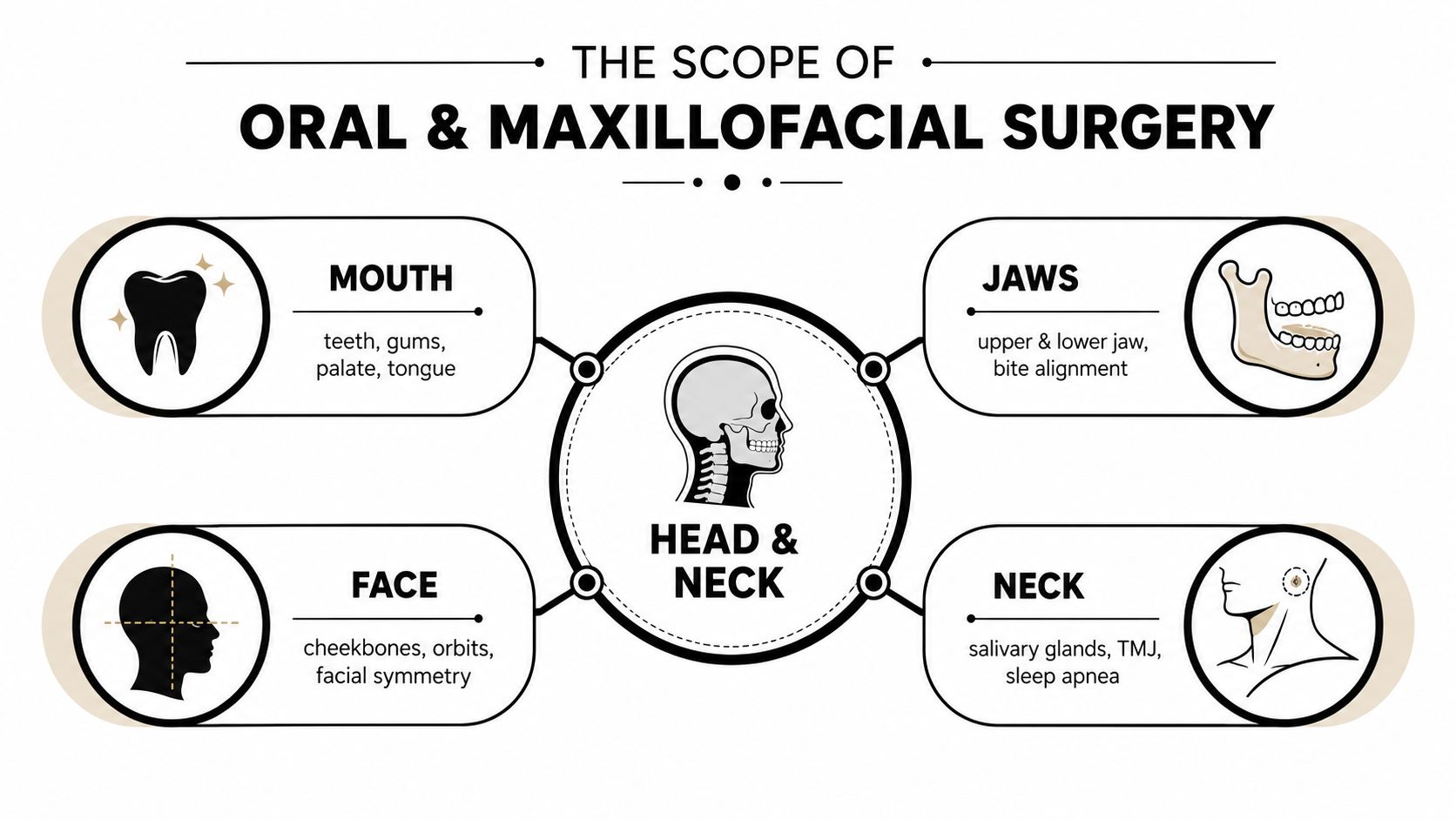
A patient usually notices the specialty by the problem it has to solve. A toothache that stays inside the tooth often belongs in routine dental care. A broken jaw, a blocked saliva gland, a facial injury, or a growth in the mouth needs a surgeon who works with the structures that shape how you bite, speak, breathe, and look Royal College of Surgeons.
What falls inside the scope
The specialty covers impacted teeth, facial injuries, jaw deformities, salivary gland disease, facial pain, cysts, tumors of the jaws, oral mucosal infections, and reconstructive or cosmetic procedures aimed at improving both function and appearance. The practical question is always the same. Will the treatment make it easier to chew, speak, heal, or look balanced again?
A jaw problem can be more than discomfort. If the bite does not meet properly, the teeth may not come together cleanly, and the muscles can strain just to close the mouth. If the face has been injured, the goal is not only to set broken bone. The surgeon also has to restore the frame that supports the lips, cheeks, and jawline.
The mouth is not isolated from the face. It sits inside a living structure that affects airway, appearance, and everyday function.
That is why oral surgeons become involved in cases like trauma, chronic pain, oral pathology, and reconstruction. They treat problems that cleaning, fillings, or polishing alone cannot solve. For patients, the benefit is concrete. The right surgery can reduce pain, restore chewing, improve speech, and bring back facial balance.
Who Performs Oral and Maxillofacial Surgery
Patients usually want one answer here, who is this person and why isn't my regular dentist doing it. The short answer is that oral and maxillofacial surgeons work in a dual-discipline space, and the training is built for cases that cross from dental care into surgical anatomy. A reference from the Intercollegiate Surgical Curriculum Programme notes that U.S. oral surgeons have years of postgraduate study after dental school ISCPS syllabus.
Why referral is a normal step
Being referred doesn't mean your dentist missed something. It usually means the problem has grown more complex than routine care, or it needs a level of surgical planning and monitoring that belongs in a specialist setting. That's common for impacted teeth near nerves, jaw misalignment, facial injuries, cysts or tumors, and reconstructive needs.
A general dentist may do straightforward extractions or coordinate early evaluation, but a board-certified oral and maxillofacial surgeon is the person who manages the tougher anatomy, the surgical risk, and the follow-through when the case is medically or structurally complicated. That difference matters when imaging, anesthesia, grafting, or reconstruction are all part of the same plan.
Why some offices handle more complex care
Global workforce data show how specialized and unevenly distributed the field remains. Estimates were available for only 104 of 195 United Nations-recognized countries, and the median global density was 0.518 oral and maxillofacial surgeons per 100,000 population PubMed. In low-income countries, the median density was 0.015 per 100,000, compared with 1.087 per 100,000 in high-income countries PubMed.
That shortage helps explain why complex cases often show up in larger centers with imaging, reconstruction tools, and multidisciplinary teams. It also explains why a surgeon's office may feel more like a medical-surgical environment than a standard dental chair side visit. For patients, that setup usually means the plan is built around safety, precision, and the chance to solve several problems in one treatment path.
Common Procedures and What They Actually Do for You
The most common procedures in the specialty are dental implants and wisdom tooth extraction Britannica. That makes sense, because both problems are about more than pain. One removes a source of crowding or infection, and the other replaces missing teeth in a way that can restore chewing and support the face.
The procedures people ask about first
Wisdom teeth removal is often done because the tooth doesn't have room to come in normally, or because it's trapped in the jaw and causing pain, crowding, or infection. Dental implants replace missing teeth with stable support, which matters when someone wants to chew comfortably again and keep the surrounding bone from collapsing after tooth loss. Jaw surgery, also called orthognathic surgery, corrects bite problems that interfere with chewing, speech, or facial balance AAOMS procedure overview.
Facial trauma repair is different. A broken jaw or injury to the midface needs the bones aligned so the face can heal in the right shape and the bite can come back together. Bone grafting is used when there isn't enough bone to hold an implant securely, and that can turn a weak foundation into one that supports biting force.
Common Oral and Maxillofacial Procedures at a Glance
| Procedure | Problem It Treats | Primary Benefit |
|---|---|---|
| Wisdom tooth removal | Pain, crowding, infection, trapped teeth | Less discomfort, lower risk of damage to nearby teeth |
| Dental implants | Missing teeth | Restored chewing and stable tooth replacement |
| Jaw surgery | Bite misalignment, facial imbalance | Better function and facial harmony |
| Facial trauma repair | Fractures and injuries | Rebuilt structure and improved appearance |
| Bone grafting | Insufficient jawbone | A stronger base for implants or reconstruction |
| Cyst or tumor removal | Growths in the jaws or mouth | Removal of abnormal tissue and protection of surrounding structures |
The key point is that these surgeries are not only about fixing a problem. They're also about what life feels like afterward, whether that's chewing without guarding one side, smiling without a visible gap, or opening and closing the mouth without pain. In surgical dentistry, function and appearance are usually linked.
Decision cue: if the goal is to restore both mechanics and appearance, the procedure often belongs in oral and maxillofacial surgery.
Modern Technology That Changes the Experience
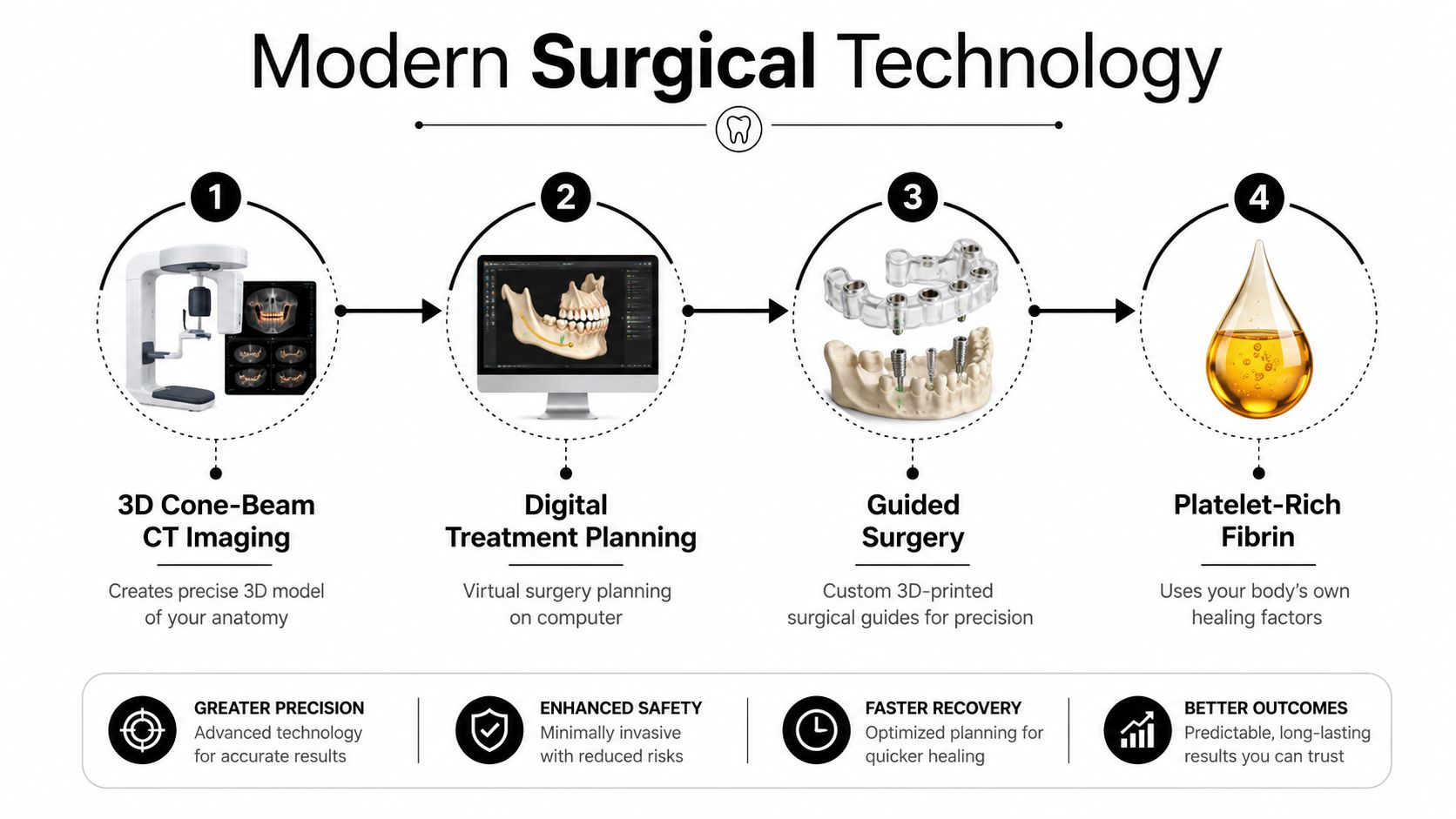
Modern oral surgery doesn't rely on guesswork. 3D CT-based planning, computer-generated surgical models, and navigation systems are increasingly used to improve precision in complex head and neck operations PMC article. For patients, that means the visit is often more predictable, the surgery can be mapped more carefully, and the treatment can be customized to anatomy instead of forcing anatomy to fit a generic plan.
What the tools actually change
3D imaging helps the surgeon see bone shape, nerve position, and available space before the first incision. Digital planning turns that scan into a map, so the surgical path is selected in advance rather than improvised in the chair. Guided surgery then helps carry that plan into the operating room with more control.
For implant cases, that matters even more when bone is limited. In those situations, advanced reconstruction can make treatment possible when it might otherwise be postponed or split into multiple stages. PRF, or platelet-rich fibrin, is used as part of the healing strategy because it comes from the patient's own blood components and supports recovery planning.
Some patients also hear about specialized implant designs, including zygomatic and pterygoid implants, especially when bone loss is severe. Those options come into play when standard implant placement isn't enough and the surgeon needs another anchor point to build a stable restoration.
If you want a broader look at how digital workflows fit into dentistry, the overview at advanced dental technology, 3D printing, and digital dentistry helps connect the dots.
The important takeaway is simple. Technology in this field isn't window dressing. It widens who can be treated, improves precision, and often makes the experience easier to plan around.
Anesthesia and Sedation Options Explained
Fear is one of the biggest reasons people delay oral surgery, and the specialty has built-in ways to deal with that. The right comfort option depends on the procedure, the patient's anxiety level, and how much numbing or sleep-like relaxation is needed. In a well-run surgical office, pain control isn't an add-on, it's part of the treatment plan.

The main comfort tiers
Local anesthesia numbs only the treatment area. You stay awake, but you shouldn't feel sharp pain, which makes it a fit for smaller procedures or short surgical steps. Oral sedation adds relaxation, while IV sedation is deeper and often used when the patient is nervous, the case is longer, or the surgeon wants a more controlled level of comfort.
General anesthesia is the deepest option, used for more complex operations or situations where the procedure and the patient's needs call for complete unconsciousness. Recovery tends to be longer as the level of anesthesia increases, and the aftercare instructions matter more.
For patients who want a clearer overview of safety concerns, is IV sedation safe is a useful place to start. If you're also trying to understand medication choices after surgery, a practical reference like bupivacaine uses and effects can help explain why numbness sometimes lasts longer than expected.
How to match the option to the patient
If you're only anxious but comfortable with being awake, local anesthesia or mild sedation may be enough. If you've avoided treatment for years because of fear, IV sedation is often the conversation to have. For more involved surgery, especially when airway control and monitoring matter, a specialist team with advanced anesthesia support is the safer setting.
A patient doesn't need to “tough it out” to get oral surgery done. The right sedation plan should make the treatment feel manageable.
What to Expect Before, During, and After Surgery
A typical surgical visit starts long before the day of the procedure. The consultation usually includes an exam, imaging, and a discussion of what the surgery is trying to fix, whether that's pain, function, or appearance. Good planning helps the patient know what's happening, who's driving home, and what recovery will look like.
The patient timeline
Before surgery, you'll usually get instructions about eating, medication, and transportation. The plan may also include a review of sedation, because the experience is very different depending on whether you're getting local anesthesia or a deeper form of comfort. On the day of surgery, the team checks vitals, confirms the plan, and moves through the procedure with monitoring in place.
The first part of recovery is usually the most noticeable. Numbness fades first, then soreness and swelling take center stage, which is why ice, rest, and a soft-food diet are such common instructions. Patients often feel like the area is improving in small steps rather than all at once.
What helps recovery stay on track
- Soft foods: Choose meals that don't require heavy chewing while tissues settle.
- Ice early: Use cold packs as directed to help with swelling.
- Take medication on schedule: Staying ahead of discomfort is easier than catching up later.
- Rest the first few days: The body heals better when the plan is calm and predictable.
- Call if something feels off: Bleeding that won't slow, worsening pain, or signs of infection deserve attention.
If you're helping an older parent, a spouse, or a child through the process, the idea of what is transitional care can help frame the handoff from surgical appointment to home recovery. That handoff is where many patients need the most support.
The good news is that people settle into a new normal gradually, not dramatically. The mouth starts feeling less like a procedure site and more like part of everyday life again.
When It Is Time to See a Specialist
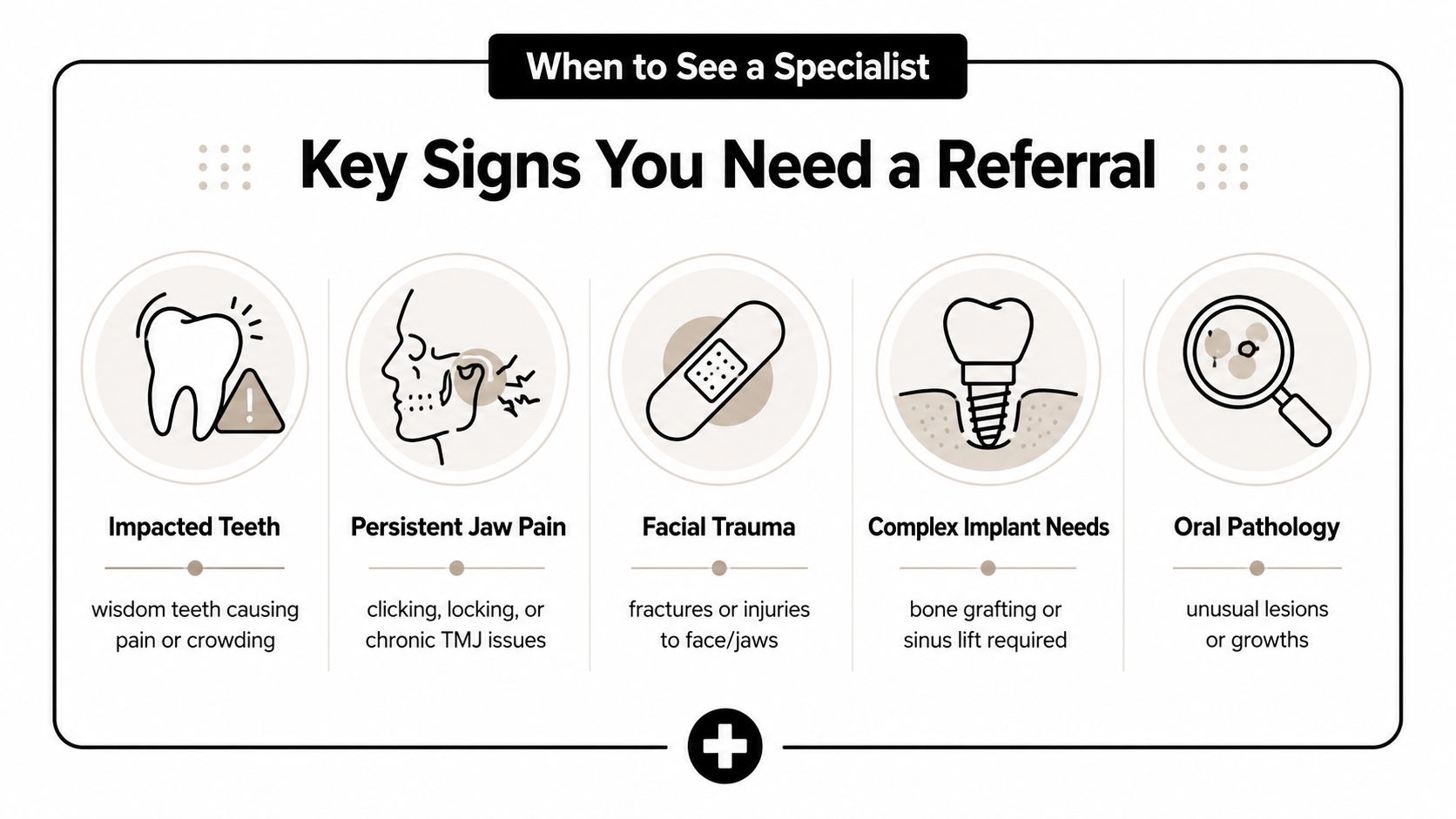
There's a point where waiting, rinsing, or trying to “watch it a few more weeks” stops being the right move. Impacted or infected wisdom teeth, dental implants after long-term tooth loss, jaw pain or misalignment, facial trauma, and oral lesions that don't heal are all reasons to ask whether oral and maxillofacial surgery belongs in the plan. Sudden toothaches or broken teeth that need same-day attention can also move quickly from routine care to urgent surgical evaluation.
A simple rule for deciding
If the problem is limited to cleaning, fillings, or a straightforward restoration, your general dentist may be enough. If the issue involves bone grafting, a difficult extraction, facial injury, persistent jaw dysfunction, or a suspicious growth, a specialist should be part of the conversation. The sooner that referral happens, the more options usually stay open.
For people who notice sensitivity after a difficult extraction, the Mouthology guide on sensitive teeth after wisdom teeth removal can be a helpful companion resource while you follow your surgeon's instructions.
Where a combined-care office can help
A practice that offers general, cosmetic, restorative, and surgical care in one place can make those handoffs simpler, especially when imaging, sedation, and urgent visits are all part of the same system. Grand Parkway Smiles provides oral surgery services, wisdom teeth removal, extractions, and IV sedation in Katy, TX, which can be useful when a case needs coordinated care rather than multiple separate offices.
If you're in Katy or the greater Houston area and you're wondering whether your jaw pain, missing teeth, or impacted wisdom teeth need specialist treatment, schedule a visit with Grand Parkway Smiles. The team can help you sort out whether routine dental care is enough or whether oral and maxillofacial surgery is the right next step, and they can walk you through the options in plain language.