You notice it when you smile, yawn, or take the first bite of something salty. The skin at the corners of your mouth stings, splits, and keeps reopening. It can look minor in the mirror, but it feels stubborn and distracting all day.
For many people, cracked corners of lips aren't just “dry lips.” They're a specific condition with a specific pattern, and the reason they keep coming back is often more mechanical than people realize. In a dental setting, that matters, because the shape of your bite, dentures, and facial support can directly affect what happens to the skin at the corners of your mouth.
Understanding Cracked Corners of the Lips
The medical term for cracked, sore corners of the mouth is angular cheilitis. In the chair, patients usually describe the same pattern. The corners stay tender, split when they open wide, then seem to improve for a day or two before cracking again.
What's actually happening
The problem starts with skin that stays damp too often. Saliva repeatedly wets the corners of the mouth, softens the surface, and irritates the tissue enough to weaken the skin barrier. Once that barrier is compromised, the area becomes easier for yeast or bacteria to irritate further.
That is why these cracks can linger even when the rest of the lips look fairly normal.
Why it feels worse than it looks
The mouth corners are under constant tension. Every conversation, meal, yawn, and toothbrush stroke pulls on skin that is already inflamed. A tiny split in that location can feel surprisingly sharp because it keeps getting stretched before it fully closes.
Common signs include:
- Soreness at the corners that flares when you open wide
- Red, irritated, or scaly skin at one or both mouth angles
- Small splits or crusting that keep returning
- Burning with salty, acidic, or spicy foods
A helpful clue is the location. Ordinary chapped lips usually affect broader areas of the lips. Angular cheilitis tends to stay concentrated right at the corners.
Barrier repair matters, but it has limits
Early care should protect the damaged skin and reduce repeated moisture exposure. If you want a simple, skin-focused explanation of why this matters, this resource on how to restore your skin's protective layer is useful background.
Creams and ointments can calm the surface. They do not change the reason those corners keep folding, rubbing, or staying wet. That distinction matters, especially for patients whose symptoms keep coming back despite using over-the-counter products correctly.
The Dental Link to Angular Cheilitis
You treat the corners with ointment, they calm down, and then they split again in the same place a week later. In my office, that pattern often points to a mechanical problem inside the mouth, not just irritation on the skin.
When mouth support changes, the corners stay wet
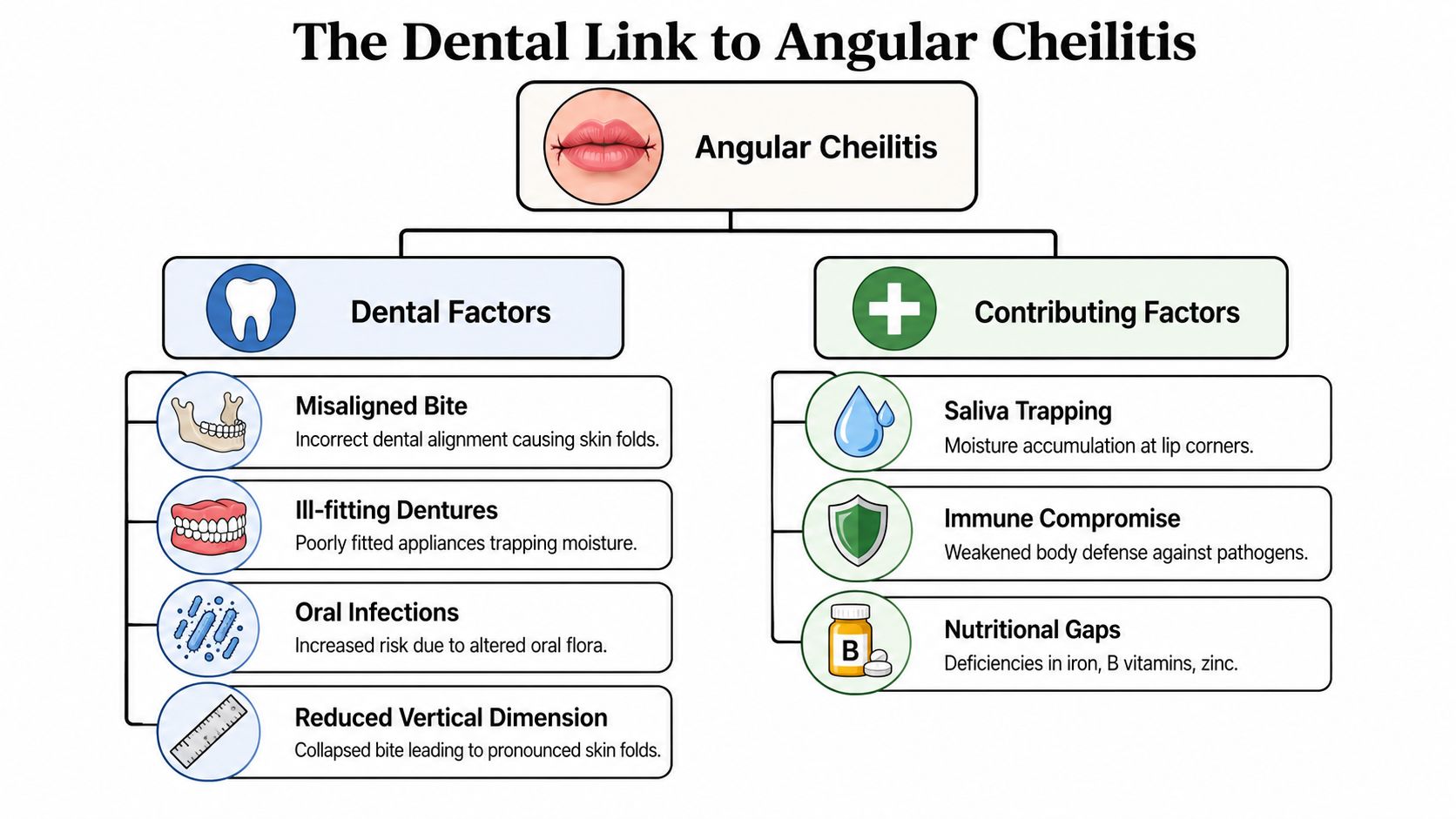
Angular cheilitis often starts with anatomy. If dentures have loosened, teeth are badly worn, or missing teeth have reduced lower-face height, the mouth corners crease inward further. Saliva settles in those folds. The skin stays damp, breaks down, and becomes much harder to heal.
That is why over-the-counter products can help without solving the problem. An antifungal or barrier ointment may reduce inflammation on the surface, but it cannot change the fold that keeps trapping moisture.
Common dental findings include:
- Ill-fitting dentures that no longer support the lips and cheeks well
- Loss of vertical dimension from worn or missing teeth, which shortens the lower face
- Bite changes that alter how the lips meet at rest
- Deeper facial creases at the commissures where saliva can collect repeatedly
Why a dental exam can change the treatment plan
A useful exam goes beyond looking at the crack itself. I check how your teeth come together, whether dentures still fit the way they should, how much facial support has been lost, and whether the corners fold inward even when your mouth is relaxed.
That information matters because the long-term fix may be dental, not dermatologic. Replacing a worn denture, adjusting the bite, or restoring missing support can reduce the constant wetness that keeps restarting the cycle.
Clinicians also recognize that angular cheilitis is commonly associated with ill-fitting dentures and deep folds at the mouth corners. Dental correction may be part of treatment, as noted earlier in the article from DermNet.
Problems dentists often catch that patients cannot
Patients usually notice the sting. Dentists often notice the structure behind it.
| Dental issue | What changes at the corner | Why healing stalls |
|---|---|---|
| Denture no longer fits well | Lip corners collapse into a deeper crease | Saliva sits on the skin longer |
| Worn or missing teeth | Lower-face height decreases | The commissures stay folded and moist |
| Uneven bite or poor lip closure | Repeated rubbing in one area | Skin reopens before it can fully repair |
Dry mouth can complicate this picture too. Thick, stringy saliva and oral yeast problems can make the corners more irritable, which is one reason I sometimes also review related issues like how dry mouth can contribute to thrush.
If the corners improve with cream but relapse in the same exact spot, I start looking harder at denture fit, bite collapse, facial contour, and whether a medical contributor should also be checked. In recurrent cases, broader testing can still be useful, and this guide to longevity testing gives a general overview of how vitamin and mineral deficiencies are evaluated.
Other Common Causes and Risk Factors
Not every case starts with dentures or bite collapse. Some people have skin that becomes easier to injure and slower to repair, so even mild moisture at the corners turns into a persistent crack.
Nutritional and medical contributors
Iron deficiency anemia, vitamin B12 insufficiency, and protein malnutrition are significant predisposing factors because they interfere with epithelial regeneration and mucosal integrity, making the mouth corners more sensitive to small irritants, as summarized in Healthline's angular cheilitis overview.
That doesn't mean every person with lip corner cracking has a deficiency. It means recurrent cases deserve a broader view, especially if the skin looks fragile, healing is slow, or there are other symptoms such as fatigue, oral soreness, or repeated irritation elsewhere.
If you're trying to understand how vitamin and mineral testing is generally approached, this guide to longevity testing offers a helpful overview.
Habits and conditions that keep irritation going
Some triggers are simple but powerful:
- Lip licking leaves more saliva on already-inflamed skin
- Smoking can increase local irritation
- Dry mouth changes the oral environment and can make secondary irritation more likely
- Diabetes or immune compromise can make recurrence harder to control
- Inhaled corticosteroids may leave residue in the mouth that supports yeast overgrowth unless the mouth is rinsed afterward
For patients who also deal with oral dryness or fungal irritation, it can help to understand the overlap between saliva changes and mouth symptoms. This article on whether dry mouth can cause thrush gives useful context.
Children and adults can have different patterns
In children, repeated licking, drooling, or mouth habits are often part of the story. In adults, the pattern is more often mixed. A structural issue may be present, but nutritional factors, medication effects, and systemic health can all add friction to the healing process.
Recurrent angular cheilitis usually isn't random. Something is repeatedly weakening the skin, trapping moisture, or interfering with repair.
At-Home Care and Over-the-Counter Solutions
For mild cases, home care can help. The goal isn't to “dry out” the corners. The goal is to protect the skin from repeated saliva exposure while reducing irritation.
What usually works first
Applying a thick emollient such as petrolatum frequently is often enough to treat saliva-induced angular cheilitis and improve the appearance of red, swollen patches, according to ChapStick's review of angular cheilitis care.
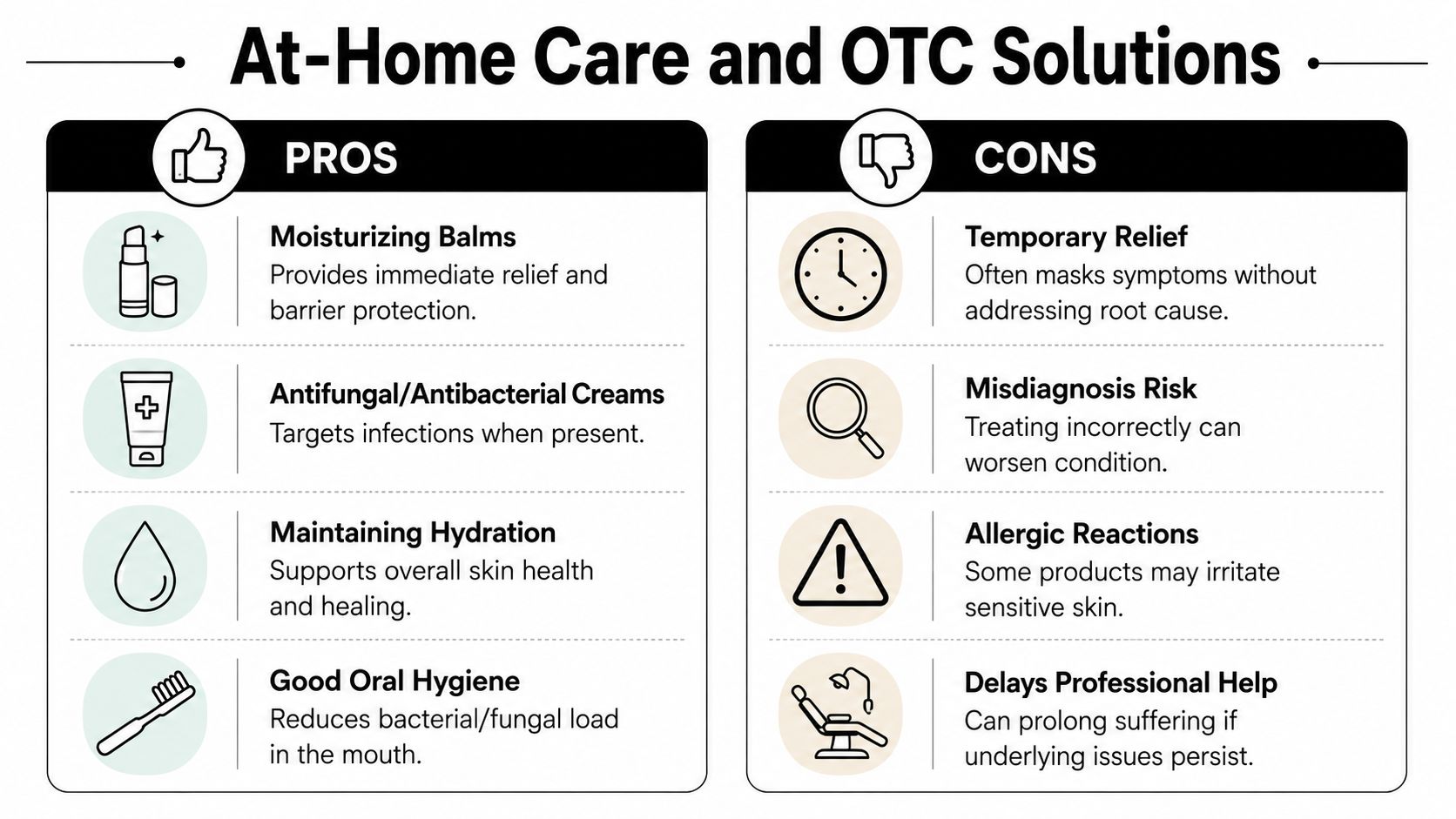
A practical home routine looks like this:
- Clean gently. Wash the area with lukewarm water. Don't scrub.
- Pat dry fully. Moisture left in the fold works against healing.
- Apply a thick barrier. Petrolatum or zinc oxide tends to stay put longer than lighter balms.
- Reapply often. Especially after meals, brushing, and before bed.
- Stop licking the area. This is the hardest step for many people, but it matters.
What to be careful with
Some people jump from product to product and make the area angrier. That's common with fragranced lip treatments, exfoliating products, essential oils, and anything that stings on application.
A few guardrails help:
- Skip harsh actives if the skin is split
- Avoid picking crusts because the crack usually reopens
- Be cautious with random antifungals if you're not sure what you're treating
- Keep oral hygiene steady so the mouth stays cleaner overall
Some people also like soothing plant-based products on dry, irritated skin. If that interests you, you can discover aloe vera dry skin benefits and compare that approach with heavier barrier ointments.
Where home care reaches its limit
Home treatment often fails for one of three reasons:
| Situation | Why OTC care falls short |
|---|---|
| The corner stays folded inward | Saliva keeps collecting |
| The cause is mixed | Infection, irritation, and anatomy are all involved |
| The trigger keeps happening | Denture fit, lip licking, or medication effects continue |
If a barrier ointment helps but the crack returns as soon as you stop, that's a clue. The surface may be healing, but the cause underneath is still active.
Professional Dental Treatments for Lasting Relief
When cracked corners of lips keep recurring, professional care changes the conversation from symptom control to cause correction.
Diagnosis first, treatment second
Angular cheilitis is common, and up to 15% of denture wearers may experience symptoms due to saliva pooling, while about 70% of cases involve Candida albicans overgrowth, according to the Cleveland Clinic's angular cheilitis overview. Those numbers matter because they show two truths at once. Infection is common, and denture-related mechanics are common too.
A dental evaluation can sort out whether the problem is mostly:
- Mechanical, such as denture fit or reduced facial support
- Inflammatory, where saliva exposure is driving skin breakdown
- Microbial, where yeast or bacteria need targeted treatment
- Mixed, which is often the practical answer
What professional treatment can include
The best treatment plan depends on what's causing the crack to persist. In practice, care may involve:
- Denture adjustment or replacement when the appliance has lost fit
- Restorative work to improve support and reduce deep commissural folds
- Targeted topical medication if the appearance suggests fungal or bacterial involvement
- Review of habits and medications that may be contributing
- Referral for medical workup if recurrence suggests a nutritional or systemic issue
A recurring crack at the lip corner is sometimes a skin problem. It's often also a bite problem, a denture problem, or a facial support problem.
Why this can improve both comfort and appearance
When the corners stop staying wet, the tissue finally gets a chance to close and remain closed. That means less pain when eating and speaking, but it also means the mouth corners can look smoother, less inflamed, and less prematurely aged.
In some cases, patients also ask about relief for other soft-tissue mouth pain. If you're comparing options for mouth lesions more broadly, this page on laser dentistry for canker sores and minor soft tissue lesions may be useful. It's a different condition, but it shows how targeted dental care can shorten the cycle of irritation and healing.
How to Prevent Cracked Lip Corners
Prevention works best when it matches the reason the problem started. A person with lip-licking habits needs a different strategy than a person with a collapsing denture fit. Still, a few habits help almost everyone.
Daily habits that make a difference
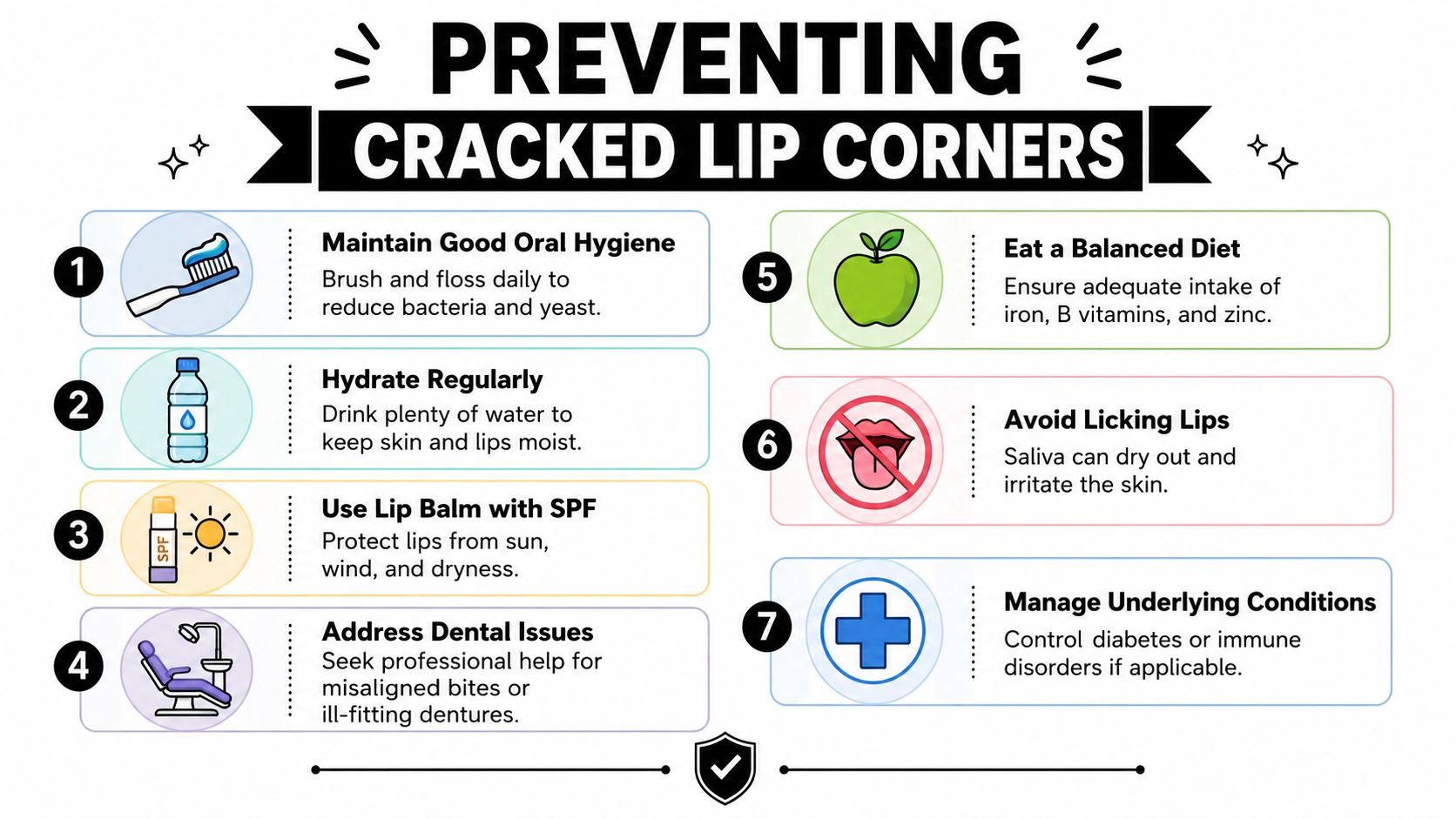
- Keep the corners protected with a simple barrier ointment when they're prone to drying or reopening.
- Rinse after inhaled corticosteroids so medication residue doesn't linger in the mouth.
- Break the licking cycle because repeated saliva exposure keeps the irritation going.
- Stay current with denture checks if you wear removable appliances and notice changes in fit, support, or facial contour.
- Address nutrition and medical issues when symptoms recur without an obvious local cause.
- Maintain oral hygiene so the mouth environment is less favorable to secondary irritation.
Signs it's time to get help
Some cases are too persistent for home care alone. It's smart to get evaluated if:
- The crack keeps coming back in the same location
- Dentures feel off or your bite seems more collapsed than before
- The corners hurt when you open wide and never fully settle
- You've tried ointments but the problem returns quickly
- The appearance bothers you because the corners stay red, creased, or inflamed
Long-term relief usually comes from matching treatment to the cause. Sometimes that's a barrier ointment and better habits. Sometimes it's a denture adjustment, restorative treatment, or a closer look at systemic factors.
If you're dealing with cracked corners of lips that won't stay healed, Grand Parkway Smiles can help identify whether the problem is related to denture fit, bite changes, oral irritation, or another dental factor. A focused evaluation can move you past temporary relief and toward a more comfortable, healthier-looking smile.