A patient in Katy calls an office after dinner, gets transferred to a voicemail tree, then spends the next hour comparing surgeon profiles, hospital affiliations, and residency blurbs that all start to sound the same. If that sounds familiar, you're not overthinking it. Oral surgeon qualifications can look confusing because the question isn't just who has a dental degree, it's who has the right training for the exact procedure, the right anesthesia privileges, and the right level of oversight for your comfort and safety.
That matters whether you're planning a wisdom-tooth extraction, implants, or a full-mouth rebuild. A qualified oral surgeon isn't just a dentist with a longer bio. The strongest credentials signal procedure-specific training, hospital exposure, and the ability to handle complications if a case gets more complex than expected.
Introduction to Choosing an Oral Surgeon
A lot of people start with the wrong test. They look for the longest list of letters after a name, or they assume any practice that says “oral surgery” offers the same level of care. In real life, patients need a simpler filter: does this clinician have the training and privileges for your procedure, in your setting, and under your local regulations?
That distinction shows up fast once pain, swelling, or appearance concerns enter the picture. A badly positioned wisdom tooth, a missing tooth that affects smiling, or a damaged jaw after trauma all call for more than routine dental maintenance. The provider you choose should be able to explain how their training connects to the treatment you need, not just repeat a title.
Practical rule: if a credential doesn't help you understand sedation, surgery, or hospital backup, it may not be the credential that matters most.
Patients in Houston and Katy often search late at night, then get pulled into jargon like board status, residency length, and surgical lists. A calmer approach is to ask one question at a time. What procedure are you having, what training does that procedure require, and who verifies that training locally?
For a plain-language overview of the procedure itself, this guide to oral surgery basics can help anchor the conversation before you start comparing surgeons. Once you know the type of care you need, the credential review gets much easier. That's the point where oral health and appearance stop feeling like abstract goals and start turning into a concrete plan.
Understanding Oral Surgeon Roles and Credentials
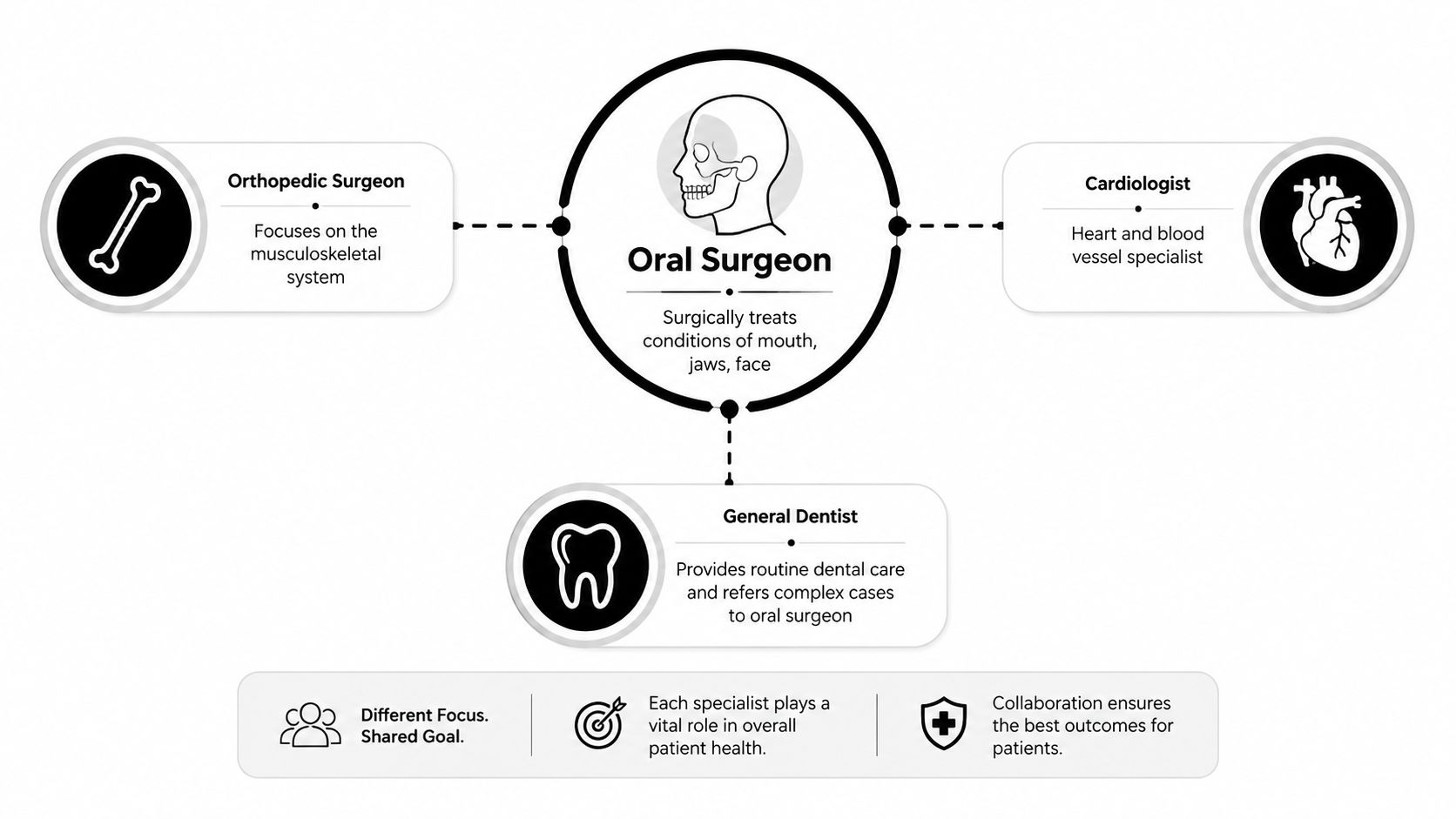
An oral and maxillofacial surgeon is best understood the way you'd understand a cardiologist or orthopedic surgeon. You wouldn't ask a family doctor to replace a joint or manage a heart rhythm problem, even if the doctor is excellent at general medicine. In the same way, a general dentist provides broad dental care, while an oral surgeon is trained for surgical problems of the mouth, jaws, and face.
The title matters because the scope matters. Oral surgeons handle impacted teeth, facial trauma, extractions that are more complicated than usual, and surgical planning that may involve other specialists. In the UK framework, the system even separates a non-specialist primary care dentist, a dentist with enhanced oral surgery skills, a specialist in oral surgery, and a consultant in oral surgery, which shows how different the levels of training can be across one profession. One underserved angle is credential confusion across countries and settings: many patients don't realize that qualification rules vary sharply by jurisdiction, with some systems requiring only dental training plus residency while others demand dual degrees or formal specialist lists. See the broader discussion in this analysis of how oral surgery credentials vary across jurisdictions.
What the title should tell you
The title “oral surgeon” should tell you that the person has advanced surgical training, not just familiarity with dentistry. In the U.S., many oral and maxillofacial surgeons complete dental school and then a separate residency, which is why the occupation is described as requiring post-doctoral training. According to one O*NET survey in the verified data, 72% of respondents said that post-doctoral training was required, while 20% said a doctoral degree alone was sufficient, a sign that the profession is viewed as specialty-level care rather than routine dental work.
Which credentials matter most
Look for credentials that match the procedure. A state dental license tells you the clinician is licensed to practice dentistry, but it doesn't automatically tell you whether they're qualified for hospital-based surgery, deep sedation, or complex reconstruction. The better question is whether their training, specialty recognition, and privileges line up with the treatment you've been told to expect.
That's why oral surgeon qualifications matter so much for appearance-related care too. A person choosing implants or reconstruction often cares about function first, but the final smile matters as well. The right specialist helps protect both.
Education and Residency Pathways
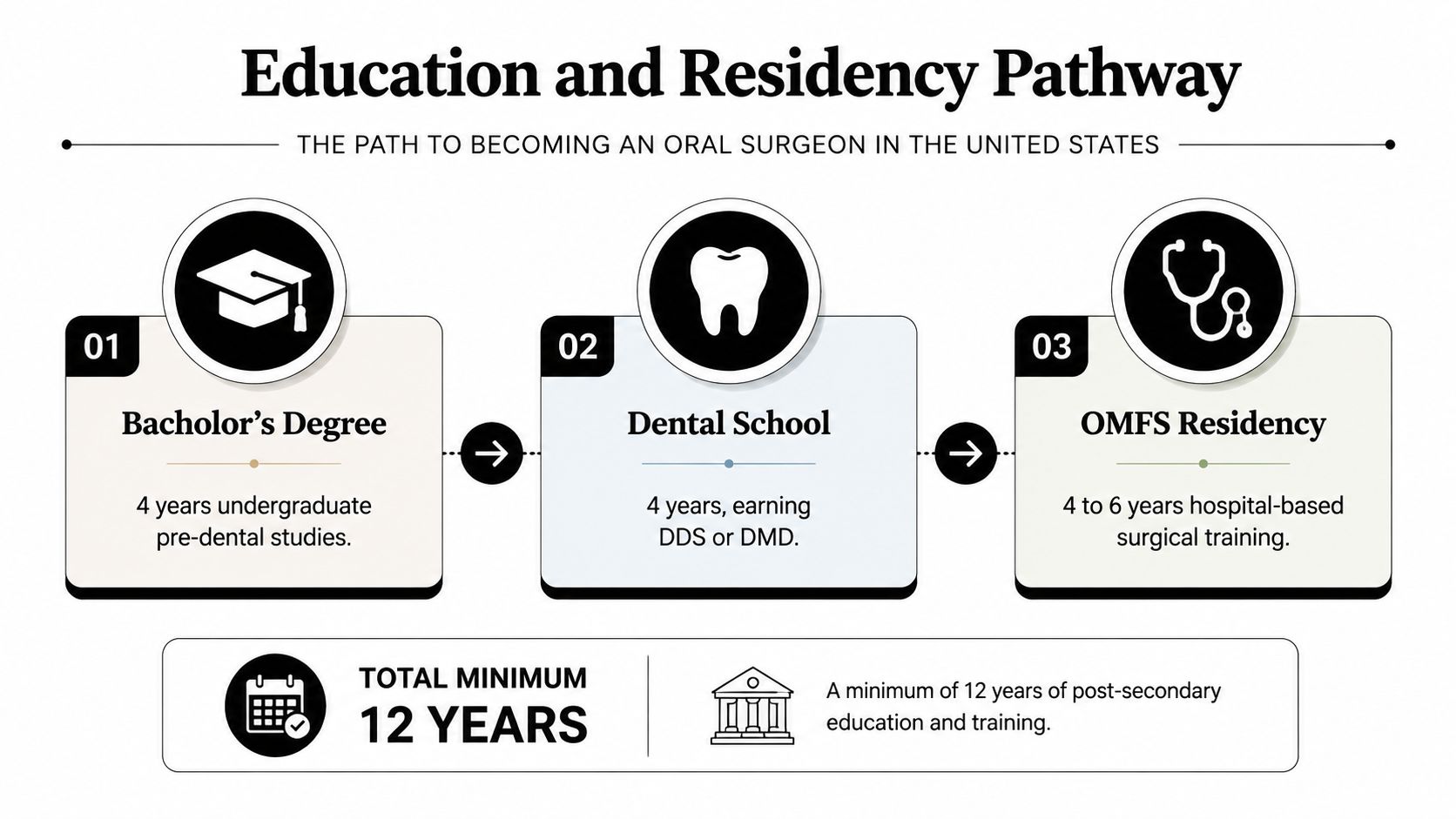
In the United States, the path starts with a D.D.S. or D.M.D., then continues into a 4-year oral surgery residency. That residency is where the specialty becomes real, because the surgeon moves beyond textbook dentistry and into hospital-based surgical decision-making. The verified data also shows that many surgeons consider this post-doctoral training mandatory, not optional.
Why residency changes the risk profile
Residency matters because it puts the surgeon in the environment where complications happen. The training includes hospital-based surgical experience with exposure to internal medicine, general surgery, and anesthesiology. That exposure is important for oral health and facial appearance alike, because a surgeon treating the mouth and jaws has to think about bleeding, airway safety, infection control, and how a face will heal after surgery.
A North American overview in the verified data describes oral surgeons as completing a four-year dental degree plus four to six additional years of residency-level training, which reinforces how long the pathway really is. Indeed's overview also aligns with that extended timeline. The important takeaway isn't the exact math, it's the fact that qualification is built in stages, not handed out after a single credential.
Practical rule: if a procedure involves sedation, bone work, or reconstruction, the training should clearly show how the surgeon was prepared for that exact level of care.
What board certification adds
Board certification, when present, is another way to confirm that a surgeon's knowledge has been tested beyond graduation. It doesn't replace residency, and it doesn't by itself tell you everything about hospital privileges or anesthesia training. It does, however, give patients another checkpoint when they're comparing providers who may otherwise sound similar.
If you're choosing based on appearance, function, and comfort, the education path should reassure you. The longer training route exists because jaw surgery, implant placement, and facial procedures can affect speech, chewing, healing, and smile symmetry. A surgeon who has lived through that training is usually better prepared to explain the tradeoffs in plain language.
Licensure Hospital Privileges and Anesthesia Credentials
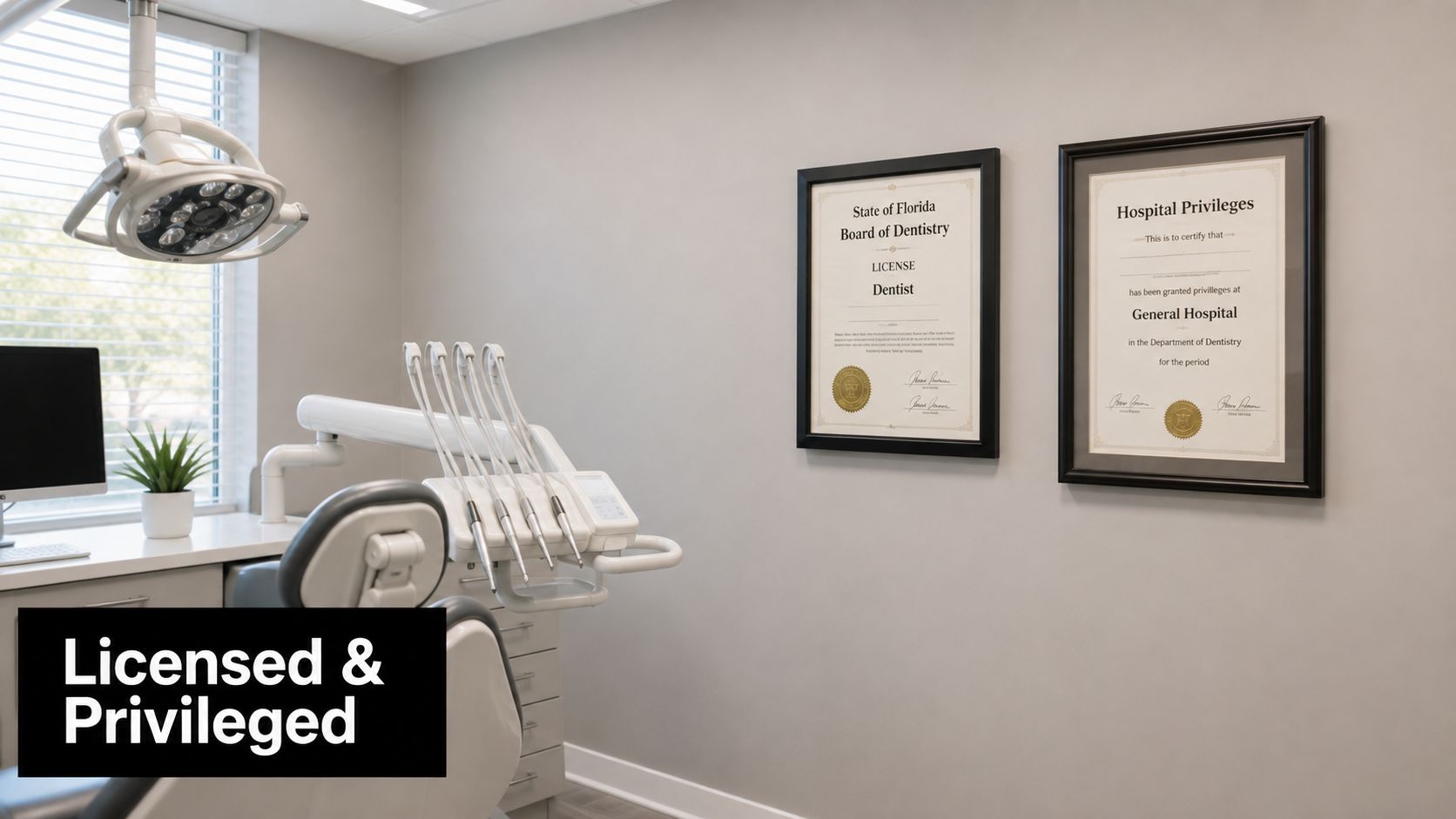
Licensure answers one question, then hospital privileges answer another. A dental license says the person can practice dentistry in that state, but many states also require additional oral and maxillofacial surgery licensure alongside dental licensure. That extra layer matters because surgery in the mouth and face often crosses into hospital systems, not just chairside dentistry.
Why hospital privileges matter
Hospital privileges signal that other institutions have reviewed the surgeon's qualifications for complex or emergency care. That review is especially relevant when a case might need an operating room, overnight monitoring, or coordination with medical teams. The American Association of Oral and Maxillofacial Surgeons notes that OMFS training includes hospital-based surgical residency with exposure to internal medicine, general surgery, and anesthesiology, and that only a completed accredited postgraduate program qualifies a surgeon for advanced hospital privileges and sedation certification, which is why the training pathway matters so much for patient safety and case planning. Read more in the IV sedation safety overview.
Anesthesia credentials deserve a separate check
Don't assume an oral surgeon who places implants automatically has the same sedation privileges as a surgeon who handles IV anesthesia or deeper hospital anesthesia. The right question is simple. Is this surgeon credentialed for the level of anesthesia your procedure needs, and is that credential current in the setting where you'll be treated?
That question matters for comfort, but it also matters for safety and appearance outcomes. If you're anxious, under-sedated, or having to repeat a procedure because the original plan wasn't matched to the right credentials, healing can become harder and cosmetic results can suffer. A patient should feel comfortable asking, “Who monitors sedation, and what backup exists if the case changes?”
How to verify locally
Check the state dental board, then ask the office what privileges the surgeon holds at nearby hospitals or surgical centers. If the procedure is being done in a clinic, ask whether emergency transfer arrangements exist. Those aren't awkward questions, they're normal due diligence for anyone planning surgery that affects oral function, facial symmetry, or both.
Advanced Training for Specialized Procedures
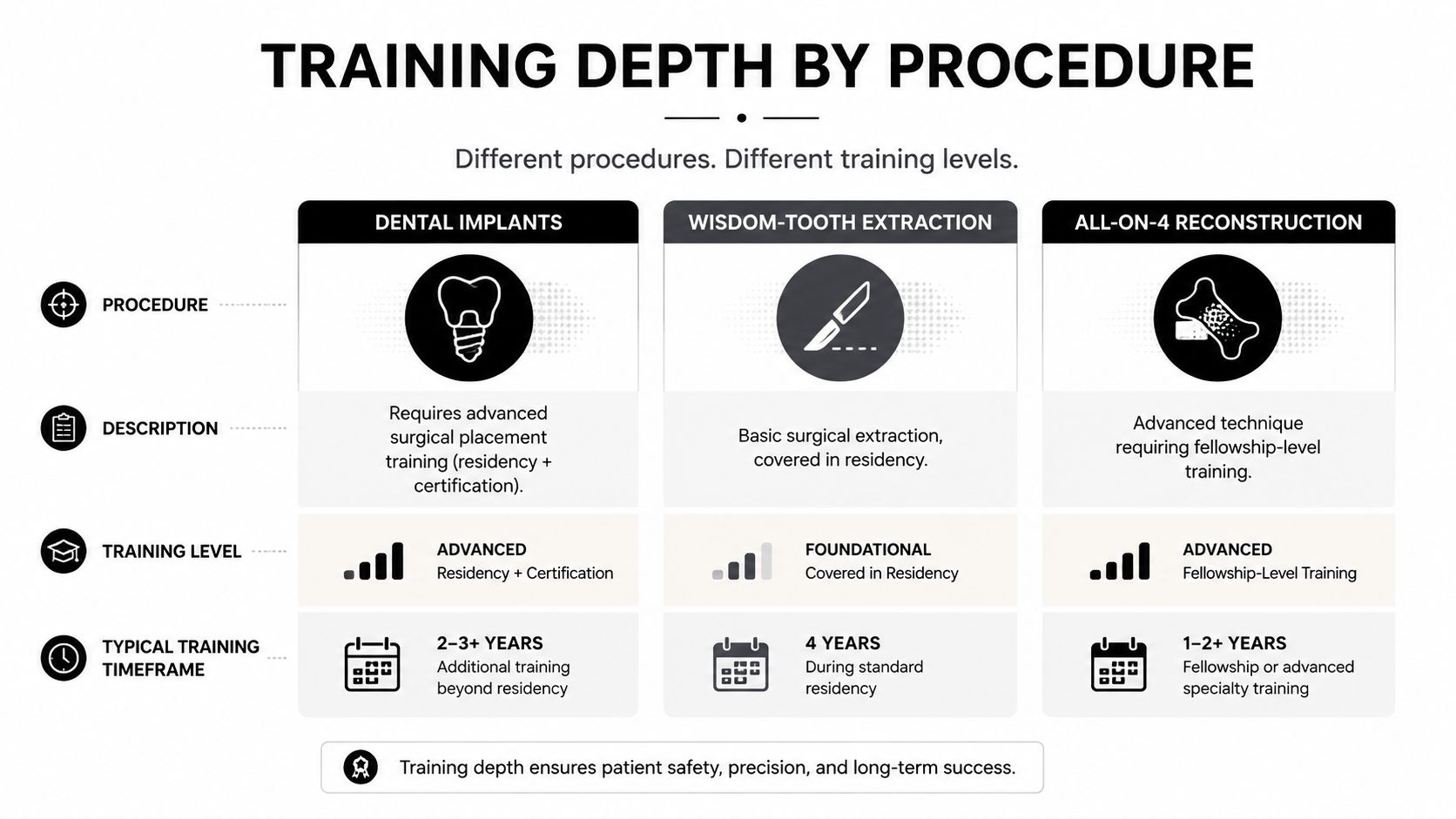
Credentials become easier to judge when you tie them to a real procedure. Implant placement, wisdom-tooth removal, and full-mouth reconstruction all sound dental, but they do not all require the same depth of surgical judgment. An oral surgeon's value is often in matching the training to the complexity.
Implants
Dental implants can improve chewing, stabilize a bite, and restore a natural-looking smile when tooth loss has changed facial support. Because of that, the surgeon needs more than a basic extraction skill set. The verified North American overview says competence in implants relies on extended, specialized preparation, and the training has to cover bone, anatomy, and restorative planning, not just drilling and placement.
Wisdom teeth
Wisdom-tooth extraction is often the procedure patients first associate with oral surgery, and for good reason. Impacted or partially erupted teeth can sit near nerves, sinuses, or dense bone, which means surgical finesse matters. Residency training covers that kind of work, and patients usually benefit when the surgeon can explain why one tooth should come out in the office while another might need a more advanced setting.
Full-mouth reconstruction
Full-mouth reconstruction is the clearest example of why oral surgeon qualifications should be matched to the exact case. These plans may overlap with prosthodontics, implant surgery, jaw alignment, and appearance goals, so the team needs to think across specialties. In Katy and Houston, a practice like Grand Parkway Smiles can serve as one option for patients who want surgical planning and restorative care under one roof, which helps keep the treatment plan coordinated.
Clinical insight: for appearance-driven cases, the right surgeon isn't just placing hardware, they're helping build a smile that functions well and looks balanced.
The stronger the procedure, the more important it is to ask who is collaborating, who is restoring the bite, and who is responsible if the surgical path changes mid-treatment. That's where advanced training shows its real value.
Spotting Red Flags and Verifying Credentials
The easiest red flag is vagueness. If a provider says they “do a lot of oral surgery” but can't clearly explain training, hospital affiliation, or anesthesia credentials, keep asking. Patients don't need to sound technical, they just need to be persistent.
A simple verification checklist
- Check the official license record: confirm the clinician's dental license through the state board, then look for any additional specialty or oral surgery status if your state requires it.
- Ask about hospital privileges: if your procedure could involve more complex surgery, emergency management, or anesthesia, ask where those privileges are held and for what type of cases.
- Request procedure-specific training: a surgeon should be able to connect their residency or postgraduate training to implants, wisdom teeth, reconstruction, or sedation.
- Look for clear sedation credentials: if IV sedation or general anesthesia is part of the plan, the office should explain who is qualified to provide and monitor it.
- Watch for weak answers: reluctance to share credentials, vague titles, or pressure to book before you understand the training are all warning signs.
A useful outside resource on dealing with fraudulent business reviews can also help when you're sorting through online noise, because reputation and credential checks should support each other, not compete. Reviews can help you notice patterns, but they don't replace licensure and training.
What to ask in the office
Ask whether the surgeon has handled cases like yours before, what the most common complication is, and how complications are managed. Those questions sound blunt, but they're the right ones. A qualified surgeon should answer without defensiveness, because competence includes explaining the tradeoffs in a way you can understand.
When the goal is better dental health or a more confident smile, the safest choice is usually the provider who welcomes verification. A calm, specific answer is more reassuring than a polished profile page.
How Grand Parkway Smiles Meets Top Standards
In Katy and the greater Houston area, patients looking for oral surgery can compare credentials and see how a multidisciplinary setting works in practice. Grand Parkway Smiles offers oral surgery alongside restorative and cosmetic care, so a patient planning implants or full-mouth treatment can have surgery and restoration discussed in the same place. That kind of coordination matters when the final goal is a healthier bite, a more natural smile, and fewer handoffs.
The practice also reflects the kind of layered care patients should ask about, including sedation dentistry, IV anesthesia, and advanced implant options. For families and adults, that means the same office can handle a surgical concern, then help with the appearance and function that come after healing. In real-world terms, that's useful when a patient wants wisdom teeth removed with sedation, or when another patient is looking at All-on-4 treatment and wants the surgical and restorative plan aligned from the start.
If you're comparing oral surgeon qualifications in the Houston area, ask the same questions you'd ask anywhere else, training, anesthesia credentials, and local privileges. Then compare how the team explains those answers. A practice that can speak clearly about procedure-specific care usually makes the decision easier for patients who want safe surgery and a better-looking result.
Grand Parkway Smiles in Katy offers oral surgery, implant care, sedation options, and restorative planning in one practice, so you can match the provider's training to the procedure you need. If you're ready to compare your options with a team that can explain credentials, anesthesia, and treatment sequencing in plain language, visit Grand Parkway Smiles and start with a consultation.