
You're in the dental chair, the room is calm, and then you notice the monitors. A screen glows nearby. A cuff sits on your arm. A small clip rests on your finger. If you're already a little nervous, it's natural to wonder whether all of that means something is wrong.
It doesn't. In dental sedation, those devices are there because anesthesia monitoring is part of safe, modern care. It keeps a close eye on breathing, circulation, oxygen levels, and recovery so the dental team can focus on your comfort while staying ready to respond to the smallest change. That's a big reason sedation dentistry feels manageable for patients who need wisdom teeth removal, implant surgery, or cosmetic treatment but don't want fear to run the appointment.
Why Anesthesia Monitoring Matters for Your Dental Visit

A patient may arrive expecting a routine dental visit, then notice a monitor screen, a cuff on the arm, and a small clip on a finger. That can feel unfamiliar, especially if sedation already has you on edge. The equipment is there to watch your body in real time while the medication is doing its work.
Why the beeps matter
Anesthesia monitoring has shifted from occasional observation to continuous physiologic surveillance. Historical reviews describe how pulse oximetry and capnography became part of routine practice, and how the broader move toward oxygenation, ventilation, and circulation tracking changed anesthesia safety standards over time (historical review of anesthesia monitoring).
For a dental patient, that change is easy to feel even if the technical details stay in the background. The beeps, lights, and readings are the team's way of checking that you remain stable from the start of sedation until you are ready to leave. A separate review of anesthesia history points to monitoring advances, especially pulse oximetry and capnography, as major safety gains in modern practice (historical review of anesthesia monitoring).
A simple way to understand it is this. The monitors work like a dashboard in a car. You do not need to stare at every gauge, but the dental team uses those signals to notice changes early, before you feel them.
Patients sometimes wonder whether monitoring is optional in a dental setting. For reputable sedation care, it is part of the plan. The standard is to know what your breathing and circulation are doing before a problem becomes obvious, so the team can respond calmly and quickly while your procedure continues.
The Core Monitors Used During Dental Sedation
During dental sedation, the monitors usually look simple, even a little ordinary. That is part of their value. They are there to give the dental team a clear read on how your body is responding while you rest, breathe, and recover through the procedure.
The devices you're most likely to see
A pulse oximeter is the small clip that usually fits on a finger. It shows how much oxygen is in your blood and often gives the team a steady pulse reading too. For patients, it is usually the easiest monitor to notice because it stays in place and works without drawing much attention.
A capnography sensor checks the carbon dioxide you breathe out. That makes it one of the clearest ways to see whether breathing is effective, not just happening. If the pulse oximeter is a snapshot of oxygen in the blood, capnography is more like a live view of airflow and exhalation.
An ECG, or electrocardiogram, tracks heart rhythm through small chest leads. It helps the team see whether your heart is keeping a steady pattern while you are sedated. A blood pressure cuff adds another layer, because circulation has to stay within a safe range as well.
Temperature monitoring matters too, especially during longer procedures or more profound sedation. The body can cool down under anesthesia, so the team checks temperature to help prevent changes that could slow recovery. In selected cases, depth-of-anesthesia tools such as BIS help estimate how sedated a patient is, which lets medication be adjusted more carefully.
A basic anesthesia workstation may also track several additional values at once, including pressure, respiration rate, EtCO2, FiO2, O2, N2O, anesthetic agent concentration, and trend storage, showing how much information a modern setup can gather while the patient remains asleep or comfortably sedated (government anesthesia workstation specification).
For patients, the practical takeaway is simple. Each monitor answers a different safety question, and together they let the dental team follow your breathing, circulation, and level of sedation without having to guess.
The goal is not to cover you in gadgets. The goal is to give the team the right information at a glance, so they can keep you comfortable and respond quickly if anything changes.
Safety Standards and Protocols in Dental Settings
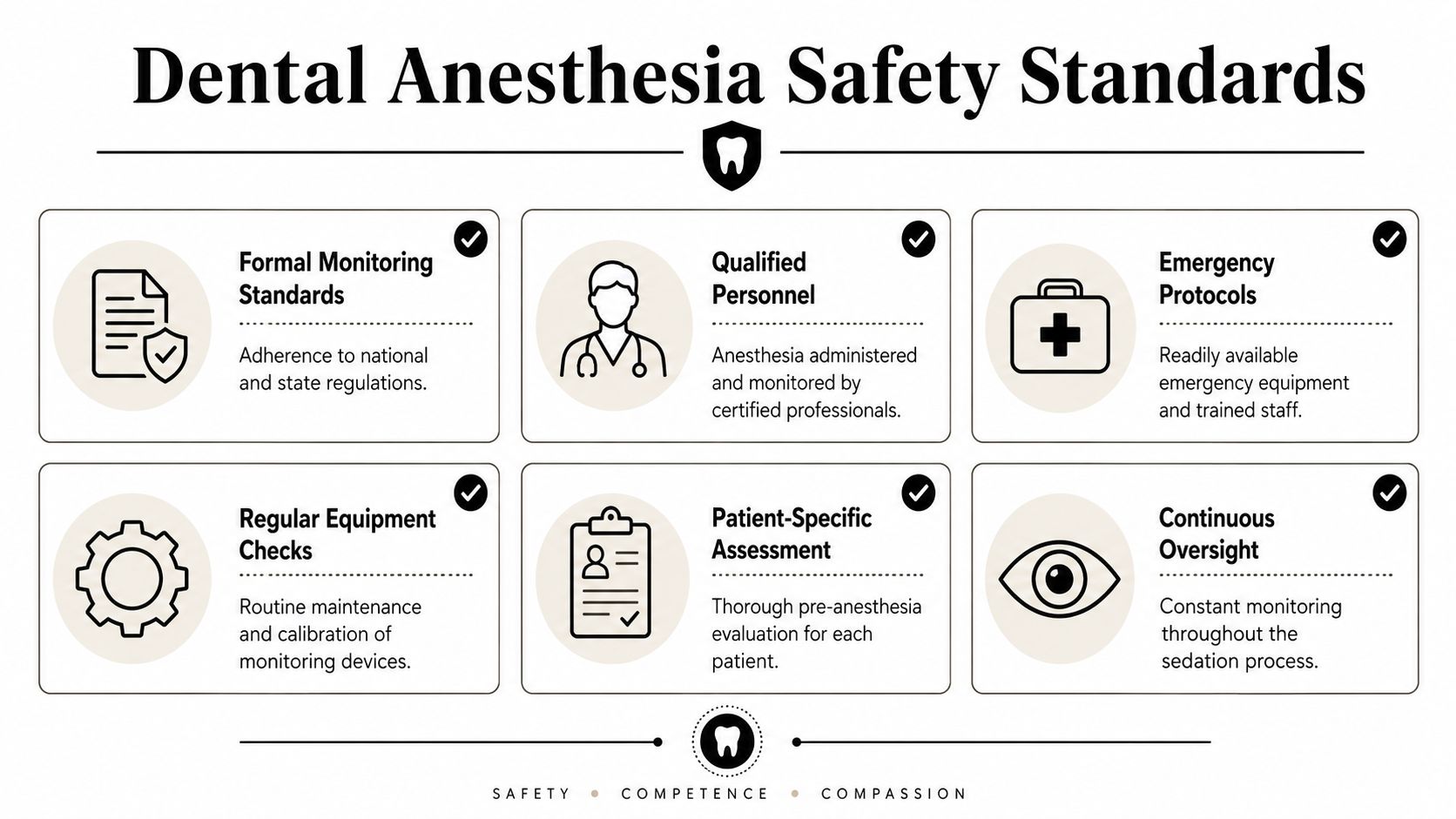
A patient who is waiting for sedation should see a clear routine, not a casual one. The room should already feel prepared, because safe anesthesia depends on written steps, trained staff, and equipment that is checked before treatment begins. The ASA Standards for Basic Anesthetic Monitoring call for attention to oxygenation, ventilation, circulation, and temperature, with pulse oximetry used during all anesthetics and capnography required when an endotracheal tube or laryngeal mask airway is inserted.
What strong protocols look like
A careful dental anesthesia team does not depend on one person glancing at a screen now and then. Monitoring should be continuous, and staff should have defined roles so someone is always watching the numbers and the patient together. For general anesthesia, the Association of Anaesthetists' 2021 standards call for ECG, pulse oximetry, noninvasive blood pressure, and capnography before induction and through transfer to recovery, with temperature measured before anesthesia and every 30 minutes until surgery ends (Association of Anaesthetists standards).
For patients, that usually means the team has a checklist mindset. Monitors are attached, settings are confirmed, and the person giving sedation is not only watching a screen, but also paying attention to breathing patterns, skin color, and how the patient responds.
Dental offices that provide sedation also need a plan for uncommon problems, even when the procedure itself is routine. Emergency equipment should be nearby, reversal agents should be available when appropriate, and the staff should have practiced what to do if a patient's condition changes. Offices that store patient records and monitoring data electronically also need good privacy habits, and a HIPAA compliant IT guide can help practices think about protecting sensitive information alongside clinical safety.
One practical example is a clinic that offers IV sedation for adults and general anesthesia for children needing extensive treatment. Grand Parkway Smiles in Katy, TX is one such option, and its sedation services are presented in a monitored setting. If you want a patient-facing overview of whether IV sedation may fit your situation, their IV sedation safety guide explains the basics in plain language.
Standards matter because they turn safety into a repeatable process. Patients should ask about that process, not only whether sedation is available.
What to Expect Before, During, and After Monitored Sedation
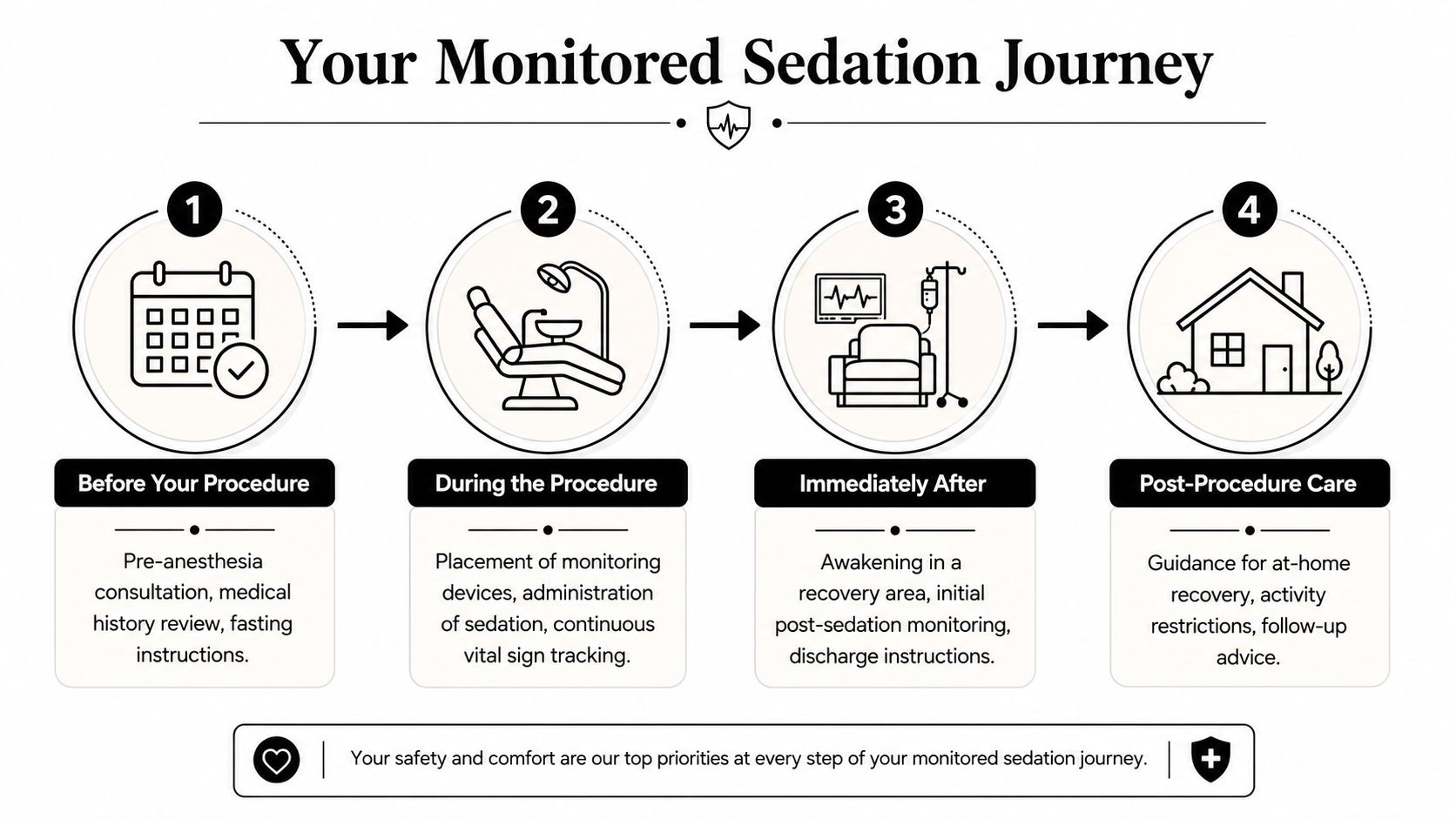
The process usually begins with a conversation, not a medication. Before sedation starts, the team reviews your medical history, asks about current medications and allergies, and gives fasting instructions so your body is prepared for the planned anesthetic. That first review helps the dental team decide what level of monitoring fits your age, health, and procedure.
From check-in to discharge
At check-in, you can expect a calm, step-by-step setup. Once you are in the chair, the monitoring devices go on before sedation deepens. A blood pressure cuff may gently inflate, a small clip may rest on your finger, and ECG leads may be placed on your chest. None of that should hurt, and most patients describe it as more awkward than uncomfortable.
During the procedure, the team keeps an eye on the screen and on you. The monitors provide numbers and waveforms, but those readings are only part of the picture. Clinicians also watch how your chest moves, listen to your breathing, and notice how you respond. If your breathing changes, your oxygen level drops, or your blood pressure shifts, the team can respond right away instead of waiting for you to feel off later.
After the dental work is finished, monitoring continues through recovery. You stay in the recovery area until your vital signs are steady and you are awake enough to understand discharge instructions. That recovery period matters because it gives the team time to confirm that breathing, circulation, alertness, and comfort are all returning to a safe baseline.
If you want a patient-level sense of what the experience can feel like, a IV sedation experience overview can make the process less mysterious, especially before your first visit.
The main idea is simple. Monitored sedation has a clear beginning, middle, and end, and each stage has its own safety checks.
How Monitoring Enables Comfortable and Transformative Dental Care

People often delay dental care because they're afraid they won't tolerate the visit. That's especially true for wisdom teeth removal, full-mouth reconstruction, All-on-4 dental implants, or longer cosmetic cases. Reliable monitoring is what makes sedation a realistic option for those patients, because it lets the team keep treatment comfortable without losing sight of safety.
Why comfort and safety belong together
The benefit isn't only that the appointment feels easier. It's that patients can sometimes complete more care in fewer visits, which matters when a case would otherwise be broken into stressful fragments. For families in Katy and the greater Houston area, that can mean access to a broad range of treatment, from pediatric dentistry to oral surgery, without letting fear decide what gets done.
Monitoring also supports more careful anesthetic adjustment. That's important in deeper sedation and in cases where the team wants to keep the patient calm, comfortable, and stable while the dentist works efficiently. It's one reason modern sedation care can fit complex restorative or cosmetic treatment without turning the experience into a guessing game.
Patients who worry about the equipment often settle down once they understand the purpose behind it. The monitors don't create the comfort, they protect it. And because the dental team can see changes early, they can keep the focus on the procedure itself, whether the goal is restoring function, replacing missing teeth, or improving appearance.
Dental sedation should feel like a supported path to care, not a risky shortcut. That's the value of monitoring; it makes restorative and cosmetic treatment more accessible to people who might otherwise avoid it.
Common Fears and Misconceptions About Dental Anesthesia
A lot of anxiety comes from mistaking monitoring for danger. Some patients see the equipment and assume it means something is likely to go wrong. In reality, the opposite is true, the monitors are there so the team can prevent problems, not just react to them.
Another common fear is waking up too late or not waking up at all. Modern monitoring is one of the biggest reasons anesthesia safety improved so dramatically over time. Historical reviews describe the move to continuous monitoring in the late 20th century as a major safety shift, and one review estimates anesthesia-related mortality in healthy patients at about 1 in 400,000, possibly up to 10 times lower than it was in the early 1980s (historical review and mortality estimate).
The discomfort question
Most monitors are light and unobtrusive. A finger clip, a cuff, and a few leads don't usually interfere with the procedure, and many patients stop noticing them after the first minute. The bigger issue is usually not physical discomfort, it's the fear of what the devices might mean.
There's also a fair question about whether more monitoring always leads to better outcomes. The answer isn't universal. Current guidance uses tools selectively, especially for higher-risk situations, and processed EEG is recommended in some contexts without being required for every case. That fits a broader trend toward choosing the right bundle for the patient rather than assuming every monitor belongs in every appointment (review on depth and nociception monitoring).
Plain answer: if your team uses only the monitors you need, that's a sign of thoughtful care, not minimal care.
Frequently Asked Questions About Anesthesia Monitoring
Can I eat or drink before my sedation appointment? Follow the fasting instructions your dental team gives you, because those rules depend on the type of sedation and your health history. Don't guess, ask before the appointment if anything is unclear.
Will someone watch the monitors the whole time? Yes. Safe sedation depends on continuous attention, not just the presence of equipment.
What if a monitor shows an abnormal reading? The team responds right away, which is the whole point of monitoring. That might mean adjusting medication, supporting breathing, or pausing until the numbers improve.
How do I choose a practice I can trust? Ask whether the office uses continuous ECG, pulse oximetry, blood pressure, and capnography when appropriate, and ask who is responsible for watching the patient during sedation. If you want a local place that offers monitored sedation and complete dental care in Katy, schedule a consultation with Grand Parkway Smiles and ask how they handle sedation, recovery, and emergency readiness.