When your dentist mentions you might need a root canal, your first thought is often about the cost. It's a valid concern, and one we hear all the time. But understanding the cost is also about understanding the incredible value of the procedure itself—it's a crucial investment in saving your natural tooth, ending pain, and preserving your healthy, confident smile.
Without getting into insurance just yet, the ballpark figure for a root canal in the U.S. can be anywhere from $700 for a simple front tooth to over $2,000 for a tricky molar. Viewing this not as an expense, but as an investment, is key. You are taking a definitive step to protect your dental health and prevent more serious, and costly, problems down the line.
Why a Root Canal Is an Investment in Your Health and Smile
Hearing the words "root canal" might sound intimidating, but it’s a highly effective, routine procedure designed to get you out of pain and preserve the natural beauty of your smile. The purpose of the treatment isn't to cause pain—it's to end it for good. By removing infected or inflamed tissue from inside the tooth, we eliminate the source of that nagging toothache and stop the infection from spreading, protecting your overall health.
Think of your tooth's internal structure like a plumbing system. A front tooth is like a single, straight pipe—relatively simple to access, clean, and seal. A molar, however, is more like a complex network of branching pipes. Cleaning this intricate system requires more time, advanced skill, and specialized tools, which is why the procedure for a molar is a greater investment.
The real victory with a root canal is saving your natural tooth. Preserving your own tooth maintains your proper bite, prevents neighboring teeth from shifting, and helps you avoid more expensive and complex procedures later on, such as dental implants or bridges. It keeps your smile complete and functional.
Average Root Canal Costs at a Glance
To give you a clearer picture of what to expect, let's break down the costs. The tooth's location and complexity are the biggest factors driving the price. In fact, national data shows that for many families in Katy and the greater Houston area, a root canal can run anywhere from $1,500 to $2,500 without insurance. This typically covers the procedure itself, necessary X-rays, and a temporary filling. If you're curious, you can discover more insights about these dental costs and see how they stack up nationally.
Here's a quick look at the typical cost breakdown before any insurance is applied.
Estimated Root Canal Cost by Tooth Type Without Insurance
This table gives you a general idea of how the price changes depending on which tooth needs treatment. You'll see that the more canals a tooth has, the more involved—and valuable—the procedure becomes for your long-term dental health.
| Tooth Type | Average Cost Range | Reason for Cost Difference |
|---|---|---|
| Front Tooth (Anterior) | $700 – $1,200 | Typically has just one canal, making the procedure simpler and quicker to complete. |
| Bicuspid (Premolar) | $800 – $1,400 | Usually has one or two canals, which adds a moderate level of complexity to the treatment. |
| Molar | $1,200 – $2,000+ | These teeth have multiple canals that are often curved, requiring more time, skill, and precision to fully restore. |
Keep in mind, these are just averages. The final cost can be influenced by several other factors, which we'll get into next.
Breaking Down Your Final Root Canal Bill
Thinking about your final root canal bill is like looking at a blueprint for restoring your tooth's health. You see one number at the bottom, but what does it actually represent? The final root canal cost isn’t a flat fee; it’s a reflection of the specific resources, skill, and technology needed to save your unique tooth and preserve your smile.
Once you understand these components, the total cost becomes a clear, logical breakdown. You can see the value behind each step of the process—from the initial diagnosis to the final restoration that keeps your tooth strong and looking great for years to come.
Tooth Location and Complexity
The primary factor shaping the investment is which tooth needs care and how complex its internal anatomy is. As we mentioned, treating a front tooth with a single canal is fundamentally different from treating a molar with three or four curved canals.
The more canals a tooth has, the more time, precision, and specialized tools are required to meticulously clean and seal the entire system. This reality directly shapes the cost, as it reflects the level of care needed to ensure a successful, long-lasting outcome for your health.
This infographic gives a great visual of how the cost aligns with the complexity of saving a front tooth versus a molar.
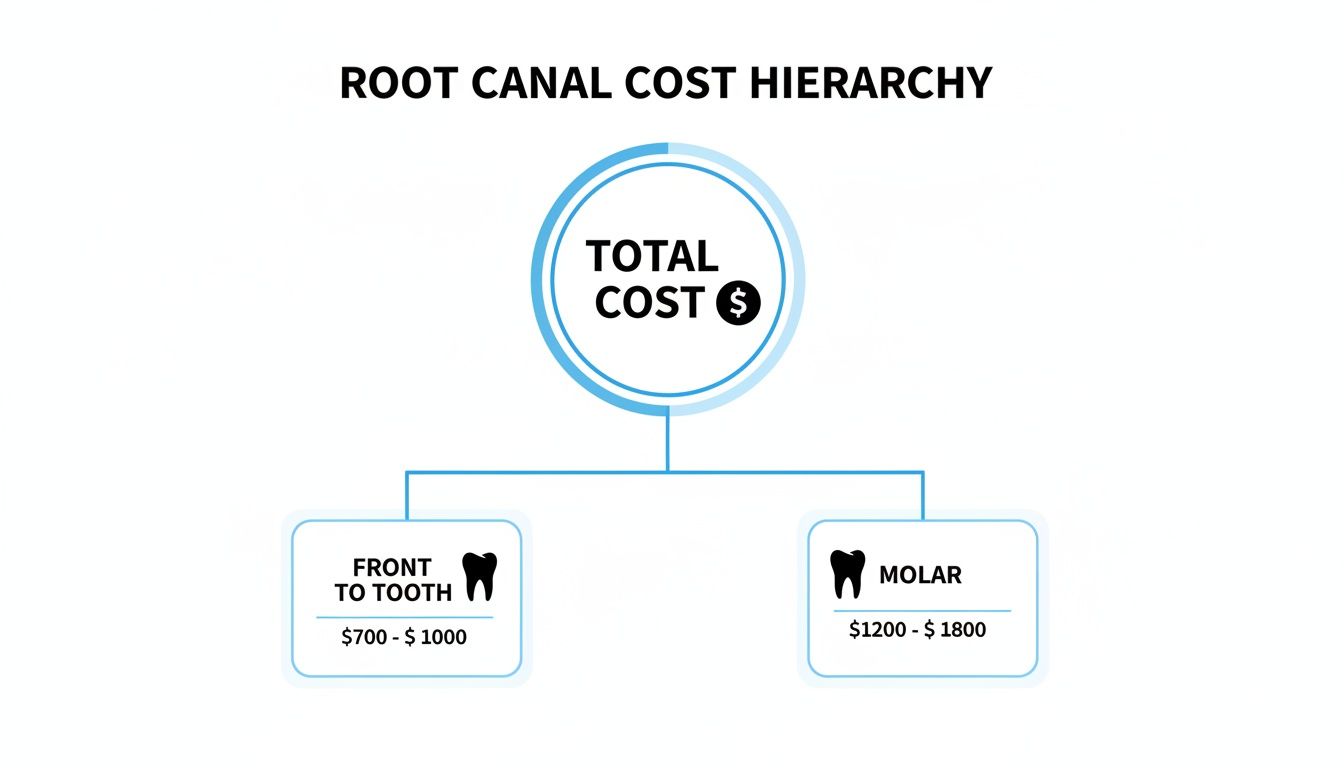
As you can see, while both procedures achieve the goal of saving a tooth, the higher complexity of a molar requires a greater investment to ensure its long-term health and function.
Additional Factors Shaping Your Bill
Beyond the tooth itself, a few other services might be necessary to ensure the best possible outcome for your smile. Each one plays a vital role in making sure your treatment is successful, comfortable, and built to last.
- Initial Treatment vs. Retreatment: A first-time root canal is the most straightforward scenario. If a previously treated tooth becomes reinfected, it requires a retreatment. This is a more intricate procedure where we carefully remove old filling material, re-clean the canals, and resolve the new infection, which understandably increases the cost but is essential for saving the tooth.
- Advanced Imaging: While we always start with standard X-rays, complex cases may benefit from a Cone Beam Computed Tomography (CBCT) scan. This amazing 3D imaging gives your endodontist a complete map of your tooth’s anatomy, enabling them to navigate even the most challenging canal systems with precision for a better outcome.
- Sedation Options: Your comfort is paramount. For patients who feel anxious, sedation dentistry ensures a relaxed and completely pain-free experience. The type of sedation you choose will be an additional element in your treatment plan, focused on your well-being.
- The Final Restoration (Crown): A root canal eliminates the infection, but the tooth needs protection to regain its full strength. A dental crown is almost always the final step, acting like a protective helmet. This allows you to chew confidently and keeps the tooth looking natural and beautiful. It's a separate, but essential, part of the overall cost to restore full function and appearance.
It's also worth noting how much these costs can change depending on where you are. Prices for dental care vary wildly by location. In the US and Western countries, a root canal might run $1,500-$2,500, while other parts of the world have very different price structures. You can learn more about how global dental prices compare to get a broader perspective.
Making Your Root Canal Affordable with Insurance and Financing
Concerns about cost should never stand in the way of receiving essential care that protects your health and smile. While the price for a root canal can seem significant, there are clear pathways to getting the high-quality treatment you need. Understanding your insurance and exploring financing options can empower you to move forward with confidence.

It’s no surprise that the need for procedures like root canals is growing. The global market for these treatments is expected to jump from $2.58 billion in 2026 to $3.38 billion by 2034. Here in North America, we account for nearly $0.97 billion of that market, largely due to our advanced dental infrastructure and insurance reimbursements that make these critical, tooth-saving treatments more accessible.
Navigating Your Dental Insurance Benefits
Most PPO dental insurance plans offer coverage for endodontic procedures, but the specifics can vary. Typically, once you’ve met your annual deductible, your plan will cover a percentage of the treatment cost—often between 50% to 80%.
To get a clear picture of your out-of-pocket costs, it's essential to confirm your benefits beforehand. Our team at Grand Parkway Smiles is happy to help with a complimentary benefits check, ensuring there are no surprises.
The most important step is understanding your plan's details before starting treatment. Knowing your deductible, annual maximum, and coverage percentage for major procedures empowers you to plan your finances and focus on what truly matters: a healthy, comfortable recovery.
Solutions When Insurance Is Not Enough
What happens if you don't have insurance, or if your plan still leaves you with a significant balance? You still have excellent options to make your root canal affordable without compromising on the quality of care your tooth deserves.
Here are a few pathways that work for many of our patients:
- In-House Savings Plans: Many dental offices, including ours, offer in-house savings plans. This is a membership that provides direct discounts on services for an annual fee—a fantastic alternative for anyone without dental coverage.
- Third-Party Financing: Companies like CareCredit function like a healthcare-specific credit card. They offer flexible payment plans, often with interest-free options, allowing you to break down the total root canal cost into smaller, manageable monthly payments.
By exploring these avenues, you can find a financial plan that fits your budget. A healthy, pain-free smile is always within reach.
The True Cost of Avoiding a Root Canal
It’s normal to consider the root canal cost, but there’s a more critical question: what is the cost of avoiding one? Postponing a necessary root canal isn't a neutral choice. It often triggers a domino effect leading to more severe health issues, damage to your appearance, and ironically, much larger dental bills later on.

When an infected tooth is left untreated, the problem intensifies. The bacteria multiply, leading to a painful and dangerous dental abscess—a pocket of pus at the tooth's root.
This severe infection doesn't stay contained. It can damage the jawbone, causing permanent bone loss and weakening the foundation of your smile. In serious cases, the infection can spread to other parts of your body, posing a risk to your systemic health.
The Financial Fallout of Inaction
Delaying a root canal almost guarantees you’ll spend more in the long run. The immediate choice is between saving the tooth with a root canal or losing it to extraction. While pulling the tooth may seem cheaper upfront, it's a shortsighted solution with long-term consequences for both your wallet and your smile.
An empty space left by an extracted tooth allows neighboring teeth to shift out of alignment. This can disrupt your bite, create cleaning difficulties, and lead to a new set of dental problems. Restoring your smile and chewing function then requires more complex and costly treatments.
Let's compare the two paths:
- Option A – The Proactive Investment: You choose the root canal and crown. This approach saves your natural tooth, preserves your bite alignment, and protects your overall oral health. The investment is upfront, but it secures the future of your smile.
- Option B – The Reactive Expense: You opt for extraction. The initial cost is lower, but you must now address the gap. This means looking at a dental implant and crown or a dental bridge—both of which are significantly more expensive than the original root canal.
View a root canal not as a cost, but as a strategic investment in your health and appearance. By saving your natural tooth now, you prevent future problems, protect the structure of your smile, and avoid the much higher expense of tooth replacement therapies.
Protecting Your Health and Appearance
Ultimately, the goal is to eliminate pain and keep your natural smile intact. A root canal achieves both. It removes the infection at its source, providing immediate relief and preventing the problem from escalating. Most importantly, it saves your tooth, which is always the best outcome for your long-term health and appearance.
Keeping your own teeth helps maintain the natural structure of your face and jaw, preventing the sunken look that can occur from bone loss after a tooth is lost. When you see the root canal cost from this perspective, its true value is clear. It's a proactive step that protects your health, your smile, and your finances from future complications.
Why an Endodontic Specialist Matters
When facing a complex health issue, you seek out a specialist. The same principle applies to your dental care, especially when the goal is to save a tooth. While a general dentist can perform a root canal, an endodontist is a specialist who has dedicated their career to mastering this precise, tooth-saving procedure.
This distinction is crucial when considering the root canal cost and, more importantly, the long-term success and health of your tooth.
An endodontist is a root canal expert. After dental school, they complete two to three more years of advanced training focused exclusively on diagnosing tooth pain and performing root canal therapy. This equips them to handle even the most complex cases with a higher degree of success, ensuring the best possible outcome for your smile.
Advanced Technology for Superior Outcomes
One of the greatest benefits of seeing a specialist is the advanced technology they use. Endodontists work with tools designed for precision that are not typically found in general dental practices.
- Surgical Microscopes: These powerful microscopes magnify the interior of your tooth, allowing the endodontist to see tiny, intricate canal structures invisible to the naked eye. This precision is vital for thoroughly cleaning and sealing the tooth.
- 3D Imaging (CBCT): For complex cases, a CBCT scan provides a complete three-dimensional view of your tooth’s anatomy. It can reveal hidden canals or unusual root shapes, creating a detailed roadmap to ensure the entire infection is treated.
This specialized equipment not only improves the outcome but also allows endodontists to work more efficiently, often resulting in a more comfortable experience for you.
Choosing a specialist is an investment in expertise. The higher success rates associated with endodontic treatment mean you are far less likely to need costly retreatment or face losing the tooth in the future.
At Grand Parkway Smiles, we believe in an integrated approach to your dental health. We have an in-house endodontist on our team, ensuring you receive specialized care without the inconvenience of referrals. This means your entire treatment, from the expert root canal to the final, beautiful crown, is managed seamlessly under one roof.
You can learn more about the key differences between a dentist and an endodontist to understand why this level of expertise is so valuable for preserving your natural smile for years to come.
Your Next Steps Toward a Healthy Smile
Now that you have a clearer understanding of the cost of a root canal, you can see it for what it truly is: a manageable and vital investment in your health. A root canal is not a procedure to fear; it's the most effective way to save your natural tooth, eliminate pain, and prevent more complex issues from compromising your smile.
Schedule Your Consultation in Katy, TX
The next step is simple. We invite you to a consultation at Grand Parkway Smiles, conveniently located for anyone in Katy or the greater Houston area. Our team is here to listen, perform a thorough examination, and create a personalized treatment plan. We prioritize your comfort, using the latest technology and offering sedation options to ensure a positive experience.
Your journey back to a pain-free, healthy smile starts with a simple conversation. We'll outline all your financial options so you can move forward with confidence and clarity.
Don't let tooth pain dictate your life any longer. Let's work together to restore your tooth's health and function. Call Grand Parkway Smiles today to book your appointment and take the first step toward lasting relief and a healthy smile.
Still Have Questions About Root Canals?
Even after understanding the costs, it’s normal to have more questions. Wondering about the procedure itself, its duration, and the recovery process are all smart things to consider. Clarifying these details can give you the confidence to move forward and protect your tooth.
One of the biggest concerns is often about pain. Let’s be clear: modern root canals are designed to relieve pain, not cause it. With effective local anesthesia and sedation options, the procedure often feels similar to getting a routine filling. The primary goal is to eliminate that throbbing toothache, and most patients feel immense relief almost immediately after treatment.
What to Expect From Treatment and Recovery
"How long will this take?" A straightforward root canal can often be completed in a single appointment of about 90 minutes. For more complex teeth like molars, or for a retreatment, we might schedule two visits to ensure the tooth is perfectly cleaned and disinfected for the best long-term result.
Afterward, it's normal to feel mild tenderness for a few days as the area heals, easily managed with over-the-counter pain relievers. Most people return to their normal routine the next day, making the recovery quick and manageable.
An essential part of the process is the final restoration. A root canal saves your tooth from infection, but it leaves it more vulnerable. A dental crown acts as a custom-fit helmet, restoring its strength so you can chew and bite confidently without risking fracture.
Trying to save on the initial root canal cost by skipping the crown is a risky gamble. It often leads to the tooth breaking, which can result in losing it permanently and facing much more expensive tooth replacement options.
Ultimately, needing a root canal is an opportunity to restore your oral health. This highly successful treatment achieves several amazing benefits:
- Stops the intense pain of an infected tooth.
- Saves your natural tooth from extraction.
- Prevents infection from spreading to your jaw or body.
- Restores your ability to chew comfortably and smile confidently.
By choosing to save your tooth, you are making a wise investment in your health that will keep your smile whole and beautiful for years to come.
Ready to finally get rid of that tooth pain and save your smile? The expert team at Grand Parkway Smiles is here to make your root canal experience as comfortable and precise as possible. Schedule your consultation today and take the first real step toward relief.