If you've ever been told you need a "deep cleaning," you're on the path to significantly improving your oral health. This specific, therapeutic treatment is designed to get your smile back on track when gum disease has started to set in.
Known in the dental world as scaling and root planing, this procedure is very different from your standard six-month cleaning. While a regular cleaning focuses on polishing the visible parts of your teeth for a brighter appearance, a deep cleaning targets the real trouble spot: the area hiding below your gumline. It's our first line of defense to stop gum disease in its tracks and restore your healthy, confident smile.
Beyond the Surface: A Deeper Look at Your Teeth
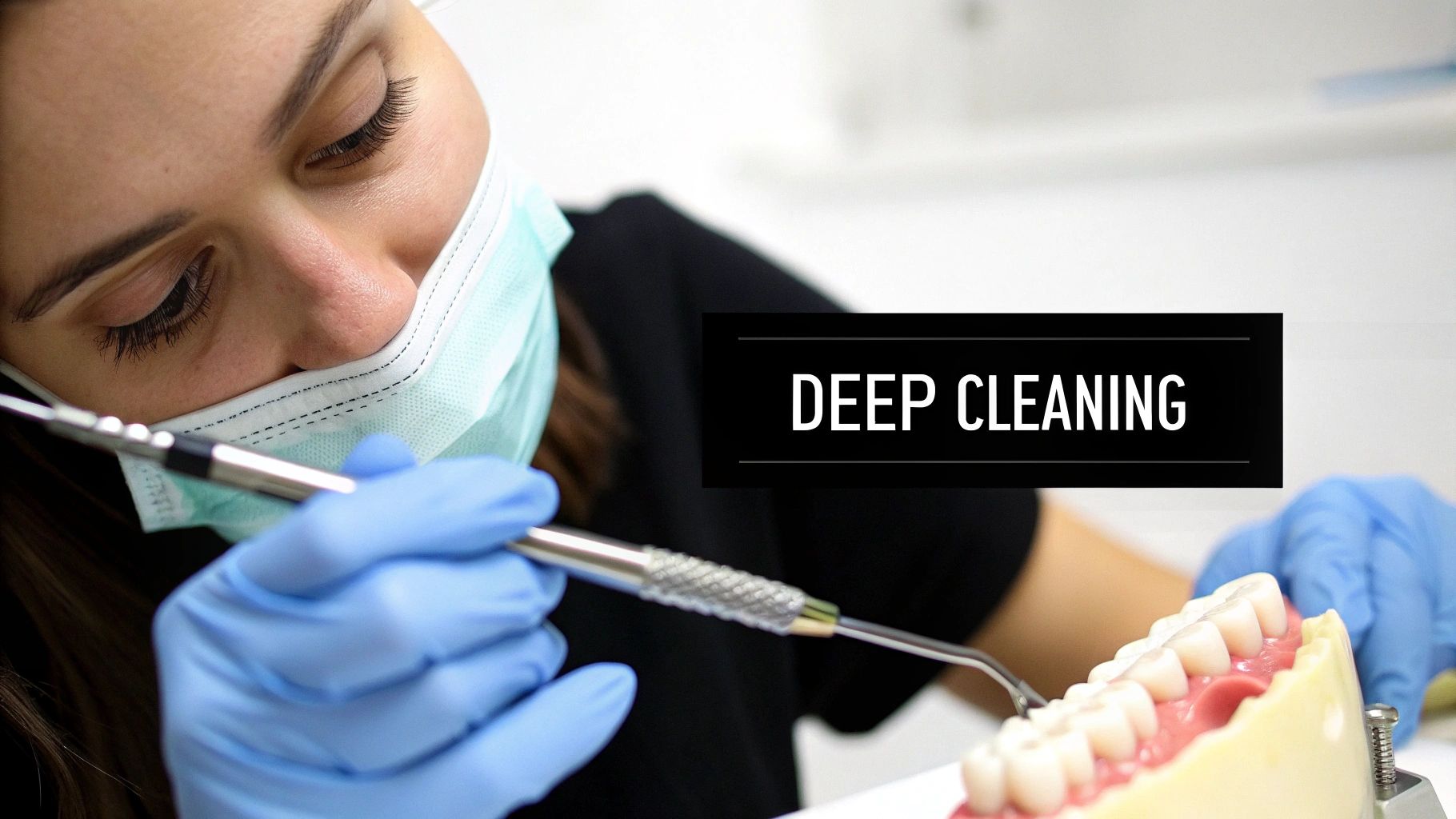
When you visit us for a routine check-up, your hygienist performs a prophylaxis cleaning. This is a preventive service that's perfect for removing the plaque and tartar that build up on the surfaces of your teeth, keeping your smile bright and healthy. Think of it as essential maintenance to keep your smile looking and feeling great.
A deep cleaning, on the other hand, is a treatment, not just a preventive measure. We recommend it when we see signs of active gum disease, or periodontitis. This condition creates deep pockets between your gums and teeth, giving harmful bacteria a place to thrive far beyond the reach of your toothbrush. This is where the health and stability of your smile are at risk.
The Foundation of Your Smile
Imagine your gums are the foundation of a house and your teeth are the structure itself. If that foundation starts to erode, the whole house becomes unstable. It's the same with your oral health. When bacteria build up below the gumline, they trigger inflammation and start to damage the very bone and tissues that hold your teeth in place, jeopardizing the future of your smile.
A deep cleaning is the critical intervention needed to repair this foundation. It’s a non-surgical treatment that halts the disease process, giving your gums a chance to heal and reattach firmly to your teeth. It’s all about securing your smile for the long haul and preserving your natural teeth.
A deep cleaning isn't just a "better" version of a regular cleaning; it's a completely different tool for a different job. While a regular cleaning maintains health and appearance, a deep cleaning restores health by treating active disease at its source.
To make this crystal clear, here’s a quick breakdown of how these two procedures stack up.
Regular Cleaning vs Deep Cleaning at a Glance
This table offers a clear, side-by-side comparison to help you quickly understand the essential differences between a routine dental cleaning and a therapeutic deep cleaning procedure.
| Feature | Regular Dental Cleaning | Deep Cleaning (Scaling & Root Planing) |
|---|---|---|
| Purpose | Preventive maintenance & cosmetic polishing | Therapeutic treatment for active gum disease |
| Area Cleaned | Teeth at and above the gumline | Below the gumline, targeting tooth roots |
| Procedure | Polishing and scaling of visible surfaces | Scaling tartar below the gums & planing (smoothing) roots |
| Anesthesia | Usually not required | Local anesthetic is typically used for comfort |
| Frequency | Recommended every 6 months | As needed to treat periodontitis |
| Goal | Maintain oral health & a bright smile | Stop gum disease progression & promote healing |
Ultimately, a deep cleaning is a crucial investment in your dental health and your overall well-being. It protects the essential structures that hold your teeth firmly in place, ensuring your smile remains both beautiful and functional for years to come.
The Hidden Dangers of Untreated Gum Disease
When we think about a healthy mouth, we usually picture bright, white teeth free of cavities. But the real foundation of a lasting smile isn't just the teeth—it's the gums. Ignoring the health of this crucial tissue can lead to serious problems that affect more than just your mouth, which is exactly why a deep cleaning is sometimes necessary. It is a direct, beneficial response to the start of gum disease.
It all begins quietly with plaque, that sticky film of bacteria always trying to form on your teeth. If you don't remove it, plaque hardens into tartar, a tough, cement-like deposit that only a dental professional can scrape away. Once tartar starts creeping below your gumline, it becomes a constant source of irritation, causing your gums to become inflamed, red, and swollen, and eventually pull away from the teeth.
From Gums to Bone: The Progression of Periodontal Disease
This pulling away creates tiny spaces called periodontal pockets. You can think of these pockets like little trenches where harmful bacteria can hide and multiply, safe from your toothbrush and floss. As these bacteria flourish, they release toxins that put your body’s immune system on high alert, triggering a chronic inflammatory response that attacks your own tissues.
This constant battle starts to break down the very structures holding your teeth in place. The infection eats away at gum tissue and, even more critically, the underlying bone that anchors your teeth. This is the hidden danger of untreated gum disease—it's a slow, often silent erosion of your smile’s foundation. What might start as minor gum irritation can eventually lead to major bone loss, loose teeth, and even tooth loss, severely impacting your appearance and ability to chew.
This isn't a rare problem. The American Dental Association has found that more than 47% of adults over 30 have some stage of periodontal disease. It's a massive global health issue, with oral diseases affecting billions of people around the world, which is why effective treatments like deep cleaning teeth are so important.
Why Deep Cleaning Is a Critical Intervention
A deep cleaning, known professionally as scaling and root planing, isn't just a more thorough cleaning; it’s a therapeutic treatment designed to stop this destructive cycle in its tracks. It's the only non-surgical method that can reach deep into those pockets to clear out the tartar and bacteria causing all the damage.
Think of it like repairing the foundation of a house to prevent it from crumbling. By cleaning out these hidden areas and smoothing the tooth roots, a deep cleaning eliminates the bacteria's home and gives your gums a clean surface to heal and reattach, creating a healthier, more stable smile.
This procedure is so vital for a few key reasons:
- Stops Disease Progression: It puts the brakes on gum disease, preventing further loss of bone and tissue that support your teeth.
- Prevents Tooth Loss: By shoring up the foundation, it is the best way to save your natural teeth for a lifetime of confident smiles.
- Boosts Overall Health: A growing body of research links advanced gum disease to other serious health problems, like heart disease and diabetes. A healthy mouth contributes to a healthy body.
- Eliminates Bad Breath: It removes the deep-seated bacteria that are often the source of persistent bad breath (halitosis), giving you fresher breath and more confidence.
Taking action is key. To learn more about how to safeguard your smile, take a look at our guide on preventing gum disease for a healthier smile. A deep cleaning is a necessary step to restore your oral health, preserve your smile, and ensure it stays beautiful and stable for the long haul.
A Step-by-Step Walkthrough of the Deep Cleaning Procedure
Let's pull back the curtain on what actually happens during a deep cleaning. Knowing what to expect can make all the difference, and our goal is for you to feel comfortable and confident. The entire process is a two-part mission: first, we clear out the infection at its source, and second, we create a perfectly smooth surface for your gums to heal and reattach, restoring the health and appearance of your smile.
This whole treatment, which we call scaling and root planing, is designed to get into places a regular cleaning just can't touch. We almost always use a local anesthetic to numb the area we're working on, so you won't feel a thing. You can just sit back and relax while we get to work restoring your gum health.
This infographic shows exactly what we're fighting against—how that sticky plaque hardens, creates deep pockets, and eventually starts to damage the bone that holds your teeth in place.
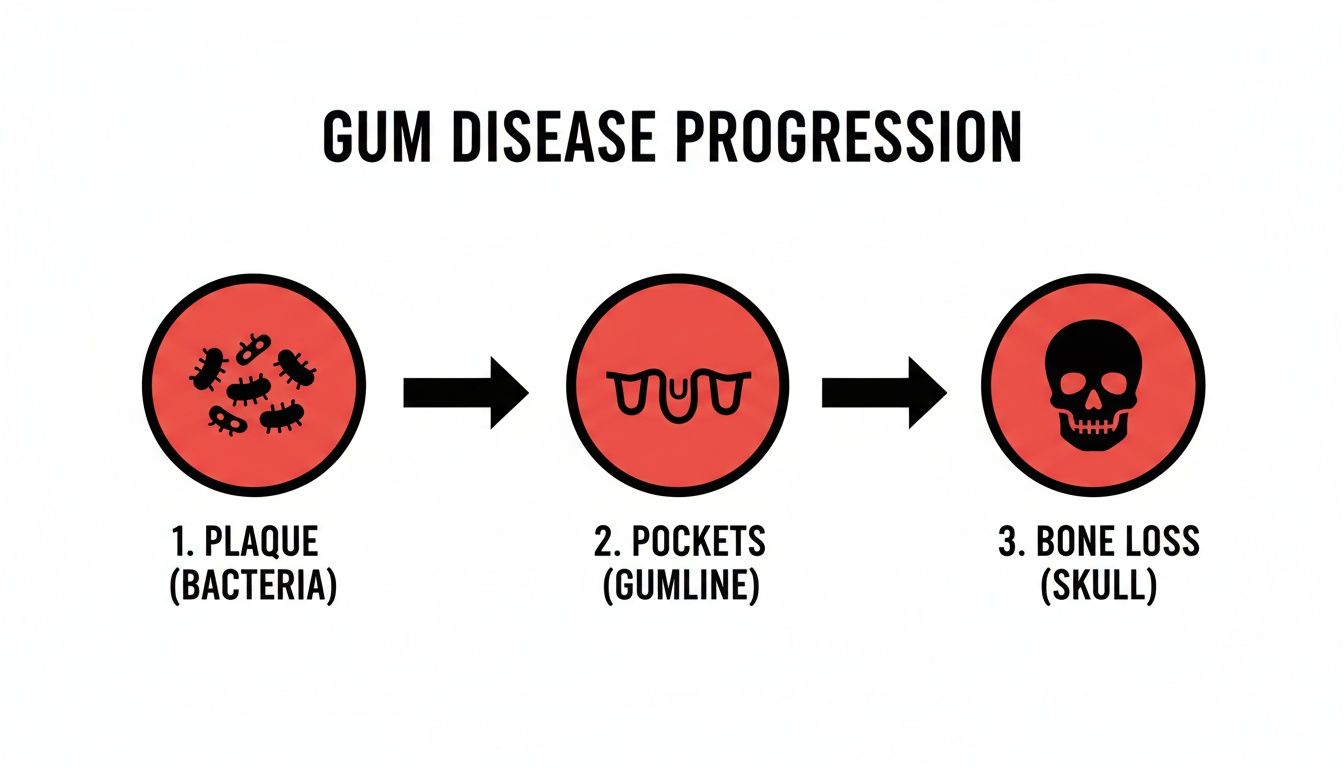
It’s a powerful visual that shows why we need to step in with a deep cleaning before the damage becomes permanent and threatens your teeth.
Stage One: Scaling to Remove Buildup
The first phase of the deep cleaning is called scaling. The goal here is simple but crucial: to meticulously remove all the plaque and hardened tartar (calculus) from the surfaces of your teeth, especially below the gumline. This step is essential for eliminating the source of the infection and inflammation.
Your hygienist will use a couple of specialized tools to get this done. We often start with an ultrasonic scaler, an instrument that uses tiny vibrations to break apart the big, stubborn pieces of tartar. At the same time, it sprays a little stream of water to flush everything away, leaving your teeth cleaner and healthier.
After the heavy lifting is done, we switch to very precise manual scalers and curettes. These hand tools let us feel our way along the tooth surface, ensuring every last bit of tartar is gone from inside those periodontal pockets. This detailed work is absolutely essential for getting rid of the bacteria fueling the infection.
Stage Two: Root Planing to Promote Healing
With all the tartar gone, we move on to root planing. This part is all about smoothing the surfaces of your tooth roots. When tartar sits on the roots for a long time, it leaves them rough and pitted—the perfect hiding spot for more bacteria to gather.
Root planing buffs out those rough patches, creating a slick, smooth surface that bacteria can't cling to easily. Even better, this clean surface encourages your gums to heal and snuggly reattach to your teeth. That reattachment is the ultimate goal, as it shrinks the depth of the pockets, firms up your gums, and protects your teeth for the future.
Scaling gets rid of the cause of the problem, while root planing creates the ideal conditions for a cure. It's a one-two punch that stops periodontal disease and gives your gums a fresh start toward optimal health.
For more stubborn cases of gum disease, we might look at other treatments as well. If you're interested in a highly effective, less invasive alternative, you can learn more about how we use advanced laser therapy to save your teeth at Grand Parkway Smiles.
Why Multiple Appointments Are Often Necessary
Because deep cleaning teeth is such a detailed procedure, we almost always split it into at least two appointments. This isn't to draw things out—it's done for your comfort and to ensure we deliver the best possible health outcome.
- Your Comfort Comes First: By focusing on one side of your mouth at a time, we can numb just that area. This avoids that awkward feeling of having your entire mouth numb at once.
- Time for Thoroughness: Breaking up the treatment gives your dental team the time to be incredibly meticulous with each and every tooth, making sure no speck of tartar is left behind for the best results.
- Makes Eating Easier: We'll treat one side of your mouth, and then you can go home and chew comfortably on the other side while the first side begins to heal.
A typical plan is to treat the upper and lower teeth on one side during the first visit, and then bring you back to do the other side. This steady, methodical approach makes the whole process comfortable, manageable, and incredibly effective for restoring your oral health.
How We Ensure a Comfortable and Pain-Free Experience

Let's be honest—the idea of any dental procedure can feel a little intimidating, especially one that works below the gumline. We completely understand that dental anxiety is a real thing, and for many people, it's a major hurdle to getting the care they need to protect their smile.
That's precisely why our entire approach to a deep cleaning is built around your comfort. We believe restoring your gum health should be a positive, empowering experience, not a stressful one.
Our commitment to a pain-free procedure begins with the most effective tool in our kit: local anesthesia. Before we even start, we take the time to thoroughly numb the specific areas of your mouth we'll be working on. This simple step ensures the scaling and root planing process is entirely comfortable, allowing you to rest easy while we work to improve your dental health.
Your Comfort Is Our Top Priority
Local anesthesia is incredibly effective and the standard of care for a reason. The goal is simple: you shouldn't feel any pain during your treatment. Once the area is numb, our team can work meticulously and efficiently to remove all the harmful bacteria without you feeling any discomfort.
But we also know that for some folks, anxiety goes beyond just the fear of pain. It can be about the sounds, the sensations, or the general environment of a dental office. If you struggle with a higher level of dental fear, we have fantastic solutions to help you feel completely at ease.
Your peace of mind is just as important to us as the clinical outcome. We will never rush you. We promise to take every step necessary to make sure you feel safe, heard, and completely comfortable throughout your entire visit.
Advanced Options for Total Relaxation
For anyone who needs a little extra help relaxing, we proudly offer sedation dentistry. This can be an absolute game-changer for patients with moderate to severe anxiety, a sensitive gag reflex, or just difficulty sitting still for longer appointments. Sedation gently guides you into a state of deep relaxation, making the whole experience feel calm and stress-free.
Here are the benefits of choosing sedation for your deep cleaning:
- Anxiety Melts Away: Sedation calms your nerves, allowing you to remain peaceful from start to finish. Many patients tell us they have little to no memory of the procedure afterward.
- Time Flies By: It makes the time you spend in the dental chair feel like it passes much more quickly, turning a longer appointment into what feels like a short, easy visit.
- Better Clinical Focus: When you're completely relaxed, our team can work even more effectively, which ensures the best possible results for your gum health.
We offer different levels of sedation, from mild options to IV sedation for a deeper state of calm, all administered under the close supervision of our experienced team. This patient-first approach means you never have to choose between your mental well-being and your oral health.
A deep cleaning is a powerful step toward getting your smile's foundation back on solid ground, and we're here to make sure that journey is as smooth and painless as it can be.
Aftercare and Recovery for Lasting Results
Think of a successful deep cleaning as a partnership. Our team handles the heavy lifting here at the office, but the care you provide at home afterward is every bit as important for getting the best long-term health and appearance benefits. The recovery period is when the real magic happens—it’s when your gums get the chance to heal, tighten up, and reattach to your newly cleaned tooth roots.
Right after your procedure, it's completely normal for the numbness from the local anesthetic to stick around for a few hours. As that feeling fades, you might notice some mild soreness, tender gums, or a bit of sensitivity to hot and cold. This is actually a positive sign! It means your body has kicked off the natural healing process and your gums are on the road to recovery.
These symptoms are usually minor and fade away within a few days. If you feel any discomfort, over-the-counter pain relievers like ibuprofen can work wonders. This temporary tenderness is a small price to pay for stopping a serious disease and preserving your smile.
What to Eat and How to Clean Your Teeth
For the first 24 to 48 hours, your main job is to be gentle with the treated area. Your gums are working hard to heal, and giving them a little TLC will make a huge difference in your comfort and the final outcome of healthier, firmer gums.
Stick to soft foods that don't require much chewing. This helps avoid irritating your healing gums. Some great options include:
- Yogurt, smoothies, and applesauce
- Soups and broths (just not piping hot)
- Scrambled eggs and mashed potatoes
- Pasta and other soft-cooked foods
On the flip side, try to steer clear of anything hard, crunchy, spicy, or extremely hot. Foods like chips, nuts, and popcorn can easily get lodged in those healing gum pockets and interfere with the healing process.
You should definitely keep brushing and flossing, but with a gentle touch. We recommend using a soft-bristled toothbrush and avoiding any vigorous scrubbing near the treated gums. When you floss, be delicate and slide the floss along the curve of the tooth instead of snapping it against the sensitive tissue. This careful routine keeps things clean without disrupting healing.
Your at-home care is more than just managing a little sensitivity; it’s an active part of your treatment. By being gentle and keeping the area clean, you’re creating the perfect environment for your gums to heal properly and for the deep cleaning teeth procedure to deliver benefits that last a lifetime.
The Role of Rinses and Follow-Up Care
We may recommend a special antimicrobial or antiseptic mouthwash to use for a short time after your deep cleaning. This rinse is a great tool for controlling bacteria while your gums are still too tender for your normal cleaning routine, helping to ensure a clean healing environment.
But the single most important step you can take to protect your investment in your oral health is coming to your follow-up appointments. A deep cleaning isn't a one-and-done cure for gum disease; it's the first major leap forward in managing a chronic condition to maintain a healthy smile.
Periodontal Maintenance Is Your Key to Success
Once you're past the initial healing phase, we'll schedule you for a periodontal maintenance appointment, usually in about three months. These aren't your typical cleanings. Periodontal maintenance visits are specifically designed to clean below the gumline in the very areas we treated, stopping harmful bacteria from coming back and protecting your smile.
Why so soon? Studies show that the bacteria responsible for gum disease can repopulate those periodontal pockets in as little as 90 days. This is why sticking to a 3-4 month schedule is so essential. These appointments allow our team to:
- Monitor Your Healing: We'll check your gum pocket depths to make sure they're shrinking and your gums are firm and healthy.
- Disrupt Bacteria: We’ll remove any plaque and tartar that has started to build up below the gumline, keeping the bacteria under control.
- Prevent Relapse: By staying one step ahead of the bacteria, we prevent the infection from returning and protect your teeth and jawbone from future damage.
Think of periodontal maintenance as the ongoing support system for your smile’s foundation. The initial deep cleaning gives your oral health a fresh start, and these regular follow-ups are what make sure it stays that way for good.
Understanding the Cost of Deep Cleaning Teeth
Let's talk about one of the first questions on everyone's mind when it comes to a dental procedure: the cost. It's completely natural to want to understand the financial side of things. A deep cleaning is definitely more involved than your typical six-month check-up, and its price reflects that extra level of care. However, it's most beneficial to see it not just as a cost, but as a vital investment in the future of your smile and overall health.
The price for a deep cleaning, which dentists call scaling and root planing, isn't a one-size-fits-all number. It’s tailored to your specific situation. The biggest factor is how advanced your gum disease is. A case with deeper gum pockets and a lot of hardened tartar buildup simply takes more time and meticulous effort to treat properly and restore health.
Factors That Influence the Cost
Another key element is how much of your mouth needs attention. We often look at the mouth in four sections, or quadrants. The final cost will depend on whether you need scaling and root planing in just one or two quadrants, or if the infection requires us to treat your entire mouth.
The cost can be influenced by:
- Number of Quadrants: Treating the whole mouth will naturally cost more than focusing on a single problem area.
- Severity of Gum Disease: Deeper pockets and heavier tartar deposits mean a more intensive procedure is needed to achieve a healthy outcome.
- Use of Sedation: If you opt for sedation dentistry to help with anxiety, that will be an additional cost. For many, it's a worthwhile one for a comfortable, stress-free experience.
Insurance Coverage and Long-Term Value
Here’s the good news: most dental insurance plans recognize that a deep cleaning is a medically necessary treatment for active periodontal disease. This often means they'll cover a significant portion of the cost. Our team at Grand Parkway Smiles is fantastic at navigating insurance benefits, and we'll do everything we can to help you understand and maximize your coverage.
Viewing a deep cleaning solely as an expense misses the bigger picture. It's a preventive investment that protects you from far more complex, invasive, and expensive procedures down the road—think gum surgery, bone grafts, and replacing lost teeth with dental implants.
By getting to the root cause of gum disease now, you're doing more than just saving a tooth; you're preserving your natural smile and appearance. This proactive mindset is a global trend; the market for preventive dental supplies is expected to grow from $5.9 billion to $8.8 billion over the next decade as people realize it’s better to invest in care now to avoid major problems later. You can read more about the growing focus on preventive dental care to see how this investment aligns with modern health priorities.
An Investment in Your Smile and Health
At the end of the day, the cost of not getting a deep cleaning when you need one is always far greater. Untreated gum disease doesn't just resolve on its own. It gets worse, leading to permanent bone loss, shifting teeth, and eventually, tooth loss. The cost to replace a single lost tooth with a dental implant or bridge dwarfs the cost of saving it with scaling and root planing.
Think of it like fixing a small leak in your home's foundation. It’s a targeted, effective repair that prevents catastrophic damage later on. By investing in your gum health today, you’re ensuring a stronger, healthier, and more beautiful smile for years to come—securing both your confidence and your peace of mind.
Answering Your Questions About Deep Cleaning
It’s completely normal to have a few questions before any dental procedure, and a deep cleaning is no different. We want you to feel confident and informed every step of the way. Here are some straightforward answers to the questions we hear most often about scaling and root planing.
Is a Deep Cleaning Procedure Painful?
Your comfort is our top priority. Before we begin, we use a local anesthetic to completely numb the area we're working on, so you shouldn't feel any pain during the actual procedure. It's common to have some mild tenderness or sensitivity in your gums for a few days afterward as things heal up, but this is easily managed with over-the-counter pain relievers and is a sign that your gums are beginning to recover their health.
What Is the Main Difference Between a Regular and a Deep Cleaning?
Think of a regular cleaning as preventative maintenance for healthy gums—it focuses on removing plaque and tartar from above the gumline to keep your smile bright. A deep cleaning, on the other hand, is a therapeutic treatment for active gum disease. It goes below the gumline to clear out the bacterial buildup that has collected on the tooth roots, which stops the disease from getting worse and helps your gums heal and reattach to your teeth for a healthier, more stable smile.
A deep cleaning isn't just a "more intense" version of a regular cleaning—it's a medically necessary treatment to address an active infection. While a regular cleaning helps keep healthy gums healthy, a deep cleaning helps diseased gums become healthy again.
How Long Does a Deep Cleaning Take?
The time it takes really depends on the extent of the gum disease we're treating. Because it’s a much more involved process than a standard cleaning, we usually complete it over two separate visits. Each appointment typically lasts between one and two hours, giving us plenty of time to be thorough and deliver the best possible health outcome while making sure you stay completely comfortable.
Does Dental Insurance Cover Deep Cleaning?
Yes, most of the time. Since scaling and root planing is a necessary medical treatment for periodontal disease, most dental insurance plans offer coverage. How much they cover will depend on your specific plan. Our team has a lot of experience working with insurance providers, and we're here to help you understand your benefits and make your care as affordable as possible.
Restoring your gum health is a powerful step toward a more confident and lasting smile. At Grand Parkway Smiles, our expert team combines advanced technology with a gentle touch to ensure your deep cleaning experience is comfortable and effective. If you're experiencing signs of gum disease or have been told you need this treatment, schedule a consultation with us today.