Losing most of your teeth rarely happens all at once. For many people, it’s years of patchwork dentistry, loose partials, broken teeth, gum problems, and the slow loss of confidence that follows. You start chewing on one side, avoiding photos, and wondering whether people notice how carefully you smile.
That’s usually the point when patients start searching for dental implants all on four. They don’t just want teeth. They want stability, comfort, and a face in the mirror that looks healthy again. They want to eat in public without worrying, speak clearly, and stop planning life around what their mouth can tolerate.
Reclaiming Your Smile and Your Life
A lot of patients arrive feeling worn down by the daily compromises of tooth loss. Some are tired of dentures that move. Others still have teeth, but they’re failing one by one and every repair feels temporary. Even when they aren’t in severe pain, they’re exhausted by the uncertainty.

The emotional side matters more than is often acknowledged. Missing or failing teeth affect how you laugh, how you order food, how you show up at work, and how long you hold eye contact. People often tell me they’ve become skilled at hiding their mouth. That habit can become part of daily life before they even realize it.
What patients usually want back
They’re not asking for perfection. They’re asking for ordinary things that tooth loss made difficult.
- Comfort at meals so they can chew without shifting, pressure points, or fear
- Confidence in conversation without worrying that teeth will slip or click
- A healthier appearance with support for the lips and lower face
- Predictability instead of a cycle of repairs, extractions, and temporary fixes
Many patients don’t say, “I want implants.” They say, “I want to stop thinking about my teeth all day.”
That’s why All-on-4 matters. It can be a practical path back to a fixed smile when an entire arch needs replacement. It isn’t magic, and it isn’t effortless, but it can be life-changing when the case is planned carefully and the patient is ready for the long-term commitment.
What Are All on Four Dental Implants
All-on-4 is a full-arch tooth replacement method that uses four strategically placed titanium implants to support a fixed bridge for one upper or lower jaw. The approach changed full-arch treatment because it made it possible, in many cases, to replace an entire arch without placing an implant for every missing tooth. In practice, two implants are usually placed more upright in the front and two are angled in the back to make better use of available bone.
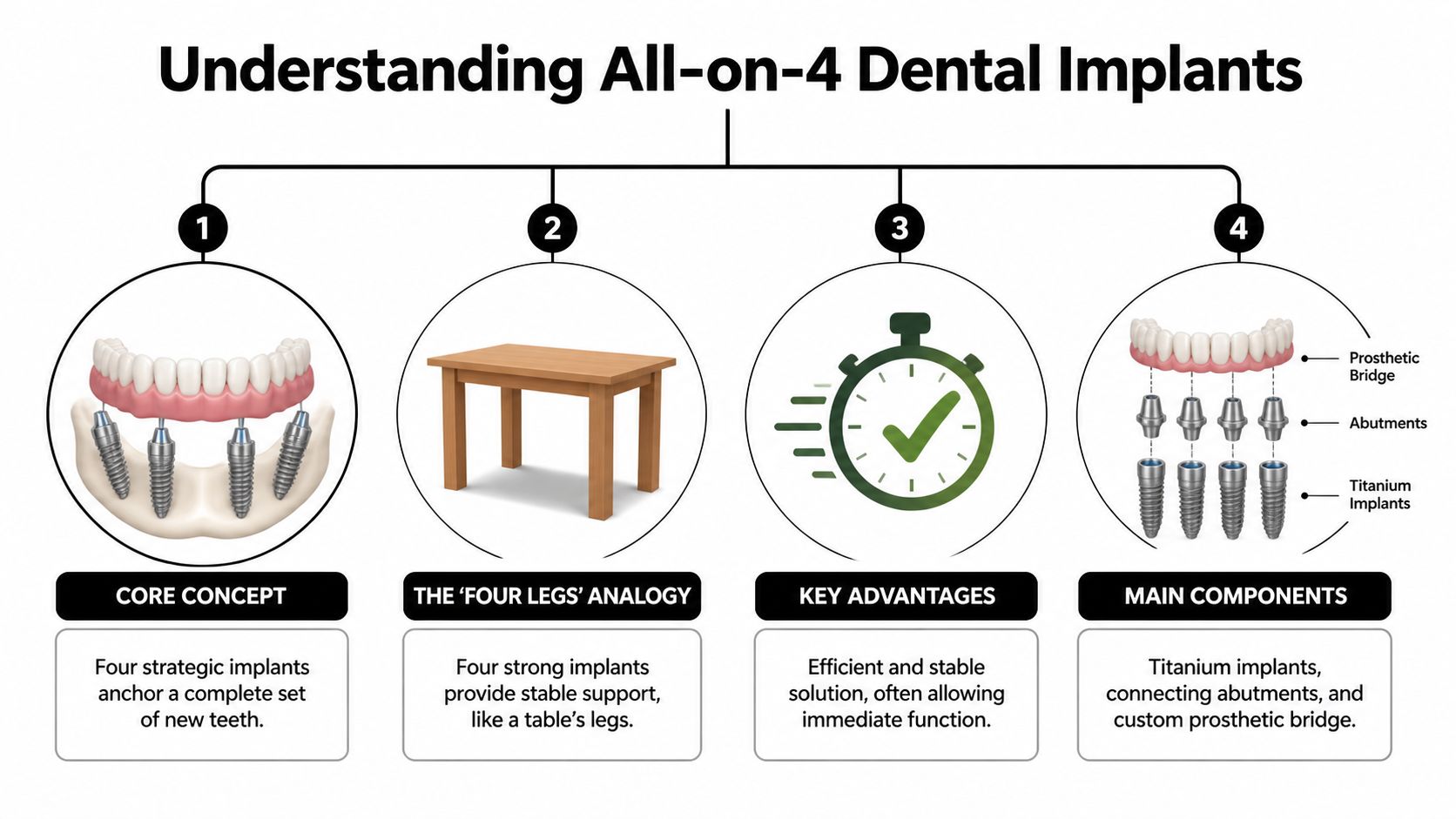
For patients, the simplest way to understand it is this. Four implants act as the anchors, and the full bridge connects them into one fixed set of teeth. You are not chewing on four separate posts. You are chewing on a carefully engineered prosthesis designed to spread force across the whole arch.
That design only works when the case is planned from the final teeth backward. At our level of care, we study the smile line, bite, bone shape, gum support, and facial profile before surgery. The 3D scan, digital planning, and prosthetic design matter just as much as the implant placement itself.
Why the back implants are angled
The back implants are often tilted rather than placed straight up and down. According to this explanation of the All-on-4 process, posterior implants may be angled up to 45 degrees. That angulation can help use the stronger bone that is available, improve support for the bridge, and avoid structures such as the sinus in the upper jaw or the nerve in the lower jaw.
In the right patient, this can reduce the need for bone grafting. It does not remove the need for judgment. Some patients still need a different plan, especially if bone loss is advanced or the bite forces are unusually high.
What you are actually getting
Patients often say they want "implants," but full-arch treatment includes several parts that must work together for years:
- Four implants placed in the jawbone as the foundation
- Multi-unit abutments or connectors that correct angulation and create the proper path for the bridge
- A fixed full-arch prosthesis built to restore appearance, speech, and chewing function
- A temporary or final set of teeth made from materials chosen for weight, strength, esthetics, and maintenance needs
This is one reason I tell patients that All-on-4 is not a single procedure. It is a full reconstruction.
Who is a candidate, and who may need more than standard All-on-4
All-on-4 is often a good option for adults who have lost many teeth, wear dentures and want a fixed alternative, or still have remaining teeth that are failing and cannot be predictably saved. It can also help patients who want a fixed solution without replacing each missing tooth with its own implant.
Some patients are not good candidates for a standard four-implant design. Severe bone loss, uncontrolled gum disease, heavy clenching, certain medical conditions, and poor home care can all change the recommendation. In a high-tech practice, that is where the value of doing everything under one roof becomes clear. A full diagnostic workup can show whether a patient fits a conventional All-on-4 plan, needs additional implants, or may benefit from more advanced options such as zygomatic implants when the upper jaw has very limited bone.
The goal is not to force every patient into the same template. The goal is to build a fixed smile that looks right, functions well, and can be maintained over the long term.
Your All on Four Procedure and Timeline
The process feels much more manageable when you understand the sequence. Most anxiety comes from not knowing what happens first, what happens on surgery day, and what the healing months are for.

Step one through step three
Evaluation and 3D planning
The first visit is about diagnosis, not sales. We examine the teeth, gums, bite, and smile line, then use 3D CBCT imaging and digital planning to study bone volume, anatomy, implant positions, and whether teeth need removal. This stage decides whether standard All-on-4 is appropriate or whether a more advanced plan is needed.Treatment design
A full-arch case is both surgical and prosthetic. That means the final teeth shape, support, bite, and cleanability must guide the implant plan. Sedation options and anesthesia are also discussed at this point so the surgical day feels controlled rather than intimidating.Pre-surgical preparation
If the remaining teeth are failing, they’re included in the overall plan. Temporary and final prosthetic goals are reviewed so the patient understands what the first bridge is for and why it isn’t always identical to the final restoration.
Surgery day and immediate teeth
Most patients focus on one question: “Will I leave with teeth?” In many cases, yes. The surgery typically takes 3 to 4 hours, and immediate loading is possible when each implant reaches at least 35 Ncm of insertion torque, which is the threshold used to support a same-day provisional bridge, as described in this clinical overview of the All-on-Four implants process.
That temporary bridge is important. It gives you fixed teeth right away, but it’s also a healing prosthesis. It protects appearance and function while the implants begin to integrate with the bone.
Same-day teeth don’t mean same-day final teeth. The first bridge is part of the healing strategy.
The healing period
After surgery, the body needs time to fuse bone to the implant surface. That process is called osseointegration. The source above notes a typical healing window of 4 to 6 months before the definitive restoration is delivered.
During that period, patients usually need to adjust how they eat and how they clean around the prosthesis. Follow-up visits matter. We monitor tissue healing, bite balance, speech, comfort, and how the provisional is functioning.
What the provisional phase is for
This phase often teaches us as much as it teaches the patient.
Function
We see how the bite behaves in real life and whether force needs to be redistributed.Speech
Certain sounds tell us whether contours need refinement.Aesthetics
Lip support, tooth display, and facial balance can be adjusted more precisely after the patient has lived with the temporary.Hygiene access
The bridge has to look good, but it also has to allow long-term cleaning underneath.
Final bridge delivery
Once healing is stable, the final prosthesis is designed and delivered. This is the stage where material selection becomes more important. Acrylic-based options and zirconia-based options each have advantages and trade-offs. Weight, repairability, esthetics, and bite force all influence the choice.
The final bridge should look natural in the context of your face, not just on a model. The best result is one that lets you eat, speak, and smile without constantly thinking about the hardware supporting it.
Benefits and Long Term Success
The most obvious benefit of dental implants all on four is that they replace a full arch with a fixed solution. But what patients usually notice first is more personal than technical. They notice that their smile looks complete again. Their face looks less collapsed. Meals become less stressful. Speech often feels more secure because the teeth don’t shift the way removable dentures can.

What patients gain day to day
A successful full-arch implant case improves both health and appearance.
- Chewing confidence helps patients return to a wider range of foods
- Smile support can improve lip support and the overall look of the lower face
- Speech stability is often better because the prosthesis is fixed
- A fixed feel reduces the mental burden that comes with removable teeth
What the long-term data shows
Long-term success is one reason this treatment remains so widely used. Clinical studies summarized in this review of All-on-4 survival rates report implant survival rates of more than 95% at 5 years and 93 to 98% at 10 years. That same source notes prosthetic survival as high as 99.2% over 10 years in some studies.
Those numbers are reassuring, but they don’t mean maintenance can be ignored. A prosthesis can remain in service even if one component needs repair or adjustment. Success depends on planning, fit, bite control, patient bone quality, and long-term home care.
For a broader look at longevity expectations, this guide on how long dental implants last is useful background.
Good implant dentistry is never just “place it and forget it.” Long-term success comes from the surgery, the prosthetic design, and the years that follow.
The trade-offs patients should know
All-on-4 is strong, but it isn’t maintenance-free. Patients can experience wear, pressure changes, speech adaptation, or prosthetic issues over time. Heavy bite forces, clenching, and poor hygiene create more problems than most patients expect.
That’s why clear expectations matter. This treatment can restore a great deal of function and appearance, but it works best for patients who are ready to return for maintenance, clean carefully every day, and treat the prosthesis like a high-quality restoration rather than indestructible hardware.
How All on Four Compares to Other Options
Choosing a full-arch solution usually means comparing three broad categories. A removable denture, an All-on-4 fixed bridge, or a plan that uses more implants across the arch. Each approach solves a different problem, and none of them is ideal for every patient.
The practical differences
Traditional dentures are removable and can restore appearance at rest, but many patients struggle with movement, sore spots, and reduced confidence when chewing. A full arch supported by many individual implants can be excellent in selected cases, but it’s often more invasive and may demand more available bone or additional grafting. All-on-4 sits in the middle as a fixed option that often reduces the number of implants needed while still restoring a full arch.
Here’s the side-by-side view most patients need.
| Feature | All-on-4 Implants | Traditional Dentures | Full Arch of Single Implants |
|---|---|---|---|
| Stability | Fixed in place and generally more secure for daily function | Removable and more likely to shift | Fixed, with support distributed across more implants |
| Chewing ability | Strong functional improvement for many patients | More limited, especially with harder or sticky foods | Strong function when the case is well planned |
| Appearance | Natural-looking full arch with good support for the smile | Can look good, but movement may affect confidence | Highly customizable for esthetics |
| Bone grafting needs | Often reduced because implants are strategically angled | No implants, so no implant-related grafting | More likely to require greater bone volume depending on the plan |
| Treatment pathway | Streamlined full-arch approach with immediate provisional possibilities | Usually the simplest path to replacement teeth | More complex surgical and restorative planning |
| Daily maintenance | Fixed prosthesis requires dedicated cleaning underneath | Removed for cleaning | Requires careful maintenance around multiple implant sites |
| Removability | Patient does not remove it | Patient removes it daily | Usually fixed |
| Overall value | Often cost-effective for a fixed full-arch solution | Lower entry cost but fewer functional advantages | Higher complexity and broader investment in many cases |
Who tends to prefer each option
Some patients choose dentures because they want the least involved treatment or need a quicker removable solution. Others know they won’t be satisfied with anything that moves and want fixed teeth from the start. Patients considering a larger number of implants often value a highly individualized approach and may already have the bone volume to support it.
The right decision depends on your anatomy, goals, tolerance for surgery, and willingness to maintain the result long term. The best treatment isn’t the most advanced one on paper. It’s the one that fits your mouth and your life.
Understanding the Cost of All on Four Implants
Cost is a real part of the decision, and patients are right to ask detailed questions. Full-arch implant care is not a single item. It includes diagnosis, planning, surgery, temporary teeth, follow-up care, and the final prosthesis. Material choices and case complexity can change the total investment significantly.
What affects the overall cost
Several factors matter more than people expect.
Complexity of the starting point
A case involving failing teeth, infection, bite collapse, or severe bone loss usually needs more planning and more clinical time.Technology and planning tools
3D imaging, digital design, and guided surgery improve precision, but they’re part of the treatment process.Sedation and surgical support
Patients who need sedation or IV anesthesia should expect that to factor into the overall plan.Final prosthesis material
Acrylic-based and zirconia-based restorations differ in feel, weight, repair considerations, and long-term behavior.
Why cheaper isn’t always cheaper
The lowest quote can leave out critical pieces. A patient may hear a number that sounds attractive, then discover it doesn’t include extractions, sedation, temporaries, follow-up visits, or the final bridge they want. In full-arch dentistry, the details matter.
A transparent financial discussion should answer these questions clearly:
- What is included in the surgical phase?
- What provisional prosthesis is included?
- What final prosthesis is planned?
- What follow-up and maintenance visits are expected?
- What happens if the case needs a more advanced implant approach?
Making treatment more manageable
Patients don’t need a vague promise of “affordable options.” They need a structure. Many practices work with most PPO plans, offer third-party financing, and provide in-house savings plans that can help spread out treatment costs or reduce certain fees. Those pathways can make the necessary care much more approachable.
This overview of how much dental implants cost is a helpful starting point when you’re trying to understand how implant pricing is typically built.
A good financial conversation should feel as clear as the clinical one. If the quote is hard to decode, the treatment plan probably is too.
The better question isn’t only “What does All-on-4 cost?” It’s “What am I getting, who is doing it, and how will this be maintained over time?” That’s the level where meaningful comparisons happen.
Why Choose Grand Parkway Smiles in Katy TX
A full-arch case goes better when the patient is not sent from office to office trying to connect separate opinions, records, and timelines. At Grand Parkway Smiles, the same practice can handle the workup, surgical planning, prosthetic design, sedation planning, and follow-up care. That kind of continuity matters when small details in bite, implant position, tissue support, and temporary teeth affect the final result.
Patients are evaluated with 3D imaging and a digital workflow that helps the team plan treatment before surgery day. The practice also offers PRF and sedation options including IV anesthesia, which can make a long appointment more tolerable for patients who are anxious or who need more involved treatment. For many people, the benefit is not just convenience. It is having one team that can see the whole case from the first scan to the final prosthesis and the maintenance visits that follow.
When standard All-on-4 isn’t enough
Some patients arrive after being told they do not have enough bone for fixed teeth. That does happen. It does not always mean the conversation is over.
For severe bone loss, advanced solutions such as zygomatic implants may be considered. These implants anchor into the cheekbone instead of relying only on the upper jaw, which can reduce the need for extensive grafting in selected cases. This discussion of zygomatic implant solutions explains how that approach can help patients who would not fit a standard All-on-4 plan.
That is one reason a high-tech, single-practice model matters. Straightforward cases need precision. Complex cases need even more. The advantage is having a team that can diagnose the limits of a conventional plan, explain the trade-offs clearly, and keep treating the patient within the same system instead of starting over somewhere else.
Frequently Asked Questions About All on Four
What can I eat after I get my new teeth
Right after surgery, patients usually need to stay with the food guidelines given by the surgical team while the implants heal. The bridge may be fixed, but the bone is still integrating with the implants, so diet discipline matters.
How do I clean under a fixed bridge
You’ll need specific hygiene tools and technique. A fixed bridge must be cleaned underneath every day, and professional maintenance visits are part of long-term success.
What is the final bridge made of
That depends on the treatment plan. Common choices include acrylic-based and zirconia-based restorations. The right choice depends on bite forces, esthetic goals, repairability, and how the case is engineered.
What if the All-on-4 bridge has problems later
That’s one reason maintenance matters. A review summarized in this overview of All-on-4 complications and maintenance notes that 12 to 15% of patients may experience prosthetic complications within 3 years, such as screw loosening or acrylic wear, and recommends professional cleanings and check-ups every 3 to 6 months.
Does it feel like natural teeth
It feels far more stable than removable dentures, but it still takes an adjustment period. The best cases feel secure, functional, and natural in daily use, even though they are still a prosthetic restoration that requires care and awareness.
If you’re considering a fixed full-arch solution, the next step is a careful evaluation, not a guess. Grand Parkway Smiles provides thorough implant planning, advanced imaging, sedation options, and full-mouth reconstruction care for patients in Katy and the greater Houston area.