A missing tooth changes more than your smile. You start chewing on one side, avoiding certain foods, covering your mouth when you laugh, or tolerating a denture that never feels as stable as you want it to. For many people, that daily irritation turns into a bigger question: am I even a candidate for dental implants?
That question matters because implants do more than fill a gap. They restore bite strength, support facial aesthetics, and give replacement teeth a more natural feel than removable options. Modern implant dentistry has also changed what candidacy means. It isn't only about whether you walk into an office with perfect bone and gums. In many cases, it's about whether a skilled team can help you become ready for implants through careful diagnosis and targeted treatment.
If you're wondering who is a good candidate for dental implants, the short answer is this: adults missing one or more teeth, with healthy gums, enough jawbone to support an implant, good overall health, and a willingness to maintain excellent oral hygiene are often strong candidates. But that ideal description isn't the whole story. Many patients who don't start there can still get to a successful outcome.
Your Guide to a Complete and Confident Smile
You may be looking at a gap in your smile, a loose denture, or a tooth that can no longer be saved and wondering whether implants are even realistic for you. In practice, candidacy is rarely a simple yes-or-no judgment on day one. It is a planning process. With the right evaluation, many patients who do not start as ideal candidates can still reach a successful implant outcome.
A well-planned implant does more than support a replacement tooth. It restores stability when you chew, helps keep your smile in proportion, and gives many patients a level of confidence they have been missing for years. The goal is not only to replace what was lost. The goal is to rebuild function in a way that is healthy, durable, and natural-looking.
What usually makes someone a good candidate
Strong candidates often share a few clinical basics:
- One or more missing teeth: Implants can replace a single tooth, several teeth, or a full arch.
- Healthy gum tissue: If gum disease is present, it should be treated first so the implant has a healthier environment to heal in.
- Enough bone for support: The jaw needs sufficient height and width, or a plan to rebuild those areas when needed.
- Stable overall health: Conditions such as diabetes can affect healing, but many patients still qualify when those conditions are well managed.
- Good home care habits: Long-term implant success depends on consistent brushing, flossing, and professional maintenance.
Age alone usually does not rule implants out.
What matters more is whether the mouth is healthy enough, or can be made healthy enough, to support treatment predictably. I often tell patients that being told you have bone loss, gum problems, or an older denture does not end the conversation. It changes the plan. Some patients move straight to implant placement. Others need periodontal treatment, a bone graft, extractions with site preservation, or a full-arch option such as All-on-4 before the case is ready.
A good implant candidate is not always the patient who arrives with perfect bone and gums. It is often the patient who is willing to go through the right diagnostic steps and preparatory treatment to get there.
A more constructive question is: what would it take to make me a strong implant candidate?
That question leads to better decisions. It focuses on what can be improved, what risks need to be controlled, and which treatment path makes the most sense for your health, budget, and goals.
The Foundation for a Successful Dental Implant
An implant's long-term success depends on the strength of its foundation: the jawbone and surrounding gum tissue. A crown may be the visible part, but the part that determines whether treatment lasts is below the gumline.
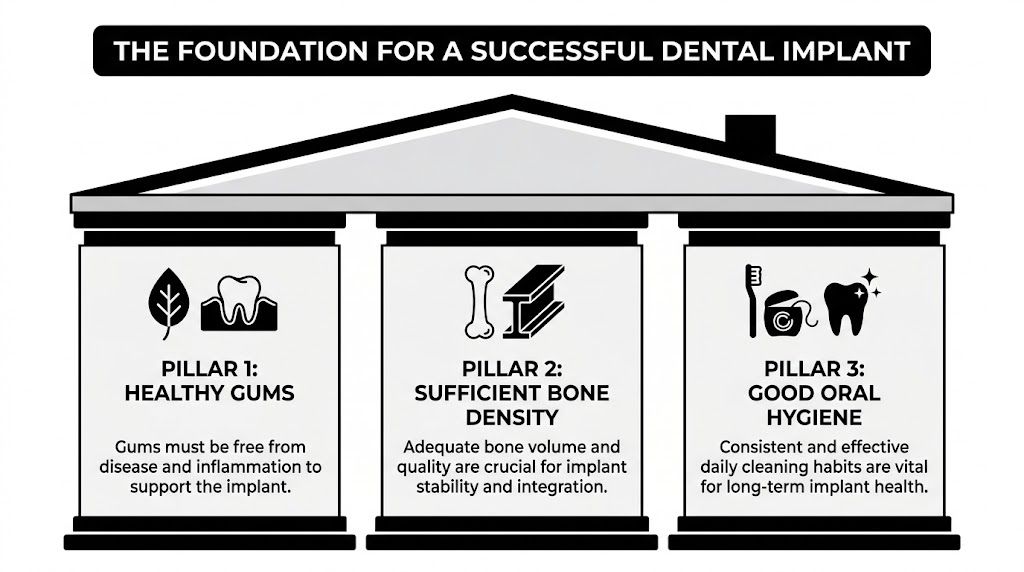
Patients often assume candidacy is decided by the missing tooth alone. It is decided by the quality of support around that area, how the mouth functions under pressure, and whether the site can heal predictably. In many cases, the starting point is not the final answer. Bone and soft tissue can often be improved before the implant is placed.
Bone creates the anchor
The implant is placed into bone, not just through gum tissue. As the area heals, the bone bonds to the implant surface through osseointegration, which is what gives the implant stability during chewing.
For standard implants in the lower jaw, candidacy commonly requires a minimum of 10mm of height and 5mm of width, assessed with 3D CBCT imaging, according to DaMico Dental Care's implant candidacy criteria. Patients do not need to memorize those measurements. They do need to know why proper imaging matters. A visual exam and a traditional X-ray cannot show the full shape, width, or density of the bone the way a CBCT scan can.
Limited bone does not automatically rule out treatment. It changes the plan. A narrower implant may work in one case. Another patient may need grafting to rebuild the site. For full-arch cases, angled implants or an All-on-4 approach may allow treatment even when bone loss has ruled out a conventional plan.
Gum tissue protects the implant day after day
Healthy gums do more than improve appearance. They form a protective seal around the implant and help shield the underlying bone from bacteria and chronic inflammation.
If the tissue is swollen, infected, or unstable, the implant starts with a weaker environment for healing. That is why active periodontal disease is treated before implant placement, not after. Patients sometimes want to move straight to surgery because the missing tooth feels like the urgent problem. Clinically, the more urgent issue may be the condition of the tissue surrounding the future implant.
Practical rule: If your gums bleed when you brush or floss, the first step is to stabilize gum health so the implant has a cleaner, healthier site to heal in.
The bite matters more than many patients expect
An implant can be placed correctly and still face trouble if the forces on it are excessive or poorly distributed. Heavy clenching, grinding, and an uneven bite can overload an implant or restoration, especially during the healing phase.
This is one reason candidacy is not only about whether enough bone is present. The team also has to determine how the new tooth will function once it is in use. A single implant in the back of the mouth handles force very differently than a front tooth implant or a full-arch restoration.
Healing capacity shapes the treatment timeline
The body has to recover well after surgery for an implant to succeed. Smoking, poorly controlled medical conditions, inconsistent home care, and missed maintenance visits can all reduce predictability.
That does not mean many of these patients are excluded. It means the foundation has to be strengthened first. Better blood sugar control, smoking cessation, periodontal treatment, or a more staged surgical plan can turn a higher-risk case into a more manageable one. Good implant care starts before the implant is ever placed.
Here is the practical way many dentists assess the foundation:
| Foundation area | What supports success | What calls for a different plan |
|---|---|---|
| Bone support | Adequate volume confirmed on CBCT, or a plan to rebuild deficient areas | Guessing based on appearance alone |
| Gum condition | Tissue free of active infection and inflammation | Placing implants into untreated periodontal disease |
| Bite forces | A bite design that distributes pressure appropriately | Ignoring clenching, grinding, or overload |
| Healing response | Stable health, good hygiene, and reliable follow-up care | Smoking, poor plaque control, or uncontrolled medical issues |
A strong foundation can often be built
The textbook candidate has healthy bone, healthy gums, a stable bite, and good healing capacity. Real patients are often more complicated than that. Teeth may have been missing for years. Bone may have shrunk. Gum disease may need treatment first.
Those findings do not end the conversation. They define the work needed to make treatment safer and more predictable. In modern implant dentistry, a good candidate is often someone who is willing to go through the right preparatory steps so the final result has a foundation that can last.
The Diagnostic Journey to Your New Smile
Most patients expect the implant consultation to feel intimidating. In reality, the best evaluations are methodical and calm. The visit is less about being judged and more about gathering the information needed to make your treatment safe, precise, and customized for your mouth.

What happens at the first visit
The process usually begins with a conversation, not a drill. The dentist asks what bothers you most. It may be a loose denture, a broken tooth, a visible gap, or trouble chewing. That goal matters because replacing one front tooth isn't planned the same way as restoring a full arch.
The clinical exam then looks at several factors at once:
- The missing-tooth site: How much room is available, and what kind of restoration fits the smile.
- Adjacent teeth: Whether neighboring teeth are healthy, restored, drifting, or overloaded.
- Gum condition: Signs of inflammation, recession, or untreated periodontal disease.
- Bite relationship: How upper and lower teeth meet, and whether clenching or uneven pressure may affect the implant.
That exam also helps determine whether an implant is the best answer at all. Sometimes it is. Sometimes another restorative plan makes more sense first.
Why 3D imaging changes the conversation
A CBCT scan acts like a three-dimensional blueprint of the jaw. Instead of guessing based on a flat image, the surgical team can evaluate bone height, width, angulation, and nearby anatomy in detail. That matters when avoiding the sinus in the upper jaw or the nerve canal in the lower jaw.
The biggest benefit for patients is precision. A CBCT-based plan helps the team decide where the implant should go, what size is appropriate, and whether additional procedures will improve long-term stability and aesthetics. It also makes the discussion more concrete. You aren't hearing vague possibilities. You're seeing the anatomy that drives the decision.
Good implant planning should feel specific. If the explanation stays vague, the diagnosis usually isn't complete.
How the diagnosis becomes a treatment plan
Once the records are complete, the findings usually fit into one of three categories:
Ready now
The site, gums, and health picture support straightforward implant placement.Ready after preparatory treatment
You may need periodontal therapy, extraction with site preservation, or bone augmentation before the implant goes in.Best treated with a different implant strategy
A patient with extensive tooth loss or reduced bone may do better with a full-arch approach than with multiple separate implants.
This stage is where anxiety often drops. The process becomes understandable. Patients can see why a recommendation was made, how appearance and function will improve, and what steps are needed to get there. That clarity is one of the most important parts of successful implant care.
Expanding Candidacy Advanced Solutions for Complex Cases
Many people rule themselves out too early. They've been told they don't have enough bone, they've worn dentures for years, or they've gone so long without a tooth that they assume the opportunity has passed. In modern implant dentistry, that often isn't true.
Complex cases still require careful standards. But difficult anatomy doesn't automatically mean treatment is off the table. It usually means the plan has to be more advanced.

When bone loss is the main obstacle
Bone shrinks after a tooth is lost. The longer the space remains empty, the more likely it is that the ridge becomes narrower or shorter. Dentures can add to that challenge because they don't stimulate the jaw the way roots or implants do.
That doesn't end the conversation. It changes it.
Bone grafting can rebuild deficient areas so the jaw can support an implant more predictably. In the upper back jaw, a sinus lift may create the vertical space needed for implant placement. If you're curious how grafting works and why it matters, this overview of bone grafting for dental implants explains the goal in patient-friendly terms.
A few practical realities matter here:
- Healing takes planning: Grafted sites need time before they can support the next stage.
- Not every defect is the same: A small ridge defect and a large posterior deficiency require different techniques.
- The final benefit is worth it: Better bone support improves implant positioning, function, and esthetics.
Full-arch treatment changes who can qualify
A patient missing all teeth in an arch doesn't always need an implant for every missing tooth. In many cases, a strategic full-arch design creates a better answer.
The All-on-4 treatment concept supports a full arch of teeth on four implants and has a 98.8 percent survival rate, according to Dr. John Patterson's 2025 implant statistics summary. That makes it an important option for patients with significant tooth loss or bone atrophy who may not be ideal candidates for traditional implant layouts.
This approach can be particularly helpful when the goal is to replace a failing dentition or move beyond removable dentures. It gives patients a fixed restoration, improved confidence when speaking and eating, and a more efficient surgical plan than placing a large number of separate implants.
A patient may not be a good candidate for one implant plan, but may be an excellent candidate for a different implant plan.
Specialized strategies for severe bone atrophy
Some advanced practices also use options such as zygomatic implants and pterygoid implants for severe upper-jaw bone loss. These are not standard solutions for routine cases. They are specialized tools for highly selected patients when conventional implant positions aren't feasible.
The key point isn't that every patient needs an advanced procedure. It's that candidacy has expanded. A thorough team doesn't stop at "not enough bone" if modern techniques can provide another path.
Here is a simple comparison of how candidacy can evolve:
| Situation | Traditional concern | Modern response |
|---|---|---|
| Single missing tooth with bone loss | Site may be too narrow for direct placement | Bone grafting can rebuild the site |
| Upper back tooth loss | Sinus limits available bone height | Sinus augmentation may create room |
| Many failing or missing teeth | Multiple separate implants may be inefficient | Full-arch concepts like All-on-4 may fit better |
| Severe upper jaw atrophy | Standard implants may not engage enough bone | Advanced implant designs may be considered by experienced teams |
The right takeaway for patients
If you've been told implants aren't possible, the most useful next step is often a second opinion with advanced imaging and a surgeon or restorative team that handles complex reconstruction. That isn't about shopping for a more convenient answer. It's about making sure the answer is complete.
A good implant candidate isn't always someone who already has ideal anatomy. Often, it's someone whose condition can be improved with the right sequence of care.
Understanding and Mitigating Implant Risks
A common scenario in my office goes like this. A patient has been told they smoke, have some gum inflammation, or need better blood sugar control, so they assume implants are off the table. In many cases, the actual answer is more encouraging. The risk needs to be reduced first.
That distinction changes everything. Implant candidacy is often a treatment sequence, not a pass or fail judgment. The goal is to identify what could interfere with healing, correct it where possible, and place the implant under better conditions.
The factors that deserve close attention
Active gum disease is one of the clearest concerns because implants need healthy surrounding tissue and stable bone support. Smoking also matters because it slows healing and makes infection harder to control. Poor home care, uncontrolled diabetes, teeth grinding, and a history of failed dental work can raise risk as well.
None of those findings automatically end the conversation.
They change the plan. A patient may need periodontal treatment before surgery, physician clearance, a temporary pause in tobacco use, or a restoration design that is easier to keep clean. Patients who want a fuller explanation of common complications can read this guide on why dental implants fail.
Risk is managed, not ignored
Good implant planning does not mean pretending every mouth starts in ideal condition. It means being honest about trade-offs.
A smoker who quits before surgery usually has a better healing environment than one who continues through recovery. A patient with inflammation around the remaining teeth often needs that disease controlled before adding an implant. Someone with heavy bite pressure may still be a candidate, but the implant number, position, and final crown design may need to change to protect the result.
That is why timing matters. The best day to place an implant is the day the mouth is ready to support it.
What risk reduction looks like in real treatment
Risk management is usually straightforward and specific:
- Control gum disease first: Bleeding, deep pockets, and active infection should be treated before implant placement.
- Improve daily hygiene: Patients who can keep natural teeth clean are better prepared to maintain implants long term.
- Coordinate medical care: Some conditions call for physician input, medication review, or better disease control before surgery.
- Address tobacco use: Even a temporary stop can improve healing conditions during the surgical period.
- Plan the restoration carefully: A crown or bridge that fits well and can be cleaned easily reduces maintenance problems later.
One area patients rarely consider is follow-up. Implant success depends on maintenance after placement, not just the surgery itself. Regular exams, x-rays when indicated, and professional cleanings help catch small problems before they become expensive ones.
Reviews also influence how patients judge dental care before they ever schedule a consultation. Practices that invest in online reputation management for dentists are often trying to make that patient experience more visible, but the ultimate measure is still the quality of diagnosis, planning, and long-term support.
The bottom line is reassuring. A risk factor does not automatically make someone a poor implant candidate. It often means the dental team has work to do first so the final result has a better chance to heal well, function comfortably, and last.
The Grand Parkway Smiles Advantage Your Partner in Implant Success
A patient may come in convinced they have already been ruled out for implants. They have worn dentures for years, they were told they have bone loss, or they worry their case is too complicated. In many of those situations, the key question is not whether implants are possible on day one. The question is what kind of planning and treatment can make them possible safely.
That is where the right dental team changes the experience. Implant care works best when diagnosis, surgical planning, restoration design, and maintenance are connected from the start. Straightforward cases benefit from that coordination. Complex cases often depend on it.
At Grand Parkway Smiles, implant candidacy is approached as a process, not a simple yes-or-no decision. Some patients are ready for placement with minimal preparation. Others need gum treatment, bone grafting, extraction timing, or a full-arch option such as All-on-4 to reach a predictable result. Good care means identifying those needs early and building a plan around them.

Why the process matters as much as the procedure
A strong implant result starts before surgery. In-house 3D imaging allows the team to examine bone volume, sinus position, nerve location, bite forces, and restorative space in detail. Digital planning helps match implant position to the final tooth, not just the available bone.
That distinction matters.
An implant can integrate well and still disappoint if the crown is hard to clean, poorly positioned for the bite, or unsupported by the surrounding gum and bone. Patients usually feel the difference in comfort and function, even if they cannot describe the technical reason. Careful planning reduces those problems before they start.
For patients who need site development, tools such as PRF can support healing and graft maturation. For patients with dental anxiety, sedation and IV anesthesia can make treatment realistic instead of something they postpone for years.
Experience matters in both routine and difficult cases
Many patients assume implant treatment is designed only for the easiest cases. In practice, modern implant dentistry gives clinicians more ways to treat missing teeth than it did years ago. Bone grafting can rebuild support in selected areas. Full-arch solutions can reduce the need for placing many individual implants. Careful sequencing can turn a difficult starting point into a manageable one.
That does not mean every patient should get implants, or that every case should be treated the same way. The trade-offs matter. A single implant, an implant bridge, and a full-arch restoration each place different demands on bone, budget, treatment time, and long-term maintenance. A practice that can explain those differences clearly gives patients a better chance of choosing the option they can live with comfortably.
Trust starts before treatment
Patients often research a practice long before they book a consultation. They look at reviews, credentials, technology, and whether the office explains treatment in a way that feels honest. This resource on online reputation management for dentists shows how practices try to make that trust visible through communication, patient feedback, and a consistent online presence.
Reviews help, but they should support clinical judgment, not replace it. The better sign is a team that explains what it sees on the scan, outlines realistic options, discusses limits openly, and stays involved after placement.
The best implant experience feels organized and specific to the patient. You should understand why you are a candidate now, what may need to happen before treatment if you are not ready yet, and what it will take to protect that result for years.
Frequently Asked Questions About Dental Implant Candidacy
Am I too old for dental implants
Usually, no. Age by itself is rarely the deciding factor. The more important questions are whether your gums are healthy, whether you have enough bone or can build it, whether your medical conditions are controlled, and whether you can maintain the restoration well.
Can I get implants if I've worn dentures for years
Possibly, yes. Long-term denture wear can come with bone loss, which may complicate treatment, but it doesn't automatically eliminate the option. Some patients need grafting. Others may be better suited for a full-arch solution rather than multiple individual implants.
What if I was told I don't have enough bone
That may be accurate, but it may not be the end of the story. Bone grafting, sinus augmentation, and alternative implant strategies can expand candidacy in many cases. The key is getting a diagnosis based on a proper clinical exam and 3D imaging.
Do implants hurt
Most patients find the process more manageable than they expected. The procedure itself is typically performed with local anesthesia, and some patients benefit from sedation. Discomfort after surgery is usually tied to the complexity of the case, whether grafting was involved, and how closely post-op instructions are followed.
How long does the process take
There isn't one universal timeline. A straightforward case may move much faster than a complex reconstruction that includes extraction, grafting, and staged healing. The most important point is that the timeline should fit the biology, not the patient's impatience. Good healing supports good outcomes.
Can smokers get dental implants
Smoking raises risk and makes healing less predictable. Some smokers still proceed with treatment, but the candidacy conversation has to be candid. A patient willing to stop smoking around surgery and during healing gives the implant a much better chance to integrate successfully.
What if I have gum disease
Active periodontal disease should be treated before implants are placed. That isn't a technicality. It is one of the most important parts of building a stable result. Once the gums are healthy and inflammation is controlled, the treatment discussion becomes much more favorable.
Are implants mainly for looks or for function
Both. They improve appearance by closing gaps, supporting a natural-looking restoration, and helping create a more complete smile. They also improve function by stabilizing the bite and making chewing and speaking feel more secure. The best implant work restores both at the same time.
How do I know if an implant is better than a bridge or denture for me
That depends on the condition of the neighboring teeth, the amount of tooth loss, the health of the gums and jawbone, and your long-term goals. If the adjacent teeth are healthy, an implant can often replace the missing tooth without cutting down those teeth for a bridge. If many teeth are missing, a removable or fixed full-arch plan may be more appropriate.
What's the smartest first step
Schedule a consultation that includes a full exam and, when appropriate, 3D imaging. Patients get the best answers when the diagnosis is based on anatomy, gum health, bite forces, and medical history, not assumptions.
If you're wondering whether implants are possible for your smile, the best next step is a personalized evaluation with Grand Parkway Smiles. Their team can assess your gums, bone, bite, and overall health, then map out whether you're ready now or what treatments could help you become a strong candidate for a lasting, confident result.