A lot of patients call when recovery seemed to be going fine, then suddenly got much worse. The common story is familiar. A tooth was removed a few days ago, soreness seemed normal at first, and then the pain turned sharp, deep, and hard to ignore.
That pattern often points to healing dry socket, or more accurately, a socket that isn’t healing the way it should until the area is cleaned, protected, and supported. The good news is that dry socket is very treatable. The key is knowing what home care can do, what it can’t do, and when advanced treatment can make recovery faster and much more comfortable.
Understanding Dry Socket and Its Intense Pain
Pain after an extraction is expected. Dry socket pain feels different. It usually ramps up instead of settling down, and many patients describe it as a throbbing pain that seems to spread through the jaw and toward the ear.
Dry socket, also called alveolar osteitis, happens when the protective blood clot in the extraction site dissolves or gets dislodged too early. That clot matters because it covers the bone and nerve endings underneath while new tissue begins to form. When the clot is lost, the socket is left exposed and the normal healing sequence is interrupted.

What the pain is telling you
Dry socket affects 2 to 5% of routine tooth extractions but can rise to 20 to 30% or higher after wisdom tooth removal. It usually appears 3 to 5 days after extraction, and pain scores have averaged 6.8 out of 10 at 48 hours, with pain often radiating to the ear, according to Medical News Today’s dry socket overview.
That timing matters. Typical post-extraction soreness should gradually improve. Dry socket usually announces itself when you expected to be turning the corner, but instead the area becomes more painful, more sensitive, and more difficult to tolerate with standard over-the-counter relief.
If you’re trying to tell whether what you’re seeing looks normal, this guide to what dry socket can look like after an extraction can help you compare common visual signs.
Why normal healing gets disrupted
A healthy extraction site needs protection, cleanliness, and stability. The clot provides all three in the early phase. Once it’s disturbed, food debris and bacteria can settle into the socket more easily, and chewing, temperature changes, and tongue movement can all irritate the exposed area.
Practical rule: If pain is intensifying several days after the extraction instead of easing, don’t assume you just need to “push through it.”
That’s why healing dry socket isn’t just about pain control. It’s about restoring a healthier environment so tissue can cover the socket again and the area can move back toward normal healing.
Immediate Home Care for Managing Dry Socket Pain
Home care is supportive care. It can reduce irritation, keep the area cleaner, and help you stay more comfortable while you arrange an exam. What it can’t do is fully debride and protect an exposed socket the way a clinical visit can.
Start with gentle measures. Aggressive rinsing, poking the area, or trying internet remedies usually makes things worse.
What to do in the first day of worsening pain
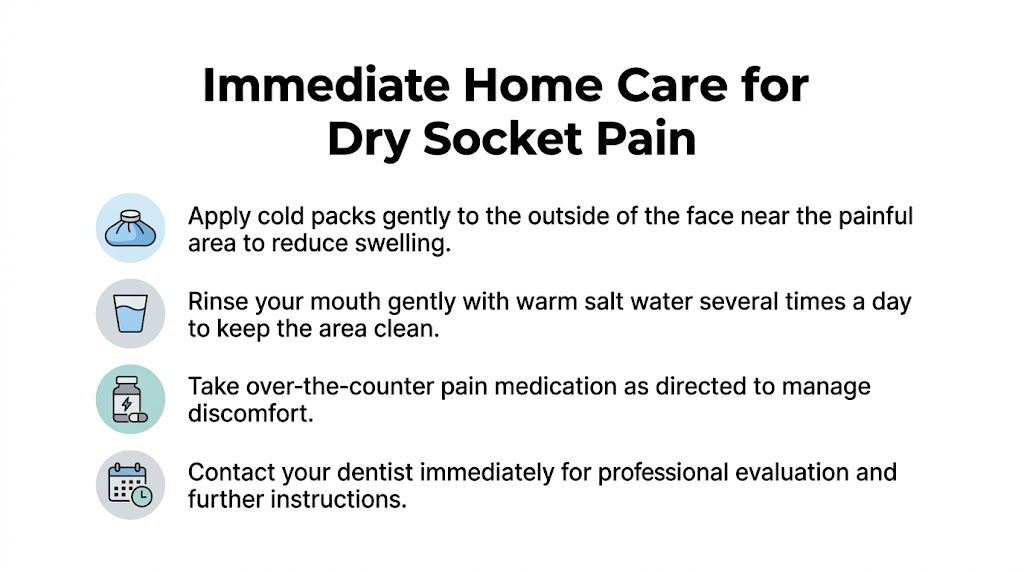
Use a cold pack on the outside of the face near the sore area. Keep it gentle. The goal is comfort, not pressure.
Rinse carefully with warm salt water if you were already given clearance to rinse after your extraction. Let the liquid fall out of your mouth instead of forcefully spitting. Any movement that creates pressure can irritate the site.
Take over-the-counter pain medication according to the package directions unless your physician or dentist told you not to use it. If you have a history of stomach ulcers, kidney disease, liver disease, blood thinners, or medication allergies, don’t improvise. Call for specific guidance.
Keep the socket clean without disturbing it
A dirty socket hurts more. Debris trapped in the area can intensify inflammation and create the feeling that the pain is “stuck.”
Use these habits:
- Rinse gently: Use warm salt water in a calm swishing motion, then let it drain out.
- Brush everything else normally: Clean teeth away from the extraction area so the rest of the mouth stays healthy.
- Don’t probe the socket: Cotton swabs, toothpicks, fingernails, and oral irrigators aimed directly into the area can delay healing.
- Stay hydrated: A dry mouth tends to feel worse and collects debris more easily.
A simple mistake is trying to clean the socket too aggressively. Gentle cleaning helps. Mechanical irritation does not.
Eat for comfort and healing
The right foods reduce irritation and make it easier to keep the area clean. The wrong foods get packed into the socket and prolong the problem.
Choose foods that are soft, easy to swallow, and not crumbly. Yogurt, applesauce, mashed potatoes, smoothies eaten without a straw, scrambled eggs, oatmeal once it’s cooled, and blended soups are usually easier to tolerate. Lukewarm foods are often better than very hot foods because exposed tissue can be temperature-sensitive.
Avoid foods that flake, crunch, or leave particles behind. Chips, nuts, popcorn, rice, seeded foods, and crusty bread are common offenders. Very spicy foods can also sting an irritated socket.
Comparing over-the-counter pain relief options
| Medication | How It Works | Dosage Guidance | Best For |
|---|---|---|---|
| Ibuprofen | Reduces inflammation and pain | Use only as directed on the product label or by your clinician | Throbbing soreness with swelling or jaw tenderness |
| Acetaminophen | Reduces pain, but not inflammation directly | Use only as directed on the product label or by your clinician | Patients who can’t take some anti-inflammatory medicines |
| Topical numbing products | Temporarily dull surface discomfort | Don’t place products into the extraction site unless your dentist told you to | Limited short-term comfort, not socket treatment |
| Cold compress | Lowers external swelling and can ease pain | Apply gently to the outside of the face in short intervals | Aching with facial tenderness |
This table is intentionally conservative. Dry socket often needs more than over-the-counter measures, and medication choice should match your medical history.
What not to do
These mistakes are common when patients are trying to get relief fast:
- Don’t use a straw: Suction can disturb the healing area.
- Don’t smoke or vape: Heat, chemicals, and suction are a bad combination for an exposed socket.
- Don’t pack the hole yourself: Store-bought clove oil, gels, or herbal pastes can burn tissue or trap debris if used incorrectly.
- Don’t keep testing the area with your tongue: Repeated contact keeps the socket irritated.
Home care has a limit
Healing dry socket at home is mostly about damage control until the site is professionally evaluated. If symptoms stay intense, if the taste or odor worsens, or if you feel like the socket is getting more exposed instead of less, don’t keep trying new remedies. That usually delays the treatment that helps.
When to Contact Your Dentist Immediately
There’s a point where home care stops being reasonable and starts becoming a delay. Dry socket is one of those situations.
Call your dentist promptly if pain becomes severe, especially when it’s getting worse instead of better a few days after extraction. Also call if the pain spreads through the jaw, toward the ear, or makes it hard to sleep, eat, or function normally.
Red flags that need a clinical exam
Watch for these signs:
- Pain that breaks through medication: If standard pain relief barely touches it, the socket may be exposed and contaminated.
- Bad taste or foul odor: That often means debris is trapped in the site.
- Visible bone or an empty-looking socket: This strongly suggests the protective clot is gone.
- Swelling that feels wrong for your stage of recovery: Increasing tenderness and irritation deserve a closer look.
- Fever, drainage, or pus: Those raise concern for infection and need direct evaluation.
Why waiting usually backfires
Dry socket pain often persists because the problem involves factors beyond inflammation. The exposed socket can hold debris that you can’t see or reach at home. Even careful rinsing from the bathroom sink doesn’t match direct clinical visualization.
Dentists can use high-magnification loupes at 6x to 8x with co-axial illumination to visualize and irrigate the socket precisely, which allows complete debris removal from exposed bone in a way that isn’t possible at home, as described in this microscope-assisted management review on PMC.
If pain is escalating and you suspect dry socket, the smartest move is an exam, not another day of guessing.
A proper diagnosis also matters because not every painful extraction site is dry socket. Infection, food impaction, normal tissue sloughing, and traumatic irritation can look similar to a patient at home. The treatment plan changes depending on what’s happening.
For patients in Katy, same-day emergency evaluation is often the fastest path to meaningful relief. The goal is simple. Confirm the diagnosis, clean the socket thoroughly, protect the area, and give you a clear recovery plan.
In-Office Treatments That Accelerate Healing
Once dry socket is confirmed, treatment becomes much more targeted. The objective isn’t just to dull pain for a few hours. It’s to remove what’s irritating the socket, protect exposed tissue, and create conditions that support reliable healing.
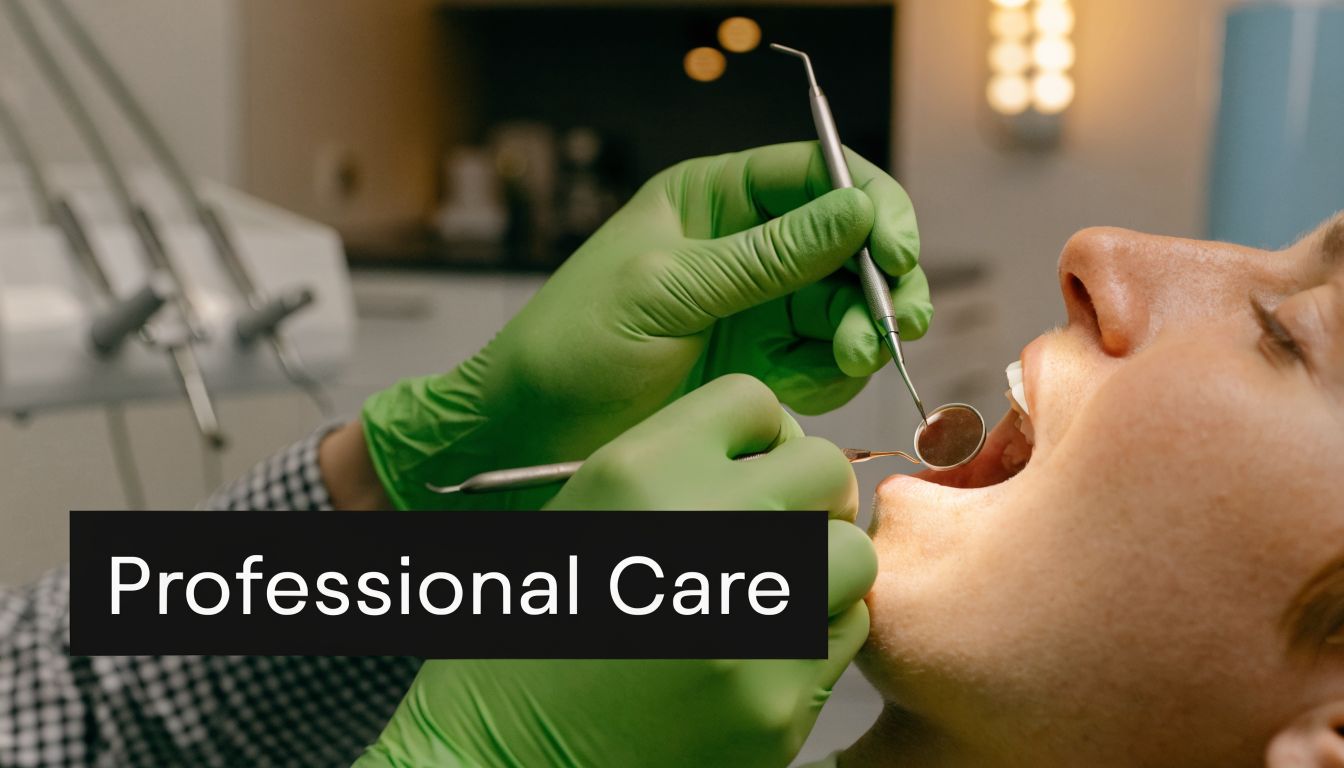
A standard office visit usually feels much more manageable than patients expect. The area is approached gently because an already-sensitive socket won’t tolerate rough handling.
The core treatment that works
Most effective dry socket care starts with careful irrigation. The socket is flushed with warm saline or chlorhexidine to remove food particles, bacterial material, and loose debris without using unnecessary force. If the area stays contaminated, the pain usually lingers.
After that, a medicated dressing may be placed. Common materials include eugenol-based paste or a lidocaine-containing dressing packed so it covers the exposed area. This serves two purposes. It protects the socket and it gives direct symptom relief.
Depending on how the site responds, the dressing may need to be changed. Mild cases may settle quickly. More stubborn sockets sometimes need repeat visits until the tissue is covering the area more reliably.
What good treatment feels like
Patients often worry that cleaning the area will be unbearable. In practice, the visit is usually a turning point because the source of irritation is finally addressed.
What usually helps most is the combination of:
- Precise cleaning: Removing trapped debris instead of just rinsing around it
- Protective dressing placement: Covering the exposed socket instead of leaving it vulnerable
- Thoughtful pain control: Matching medications to the level of symptoms
- Clear home instructions: So the next few days support healing instead of disrupting it
A clinic may also provide a curved-tip syringe for careful home irrigation once dressing removal is appropriate, along with instructions for saline or prescribed rinses. That kind of follow-through is important because the socket still needs to stay clean as surface tissue closes over it.
The role of pain medication and antibiotics
Pain relief matters, but it’s supportive, not definitive. Anti-inflammatory medication can make recovery easier to tolerate. Antibiotics may be prescribed if infection is suspected, but they aren’t the solution for every dry socket. If the main issue is exposed bone and trapped debris, cleaning and protection come first.
That trade-off is important. Medication can reduce symptoms. It cannot substitute for mechanical cleaning of a contaminated socket.
Clinical reality: The dressing eases pain quickly, but the real benchmark is tissue coverage over the socket, not how numb it feels that afternoon.
Advanced biologics and why PRF is getting attention
An interesting development in dry socket care involves Platelet-Rich Fibrin, or PRF, an advanced biologic made from the patient’s own blood and used as a regenerative support material. Instead of acting only as a medicated cover, it functions more like a biologic scaffold that supports tissue repair.
Clinical data cited in this discussion of PRF in dry socket management reports that PRF can reduce infection risk by 30 to 50% in high-risk sockets and promote faster tissue regeneration compared with traditional dressings, helping shorten the usual 7 to 10 day healing timeline.
For patients, that can mean less exposed tissue, less lingering irritation, and a more comfortable recovery window. It’s one of the more meaningful differences between basic symptom management and regenerative treatment.
Why PRF can be a smart option
PRF isn’t necessary for every extraction problem, but it can be particularly useful when the goal is to support stronger soft-tissue healing and reduce complications in higher-risk situations.
Its advantages are practical:
- Biologic support: It encourages tissue regeneration rather than only covering the area.
- Less dependence on repeated dressings: In some cases, regenerative support can reduce how long the socket stays vulnerable.
- Useful in surgical cases: This matters for wisdom teeth and other extractions where healing demands are higher.
- Compatible with comfort-focused care: Patients who need sedation-based treatment can still receive regenerative support as part of their surgical plan.
At an advanced surgical practice such as Grand Parkway Smiles, PRF and 3D imaging may be integrated into extraction planning and post-extraction care for patients who need more complex treatment.
What determines the right in-office plan
Not every socket needs the same approach. A simple painful socket may respond well to irrigation and a dressing. A high-risk surgical site, a patient with difficult healing, or someone who has significant anxiety may benefit from a more advanced plan built around comfort, prevention, and regenerative support.
That’s the difference between generic advice and individualized care. Healing dry socket improves when treatment matches the biology of the site, not just the pain level.
How to Prevent Dry Socket After Your Next Extraction
The best dry socket treatment is avoiding dry socket in the first place. Prevention matters because a healthy clot protects the socket before problems begin, and once that clot is lost, recovery gets slower and more uncomfortable.
Patients often assume prevention is mostly about what happens in the office. The surgery matters, but recovery habits matter just as much.

The risk factor patients underestimate most
Smoking and tobacco use can increase dry socket incidence by 3 to 4 times, and almost 50% of healing delays are linked to poor compliance with home-care instructions such as daily saline rinses, according to Mayo Clinic’s dry socket treatment guidance.
That’s why prevention is partly surgical and largely behavioral. Even a well-done extraction can develop complications if the clot keeps getting disturbed after you go home.
If you’re preparing for a future procedure, this guide on how to prevent dry socket after extraction covers the habits that protect healing from the start.
The first few days matter most
Think of the blood clot as fragile early tissue, not a scab you can test. The goal is to leave it undisturbed while the body starts building new coverage over the socket.
The most useful rules are straightforward:
- Avoid suction: No straws, forceful spitting, or anything that creates pulling pressure in the mouth.
- Pause tobacco use: Smoking, vaping, and chewing tobacco all work against stable healing.
- Follow the rinse schedule exactly: Rinsing too early, too hard, or not at all can each create problems.
- Choose soft foods: Keep sharp, crunchy, and crumbly foods away from the surgical area.
Prevention is a partnership
A good extraction plan includes clear aftercare instructions, but instructions only work if they’re followed closely. Patients who do well after surgery tend to be the ones who keep recovery boring. They don’t test the area, don’t change the plan midstream, and don’t assume they’re “fine now” because the first day felt easy.
That also applies to oral hygiene. You still need a clean mouth, but the cleaning has to be controlled. Brush the rest of your teeth thoroughly. Around the extraction site, be gentle and follow the timing your surgeon gave you.
The safest recovery is usually the least dramatic one. Protect the clot, keep the mouth clean, and resist the urge to overmanage the site.
Smart questions to ask before an extraction
If you’re planning a wisdom tooth removal or another surgical extraction, ask practical questions before the procedure:
- What rinse schedule should I follow? Timing matters.
- When can I return to normal brushing near the area? Don’t guess.
- Which foods should I avoid first? Small food particles cause trouble.
- What should make me call the office right away? It helps to know the threshold in advance.
Patients at higher risk should plan ahead
Some extractions are more prone to healing issues because of location, complexity, or patient habits. In those cases, prevention may involve a more protective surgical strategy and closer follow-up.
That’s also where advanced options such as PRF can fit into the conversation before surgery, not just after a complication develops. The best approach is often the one that reduces the chance of exposed bone and painful recovery from the beginning.
Your Partners in Healthy Recovery at Grand Parkway Smiles
Dry socket can feel alarming because the pain is out of proportion to what many patients expect after an extraction. What usually helps most is a calm response. Keep the area protected, use gentle home care, and get the socket evaluated when symptoms fit the pattern of worsening post-extraction pain.
The biggest misunderstanding is thinking healing dry socket is only about pain medicine. Pain control matters, but recovery improves when the underlying problem is addressed. That means cleaning the socket thoroughly, protecting exposed tissue, and supporting the return of healthy surface coverage.
What patients need during recovery
Patients don’t need a lecture. They need a clear answer to three questions:
- Is this normal?
- Can I do anything tonight to make it better?
- What treatment will fix the problem?
The answer often starts with reassurance. Dry socket is painful, but it’s manageable. Once the site is properly examined and treated, patients usually feel much more in control of the recovery process.
Why integrated dental care matters
Extraction recovery doesn’t happen in isolation. Some patients need a straightforward post-op check. Others are balancing anxiety, a difficult wisdom tooth surgery, future implant planning, or a more complex restorative case.
That’s where a multidisciplinary setting helps. When oral surgery, restorative planning, sedation options, imaging, and follow-up care all exist under one roof, treatment decisions become more coordinated. The result is a recovery plan that fits the patient, not just the socket.
Comfort changes the experience
A lot of dental fear comes from uncertainty and the expectation that treatment will be rough. Dry socket visits should feel the opposite. The care should be targeted, efficient, and designed to lower irritation, not add to it.
For anxious patients, comfort support can make the difference between delaying care and getting help promptly. That matters because dry socket rarely improves by waiting. It improves when someone cleans the site properly and protects it.
Relief usually starts when the socket is treated, not when the patient gets tougher.
The goal is more than getting out of pain
A well-managed extraction recovery protects more than comfort. It supports better oral health, cleaner healing, and a smoother path if future treatment is needed. That matters whether the extraction was a wisdom tooth removal, a damaged tooth that couldn’t be saved, or part of a larger restorative plan.
Patients do best when they know what they’re dealing with and have a team ready to respond quickly. Recognize the pattern, avoid home fixes that irritate the site, and seek treatment early when the symptoms match dry socket.
If you’re dealing with worsening pain after an extraction and want a clear answer, contact Grand Parkway Smiles. The team provides same-day emergency dental care, oral surgery follow-up, sedation options, and advanced treatment planning to help patients in Katy and the greater Houston area recover more comfortably.