When you’re thinking about a dental implant, the questions usually sound practical at first. Will it look natural? Will I be able to chew normally again? Will my smile feel like mine? Then a quieter question tends to show up underneath all of that. What if it fails?
That concern is reasonable. An implant isn’t just a dental procedure. It’s an investment in your appearance, your comfort, your bite, and your confidence in social and professional life. For many people, it’s also the step that finally lets them stop hiding a missing tooth when they laugh or speak.
The good news is that implant failure is not the norm. The better news is that when you understand why do dental implants fail, you can do a lot to lower the risk. Most implant problems follow a timeline. Some happen during healing, when the implant is trying to bond with bone. Others happen years later, after a patient has been doing well for a long time. That timeline matters because the cause, the warning signs, and the solution are different at each stage.
Your Guide to a Lasting Smile with Dental Implants
A healthy implant does more than fill a gap. It supports your facial appearance, helps you chew with confidence, and prevents the “one missing tooth” problem from turning into drifting, uneven wear, and a smile that slowly changes shape. That’s why so many patients feel hopeful when they choose treatment, but also a little uneasy about whether the result will last.

Dental implants remain one of the most dependable options in restorative dentistry. Studies summarized by Northwest Oral Surgeons on dental implant failure statistics report 90 to 95 percent survival at 10 years, which translates to a cumulative failure rate of 5 to 10 percent over that period. That’s why dentists often consider implants a reliable long-term replacement for missing teeth.
Still, “high success” doesn’t mean “no risk.” A patient can have excellent treatment and still need careful planning, thoughtful healing, and long-term maintenance. Implants behave a lot like a high-quality roof on a home. Good materials matter, but the structure underneath, the installation, and the maintenance all matter too.
Why this topic matters to your smile
Implant failure isn’t only about losing a fixture in the jaw. It can affect:
- Appearance by changing gum contours or causing bone loss that alters the way the restoration looks
- Function by making chewing uncomfortable or unstable
- Confidence because any looseness, pain, or swelling can make you second-guess your smile
- Future treatment since a damaged site may need additional healing before a replacement can be placed
A lasting smile depends on two phases going well. First, the implant has to heal correctly. Second, it has to stay healthy under daily use for years.
What patients should focus on
You don’t need to memorize implant engineering. You do need to understand the major pressure points:
- Healing quality in the first months
- Gum and bone health in the years after placement
- Bite forces from grinding, clenching, or an imbalanced restoration
- Medical and lifestyle factors that can interfere with healing or maintenance
Once you see implant failure through that lens, the subject gets much less mysterious.
Understanding Implant Success and Failure
A successful implant becomes part of your jaw through osseointegration. That’s the biological bond between the titanium implant and surrounding bone. If you want a simple analogy, think of a fence post set into concrete. If the post is stable and the material around it hardens the right way, it can handle daily force. If that bond never sets properly, the structure won’t hold.
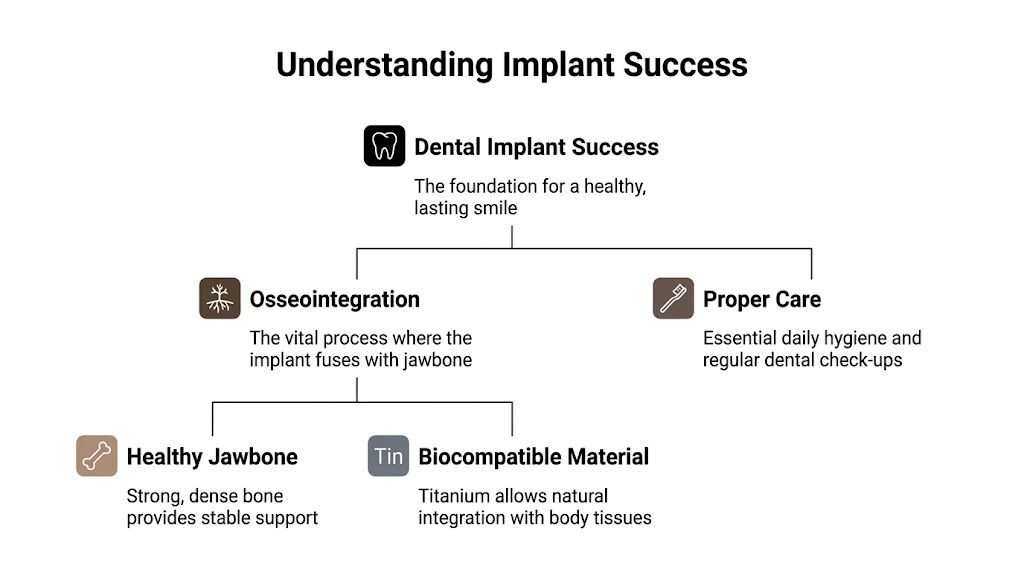
If you want a patient-friendly overview of how clinicians think about the dental implant success rate, it helps to start with that bond. Everything else builds on it.
What counts as implant success
An implant is considered successful when it stays stable, supports function comfortably, and remains surrounded by healthy bone and gums. Success isn’t just “the post is still there.” It also means:
- the implant doesn’t move
- the gum tissue stays calm rather than chronically inflamed
- the bite feels balanced
- the final crown, bridge, or full-arch restoration looks natural and works well
For patients, this is what success feels like in real life: eating without fear, smiling without covering your mouth, and forgetting that the tooth was ever missing.
Early failure and late failure
Dentists usually divide implant failure into two timelines because the causes are different.
| Timeline | What it usually means | Typical pattern |
|---|---|---|
| Early failure | The implant never established a stable bond with bone | Trouble appears during healing or before the implant has fully integrated |
| Late failure | The implant was stable, then lost support over time | Problems develop after function has already been established |
Early failure is the “foundation never set” problem. Late failure is the “foundation was good, but years of damage weakened it” problem.
Why the timeline matters
The timeline changes the investigation. With an early problem, a dentist looks hard at healing biology, bone quality, infection, and whether the implant was disturbed before integration. With a later problem, the focus shifts toward plaque-related inflammation, progressive bone loss, and long-term mechanical stress.
Practical rule: If an implant never feels fully settled, think healing. If it worked well for years and then changed, think disease or force.
Failure doesn’t always start with pain
That surprises many patients. A failing implant may begin with subtle signs:
- a crown that starts to feel “different” when you bite
- gum bleeding during brushing
- puffiness around the implant
- a bad taste or odor near the site
- increasing sensitivity to pressure
- a sense that the tooth is not as solid as before
Some of those signs point to inflammation. Others point to movement or overload. Either way, they deserve attention early, because the earlier the cause is identified, the more treatment options you usually have.
The Primary Causes of Early Implant Failure
Early implant failure usually comes down to one core problem. The implant didn’t get the quiet, stable healing environment it needed.
During the first phase after placement, the jawbone has to accept the implant and grow tightly around it. That process is biological, but it’s also mechanical. Bone needs good blood supply, enough volume, and freedom from disruptive movement. If any one of those factors is off, the implant may not lock in.
Bone quality and initial stability
Not every jawbone gives an implant the same starting point. Some sites have strong, dense bone that grips the implant well from day one. Other sites are softer, thinner, or shaped in a way that makes stability harder to achieve. That doesn’t mean treatment can’t work. It means planning has to be precise.
When a site lacks the right amount or quality of bone, grafting may be part of the preparation. Patients who want a simple explanation of that step often find it helpful to review bone grafting for dental implants before treatment discussions.
A weak site is a little like trying to anchor a screw into crumbling drywall instead of a solid stud. The hardware may look fine at placement, but it won’t tolerate stress the same way.
Micromotion and premature loading
One of the clearest early threats is biomechanical overload. According to the reviewed evidence in this implant complications article on PubMed Central, premature loading before osseointegration is complete, which can take 3 to 9 months, or forces that exceed the bone’s strength can create micromotion and prevent the implant from fusing with the jawbone.
That’s why timing matters so much. Patients sometimes assume that if an implant feels “pretty good,” it must be ready for normal use. Healing bone doesn’t work that way. It needs stability before it needs pressure.
Infection during the healing phase
Bacteria can also interrupt the healing process. In the early stage, infection doesn’t just irritate the gums. It can interfere with the implant’s relationship with the bone itself. Instead of healthy integration, the site may stay inflamed and unstable.
Common contributors include:
- Plaque accumulation around a fresh surgical site
- Poor post-operative cleaning because the patient is afraid to touch the area
- Existing gum inflammation nearby that wasn’t fully controlled beforehand
- Systemic healing issues that make the tissues slower to recover
Surgical precision matters
Implants are technique-sensitive. Placement depth, angle, heat control during drilling, and the way forces will be distributed later all affect the outcome. The goal isn’t merely to insert an implant where a tooth used to be. The goal is to place it where bone, gum tissue, and bite mechanics can support it long term.
Here’s where experience makes a practical difference:
- Planning the position so the future crown doesn’t force the implant into a poor angle
- Respecting bone biology rather than pushing a site beyond what it can support
- Avoiding early stress while the implant is still integrating
An implant can fail early even when the restoration looks good from the outside. Healing success depends on what’s happening below the gumline.
What works and what doesn’t
A few trade-offs are worth stating plainly.
| What helps early healing | What tends to create problems |
|---|---|
| Careful site evaluation | Rushing into placement without understanding bone conditions |
| Controlled healing time | Chewing aggressively too soon |
| Clean surgical and home-care habits | Letting plaque sit around a healing implant |
| Thoughtful restoration timing | Treating a fresh implant like a fully matured tooth |
Patients often ask whether early failure means they “rejected” the implant. Usually, that’s not the right frame. In most cases, the issue is not rejection in the way people think about organ transplants. It’s failed integration, often because biology, force, or infection got in the way.
Why Implants Can Fail Years After Placement
A late implant problem feels especially frustrating because the implant may have seemed completely dependable for a long time. You chewed on it, smiled with it, and stopped thinking about it. Then something changes. The gum gets tender. The bite feels off. The implant starts to seem less secure.
Late failure usually comes from one of two buckets. Disease around the implant, or force that keeps stressing it over time.
Peri-implantitis and slow bone loss
The most common late cause is peri-implantitis. It’s an inflammatory infection around the implant that damages the supporting bone. A clinical summary from Brent Maxson DMD on implant failure causes notes that peri-implantitis is the most common cause of late implant failure and can affect up to 22 percent of implants.
The reason this condition matters so much is that bone loss around an implant can progress unnoticed. Natural teeth have a periodontal ligament. Implants do not. That means implants don’t always give the same early sensory warnings that natural teeth do.
How late disease progresses
Peri-implantitis often follows a stepwise pattern:
- Plaque builds up near the implant margin.
- The gums become inflamed, which may show up as redness or bleeding.
- Bacteria remain in the area, and the inflammatory response continues.
- Bone support begins to shrink, sometimes without dramatic pain.
- The implant loses stability as its anchor weakens.
What makes this especially important for appearance is that bone and gum loss can change the look of the restoration. A crown that once blended beautifully can start to show dark spaces, receding tissue, or an elongated appearance.
A late implant problem often starts as a hygiene or maintenance problem long before it becomes a “loose implant” problem.
Mechanical wear over time
Not every late failure is an infection. Some are force-related. A patient may grind at night, clench during stress, or bite in a way that places repeated pressure on one implant or one section of a full restoration. Over time, that can strain the bone, the abutment, or the prosthetic components.
Mechanical issues tend to show up as:
- a crown that feels high or off-balance
- screw loosening
- chipping or wear of the restoration
- soreness when chewing
- gradual overload to the surrounding bone
An implant is strong, but it isn’t indestructible. A well-placed implant can still suffer if the forces on it are poorly distributed year after year.
Bruxism is often underestimated
Teeth grinding deserves special attention because patients often don’t realize they do it. Bed partners notice the noise. Dentists notice the wear. Patients usually notice jaw fatigue, headaches, or a chipped tooth before they think about bruxism.
When heavy clenching is left unmanaged, the implant system has to absorb repeated stress without the cushioning effect that natural teeth have. That’s why nightguards, bite adjustments, and periodic review of the way the restoration meets opposing teeth can matter so much over the long haul.
The maintenance gap
Many late failures don’t come from one dramatic event. They come from a maintenance gap. A patient feels fine, skips recall visits, cleans around the implant less carefully than they think, and doesn’t realize anything is wrong until bone loss is already advanced.
This is why professional follow-up matters even when everything feels normal. A dentist can often detect tissue inflammation, bite imbalance, or early bone changes before the patient notices obvious symptoms.
Key Patient Risk Factors That Increase Failure Rates
Some implant risks belong mostly to the procedure. Others belong to the patient’s health, habits, and daily environment. That distinction matters because patient factors are often manageable. They’re not a reason to give up on implants. They’re a reason to plan better and monitor more carefully.
A history of gum disease changes the conversation
Among all patient-related risks, past periodontal disease is one of the most important. The American Association of Endodontists summarizes research showing that in patients with treated chronic periodontitis, dental implants fail at a rate 10 times higher than natural teeth preserved through periodontal therapy in this AAE report on implant risk in treated periodontitis patients.
That doesn’t mean someone with a history of gum disease can’t be a good implant candidate. It means gum health has to be treated as an ongoing condition, not a box that gets checked once before surgery. If you want a plain-language refresher on how periodontal disease affects the supporting structures around teeth and implants, it helps explain why maintenance is so central after treatment.
Smoking and healing problems
Smoking remains one of the biggest red flags in implant planning because healthy healing depends on blood supply. When tissues don’t get the circulation they need, the risk of delayed healing and infection rises. The same issue can make long-term gum stability harder to maintain.
In practice, smoking changes the conversation from “Can we place an implant?” to “How do we improve the odds before, during, and after placement?” Patients who reduce or stop tobacco use give themselves a much better biological environment for success.
Diabetes and systemic health
Uncontrolled diabetes can complicate healing and make infection control harder. The issue isn’t just the day of surgery. It’s the body’s overall ability to repair tissue, manage inflammation, and respond to bacterial challenges around the implant.
Other medical conditions and medications can also affect bone metabolism and healing. That’s why a thorough medical history matters. It’s not paperwork for its own sake. It shapes treatment timing, surgical approach, and follow-up intensity.
Bruxism and clenching habits
Some risks don’t show up in bloodwork or radiographs right away. Bruxism is one of them. Patients who grind or clench can overload even a well-integrated implant, especially over time.
A practical way to think about this is with a simple comparison:
| Risk factor | Why it matters |
|---|---|
| Gum disease history | Raises the chance of inflammatory problems around the implant |
| Smoking | Interferes with healing and tissue health |
| Uncontrolled diabetes | Makes healing and infection control harder |
| Bruxism | Adds repeated mechanical stress to the implant system |
| Poor daily hygiene | Allows plaque to remain in contact with the gums and implant surfaces |
These risks can be managed
Patients sometimes hear “risk factor” and assume the answer is no. That’s not how good treatment planning works. A better question is whether the risk can be brought under control.
That may mean:
- improving periodontal stability before implant placement
- coordinating care with a physician for metabolic conditions
- using a nightguard when grinding is present
- setting a stricter hygiene and maintenance schedule
- designing the final restoration to reduce excess force
Risk doesn’t mean failure is inevitable. It means the case needs a more disciplined plan.
The most successful patients usually aren’t the ones with perfect mouths on day one. They’re the ones who understand their risk profile and stay engaged in managing it.
How You Can Help Prevent Dental Implant Failure
Implant prevention is a partnership. Your dentist handles diagnosis, planning, placement, and restoration design. You handle the daily conditions that let the implant stay healthy. Both sides matter.
A lot of patients assume prevention starts after surgery. It starts earlier, with the choices that shape healing. Smoking status, gum condition, medical control, and bite habits all affect what happens next.
The daily habits that protect an implant
Home care needs to be deliberate. An implant can’t get cavities, but the surrounding tissues can still become inflamed and lose support. The goal is simple. Keep plaque from sitting undisturbed around the gumline.
That usually means cleaning tools beyond a standard brush alone. Many patients do better when they combine brushing with interdental brushes, implant-specific floss, or water flossing. If you want a practical home routine, this guide on how to care for dental implants gives a useful overview of daily maintenance.
What prevention looks like in real life
These habits make the biggest difference:
- Brush with intention rather than rushing past the implant area
- Clean between teeth and around the implant every day, not just when food feels stuck
- Keep recall visits so a dentist can catch early inflammation or bite problems
- Mention any change quickly if the implant starts feeling sore, different, or slightly mobile
- Wear a nightguard if prescribed because untreated grinding can undo otherwise good work
What works better than “waiting to see”
Patients often wait because the problem seems minor. A little bleeding. A little puffiness. A bite that feels off only once in a while. That wait-and-see approach is one of the biggest reasons manageable issues become expensive ones.
Here’s the better rule set:
- If the gums bleed around the implant repeatedly, get it checked.
- If the bite changes, don’t assume it’s nothing.
- If you’ve had gum disease before, don’t loosen your maintenance routine when the implant feels fine.
- If you grind, treat the nightguard like part of the implant system, not an optional extra.
The professional side of prevention
Your dental team should also be doing active prevention, not passive observation. That includes checking tissue health, evaluating bone support on appropriate follow-up imaging, and reviewing how the restoration contacts the opposing teeth.
Small corrections made early are often the difference between routine maintenance and major repair.
Prevention protects more than the implant
Patients usually think about implant failure as a hardware problem. It’s really a smile-health problem. Prevention protects:
- the gum line around the restoration
- the bone that supports facial contours
- your ability to chew comfortably
- the natural look of the final result
- the time and money already invested in treatment
That’s why prevention isn’t busywork. It’s how you protect the appearance and function you chose the implant for in the first place.
Fixing a Failing Implant with Modern Dental Solutions
Finding out an implant is in trouble can feel discouraging, but it doesn’t mean the situation is hopeless. The right solution depends on the cause, the timing, and how much bone and soft tissue support remain.
Some implants can be stabilized. Others need to be removed and replaced after the area is rebuilt. The key is not to treat every failing implant as the same problem.
When the implant may be saved
If the issue is caught early enough, a dentist may be able to control inflammation around the implant and prevent further breakdown. The exact approach depends on what’s driving the problem, but the goals are consistent:
- reduce bacterial contamination
- calm the inflamed tissue
- remove contributing factors such as excess cement or plaque retention
- correct bite overload if force is part of the problem
In practical terms, that may involve deep cleaning around the implant, local anti-infective treatment, and close monitoring. If the problem is more advanced, surgery may be needed to access the area directly and manage damaged tissue or bone loss.
When removal is the better choice
Sometimes the implant is too compromised to predictably save. In those cases, removal can be the most conservative long-term decision. That sounds counterintuitive, but leaving a failing implant in place can allow more bone loss and make the next restoration harder.
After removal, the site often needs healing and ridge repair before another implant is considered. That extra step can feel frustrating, but it creates a stronger base for the next attempt.
Replacement and advanced alternatives
Not every patient who loses an implant should receive the same treatment again in the same way. A failure often reveals something important about the site, the force pattern, or the patient’s biology. That information can lead to a better second plan.
For complex cases, a dentist may consider alternatives such as:
- re-grafting the area before a future implant
- changing implant position or design to improve support
- revising the prosthetic plan so force is distributed more evenly
- using full-arch concepts such as All-on-4 when multiple teeth or a failing dentition are involved
- considering zygomatic implants in upper-jaw cases with severe bone limitations
Those advanced options matter because they expand what’s possible for patients who were told they had “not enough bone” or who had trouble with earlier treatment. They can restore both function and facial confidence when standard approaches are no longer ideal.
A failed implant doesn’t erase the goal. It changes the roadmap.
The real objective is a durable, natural-looking result
The best rescue plan isn’t just about putting another implant in the jaw. It’s about rebuilding a smile that looks right, feels stable, and can be maintained over time. That may require periodontal care, grafting, bite adjustment, prosthetic redesign, or a more advanced surgical option.
For patients, hope usually returns when the problem is explained clearly. Once you know whether the issue is infection, force, tissue loss, or a combination, the next steps become much easier to understand.
If you’re worried about a loose implant, gum inflammation around an implant, or you want a second opinion before starting treatment, Grand Parkway Smiles offers complete implant care in Katy under one roof. Their team provides advanced diagnostics, restorative planning, surgical options, and full-mouth solutions designed to protect your oral health, restore appearance, and help you move forward with confidence.