If you're reading this after hearing that a tooth can't be saved, you're probably juggling a few worries at once. Will the gap show when you smile? How much will it hurt? Should you remove the tooth now and deal with replacement later, or handle both together?
Those questions are normal. An extraction and implant plan can sound like a big leap, especially when you're already dealing with pain, infection, or a broken tooth. But in many cases, this process isn't about losing something. It's about rebuilding support for your bite, your appearance, and your long-term dental health in a way that feels stable and natural.
The Modern Solution to Tooth Loss
A failing tooth can make daily life feel uncertain. You may chew on one side, hide your smile in photos, or worry that waiting will make things worse. The good news is that dentistry gives you a way to remove a damaged tooth and replace it with something designed to function like a natural root and crown.

Why implants changed the conversation
For many adults, the old question used to be, "How do I fill the space?" Now the better question is, "How do I protect the bone and restore the tooth in the most durable way?" Dental implants became central to that shift because they replace the missing root, not just the visible part of the tooth.
The demand for implants has grown significantly, and projections for 2026 indicate that 17 to 23 percent of adults with missing teeth could have at least one implant, reflecting their strong success rates and role in preserving jawbone health, according to dental implant demand statistics.
That matters for more than chewing. When a tooth is removed and nothing replaces the root, the jawbone in that area no longer receives the same stimulation. Over time, the ridge can shrink, which can affect nearby teeth, facial support, and the look of your smile.
Why this can be a health decision and an appearance decision
An extraction and implant often helps in several ways at once:
- Support for your bite: A replacement tooth helps you chew more evenly.
- Protection for neighboring teeth: Unlike a bridge, an implant doesn't require reshaping the teeth next to the space.
- A natural look: The final crown is designed to blend with your smile.
- Bone preservation: Replacing the root helps maintain the underlying structure.
If you're comparing solutions, it can help to review a broader guide to tooth replacement options so you can see how implants differ from bridges and removable choices.
A replacement tooth isn't only cosmetic. It can protect how your mouth functions years from now.
If you're currently wearing a bridge or considering one as an alternative, practical home care matters too. This guide on DentalHealth.com for bridge cleaners gives a useful overview of how cleaning tools differ and why access under a bridge takes extra attention.
Understanding Extraction and Implants
The phrase extraction and implant sounds like one procedure, but it's really a coordinated sequence. First, the dentist removes the damaged tooth as carefully as possible. Then the team prepares the area for a replacement tooth that starts below the gumline, where the original root used to be.
What a modern extraction really means
Many patients hear "extraction" and picture a rough, forceful procedure. Modern treatment aims for the opposite. The goal is an atraumatic extraction, which means removing the tooth while protecting as much surrounding bone and gum tissue as possible.
Consider the preparation of a building site: If the foundation area is kept clean and intact, the next step is more predictable. If the bone and soft tissue are damaged during removal, rebuilding becomes harder.
A careful extraction usually includes:
- Gentle tooth removal: The dentist works to minimize trauma to the socket walls.
- Cleaning the site: Any unhealthy tissue is removed so healing can begin in a cleaner environment.
- Planning for the next step: The team evaluates whether the area is ready for immediate implant placement or whether healing should come first.
The three parts of an implant
An implant is easier to understand when you compare it to a natural tooth.
| Part | What it does | Natural tooth comparison |
|---|---|---|
| Implant post | Sits in the jawbone | Root |
| Abutment | Connects the post to the visible tooth | Connector above the root |
| Crown | Looks like the tooth you see when you smile | Enamel-covered top of the tooth |
The implant post is the anchor. The abutment is the connector piece. The crown is the custom-made tooth that matches your smile.
Why patient education matters
A lot of fear comes from not knowing what each part does or why the process takes time. Good educational tools can make that easier. Resources that improve patient care through education are useful because they turn confusing clinical terms into plain language patients can use in decision-making.
Practical rule: If you don't understand why a step is being recommended, ask your dentist to explain what problem that step is solving.
That question alone often lowers anxiety. It changes the experience from "something is happening to me" to "I understand why this plan fits my mouth."
Immediate vs Delayed Implants What Is Right for You
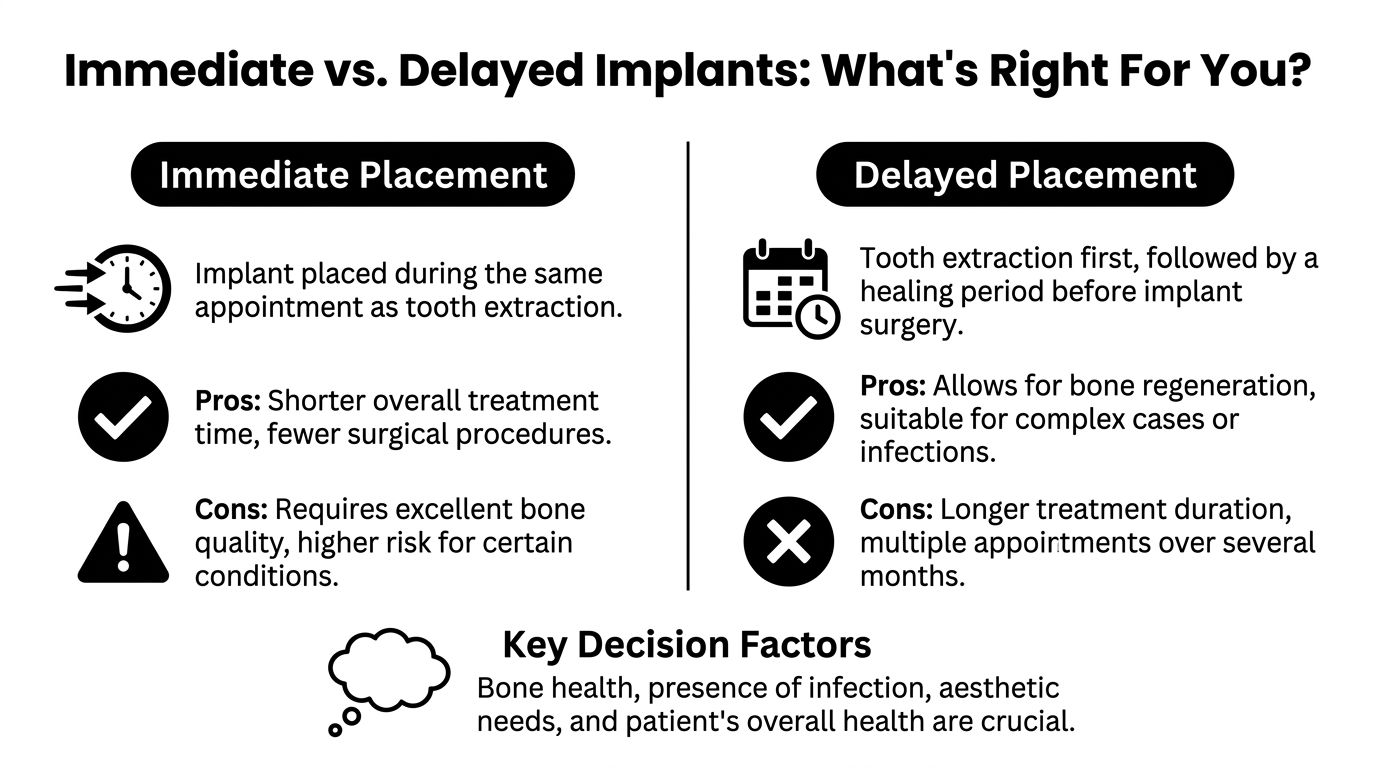
For many patients, this is the hardest part of the decision. Should the implant go in the same day as the extraction, or should you let the area heal first and place the implant later? Both options can be appropriate. The right one depends on bone shape, infection, gum condition, bite forces, and smile-line concerns.
When immediate placement makes sense
An immediate implant is placed at the extraction visit. In a favorable case, this can shorten the overall process and preserve the natural contours of the area, which is especially helpful in visible parts of the smile.
Immediate post-extraction implants can be highly successful when primary stability is achieved with a torque of 35 to 50 Ncm, which can reduce surgical time and, in ideal cases, eliminate the need for extra bone fillers, according to this clinical review of immediate postextraction implant placement.
Immediate placement is often considered when:
- The socket walls are intact: Bone support is present where the implant needs to anchor.
- The area is well controlled: Infection or tissue damage isn't making the site unpredictable.
- Appearance matters strongly: Front teeth often benefit from preserving the ridge shape as much as possible.
A patient exploring same-day dental implants is usually asking a reasonable question. Can this be done now, safely, without sacrificing predictability?
When delayed placement is the wiser choice
Delayed, or staged, treatment often feels less exciting because it takes longer. But longer doesn't mean worse. In some mouths, it's the more careful choice.
If the tooth has a significant infection, the bone is thin, or the site needs grafting and tissue healing, placing the implant later can give the dentist a stronger foundation to work with. This is common in molars and in cases where the original tooth failed after a long period of damage.
If your dentist recommends waiting, that usually means they're protecting the result, not withholding treatment.
A side-by-side way to think about it
| Question | Immediate placement | Delayed placement |
|---|---|---|
| How fast is treatment? | Shorter overall timeline | Longer timeline with healing phases |
| Who is it best for? | Healthier sockets with good bone support | Compromised sites, infection, thin bone, complex molars |
| What about appearance? | Often helpful for preserving smile contours | May be better when tissue needs to recover first |
| Why would a dentist choose it? | To streamline care when conditions are ideal | To improve predictability when the site needs rebuilding |
Many anxious patients want the fastest option. Most dentists want the safest option that still looks good years from now. When those two line up, immediate placement can be excellent. When they don't, a staged plan is often the smarter path.
Your Journey to a New Smile The Step by Step Process
Uncertainty makes treatment feel bigger than it is. Patients often feel calmer when they know what happens first, what happens next, and where the final smile fits into the process.

The planning appointment
Your first visit usually focuses on answers, not action. The dentist examines the tooth, reviews your health history, takes images, and looks at the quality and volume of bone. If the practice uses 3D CBCT imaging, that scan helps map the site in three dimensions so the team can evaluate space, angulation, and nearby structures before surgery.
This is also when the discussion becomes personal. Are you worried most about pain? About how the front tooth will look? About finishing treatment in as few visits as possible? Those concerns affect the treatment plan.
The extraction and site preservation phase
Once the plan is clear, the next step is removing the tooth carefully. After a tooth extraction, the jawbone ridge can lose significant volume, but atraumatic extraction techniques combined with immediate ridge preservation can preserve bone height and may reduce the need for more complex augmentation later, according to this review on tooth extraction healing and implantation.
That often means the appointment includes more than taking the tooth out. The dentist may also shape and protect the site so it heals with better contour and support.
A patient-friendly way to think about this phase is:
- Remove the problem tooth carefully
- Protect the bone and gum architecture
- Create the best possible site for the future tooth
The implant phase
If you're a candidate for immediate placement, the implant may go in at the same appointment. If not, you'll return after healing for implant surgery. Either way, the goal is the same. The implant is positioned where it can support function and look natural once restored.
Some patients receive a temporary tooth during healing, especially in visible areas. Others wear a removable temporary option while the implant integrates.
Healing isn't wasted time. It's the stage where the implant becomes part of the foundation for your future crown.
The final crown and smile match
After healing, the restorative phase begins. The implant is checked, impressions or digital scans are taken, and a crown is made to match the shape and shade of your surrounding teeth. At this point, many patients finally see the process come together.
The finished result should do more than fill a gap. It should support speech, chewing, and the appearance of a natural smile. A good crown doesn't call attention to itself. It lets you stop thinking about the missing tooth.
Your Experience Comfort Safety and Recovery
Many individuals don't fear the implant itself as much as they fear the experience around it. They want to know if they'll feel pain, how the team keeps the procedure safe, and what recovery will be like once they get home.
Comfort during treatment
For many extractions and implants, local anesthesia is enough to keep the area numb. For patients with stronger anxiety, some offices also offer deeper comfort options such as sedation or IV anesthesia. That doesn't change the biology of healing, but it can change the emotional experience of getting there.
Comfort also comes from pacing. A calm team explains what's happening, checks that you're numb before starting, and gives you clear instructions before you leave. That kind of communication matters as much as the medication for many anxious patients.
Safety at each stage
Safety starts before surgery. Careful imaging, health review, bite analysis, and treatment planning reduce surprises. During the procedure, sterile technique and guided placement principles help the dentist work with more control and precision.
Dental implants also have a strong long-term track record. Studies report survival rates consistently exceeding 95 to 98 percent, with early failures being rare, as summarized in these dental implant statistics. That doesn't mean every case is automatic. It means proper planning and follow-up give patients a dependable path forward.
Recovery at home
Most patients do best when they keep recovery simple and steady.
- Protect the area: Don't chew on the surgical site until your dentist says it's ready.
- Choose softer foods: Soups, yogurt, eggs, smoothies, and other easy-to-chew foods are often more comfortable early on.
- Keep the mouth clean carefully: Follow the hygiene instructions you were given and avoid aggressive brushing near the site.
- Stay consistent with follow-up: Healing checks let your dentist spot small concerns before they become bigger ones.
Recovery is usually more about tenderness and swelling control than about severe pain.
Aftercare isn't a small detail. It's part of the treatment. Good habits during healing help support the kind of long-term result patients want when they choose an implant in the first place.
Investing in Your Smile Costs and Financing Options
Cost is one of the first questions people ask, and it should be. An extraction and implant is a significant dental decision, so you deserve a clear explanation of what affects the total investment and what options may help make treatment manageable.
What shapes the total cost
No two implant cases are exactly alike. The final fee can vary based on how simple or complex the site is and how many steps are needed to build a healthy, stable result.
Common factors include:
- The extraction itself: A straightforward removal is different from a more involved surgical extraction.
- Site preparation: Some patients need ridge preservation or grafting to support the future implant.
- The implant components: The post, abutment, and crown are separate parts of the final restoration.
- Temporary tooth options: A front tooth may require a temporary restoration during healing.
- Complexity of the bite and smile design: Matching the look and function of the surrounding teeth takes planning and lab work.
What you're paying for
It's helpful to think beyond the day of surgery. You're not only paying for removal of a damaged tooth. You're investing in diagnosis, imaging, surgical planning, materials, healing support, and the custom restoration that finishes the case.
That broader view often helps patients understand why treatment can differ from a simple filling or crown. The goal isn't just to patch a problem. It's to rebuild a missing tooth from the root up in a way that supports health and appearance.
Ways patients often manage treatment
Payment options vary by office, but many practices offer a mix of support:
| Option | How it may help |
|---|---|
| PPO insurance | May contribute to parts of treatment, depending on the plan |
| In-house savings plans | Can help patients without traditional insurance access reduced fees on certain services |
| Third-party financing | May allow treatment to be divided into monthly payments |
| Phased treatment | In some cases, care can be sequenced over time based on clinical need and budget |
If cost feels overwhelming, ask for a written treatment plan and have the office explain which steps are essential now and which ones depend on healing or case complexity. Clear numbers and clear timing usually reduce stress quickly.
The Grand Parkway Smiles Advantage
You may start this process thinking the main decision is whether to replace the tooth at all. In many cases, the harder question is more specific. Should the implant go in right away, or is it safer to wait and rebuild the area first?
That choice is not guesswork. It becomes clearer when the right people review the site together.
Why a multidisciplinary setting matters
Extraction and implant care can look simple from the outside, but several decisions affect the final result. The condition of the gum tissue, the amount of remaining bone, the position of nearby teeth, the way your bite comes together, and the presence of infection all matter. A healthy front tooth and an infected back molar may both need removal, yet they often call for very different treatment plans.
This is why a multidisciplinary setting helps. Instead of treating surgery, healing, and the final crown as separate steps handled in isolation, the team can evaluate them as one connected plan. That matters most when you are deciding between an immediate implant and a delayed implant. If the site is clean and stable, immediate placement may protect appearance and shorten treatment. If the area is infected, missing bone, or under heavy bite pressure, a delayed approach may offer a safer and more predictable path.
For more involved cases, a staged timeline is often the wiser choice, as noted in the ITI consensus on implants in postextraction sites. The goal is not speed for its own sake. The goal is placing the implant in a site that can support it well for years.
How technology improves decisions and comfort
Good technology does more than produce impressive images. It helps the team answer the questions patients care about most. Is there enough bone? Is the implant likely to be stable now, or would healing first improve the result? How close are the sinus or nerve? What will the tooth look like when treatment is complete?
Tools that often improve planning and treatment include:
- 3D imaging: Shows bone shape and nearby anatomy in far more detail than a basic 2D view.
- Digital planning: Helps the team plan implant position with the final crown in mind, not just the day of surgery.
- PRF: Used in some offices to support healing after extraction or grafting.
- Advanced implant options: May help patients with significant bone loss who are not good candidates for standard approaches.
Grand Parkway Smiles is a Katy practice that offers extractions, dental implants, 3D imaging, PRF, sedation dentistry, and advanced options such as zygomatic and pterygoid implants under one roof. For patients, that usually means fewer disconnected opinions and a more coordinated process from diagnosis to final restoration.
Why this matters when you're anxious
Anxiety often comes from uncertainty. Patients want to know why one option is being recommended, what the backup plan is, and how the office will keep them comfortable throughout treatment.
A well-coordinated team can answer those questions clearly. They can explain why your case may be a good fit for immediate placement, or why waiting could protect your long-term result. They can also use current imaging, sedation options, and careful follow-up to improve safety and make the experience feel more manageable.
That clarity changes the decision-making journey. Instead of feeling pushed into a one-size-fits-all plan, you can understand the reasoning behind each step and choose a path that supports your health, comfort, and appearance.