A missing tooth rarely stays a small problem. At first, many people adapt by chewing on the other side, smiling with their lips closed, or avoiding crunchy foods in public. Then the workarounds start shaping daily life. Meals get less enjoyable, photos feel uncomfortable, and even confident people begin second-guessing their smile.
That’s usually when the search for affordable dental implants houston begins. Most patients aren’t just asking, “What’s the lowest price?” They’re asking a better question: “How can I fix this well, protect my health, and avoid paying twice?” That’s the right way to think about it. In implant dentistry, affordability isn’t only about the fee you see today. It’s about how stable, functional, and natural your result is years from now.
Regain Your Smile and Your Life with Dental Implants
A missing tooth changes more than appearance. It changes how people eat, how clearly they speak in some situations, and how relaxed they feel when they laugh. When several teeth are missing, the effect is even bigger. Patients often tell us they feel older than they are, or that their smile no longer matches how they feel inside.
Dental implants help because they replace what the mouth lost. Instead of resting on the gums like a removable appliance, an implant supports a replacement tooth from within the jaw. That gives patients something they can trust when they bite into food or speak without worrying that a denture might move.
Why affordability means more than the lowest quote
A low number in an ad can sound reassuring when you’re already worried about cost. But that number often doesn’t tell you whether the plan includes careful diagnosis, proper surgical planning, a strong final restoration, or the follow-up needed to protect your investment.
True value comes from a treatment plan that fits your mouth, your health, and your goals. For one person, that may mean replacing a single front tooth so the smile looks natural again. For another, it may mean moving from a loose lower denture to an implant-supported solution that makes eating easier and restores confidence in social settings.
Dental implants aren’t only about filling a gap. They help restore comfort, facial support, and the freedom to stop thinking about your teeth all day.
Patients across Houston often feel overwhelmed because they’re comparing very different treatments that are all advertised as “affordable.” The right starting point is a careful evaluation, followed by a realistic discussion about what works, what doesn’t, and what will hold up over time.
The Hidden Costs of Missing Teeth
A patient may lose one tooth, put treatment off for a year, and feel mostly fine at first. Then meals start taking more effort. Food collects in places that were easy to clean before. A bite that once felt natural begins to feel uneven.

That pattern is common because a missing tooth affects more than the space you can see. The surrounding teeth, the jawbone, and the way the upper and lower teeth meet all respond to that loss. Some changes happen slowly, but they still matter.
Your jawbone needs stimulation
The jawbone stays stronger when it receives regular pressure through the tooth root during chewing. Once a tooth is gone, that area loses part of the stimulation that helps maintain bone.
Over time, the body may resorb bone in that spot. As the support changes, nearby teeth can drift, the bite can shift, and the face may lose some fullness. In patients who have gone years without replacement, those changes can limit future treatment options and increase the amount of care needed later.
That is one reason affordability should be judged over years, not by the lowest starting quote.
Why delaying treatment can cost more later
Patients often focus on the missing tooth itself. In practice, the added costs usually come from what happens around it. A tooth that tilts into the space can become harder to clean. Opposing teeth can over-erupt. Bone loss can turn a straightforward implant case into one that also needs grafting or more complex planning.
At Grand Parkway Smiles, I want patients to understand that lower total cost often comes from doing the case carefully the first time. Proper imaging, a clear surgical plan, and the right restoration may cost more upfront than a stripped-down option, but they can reduce the chance of avoidable revisions.
For patients comparing options, this overview of what affects dental implant cost over time helps explain why the cheapest path is not always the least expensive one.
The problems patients notice first
Many people do not feel bone loss directly. They notice the day-to-day effects.
- Chewing shifts to one side. That can put extra force on certain teeth and make eating less comfortable.
- Neighboring teeth begin to lean. Even small movement can create food traps and make brushing and flossing harder.
- Speech may change. Front tooth loss can affect how some words and sounds are formed.
- Facial support can decrease. Lips and cheeks may lose support over time.
- Confidence often drops. Patients may cover their smile, avoid photos, or stop eating certain foods in public.
This affects health as much as appearance
A missing tooth can look like a cosmetic issue from the outside. Inside the mouth, it is often a functional problem first. Bite balance, bone support, comfort, and cleanability all change after tooth loss.
Implants are often recommended because they replace the root as well as the visible tooth. Bridges and dentures still have an important place, and for some patients they are the right choice. But when the goal is to preserve bone, protect bite stability, and avoid a cycle of repeated fixes, an implant often gives better long-term value and more peace of mind.
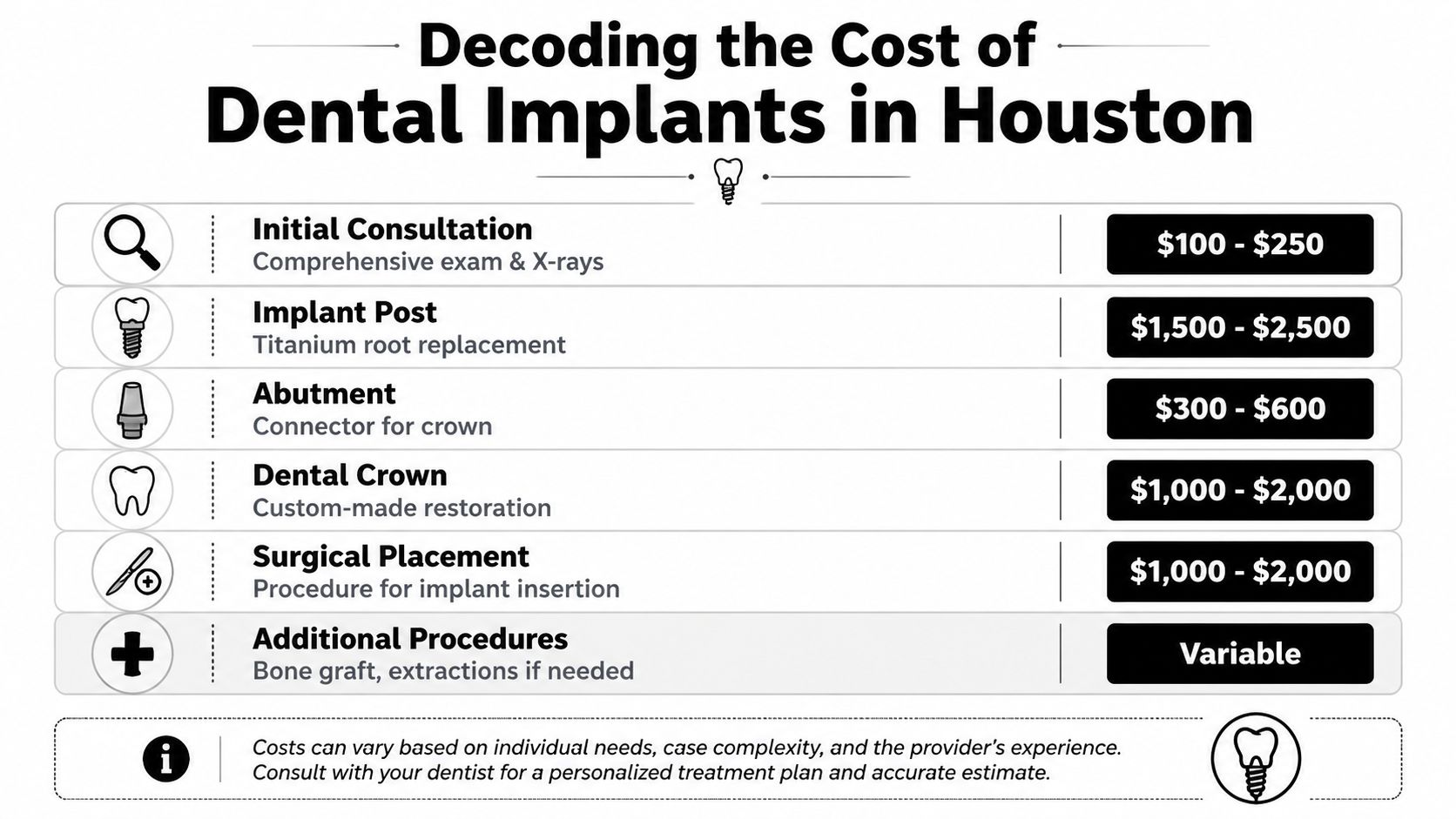
Decoding the Cost of Dental Implants in Houston
A patient will often call our office after seeing a low implant price online, then pause when they learn that the advertised number may not include the exam, 3D imaging, bone grafting, the temporary tooth, or the final crown. That is where confusion starts. A dental implant is not a single purchase. It is a treatment process, and the fundamental question is whether the plan is built to last.
What a single implant usually includes
Implant fees usually reflect several separate parts of care brought together into one treatment plan. In a straightforward case, the total may include:
- The implant fixture. The titanium post placed in the jawbone.
- The abutment. The connector that supports the final tooth.
- The crown. The custom restoration you see when you smile.
- Surgical placement. The procedure, sterile setup, and surgical time.
- Diagnostics and planning. Exams, imaging, and the measurements that guide safe positioning.
That last item is often where value becomes clearer. An implant placed a few millimeters off can create gumline problems, bite issues, or a crown that never feels quite right. Careful planning costs money up front, but it often lowers the chance of repairs, remakes, or replacement later.
Why prices differ across Houston
Fees vary across Houston for practical reasons. Office overhead is different in Katy than in central business and retail districts. Lab choices differ. Technology differs. So does who is directing the case and whether the office handles treatment in a coordinated way or sends patients from place to place.
Lower pricing is not automatically a red flag. Sometimes an efficient practice keeps costs under control without cutting corners. The concern is an incomplete quote that looks affordable at first and grows as each missing piece gets added back in.
Patients who want a broader local comparison can review this page on how much dental implants cost in Katy.
A quick comparison of replacement options
| Feature | Dental Implants | All-on-4 Implants | Traditional Dentures |
|---|---|---|---|
| Best use | One or several missing teeth | Full arch tooth replacement | Full arch replacement with removable appliance |
| Fixed or removable | Fixed | Fixed | Usually removable |
| Bone support | Helps preserve jaw stimulation | Helps preserve jaw stimulation across an arch | Doesn’t replace tooth roots |
| Treatment scope | Tooth-by-tooth replacement | Full set supported by four implants | Gum-supported prosthesis |
| Upfront cost style | Per tooth | Per arch | Usually lower initial fee |
| Long-term value focus | High for suitable candidates | Strong for full-arch cases | May involve more ongoing adjustment |
What drives the total cost up or down
Two cases can look similar from the outside and require very different treatment inside the mouth. Bone volume, gum health, bite pressure, smile line, and healing history all affect the plan.
These are the cost factors I pay closest attention to:
Planning quality
Good imaging and bite analysis help place the implant where the final tooth needs to be, not just where bone happens to be available. That improves appearance, cleanability, and force distribution.
Case complexity
A back tooth and a front tooth are not priced the same for good reason. Front teeth demand tighter cosmetic control. Full-mouth cases require more sequencing, more records, and more decision-making.
Additional procedures
Some patients need bone grafting, sinus work, extractions, or temporary restorations before the final tooth can be made. Those steps add to the fee, but they may be the reason the implant has a healthier foundation.
Who is responsible for the result
When planning, surgery, and restoration are coordinated well, the process is usually more predictable. Accountability is clearer too. If several providers are involved without a tightly managed plan, patients can end up paying in time, stress, and revision costs.
A clear implant quote should explain what is included now, what might be needed later, and which fees depend on healing or anatomy.
The long-term value question
This is the part patients remember after treatment is finished. True affordability is not the lowest number on day one. It is the confidence that your implant was placed in the right position, restored correctly, and designed to serve you well for years.
At Grand Parkway Smiles, that is how we discuss cost. A cheaper shortcut can become the most expensive option if it leads to a failed implant, a poorly fitting crown, or repeated repairs. A well-planned case often carries a higher initial fee, but it gives patients something many discount offers do not. Stability, comfort, and peace of mind.
Your Implant Treatment Options All-on-4 vs Standard Implants
Not every missing-tooth problem needs the same solution. Some patients need one tooth replaced. Some need several. Others are dealing with a full arch of failing teeth, a loose denture, or widespread bone loss. The right treatment depends on what’s missing, what can be saved, and what kind of day-to-day function you want back.

Standard implants for one tooth or a few teeth
A standard implant is the most direct option when you’re missing a single tooth or a limited number of teeth. Think of it as a one-to-one replacement. The implant acts as the new root, and a custom crown sits on top. If several teeth are missing, multiple implants can support separate crowns or a bridge, depending on spacing and bite forces.
This option works well when nearby teeth are healthy and you don’t want to reshape them for a traditional bridge. It also gives the restoration a more independent feel. Each implant-supported tooth can be planned to fit your bite, gumline, and smile.
Standard implants are often the best fit when:
- One visible tooth is missing and smile appearance matters.
- A back tooth is gone and you want stable chewing again.
- Several teeth are missing in different areas and a removable appliance isn’t appealing.
All-on-4 for a full arch
All-on-4 is different. Instead of replacing each tooth with its own implant, the dentist uses four strategically angled implants to support a full arch of teeth. A good analogy is a bridge built on four strong pillars. The strength comes from how those pillars are positioned and how the load is shared across them.
According to the treatment overview from Unity Dental Care, the All-on-4 technique uses four strategically angled implants to maximize bone contact, often avoid bone grafting, and allow a fixed prosthesis on the same day as surgery. It can reduce treatment time from 6 to 12 months to a single day and lower costs by 30 to 50 percent compared with traditional full-arch methods (All-on-4 treatment overview).
That makes All-on-4 especially appealing for people who:
- have many failing or missing teeth in one arch
- are tired of a denture moving while they eat or talk
- want a fixed solution rather than something removable
- may not want a longer path involving extensive grafting
How to think about the trade-offs
The choice isn’t “Which treatment is better?” The better question is “Which treatment fits the condition of your mouth?”
Choose standard implants when precision per tooth matters
If the rest of your mouth is healthy, replacing only what’s missing is often the most conservative route. You keep more of what’s already working and restore the specific areas that need support.
Choose All-on-4 when the whole arch needs a reset
If many teeth are failing, trying to save each one can become inefficient and emotionally draining. In those cases, a full-arch implant plan can offer a more stable and more unified solution.
Patients usually do best when treatment matches the real condition of the arch, not when they try to force a smaller procedure onto a larger problem.
Where mini dental implants fit
Mini dental implants are a separate category. They aren’t just “regular implants at a lower price.” They’re narrower implants with a specific role. They are often used to stabilize loose dentures or help certain patients who need a less invasive option.
Mini implants can be very useful in the right case, especially for lower denture retention or for patients whose health history limits more extensive surgery. But they are not the default answer for every missing-tooth situation. Their strength and indications differ from standard implants, so the treatment plan has to match the forces they’ll carry.
What works and what doesn’t
Some patterns lead to better outcomes than others.
- Works well. Matching the implant type to the number of missing teeth and the quality of available bone.
- Works well. Using fixed full-arch treatment when the whole arch is compromised.
- Doesn’t work well. Choosing based only on the cheapest ad without understanding whether the restoration is removable, fixed, temporary, or final.
- Doesn’t work well. Treating a complex full-mouth problem like it’s just a single missing-tooth problem repeated several times.
A patient with one missing molar and strong surrounding teeth usually needs a different solution than someone struggling with a worn, unstable, or collapsing bite. The best treatment doesn’t sound the same for both because the problem isn’t the same.
The Path to Your New Smile What to Expect on Your Journey
Most patients feel better once they understand the sequence. Implant treatment is methodical. It isn’t rushed, and it shouldn’t feel mysterious. Each step has a purpose, and each one affects comfort, appearance, and long-term stability.
The first visit and planning phase
The process begins with an exam and a close look at the condition of the teeth, gums, bite, and bone. Through this assessment, candidacy becomes clear. Some patients are ready for a straightforward implant plan. Others need to discuss whether a failing tooth can be saved, whether a full-arch option makes more sense, or whether a denture should be stabilized first.
Three-dimensional imaging helps make that decision with more precision. A CBCT scan can cost $300 to $500 in planning for advanced implant treatment, according to the All-on-4 data provided in the Houston market review. The point of that scan isn’t to add unnecessary cost. It’s to locate bone, avoid important structures, and plan implant position more accurately.
The surgery day
Patients are often surprised by how manageable the procedure feels. Local anesthesia is used to numb the area, and sedation options can help people who feel anxious or who are having more extensive treatment. A calm surgical appointment usually starts long before the procedure itself, with careful planning and clear instructions.
When a patient is receiving full-arch treatment, the appointment is naturally more involved than a single implant. But even then, the focus is the same: precision, comfort, and protecting healing conditions from the start.
Healing and osseointegration
After placement, the implant needs time to integrate with the bone. This biological process is called osseointegration. It means the bone bonds around the implant so the restoration has a stable foundation.
Healing isn’t only about waiting. It includes eating the right foods, keeping the area clean, attending follow-up visits, and protecting the implant from unnecessary pressure while the site matures. Patients who understand this phase usually have a smoother experience because they know why the temporary limits matter.
The final restoration
Once the implant is ready, the final crown, bridge, or full-arch prosthesis is attached. This is the step patients often imagine first, but it only works well when the earlier stages are done carefully.
The final restoration should do more than fill a space. It should support chewing, look balanced with the face, and feel natural enough that you stop thinking about it constantly.
When mini implants are the right path
For some patients, a smaller and less invasive option is the better one. A Houston implant affordability review notes that mini dental implants measure 1.8 to 2.9 mm in diameter and often cost $500 to $1,500 per implant in Houston, making them a practical option for denture stabilization and for some elderly or medically limited patients (mini dental implants in Houston).
That matters because not every patient wants or needs the same level of surgery. If the goal is to help a loose denture stay put more reliably, mini implants may be the sensible route. If the goal is a fixed tooth replacement under heavier biting pressure, a standard implant plan may be more appropriate.
Making Implants Affordable Financing Insurance and Savings Plans
Patients often assume they have only two choices: pay everything at once or delay treatment. In reality, there are usually several ways to make implant care more manageable without cutting corners on the plan itself.
Start with what insurance may help cover
Dental insurance can be confusing because implant treatment has multiple parts. One portion may be handled differently than another. In some plans, the crown or other restorative component may receive more support than the surgical component. The details depend on your policy, waiting periods, annual maximums, and how the treatment is coded.
That’s why the first practical step is simple. Ask for a benefits review before you commit, and make sure you understand what the estimate includes. Patients who want a plain-English overview can review Grand Parkway Smiles dental insurance and financing options to see how these conversations are typically structured.
Monthly payments can protect your treatment quality
If paying the full amount at once would push you toward a weaker short-term option, financing can be the healthier decision. Spreading treatment into manageable payments often lets patients choose the plan they need instead of the plan they can tolerate this month.
Some patients also compare outside lending resources before making a decision. If you’re evaluating broader budgeting options for a major health expense, a guide on how to apply for personal finance can help you think through payment structure and affordability in a practical way.
The best payment plan is the one that lets you complete the right treatment without creating financial strain or forcing avoidable shortcuts.
Other ways patients reduce total cost
A smart financial plan isn’t only about the loan or monthly payment. It’s also about reducing fragmentation and surprise fees.
- Choose coordinated care when possible. If imaging, surgery, restoration, and follow-up are planned together, patients often get a clearer picture of total cost.
- Ask what is included in the quote. A low quote can become a high final bill if key steps weren’t part of the original number.
- Consider in-house savings plans. For patients without insurance, these plans can reduce the cost of supporting care and routine maintenance.
- Don’t ignore maintenance. Protecting an implant with good home care and regular professional monitoring is part of affordability.
One practical option in Katy is Grand Parkway Smiles, which provides implant care, accepts many PPO plans, and offers in-house savings and financing within a single practice setting. That doesn’t make every case simple, but it can make the financial conversation easier to follow because the treatment steps are coordinated more closely.
Frequently Asked Questions About Dental Implants
Is the dental implant procedure painful
Most patients say the anticipation is worse than the procedure. The area is numbed thoroughly, and sedation options can help if you’re anxious or having a more involved surgery. Afterward, soreness is expected, but it’s usually manageable with the instructions your dentist gives you.
How long do dental implants last
Implants are designed as a long-term solution. Their longevity depends on planning, placement, bite forces, gum health, and home care. In practical terms, implants tend to perform best when patients treat them like a health investment, not like a one-time purchase they never have to think about again.
Am I too old for dental implants
Age by itself usually isn’t the deciding factor. Overall health, bone quality, healing ability, and your specific goals matter more. Many older adults are strong implant candidates, especially when the goal is stabilizing a denture or restoring comfortable chewing.
Are implants only for appearance
No. A better-looking smile is an important benefit, but implants also support chewing, help maintain bite stability, and can preserve facial support after tooth loss. For many patients, the health benefits are what make the treatment worth pursuing.
What if I’ve been missing teeth for a long time
That doesn’t automatically rule you out. Long-term tooth loss can reduce available bone, so the planning stage becomes even more important. Some patients still qualify for standard implants, while others are better served by full-arch treatment or denture stabilization.
Are mini dental implants the same as regular implants
No. Mini implants are narrower and are often used in specific cases such as stabilizing removable dentures. They can be very useful, but they are not a universal substitute for standard implants.
A good implant consultation doesn’t begin with a sales pitch. It begins with diagnosis, because the right answer depends on the condition of your mouth.
Take the First Step Toward Your Confident New Smile
Affordable implant care isn’t about chasing the smallest number on a website. It’s about choosing a plan that restores your smile, protects your oral health, and lowers the chance that you’ll need expensive corrections later.
That’s why the total cost of ownership matters. A market review of Houston implant advertising notes that many low-price offers focus on upfront cost while overlooking long-term survival, maintenance, and revision risk, and that specialist-led placement can reduce the lifetime risk of costly revisions (long-term implant affordability and revision risk). That’s the part patients should pay close attention to.
If you’re weighing your options, start with a real diagnosis and a transparent conversation. The right plan should make sense medically, cosmetically, and financially. When those three line up, implants can restore far more than teeth. They can restore ease, confidence, and quality of life.
If you’re ready to explore your options, schedule a consultation with Grand Parkway Smiles. You’ll get a clear evaluation, a realistic treatment discussion, and a straightforward next step based on your goals, not guesswork.