You may already be doing the small things people do when they don't like their smile. Smiling with closed lips in photos. Covering your mouth when you laugh. Looking at one chipped edge, one dark tooth, or one uneven gap in the mirror and seeing it before anything else.
That feeling is more common than often acknowledged. Many adults aren't looking for a dramatic, artificial change. They want their teeth to look healthy, balanced, and natural again. In the right case, veneers can do exactly that. They can improve appearance in a very visible way, and they can also help protect teeth that have minor wear, chips, or enamel defects.
Some patients also need more than one cosmetic approach to get the smile they want. If the concern is a high smile line rather than the teeth alone, resources like this expert advice on gummy smile botox can help explain another option that may be discussed alongside dental treatment.
Reclaiming Your Confidence with a New Smile
Veneers are thin coverings bonded to the front of teeth, but that definition doesn't explain why people ask about them. They often ask because something about their smile no longer matches how they want to look. It may be a front tooth that chipped years ago, staining that whitening won't fully mask, or edges that look shorter and flatter than they used to.
What makes veneers appealing is that they can address several of those concerns at once. Instead of chasing one issue at a time, veneers can change color, shape, surface texture, and proportion in a single treatment plan. That matters when a smile looks “off” for more than one reason.
What patients usually want back
Patients rarely say, “I want laminated ceramic restorations.” They say things like:
- “I want my front teeth to match.” One darker tooth or one worn edge can draw attention quickly.
- “I want a cleaner, brighter look.” Not oversized or overly white. Just fresher.
- “I'm tired of noticing the same flaw every day.” Small cosmetic issues can feel much bigger when they're on front teeth.
A veneer works a bit like a custom-fitted façade on the visible surface of a tooth. If the foundation underneath is healthy and stable, that outer layer can make the whole tooth look whole again.
A good veneer case doesn't look like “veneers.” It looks like healthy teeth that happen to be exceptionally well proportioned.
The benefits of veneers become clearer when you separate them into two categories. First, the visible transformation. Second, the practical support they can provide for selected teeth that are chipped, worn, or uneven.
The Transformative Aesthetic Benefits of Veneers

A patient sits down and says, “My teeth are healthy. I just don't like how they look in photos.” That is a common veneer conversation.
The concern is usually not one dramatic flaw. It is a collection of smaller issues that pull attention forward. Uneven edges. A tooth that looks darker than the rest. Front teeth that seem a little too short, narrow, or worn. Veneers help by changing those visible details together, so the smile reads as balanced instead of patched.
Color that looks clean, not flat
Whitening can be very helpful, but it only changes the color of natural tooth structure. If a front tooth has deep discoloration, mottling, or surface defects, a brighter shade alone may not solve the problem.
A veneer covers the front-facing surface with a custom material that lets us control several visual features at once. Shade matters, but so do translucency, brightness, and surface finish. That combination is why a well-made veneer tends to look more like natural enamel than a flat block of white. In practice, the goal is rarely “as white as possible.” The goal is a color that fits the face, the adjacent teeth, and the patient's age.
Shape and proportion often make the biggest difference
Patients usually notice color first, but shape is often what makes a smile look tired or unbalanced. Small changes can have a strong effect. Lengthening a worn edge by a millimeter or softening a square corner can make teeth look healthier and more even without making them look done.
That matters because the eye reads patterns quickly. If one front tooth is shorter, twisted, or narrower, people may not identify the exact issue, but they notice that something feels off. Veneers let us correct those proportions with precision.
They can also improve the appearance of minor spaces or slight visual crowding in the front. Veneers do not move teeth, so they are not the right answer for every crooked smile. For patients comparing cosmetic camouflage with orthodontic treatment, Toothfairy's solutions for crooked teeth gives a helpful overview of where each approach fits.
Surface texture helps a smile look natural
Natural teeth are not perfectly smooth like plastic. Healthy enamel reflects light with subtle texture, contours, and tiny variations. Reproducing that detail is part of what separates a believable veneer result from one that looks obvious.
At Grand Parkway Smiles, smile design starts with how light will hit the teeth in real life, not just how a model looks on a shade tab. That is why the final result depends on more than picking a brighter color. It depends on getting the line angles, edge shape, and polish right so the veneers blend with the rest of the smile.
If you want a broader patient-friendly explanation, this guide on what veneers are and how they create a perfect smile explains how these cosmetic changes work together.
Veneers are often at their best when several small visual problems are tied together into one clean, coherent result.
A good aesthetic plan also includes restraint. Veneers can improve chips, discoloration, mild asymmetry, and uneven edges very effectively. They are a poor substitute for treating active gum disease, major bite problems, or crowding that really needs tooth movement. That trade-off matters, and patients make better decisions when it is explained clearly.
Beyond the Smile The Functional Advantages of Veneers
A veneer is often described as cosmetic, but that label is incomplete. In selected cases, veneers also offer practical support for the front teeth by restoring a smoother, stronger visible surface where enamel has been chipped, worn, or irregular.
How the bonded layer helps
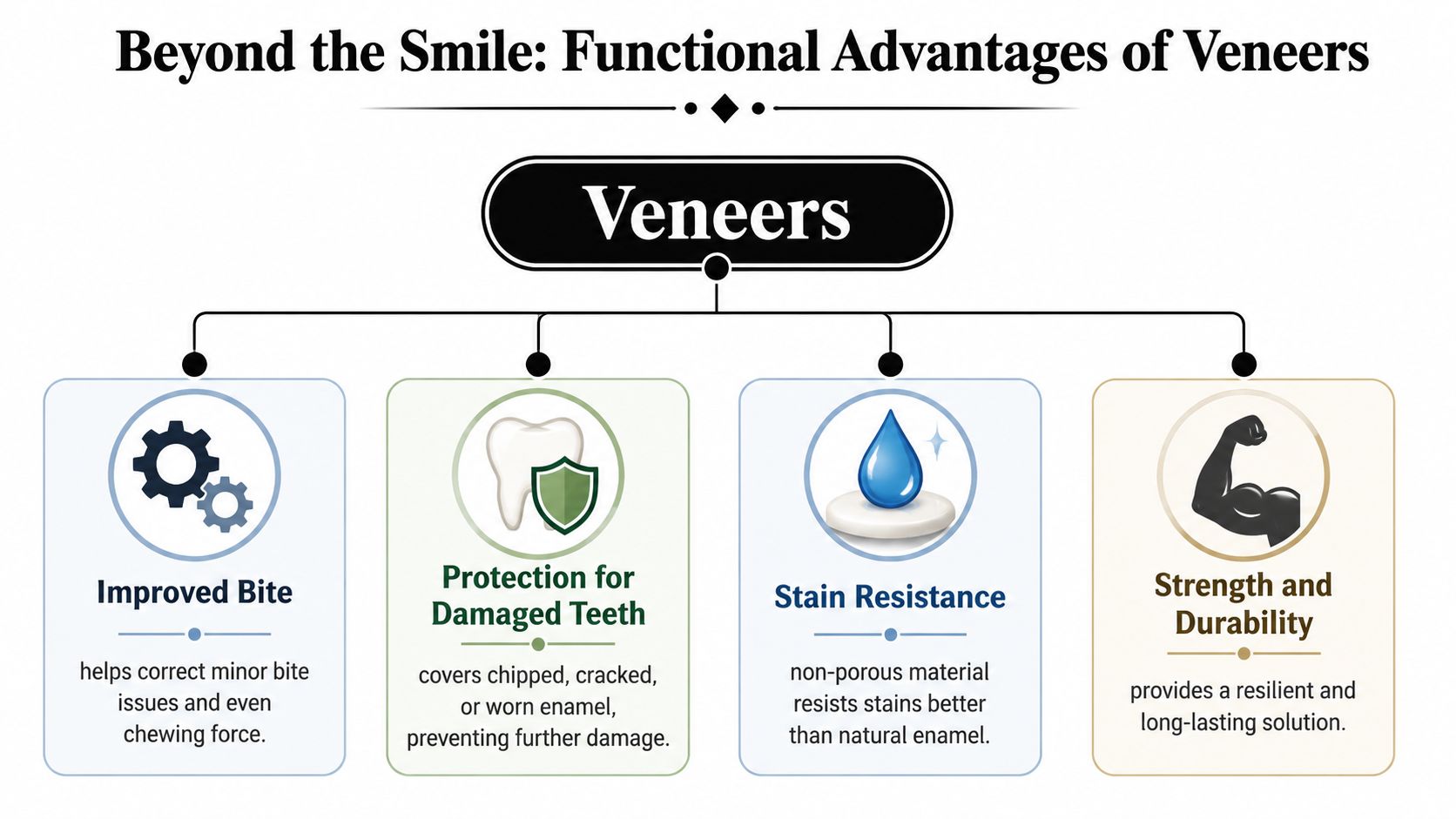
When a front tooth has a chipped corner or a worn edge, the problem isn't only visual. That damaged shape can create stress points. A thin bonded ceramic covering can restore the contour, reduce rough irregular edges, and reinforce the visible enamel surface.
Evidence-based dental references describe veneers as a way to strengthen teeth weakened by chips and wear, with the bonded ceramic layer helping reduce localized stress points and reinforce the enamel surface, as explained in this discussion of functional benefits of porcelain veneers.
Consider the act of repairing a cracked tile edge before the crack spreads. You're not rebuilding the entire floor. You're restoring the exposed surface so it handles daily use more evenly.
Where functional benefits show up in daily life
Patients usually notice the practical side of veneers in ordinary moments, not dramatic ones.
- Smoother edges: A chipped tooth edge can catch the lip or feel sharp. Restoring the contour makes the tooth feel normal again.
- Less visual and physical wear: Teeth that look flattened from grinding or age can often be rebuilt at the front surface in a conservative way.
- Better contours for cleaning: When small defects or awkward shapes are corrected, it can become easier to brush and floss around those teeth effectively.
- Resistance to everyday staining: Porcelain's low porosity helps it resist external stains from coffee, tea, and wine better than natural enamel.
When this approach is useful
Functional veneers make sense when the tooth is still structurally sound and the goal is to reinforce the front-facing enamel surface, not replace the whole tooth. They can be especially useful for:
- Minor edge wear
- Small chips or superficial cracks
- Localized enamel defects
- Teeth that need contour correction without full crown coverage
Veneers can protect a compromised front tooth, but they don't replace treatment for decay, gum disease, or heavy structural breakdown.
That distinction matters. If a tooth needs full circumferential coverage, deeper reinforcement, or true bite correction, another option is usually more appropriate.
Understanding Your Veneer Options Porcelain vs Composite
Not all veneers are made the same way. The material changes how the restoration looks, how it wears over time, and how much maintenance it may need. For most patients, the choice is between porcelain veneers and composite veneers.
Why porcelain is often chosen for long-term cosmetic work
Porcelain is a ceramic material. Peer-reviewed literature describes modern ceramic systems as valued for strength, biocompatibility, conservative preparation, and aesthetics, and notes they can often be placed in a minimally invasive way that preserves as much natural enamel as possible, as reviewed in this clinical overview of ceramic veneers.
That matters because enamel is the best surface for reliable bonding. When preparation stays conservative, veneers can act more like a bonded laminate than a full-coverage restoration. In simple terms, less healthy tooth structure has to be removed than with a crown in many cases.
Where composite fits
Composite veneers use tooth-colored resin shaped directly on the teeth. They can be a reasonable option when someone wants a quicker cosmetic improvement, a more repairable material, or a lower-cost entry point into smile enhancement.
They can look very good in the right hands. The trade-off is usually in long-term stain resistance, surface polish retention, and overall durability compared with porcelain.
Porcelain vs. Composite Veneers At a Glance
| Feature | Porcelain Veneers | Composite Veneers |
|---|---|---|
| Appearance | Highly refined, lifelike surface with strong shade stability | Can look attractive, but surface finish may change sooner |
| Durability | Generally favored when longevity is the priority | More prone to wear and maintenance over time |
| Stain resistance | Better resistance to external staining | More likely to pick up discoloration |
| Preparation | Often conservative and enamel-preserving in the right case | May involve little to modest preparation, depending on design |
| Repairs | More difficult to patch directly if damaged | Easier to modify or repair chairside |
| Treatment style | Common choice for comprehensive smile design | Common choice for selective cosmetic correction |
For a closer patient-focused breakdown, this page on the difference between porcelain and composite veneers explains how the materials compare in practical terms.
Decision rule: Choose based on your goals, not only on speed. If shade stability and long-term surface quality matter most, porcelain usually makes more sense. If flexibility and lower upfront commitment matter more, composite may be worth discussing.
Are You a Good Candidate for Dental Veneers?
Veneers can be an excellent treatment for the right patient and a poor shortcut for the wrong one. Candidacy matters as much as technique. The best results happen when the teeth and gums are healthy, the enamel is suitable for bonding, and the cosmetic goals match what veneers can do.
Signs veneers may be a good fit
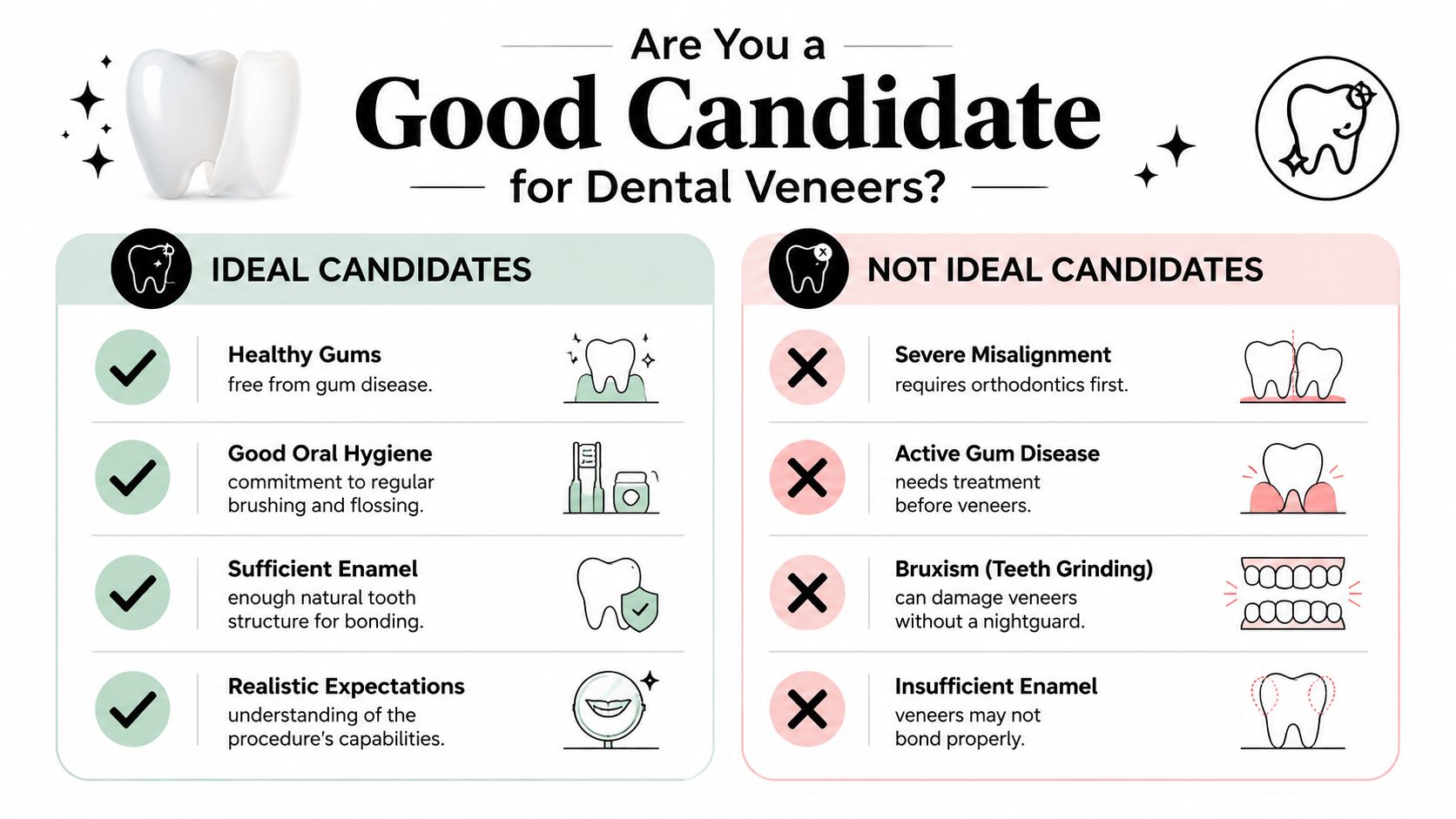
Evidence-based patient guidance notes that veneer benefits are highest for people with localized enamel defects, minor spacing, or chips, while veneers aren't recommended for patients with underlying oral health problems or complex orthodontic needs, as outlined in this CareCredit veneer guide.
In practice, good candidates often have concerns like:
- Front tooth chips
- Teeth that are uneven in shape or size
- Staining or discoloration that hasn't responded well enough to whitening
- Small gaps
- Mild visual misalignment
A patient also needs enough healthy enamel for strong bonding. Veneers work best when the tooth is a stable base, not when it's already heavily broken down.
When another treatment should come first
Some situations call for a different plan before veneers are even considered.
- Active gum disease: inflamed or unhealthy gums need treatment first.
- Untreated decay: bonding over a diseased tooth doesn't solve the underlying problem.
- Severe grinding: heavy bruxism can overload veneers unless managed carefully.
- Major crowding or bite problems: orthodontics or more extensive restorative treatment may be more appropriate.
- Insufficient enamel: bonding becomes less predictable when the substrate isn't ideal.
Realistic expectations matter
Veneers can improve how teeth look and provide limited surface reinforcement in the right case. They do not move roots, cure clenching, or replace foundational dental care.
A strong veneer plan starts with an honest answer to one question: are we enhancing healthy teeth, or trying to hide a larger problem?
That's the difference between a result that stays stable and one that creates avoidable complications.
The Veneer Process Longevity and Long-Term Care
A patient often arrives with the same concern. They want a better smile, but they also want to know what daily life looks like after treatment and whether the result will hold up. That part matters just as much as the before-and-after photo.
What happens during treatment
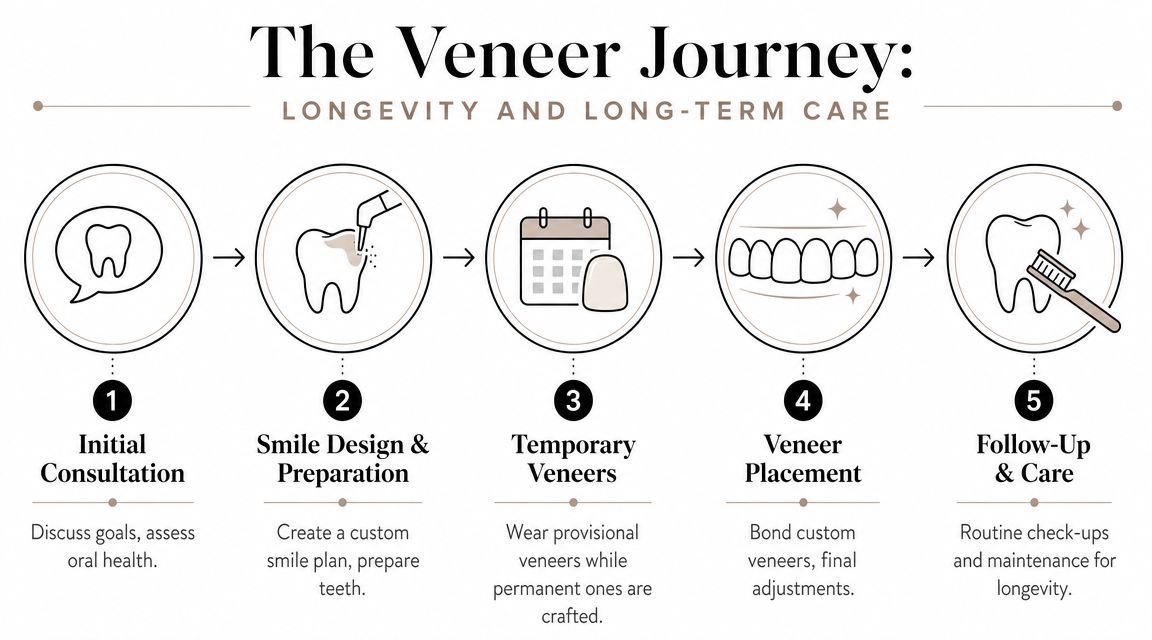
The process usually starts with planning, not drilling. The teeth, gums, and bite all need to be healthy and stable before veneers are placed, because a good cosmetic result depends on a solid foundation. If I see signs of clenching, gum inflammation, or an uneven bite, I address that first or build it into the treatment plan.
Next comes smile design and tooth preparation. A small amount of enamel is often reshaped so the veneer has room to sit naturally and blend with the rest of the smile. Digital scans or impressions are then used to guide fabrication, and that step affects more than appearance. It also influences how the veneers meet when the patient bites, speaks, and chews.
Temporary veneers are often part of the process.
They protect the prepared teeth and let the patient test-drive the new shape and length before final bonding. That preview is useful because small changes at this stage can make the final result look more natural and feel more comfortable.
At the bonding visit, each veneer is evaluated individually for fit, shade, contour, and bite contact. That last part is easy to overlook, but it is one of the reasons veneers can offer both aesthetic improvement and practical support. A veneer that looks beautiful but hits too hard during chewing is more likely to chip or feel wrong.
How long veneers can last
With good case selection and good habits, veneers can last many years. Porcelain usually holds its polish and color longer, while composite can be a more conservative option but may need more maintenance over time.
Longevity depends on several factors working together. The strength of the bond matters. The way the bite comes together matters. The patient's habits matter too. Someone who avoids chewing ice and wears a nightguard when recommended usually gives veneers a much better chance of staying intact.
That balance is important to understand. Veneers are durable, but they are not indestructible.
Habits that protect your investment
Long-term care is usually straightforward and very manageable.
- Brush and floss every day: Veneers cover the front surface of the tooth, but the tooth and gumline still need normal care. Healthy gums keep the margins looking clean and natural.
- Avoid using teeth as tools: Tearing open packages, biting nails, or holding objects with the front teeth puts unnecessary stress on the edges.
- Use caution with very hard foods: Ice, hard candy, and similar habits can create small fractures or edge chips.
- Wear a nightguard if it is recommended: Grinding places repeated pressure on veneers and on the natural teeth supporting them.
- Keep regular checkups: Small bonding changes, bite shifts, or early wear are easier to correct before they become larger problems.
The long-term goal is simple. Veneers should improve how the smile looks and support comfortable day-to-day function. When the planning is careful and the maintenance is consistent, patients usually find that caring for veneers feels a lot like caring for natural teeth, just with a little more intention.
Begin Your Smile Makeover at Grand Parkway Smiles
The benefits of veneers aren't limited to looking better in photos, although that matters to many patients. In the right case, veneers can refresh color, improve symmetry, repair visible wear, and restore confidence in a smile that has felt like a source of stress for years.
What matters most is choosing the right case and the right plan. Some patients need porcelain veneers for long-term smile design. Others are better served by whitening, bonding, orthodontic treatment, gum contouring, or restorative care before cosmetics are considered. Good cosmetic dentistry is conservative, honest, and specific to the person sitting in the chair.
At a practice where diverse needs are addressed, that evaluation can happen in one place. That's useful for patients who may need input beyond appearance alone, especially if bite wear, old dental work, enamel loss, or anxiety about treatment are part of the picture. Technology such as digital smile planning and 3D imaging can help the team assess fit, function, and aesthetics more precisely, while sedation options can make care much easier for nervous patients.
A veneer consultation should feel clear, not sales-driven. You should leave knowing whether veneers are a smart option for your smile, what trade-offs come with each material, and what kind of result is realistic for your face, teeth, and long-term dental health.
If you're considering veneers and want a treatment plan built around both appearance and oral health, schedule a consultation with Grand Parkway Smiles.