A dental filling usually costs $150 to $300 per tooth, and if you have dental insurance, you’ll often pay $50 to $150 out of pocket. The final price depends mostly on the filling material you choose and how large the cavity is, including how many tooth surfaces need repair.
The question of how much a filling costs often arises right after hearing some version of, “You’ve got a cavity.” That moment can bring two worries at once. One is your tooth. The other is your budget.
The good news is that fillings are one of the most straightforward ways to protect both. When you understand what drives the fee, what options affect appearance and durability, and how payment works in Katy and the Houston area, the decision feels much less stressful.
Understanding the Cost of a Dental Filling
A filling sounds simple, but the bill can vary more than patients expect. The reason is that a filling isn’t one identical product. Your dentist is repairing a specific tooth, in a specific location, with a specific material, and the amount of damage matters.
For patients with dental insurance, out-of-pocket cost for a filling typically falls between $50 and $150 per tooth, while the national average is $259 per filling for patients overall, and 99% of patients choose tooth-colored composite fillings for a natural look, according to Aspen Dental’s filling cost overview. That preference makes sense. Individuals generally want a restoration that blends into their smile, especially if the tooth shows when they talk or laugh.
What patients are really paying for
You’re paying for more than the material placed in the tooth. You’re also paying for:
- Diagnosis: finding the cavity and judging its depth and shape.
- Precision work: removing decay while preserving healthy tooth structure.
- Tooth restoration: rebuilding the tooth so you can bite and chew normally again.
- Appearance: choosing whether the filling blends with your natural enamel.
- Planning: matching treatment to your insurance, savings plan, or financing options.
Practical rule: Ask for the estimate before treatment begins, and ask what factors could change it. A clear answer usually means a clear process.
For patients who like to understand the business side of healthcare costs in more detail, there are useful discussions on essential financial resources for medical practices that help explain why treatment pricing can look different from office to office.
The most useful way to think about filling cost
Don’t look at the number in isolation. Look at what the filling helps you avoid. A filling restores the tooth while the problem is still manageable. It also gives you a chance to choose the balance that fits you best: lower upfront cost, better appearance, or stronger long-term durability.
Why a Filling is a Critical Health Investment
A cavity doesn’t stay frozen in place. If decay is left alone, it usually gets deeper and removes more healthy tooth structure over time. That’s why a filling is less like buying an accessory and more like fixing a small roof leak before water damages the whole room.
Small repair now, bigger problem later
When a cavity is still limited, a filling can seal and rebuild the tooth efficiently. That protects the nerve, restores chewing strength, and helps you clean the area more effectively at home. Waiting often means the tooth becomes weaker, more sensitive, or more likely to crack.
Patients often focus on price first, which is understandable. But the underlying question is usually this: “What does it cost me if I delay?” In dental health terms, delay can mean pain, infection, more structural loss, and fewer simple options.
Treating a cavity early usually preserves more natural tooth and gives you more conservative choices.
Health and appearance both matter
A filling doesn’t just stop decay. It also helps restore normal daily function.
That matters in ways patients notice quickly:
- Chewing comfort: Food stops catching in the damaged area as easily.
- Sensitivity control: Cold or sweet sensitivity may improve once the cavity is sealed.
- Tooth strength: The remaining tooth is supported instead of left hollowed out.
- Smile appearance: Tooth-colored materials can keep the repair discreet.
For visible teeth, appearance isn’t vanity. It’s part of feeling comfortable when you smile, speak, or sit in a meeting without thinking about a dark spot in your tooth.
Why the “watch it and wait” approach often fails
There are times when monitoring a very early area makes sense. But once a cavity clearly needs a filling, waiting doesn’t usually make the treatment cheaper or simpler. Decay tends to spread through weak areas rather than stop on its own.
That’s why a filling is best viewed as a health investment. You’re protecting the tooth you already have. In dentistry, keeping healthy natural tooth structure is almost always the most valuable outcome.
A Detailed Breakdown of Filling Costs by Material
Two fillings can both fix a cavity and still lead to very different long-term costs. In my office, that usually comes down to one practical question: are you paying only for today’s visit, or are you choosing the option that is likely to hold up best for that tooth over time?
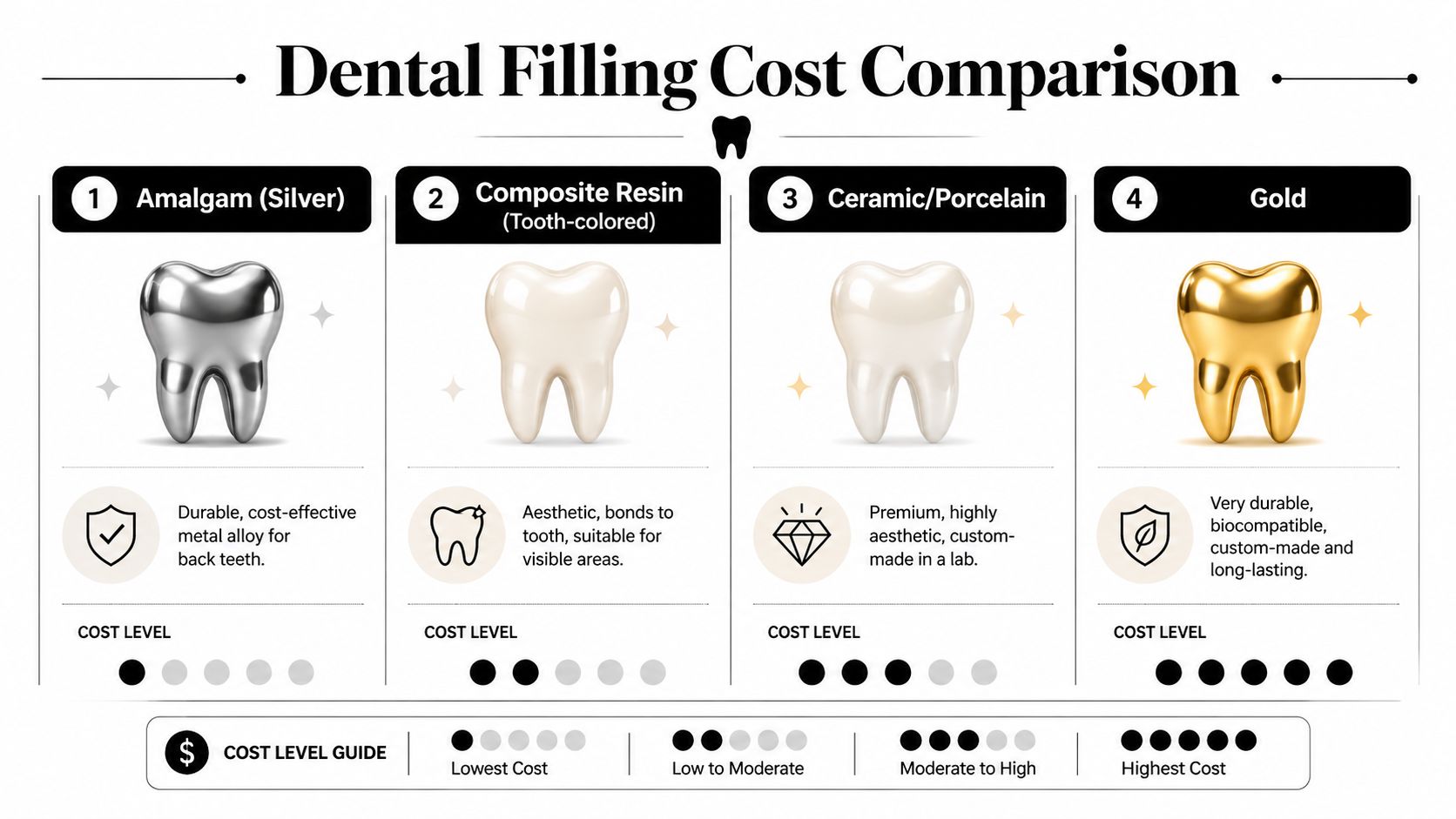
According to GoodRx’s dental filling cost guide, a dental filling commonly falls in the $150 to $300 range, with amalgam averaging about $160, composite resin about $191, gold about $400, and porcelain about $1,150 per tooth. GoodRx also notes that uninsured patients may pay $135 to $370 for a single-surface composite filling. Those numbers are useful for setting expectations, but they do not tell the whole story for Katy patients comparing appearance, durability, insurance coverage, and how likely a material is to avoid a larger future expense.
The main filling materials
Amalgam
Amalgam is the traditional silver-colored filling. It has been used for many years and is often one of the lower-cost options for back teeth.
Its main advantage is function at a modest upfront fee. Its main drawback is visibility. Some patients are comfortable with that in a molar. Others are not.
Composite resin
Composite is the tooth-colored option many patients choose today. It blends with natural enamel, bonds directly to the tooth, and often allows for a more conservative repair.
For small to moderate cavities, especially in visible areas, composite is often the best balance of appearance and practicality. If you want to learn more about tooth-colored dental fillings, this is usually the material people mean.
Porcelain
Porcelain restorations are usually used when a tooth needs a more customized, lab-made solution rather than a simple direct filling placed in one visit. They can look very natural and wear well in the right case.
The trade-off is price and process. Porcelain usually costs more upfront and may involve more than one step.
Gold
Gold is less common now, but it still performs well over time in selected cases. Some patients choose it because of its track record and durability.
The trade-off is obvious. It is visible, and it is usually not the economical choice at the start.
Cost, lifespan, and who each material fits best
Material choice is where total cost of ownership starts to matter. A lower initial fee can still become the more expensive path if the restoration fails earlier, leaks, chips, or needs replacement sooner on a high-pressure chewing surface. A higher initial fee can make sense if it lasts longer in the right tooth and helps you avoid repeat treatment.
The Cleveland Clinic notes that fillings can be made from amalgam, composite, ceramic, and gold, and that they may last up to 20 years depending on the material and the amount of wear they take over time. The same source explains that durability varies by material and by where the filling sits in the mouth, which is exactly why the cheapest option on paper is not always the least expensive choice over several years. Cleveland Clinic’s overview of dental fillings is a helpful reference for those differences.
| Dental Filling Cost & Longevity Comparison (2026 Estimates) | |||
|---|---|---|---|
| Material Type | Average Cost per Filling | Expected Lifespan | Best For |
| Amalgam | Lower-cost range in many offices | Often durable for back teeth | Patients prioritizing function and upfront savings |
| Composite resin | Mid-range cost in many offices | Varies with bite pressure and size of filling | Visible teeth and patients who want a natural look |
| Porcelain | Higher upfront cost | Often chosen for longer-term aesthetics and wear resistance | Larger cosmetic restorations and customized treatment |
| Gold | Higher upfront cost | Known for long service in the right case | Patients focused on longevity over appearance |
The total cost of ownership matters
In Katy and the Houston area, I usually encourage patients to compare three numbers, not one. Start with the fee for today. Then ask how long the material is likely to serve in that specific tooth. Then ask what happens financially if it fails and the tooth needs a larger restoration later.
That is the roadmap that helps people make a smart decision for both health and budget. If you have insurance, an in-house membership plan, or monthly financing available, a stronger or more aesthetic option may be more realistic than it first appears.
Key Factors That Influence Your Final Price
Two patients in Katy can both hear, “You need a filling,” and still leave with very different estimates. The reason is simple. The fee reflects how much tooth has to be rebuilt, how difficult the area is to restore well, and what it takes to make that repair hold up under daily chewing.

Surface count changes the fee fast
A one-surface filling is usually the lower end of the range. A filling that covers two or three surfaces takes more time, more material, and more precision to shape so food does not trap and your bite still feels normal.
That difference matters more than many patients expect. If decay starts on the chewing surface but also spreads between teeth, the restoration becomes a larger project. In practical terms, the price rises because the appointment is more involved, not because the office is charging for the same procedure twice.
Other variables that affect the estimate
Surface count is only one part of the quote. I also look at whether the tooth is easy to isolate, whether the cavity is close to the nerve, and how much healthy structure is left to support the filling.
A few common price drivers include:
- Tooth location: Back molars are harder to reach and usually take more working time than front teeth.
- Depth of decay: Deeper cavities may need liners, bases, or extra steps to protect the tooth.
- Tooth condition: A tooth with old fillings, cracks, or weakened walls often requires a more careful rebuild.
- Contact with neighboring teeth: Restoring between teeth takes more technique than repairing a simple pit on top.
- Bite pressure: Heavy clenching or grinding can influence the material choice and the design of the filling.
- Comfort options: Numbing is standard, but some patients choose additional comfort measures that affect the total.
Why estimates can differ between patients
A quick phone quote is only a starting point. Until the dentist examines the tooth and reviews the X-rays, no one can tell whether the cavity is small and straightforward or whether it wraps around the tooth and sits close to the nerve.
This is also where total cost of ownership comes in. A larger, high-stress filling on a molar may need a different plan than a tiny filling on a front tooth. Choosing the lowest upfront fee can work well in the right case, but in other cases it raises the chance of replacement, fracture, or a future crown. For families trying to balance health and budget in Katy and the Houston area, that bigger picture often matters more than the first number on the estimate.
If you do not have coverage, it helps to find affordable dental insurance or ask your dental office about membership plans and financing before treatment starts.
One practical question clears up a lot of confusion: ask whether the estimate is for one surface, two surfaces, or more. That tells you far more than a generic price range ever will.
Navigating Insurance and Flexible Payment Options
For many families, this is the section that matters most. The filling may be necessary, but the practical question is still, “How do I pay for it without derailing the month?”

What insurance usually changes
Dental insurance often moves fillings from a major expense to a manageable one. According to Humana’s cavity filling cost guide, insured patients typically pay $50 to $150 out of pocket, compared with the full procedural cost of $200 to $335 for uninsured patients. The same source notes that this is a 65% to 75% reduction.
That’s a meaningful gap. It also explains why checking coverage before treatment is worth the effort.
If you have a PPO plan, ask these questions before your appointment:
- Is the office in network or out of network?
- Is composite covered on this tooth, or only amalgam-level reimbursement?
- Have you met your deductible?
- How much of your annual maximum is still available?
Options if you don’t have insurance
No insurance doesn’t mean you have to postpone care. Many patients use a mix of practical tools to keep treatment affordable.
Common approaches include:
- In-house savings plans: These can reduce the cost of routine and restorative care for patients who prefer a membership-style option.
- Third-party financing: This spreads the cost over time instead of requiring one larger payment at once.
- Treatment prioritization: If multiple teeth need work, dentists can often help sequence treatment by urgency.
- Insurance shopping: If you’re comparing plans, a guide to find affordable dental insurance can help you understand basic plan types and cost-conscious options.
The key is not to let uncertainty stop the conversation. Most dental offices can explain your estimate in plain language and show you more than one way to move forward.
A practical roadmap for Katy and Houston families
Patients in this area usually do best when they look at filling cost in this order:
- Start with insurance benefits if you have them.
- Compare the material recommendation to your goals for appearance and longevity.
- Ask about in-house savings options if you’re uninsured or underinsured.
- Use financing for larger treatment plans when spacing payments makes care easier to accept.
That approach keeps the decision grounded in both dental health and real household budgeting.
What to Expect During Your Filling Appointment
A lot of anxiety comes from not knowing what’s going to happen once you sit in the chair. The process is usually much more routine and comfortable than patients expect.

The visit from start to finish
A typical filling appointment starts with an exam and any imaging needed to confirm the cavity’s size and location. Once the dentist reviews the tooth, you’ll talk through the material choice and the expected result.
Next comes numbing the area. Local anesthetic is used so the treatment is comfortable. After the tooth is numb, the decayed portion is removed, the area is cleaned, and the filling material is placed and shaped.
If you’d like a simple overview of the procedure itself, this page on filling a cavity walks through the basics in patient-friendly language.
What the dentist checks before you leave
Once the filling is in place, the dentist will polish it and check your bite. That step matters more than people realize. A filling that feels even slightly high can make chewing uncomfortable, so fine adjustments are a routine part of getting the result right.
Patients often notice a few immediate benefits after the appointment:
- A smoother tooth surface
- Less food trapping
- Improved comfort when chewing
- A more natural appearance if tooth-colored material was used
If you’re nervous about dental treatment
Dental anxiety is common. Some patients are calm once they understand each step. Others prefer additional comfort measures.
A good filling appointment should feel predictable, well explained, and controlled. You shouldn’t feel like things are happening to you without context.
For patients with stronger anxiety, many practices also offer sedation options. If that’s you, it’s worth bringing up before the appointment instead of trying to “push through” it. Comfortable dentistry usually starts with a clear conversation.
When a Filling Is Not the Right Solution
Not every damaged tooth can be restored with a simple filling. Sometimes the cavity is too large, the tooth has lost too much structure, or the remaining enamel and dentin won’t support a direct filling well.
Signs a larger restoration may be better
A dentist may recommend something beyond a filling when:
- Too much tooth structure is missing: The tooth may need more coverage and support.
- The cavity is very extensive: A filling may not be strong enough for long-term chewing forces.
- A cusp is weakened or cracked: The tooth may need protection that wraps over the biting surface.
- The existing filling is already very large: Replacing it with another direct filling may not be the most durable move.
In those situations, inlays, onlays, or crowns may provide a more stable result.
Why that recommendation can still save money
Patients sometimes feel frustrated if they expected a filling and hear they need something larger. But this usually reflects tooth condition, not upselling. A restoration has to match the amount of damage.
If the tooth can’t reliably hold a filling, choosing the “cheaper” option first may only delay a more appropriate repair. Good dentistry isn’t just about doing the least expensive treatment today. It’s about doing the treatment that gives the tooth the best chance to function well over time.
Your Next Step to a Healthy Smile in Katy TX
If you’ve been wondering how much does a filling cost, the clearest answer is that most fillings fall in the $150 to $300 range, while many insured patients pay $50 to $150 out of pocket. But the number that matters most for your own case depends on material, cavity size, tooth location, and how the tooth needs to function after it’s restored.
The best decisions usually come from looking beyond the sticker price. A filling protects your tooth, helps maintain normal chewing, and can preserve the natural look of your smile. That’s especially true when treatment happens before the cavity becomes a larger structural problem.
If you’re comparing local providers, online reviews and local visibility often shape where patients begin their search. For practice owners and healthcare teams interested in that side of patient access, this guide on how to rank higher in local search offers a practical look at why nearby patients find one office over another.
For you as a patient, the next move is simpler. Get the tooth evaluated, ask for a clear estimate, and choose the option that fits both your oral health and your budget. Waiting rarely improves the situation. Early treatment usually gives you the most conservative, most affordable path.
If you’re in Katy or the greater Houston area and want a personalized quote for a filling, Grand Parkway Smiles can help you understand your options, explain the trade-offs clearly, and create a treatment plan that fits your smile and your budget.