When you're thinking about a dental implant, one of the first questions that usually comes to mind is, "How long is this actually going to last?" It’s a great question. The short answer is that with proper care, the titanium implant post itself—the part that fuses with your jawbone—is designed to last a lifetime.
The crown on top, which gives you a beautiful, natural-looking tooth, typically has a lifespan of 10 to 15 years before it might need to be replaced due to normal wear and tear.
Unpacking the True Lifespan of Your Dental Implant
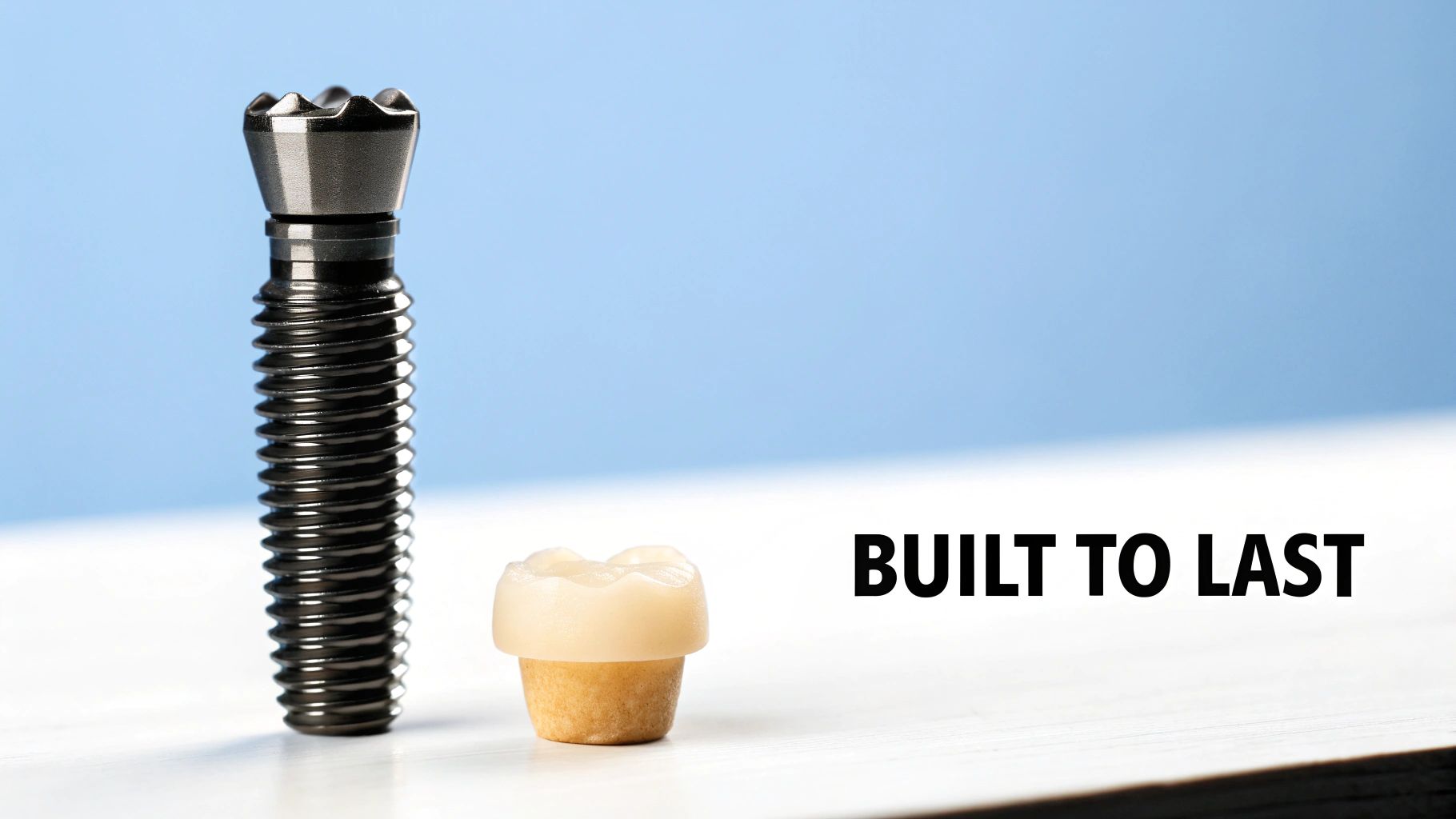
When you get a dental implant, you’re not just getting a single piece. It’s a sophisticated two-part system engineered for incredible durability and a natural look. Breaking down these two components is the key to understanding why implants are such a fantastic long-term solution for restoring your smile and oral health.
The Implant Post: A Lifelong Foundation
Think of it like building a house. The titanium implant post is the permanent foundation for your new tooth. We surgically place it into your jawbone, where it fuses directly with the bone through a natural process called osseointegration.
This creates an incredibly strong and stable anchor that acts just like a natural tooth root. Because this foundation literally becomes part of your jaw, it’s built to last for decades—often for the rest of your life—providing a permanent base for a beautiful smile.
The Crown: The Visible Part of Your Smile
The second part is the crown, the tooth-colored portion you see that attaches to the implant post. Sticking with our house analogy, the crown is like the roof. It’s made from tough, durable materials designed to handle the daily grind of biting and chewing while looking completely natural.
But just like a roof, it’s exposed to constant wear and tear. Over time, this means the crown will eventually need to be replaced. While the implant post stays put, the crown typically lasts between 10 and 15 years, ensuring your smile looks great and functions perfectly for a very long time.
To give you a clearer picture, let's compare the lifespan of different dental solutions.
Dental Implant Lifespan At a Glance
This table breaks down how long you can expect dental implant components to last compared to other common tooth replacement options, highlighting their impact on your oral health and appearance.
| Tooth Replacement Option | Average Lifespan | Key Considerations |
|---|---|---|
| Dental Implant Post | Lifetime | Becomes a permanent part of your jawbone, preserving your facial structure. |
| Dental Implant Crown | 10-15 years | Restores the natural look of your smile; easily replaceable. |
| Traditional Bridge | 5-15 years | Requires altering healthy adjacent teeth; can fail if anchor teeth decay. |
| Partial/Full Dentures | 5-10 years | Can accelerate jawbone loss, affecting the fit and your facial appearance. |
As you can see, the implant post itself is in a class of its own when it comes to permanence. This is what makes it such a powerful investment in your long-term oral health and the beauty of your smile.
A dental implant offers more than just a cosmetic fix; it restores the full function of a natural tooth. This allows you to eat, speak, and smile without hesitation, significantly boosting your quality of life and self-assurance.
The success rates back this up. The data on implant longevity is impressive, with studies showing that the implant posts have a remarkable survival rate. Some research points to a 95.6% survival rate over a period of 38 to 40 years. This really highlights the incredible permanence of the implant itself, far outlasting other tooth replacement options.
You can learn more about the findings on dental implant longevity and see why they are considered such a reliable and lasting solution for your smile.
The Science Behind a Lasting Implant Smile
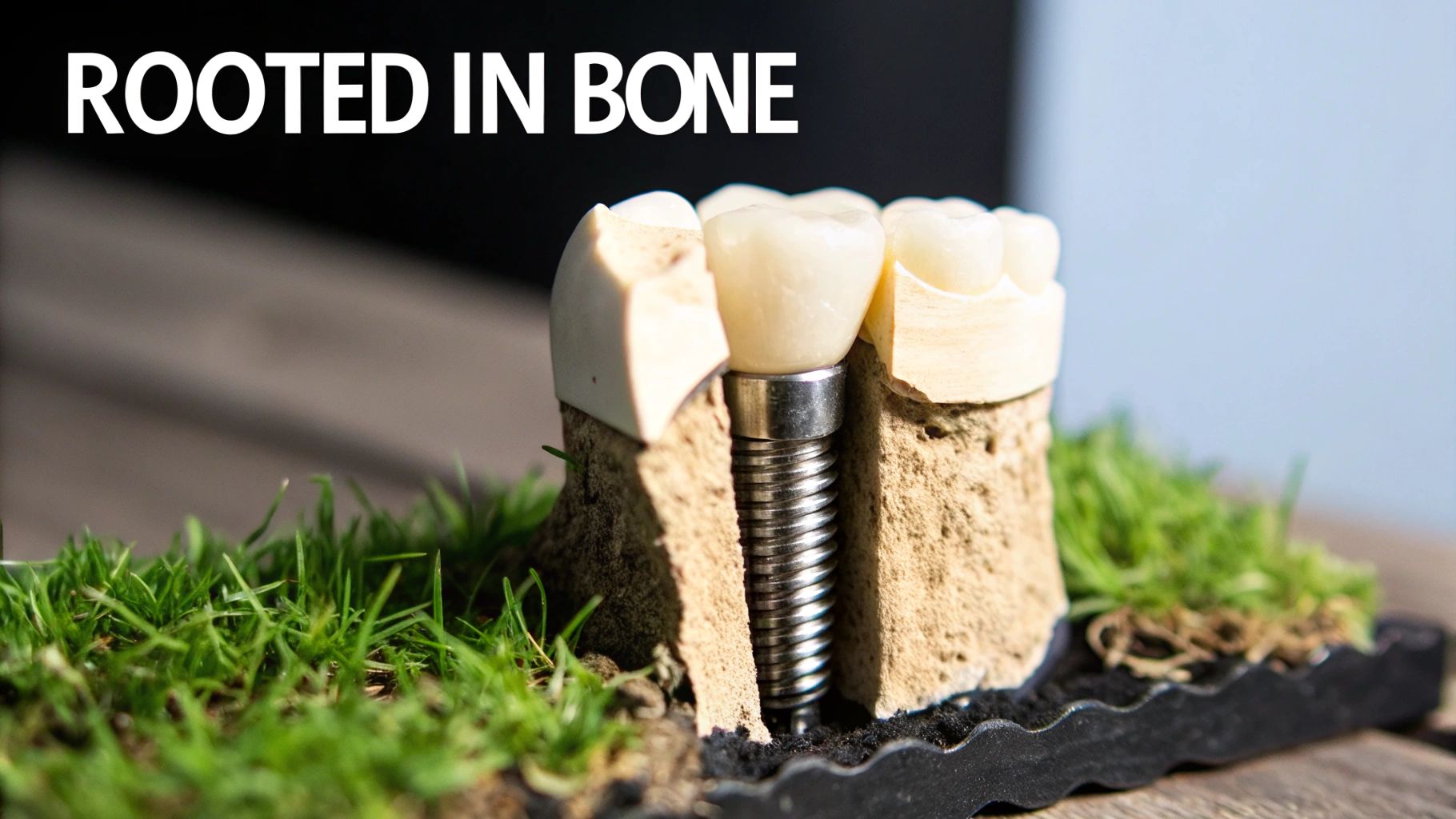
So, what’s the secret sauce that makes a dental implant so incredibly strong and long-lasting? It all comes down to a natural biological process called osseointegration. It might sound a little scientific, but this process is the entire reason an implant can last for decades and provide such incredible benefits for your health and appearance.
Think about a healthy, mature tree. Its roots don't just sit loosely in the ground; they actively grow into the soil, weaving themselves into the earth until the tree is a solid, immovable part of the landscape. Osseointegration is surprisingly similar. The implant post, typically made from a body-friendly material like titanium, is carefully placed into your jawbone.
Over the next few months, something amazing happens. Your body's own bone cells recognize the titanium post and begin to grow directly onto its surface, fusing with it. This creates an incredibly strong, living bond between your bone and the implant. In essence, the implant becomes a brand-new, man-made tooth root, anchored with the same kind of stability as your natural teeth.
More Than Just a Stable Tooth
This fusion is what gives an implant its rock-solid stability, but the benefits for your health and appearance go much deeper. When you lose a tooth, the part of the jawbone that used to hold it in place suddenly has no job to do. It’s no longer getting the stimulation it needs from daily chewing.
Without that stimulation, the bone begins to shrink away, or resorb. This process, called bone atrophy, can dramatically change your appearance over time.
Jawbone loss can alter the very structure of your face, leading to a sunken or prematurely aged look. Because dental implants mimic the function of a natural tooth root, they provide the stimulation needed to keep your jawbone strong and healthy, which helps preserve your natural facial contours.
This active preservation of your jawbone is a benefit you only get with dental implants. Other options like dentures and bridges are great for filling the gap in your smile, but they simply rest on top of the gums. They don't engage the jawbone below, which means bone loss can continue unchecked, often causing these appliances to fit poorly and need frequent adjustments over the years.
The Foundation for a Healthy Smile
By preventing bone loss, dental implants create a solid foundation not just for the replacement tooth, but for your entire oral health. This powerful process brings a few key benefits for your appearance and well-being:
- Protecting Adjacent Teeth: Implants are standalone solutions. They don't need to lean on neighboring teeth for support, unlike dental bridges, which require us to shave down perfectly healthy teeth to anchor the bridge.
- Maintaining Facial Structure: By keeping your bone density intact, implants support your cheeks and lips from the inside out. This helps you maintain a more youthful and natural appearance for years to come.
- Ensuring Long-Term Stability: The direct fusion with your bone means no slipping, no clicking, and no shifting. You get the confidence to eat, speak, and laugh without a second thought.
Understanding how osseointegration works really puts into perspective how long dental implants last and why they’re seen as the gold standard for replacing missing teeth. To learn more, you can explore our detailed guide on the factors influencing dental implant success. This foundational process restores more than just a tooth—it restores the entire biological system that supports a healthy, vibrant smile.
What Determines How Long Your Implants Really Last?
While dental implants are built to be incredibly tough, ensuring they last a lifetime is a partnership between the skill of your dental team and your own commitment to your health. A few key factors all play a role in determining your implant's success, from the first day of healing to its performance decades later.
When you understand these elements, you can take an active role in protecting your investment and enjoying the benefits of a full, confident smile for years to come. The goal is to create a healthy environment where your implant can thrive.
Your Health and Daily Habits Are Everything
Believe it or not, the single most important factor in your implant's success is you. Your body's ability to heal and the choices you make every day have a huge impact on the health of the bone and gums that support your beautiful new tooth.
First and foremost, excellent oral hygiene is non-negotiable. The implant itself can't get a cavity, but the gums around it are still vulnerable. If plaque builds up, it can lead to an infection called peri-implantitis. Left untreated, this infection can damage the jawbone, causing the implant to become loose and eventually fail.
Think of peri-implantitis as the kryptonite for dental implants. It’s a serious form of gum disease specific to implants that can quietly destroy the strongest foundation if you don't stay on top of your cleaning routine, jeopardizing your beautiful smile.
Lifestyle choices matter, too. Smoking is one of the biggest risks for implant failure because it restricts blood flow to your gums and bone. This slows down healing right after surgery and makes it harder for your body to fight off infections down the road, compromising the health and stability of your implant.
Certain health conditions can also get in the way. For example, uncontrolled diabetes can impair your body's natural healing process and increase your risk of infection, making it tougher for the implant to stay firmly anchored for the long haul.
The Skill Behind the Surgery
The experience and precision of your dental surgeon lay the groundwork for your implant's long-term success. Placing an implant is a highly technical procedure that demands meticulous planning to ensure a beautiful and functional outcome.
A great surgeon will use advanced tools, like 3D CBCT scans, to get a perfect picture of your jawbone. This allows them to map out the ideal spot to place the implant, ensuring it goes into the strongest bone at just the right angle to support the final crown.
This precision is critical for a few reasons:
- Maximum Bone Support: Placing the implant in a dense part of the jaw ensures it can handle the powerful forces of chewing for decades.
- Protecting Vital Structures: Careful mapping helps avoid any damage to nearby nerves, sinuses, or the roots of adjacent teeth.
- Perfecting Your Bite: The implant must be angled to align with your natural bite, which ensures a comfortable function and a seamless appearance.
The quality of the materials is also a big deal. Using high-grade, biocompatible titanium for the implant post and strong, natural-looking porcelain or zirconia for the crown makes a huge difference in how long your new tooth will last and how beautiful it will look.
Your Jawbone and the Implant's Location
The condition of your jawbone is the literal foundation for your dental implant. For the implant to be successful, it needs to go through osseointegration, where your bone actually fuses to the titanium post. This can only happen if you have enough healthy bone volume and density to start with.
If a tooth has been missing for a while, the jawbone in that spot often starts to shrink. In these cases, a bone grafting procedure may be needed first to rebuild the area. This extra step creates a solid base and dramatically improves the chances of your implant lasting a lifetime, supporting a healthy and complete smile.
Finally, where the implant is in your mouth matters. Implants replacing front teeth usually don't have to work as hard as those in the back. Your molars do all the heavy lifting when you chew, so implants there have to withstand much greater forces. A well-placed implant is designed for this, but the extra stress can sometimes affect the lifespan of the crown over many years.
When all these factors are managed well, the results are incredible. Long-term studies show just how durable implants can be. One major meta-analysis found that even after two decades, the survival rate for dental implants was 88%. That means nearly 4 out of 5 implants are still going strong after 20 years, a testament to their strength when properly placed and cared for. You can dive into these long-term implant survival findings to see the data for yourself.
Comparing the Durability of Tooth Replacement Options
When you're looking at ways to replace a missing tooth, it's natural to focus on the immediate cost and how it will look. But the real value of any solution is found in its durability and the long-term impact it has on your overall dental health and appearance. Let's break down how dental implants really stack up against older methods like bridges and dentures.
Choosing a tooth replacement is about investing in your future health and confidence. While other options can fill a gap, only dental implants address the underlying issues of tooth loss, providing a permanent, foundational solution for your smile.
Implants Versus Dental Bridges
A traditional dental bridge has long been a go-to for filling a gap left by a missing tooth. The concept is straightforward: a false tooth (called a pontic) is held in place by crowns anchored to the healthy teeth on either side of the gap. While it works, this approach comes with a pretty big compromise for your dental health.
To place a bridge, a dentist has to shave down the enamel of those two adjacent—and often perfectly healthy—teeth to fit the crowns. This permanently alters their natural structure and, unfortunately, makes them more vulnerable to decay down the road.
Bridges typically last somewhere between 5 and 15 years before they need to be replaced. And usually, the failure isn't with the bridge itself but with the anchor teeth, which can develop cavities or gum problems. Implants, on the other hand, are completely independent. They don't rely on or damage your neighboring teeth, which is a huge win for preserving your natural smile.
As you can see, the recipe for success is in your hands. Consistent hygiene, choosing an experienced dentist, and keeping yourself healthy are the keys to making your implant last a lifetime, ensuring a beautiful, healthy smile for years to come.
Implants Versus Dentures
Dentures are removable appliances that sit on top of the gums. They're a fast and often more affordable way to replace several teeth at once, but they have some well-known drawbacks when it comes to function and your long-term appearance.
Because they aren't anchored to anything, dentures can slip or shift when you're eating or talking, which can be both uncomfortable and embarrassing. But the bigger issue is what you can't see: they do absolutely nothing to stop the jawbone loss that happens after you lose your teeth. Over time, your jaw shrinks and changes shape, causing dentures to become loose and affecting your facial profile. This means frequent trips for relinings or complete replacements, often every 5 to 10 years.
In stark contrast, dental implants actually fuse with your jawbone. This process provides the stimulation your bone needs to stay strong and healthy, preserving your facial structure and giving you a secure foundation that feels and works just like your own teeth.
Comparing Tooth Replacement Options Over Time
To really see the difference, it helps to put these options side-by-side. While the initial investment for implants is higher, their lifetime value quickly becomes clear when you consider the priceless benefit of better long-term oral health and a confident, natural-looking smile.
| Feature | Dental Implants | Dental Bridges | Full/Partial Dentures |
|---|---|---|---|
| Average Lifespan | Post: Lifetime Crown: 10-15+ years |
5-15 years | 5-10 years |
| Jawbone Health | Actively preserves bone | No protection; bone loss continues | Accelerates bone loss |
| Impact on Other Teeth | None; protects adjacent teeth | Requires altering healthy teeth | Can stress adjacent natural teeth |
| Appearance & Function | Looks and feels like a natural tooth | Can look good, but function is limited | Can look unnatural; often unstable |
| Long-Term Cost | Higher upfront, lower over time | Lower upfront, high replacement costs | Lowest upfront, ongoing expenses |
At the end of the day, while bridges and dentures can certainly restore the appearance of a smile, only dental implants get to the root of the problem by addressing the biological consequences of tooth loss. They are the only solution that truly becomes a part of you, offering unmatched stability, preserving your health, and giving you a beautiful, functional smile that is built to stand the test of time.
A Practical Guide to Protecting Your Dental Implants
Getting a dental implant is a fantastic investment in your health, confidence, and quality of life. And like any smart investment, it needs a bit of upkeep to keep your smile looking its best for years to come. The good news? Protecting your implant is actually pretty simple and fits right into the same daily habits that keep the rest of your smile healthy.
Think of it like caring for a beautiful garden; a little daily attention combined with regular professional check-ups is the secret to keeping it thriving for decades.
Your Daily Maintenance Routine
The bedrock of great implant care is a solid daily hygiene routine. While the implant itself can't get a cavity, the gums and bone holding it in place absolutely can. Your number one job is to keep that area free of plaque to prevent infections that could threaten your implant's stability and your oral health.
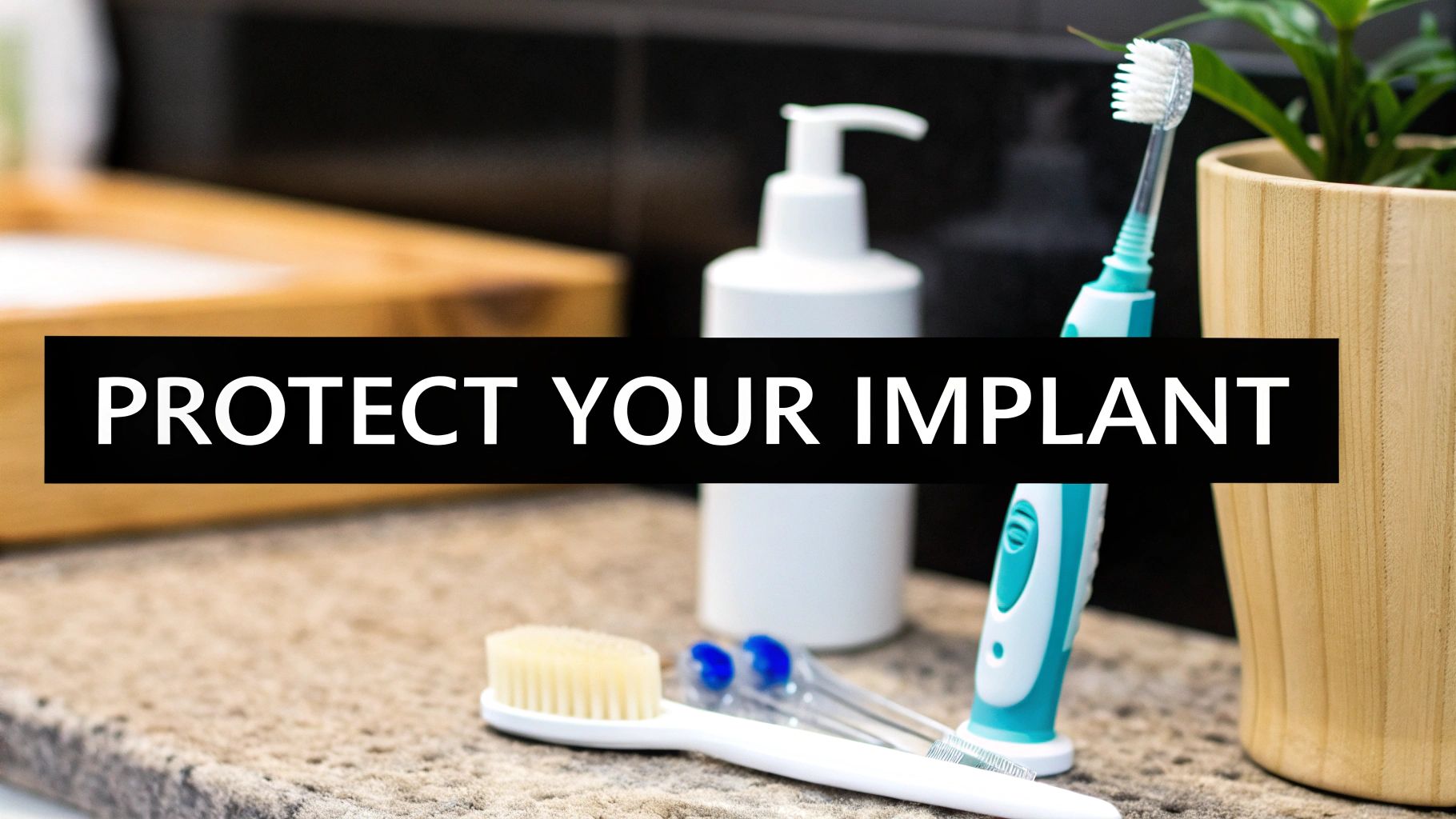
To get the job done right, you might need a few extra tools in your bathroom cabinet. These are designed to be tough on plaque but gentle on your implant and the surrounding tissues.
Your Implant Care Toolkit:
- Soft-Bristled Toothbrush: It's a must. A soft brush cleans effectively without scratching the crown or irritating the delicate gum line around the implant.
- Water Flosser: An absolute game-changer. This device uses a gentle stream of water to flush out plaque and food debris from those tricky spots around the base of the implant.
- Interdental Brushes: These little brushes are perfect for getting into the tight spaces between your implant and your natural teeth, cleaning the sides of the implant where a regular brush can't reach.
Making these tools part of your twice-a-day brushing and flossing habit creates a powerful defense against harmful bacteria. A meticulous routine is truly the best insurance for keeping your implant and the bone around it strong and healthy.
The Non-Negotiable Role of Professional Cleanings
Even with the best home care, nothing replaces a professional cleaning. Your dental hygienist has the skill and the specialized tools to remove hardened plaque—or tartar—that your toothbrush simply can't handle. These appointments are about so much more than just a cleaning; they are vital health checks for your implant.
During a professional cleaning, your dentist and hygienist can spot subtle signs of trouble that you might miss. Early detection of issues like minor gum inflammation or a loose crown allows for simple, proactive treatment before a small problem becomes a serious threat to your implant and your smile.
We strongly recommend visiting your dentist at least twice a year for these crucial maintenance appointments. Here at Grand Parkway Smiles, we use specific instruments made from materials that won't scratch or damage your implant crown, ensuring you get a deep, safe clean every single time.
For a deeper dive, check out our comprehensive guide on how to care for dental implants for more detailed tips and techniques.
Recognizing the Early Warning Signs
A huge part of protecting your investment is simply knowing what to look out for. While implant problems are uncommon, being an active partner in your oral health makes all the difference. If you notice any of the following signs, it's time to call your dentist right away.
Key Warning Signs to Monitor:
- Pain or Discomfort: A healthy implant should feel like your other teeth. Any lasting pain, especially when you bite down, is a red flag.
- Swelling or Bleeding: If the gums around your implant look red, puffy, or bleed easily, it's a classic sign of inflammation that needs to be addressed.
- Noticeable Movement: Your implant should feel rock-solid. If you can feel any wiggling or movement at all, it requires immediate professional attention.
- Difficulty Chewing: If it suddenly feels strange or uncomfortable to bite down, it could signal an issue with the crown or the implant itself.
By committing to this straightforward aftercare plan, you take control of your implant's future. Your daily habits and your partnership with our dental team are the ultimate safeguards for your beautiful, long-lasting smile.
Starting Your Implant Journey in Katy, TX
If you're in the Katy or Houston area and considering dental implants, the first step is understanding the path to a beautiful, permanent new tooth. It's a clear, patient-focused process designed to give you the best possible result. Here at Grand Parkway Smiles, we make sure you know what's happening from day one, always focusing on your comfort and a successful outcome.
Your initial consultation is really just a conversation. We’ll start with a detailed oral exam to get a complete picture of your dental health. This isn't just a quick peek—we look closely at your teeth, gums, and bite to make sure your new smile is being built on the strongest foundation possible.
Advanced Planning for a Lasting Result
When you ask, "how long do dental implants last?" the answer starts with meticulous planning. We use advanced 3D cone-beam computed tomography (CBCT) scans to get an incredibly detailed, multi-dimensional view of your jawbone. This isn't your standard x-ray.
This powerful imaging lets us measure your bone density, map out the exact location of nerves, and pinpoint the perfect spot for your implant with surgical precision. It takes all the guesswork out of the equation.
This careful planning allows us to create a treatment plan tailored specifically to you. We'll walk you through every detail, explaining how our approach will restore not just the look of your smile, but its full function, so you can eat and speak with complete confidence again.
Building Trust Through Technology and Care
Our commitment is to deliver beautiful, durable results that stand the test of time, and the data backs this up. The reliability of modern dental implants is well-documented.
Global studies show impressive cumulative survival rates of 96.7% at 5 years and 92.5% at 10 years. That's consistency you can count on. With proper care, this investment in your health and appearance will serve you well for decades to come. You can discover more insights on these long-term implant survival rates and see the proof for yourself.
When you're looking for an implant provider in Katy, TX, what other patients say is incredibly valuable. Learning about the importance of Google reviews for local businesses can show you how real-world experiences reflect a practice's trustworthiness. Our goal is to earn your confidence by being professional, transparent, and completely focused on you. From advanced imaging to a comfortable experience, every step is designed to deliver a beautiful, functional, and long-lasting new smile.
Of course. Here is the rewritten section, crafted to sound completely human-written and natural, following the style of the provided examples.
Your Dental Implant Questions, Answered
When you’re thinking about a permanent fix for a missing tooth, it's completely normal to have a few questions. Getting straight answers is the best way to feel confident about investing in your long-term dental health and appearance. Let's tackle some of the most common things patients ask us about the benefits of dental implants.
Can I Eat Normally With Dental Implants?
Absolutely, yes. This is honestly one of the biggest and best benefits of a dental implant—it brings back your full chewing power. Because the implant post actually fuses with your jawbone, it creates an incredibly stable root.
This means you can bite into a crunchy apple or enjoy a steak without the slipping or discomfort you often get with traditional dentures.
The real goal of a dental implant isn't just to fill a space. It's to bring your smile back to its natural, fully-functional state. That means restoring the simple joy of eating what you love without having to think twice about it, which makes a huge difference in your day-to-day life.
Will My Dental Implant Look Natural?
We take incredible care to make sure it does. Modern dental crowns are made from high-quality porcelain or zirconia, two materials that are fantastic at mimicking the subtle translucency and color of natural tooth enamel.
Our team meticulously matches the new crown to the exact shade and shape of your neighboring teeth. The result is a replacement that blends in so seamlessly, it's virtually impossible to tell it apart from your natural teeth. It just looks like your smile.
Is It Possible for My Body to Reject an Implant?
This is a common concern, but true "rejection" is extremely rare. Implant posts are made from titanium, a material that is biocompatible. In simple terms, your body doesn't see it as a foreign object, which is what allows that amazing fusion process—osseointegration—to happen in the first place.
When an implant does fail, it's almost always due to other factors like a developing infection or poor oral hygiene, not your body rejecting the material itself. This is why good dental health habits are so crucial.
Ready to explore a permanent solution for your smile with a team you can trust? The experts at Grand Parkway Smiles are here to answer all your questions and create a personalized plan to restore your confidence. Schedule your consultation today!