Let's get right to the big question on everyone's mind: Is Invisalign cheaper than braces? Many people assume traditional braces are the wallet-friendly choice, but the reality is that the final costs are often very similar. In many cases, the price difference is so small that the decision comes down to your personal health needs and what best enhances your lifestyle, not just the bottom line.
The True Cost of a Perfect Smile: Invisalign vs. Braces
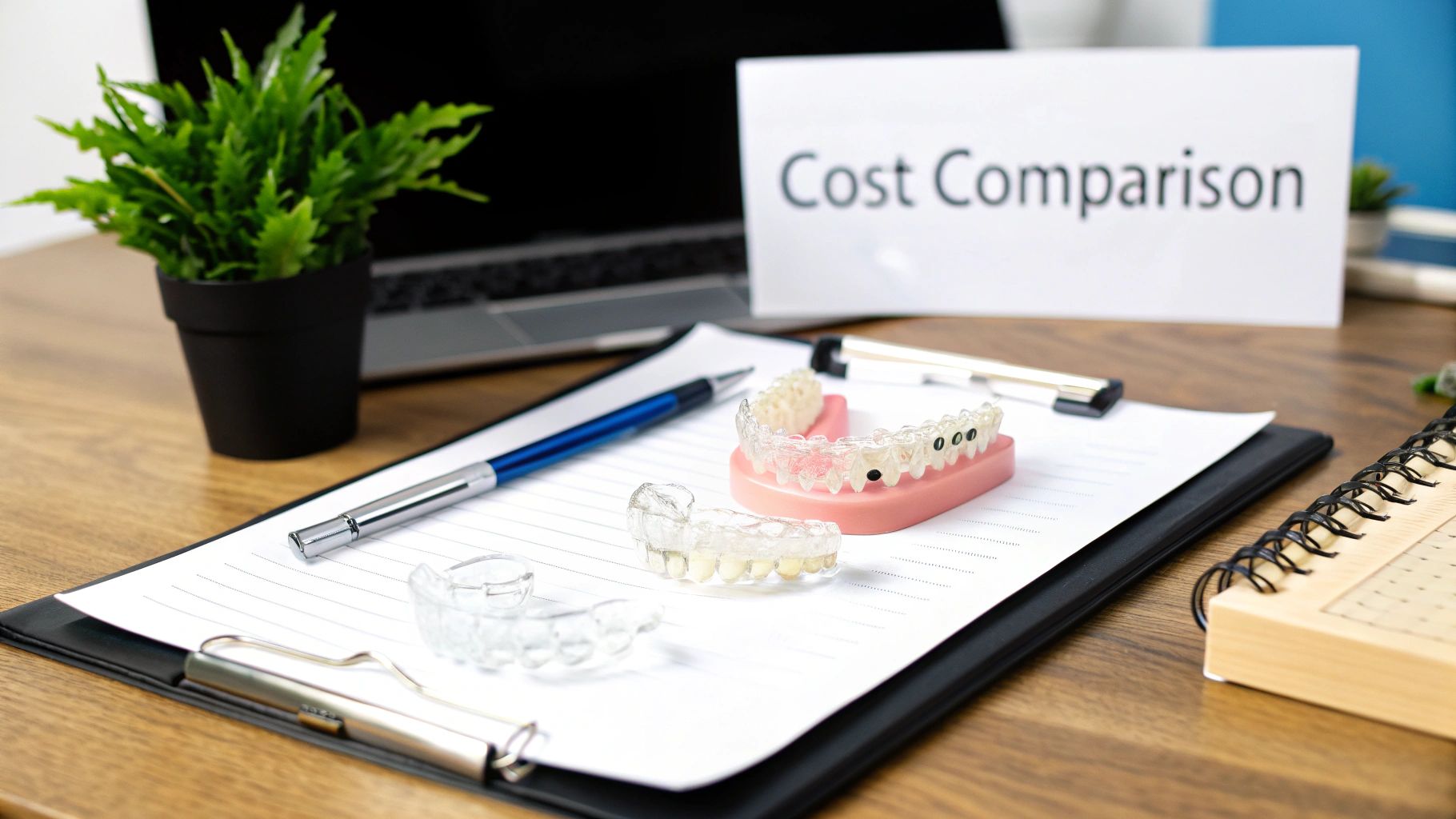
When you're thinking about straightening your teeth, the final price tag is a huge factor. Both Invisalign and traditional braces are a significant investment in your oral health and confidence, designed to give you that beautifully aligned smile you've always wanted. But the journey to that smile comes with different costs, benefits, and impacts on your daily routine.
The old idea that metal braces are always the cheaper route is becoming a thing of the past. As the technology behind clear aligners improves and treatments become more efficient, the financial gap between these two popular options has closed significantly. Understanding the average costs is the first step to making a smart decision for your dental health.
A Look at Average Treatment Costs
Historically, the financial difference was a major deciding factor for patients. On a global scale, Invisalign treatment can run anywhere from $6,000 to $9,000, while traditional braces often land between $4,500 and $8,500. But here in the United States, those numbers are much closer. Averages now show Invisalign costing around $4,975 and braces at about $4,800, which really highlights that shrinking price gap. You can read more about these cost findings here.
This initial look shows that while braces might have a slightly lower starting price, the final cost for achieving your ideal smile really depends on your specific dental situation. Several key factors will influence your total investment, including:
- Case Complexity: Simple crowding or spacing issues will cost less than complex bite corrections that impact function.
- Treatment Duration: The longer you're in treatment, the more appointments and materials you'll need for a successful outcome.
- Geographic Location: Costs naturally vary between different cities and states.
- Your Orthodontist's Expertise: An experienced specialist's skill and technology can influence pricing and the quality of your results.
Quick Comparison: Invisalign vs. Traditional Braces
To give you a clearer picture, here's a quick snapshot of the core differences between Invisalign and braces. This table helps frame the conversation by focusing on the factors that impact your oral health, appearance, and day-to-day life.
| Feature | Invisalign | Traditional Braces |
|---|---|---|
| Average Cost Range | $3,500 – $8,000 | $3,000 – $7,000 |
| Appearance | Nearly invisible clear aligners | Visible metal or ceramic brackets and wires |
| Comfort Level | Smooth plastic, less gum irritation | Can cause mouth sores and discomfort |
| Oral Hygiene | Easy; remove aligners to brush & floss | More challenging; requires special tools |
| Dietary Restrictions | None; you take them out to eat | Avoid hard, sticky, and chewy foods |
At the end of the day, the most cost-effective choice is the one that best suits your dental needs and promotes a healthy lifestyle. The only way to get a precise, accurate quote for your unique smile is through a personalized consultation.
Getting to the Real Price of Your Orthodontic Treatment
That first number your orthodontist gives you? Think of it as a starting point. To figure out if Invisalign is actually cheaper than braces for you, you have to understand what's driving the total cost of achieving your best smile. Both paths have variables that can influence the final price.
The single biggest factor in your quote is the complexity of your dental case. If you just need a minor cosmetic tweak—like closing a small gap or nudging a few front teeth into alignment—the cost will be lower. These straightforward cases mean fewer Invisalign aligners or less time in braces, which directly cuts down the expense.
But when you're dealing with more complex oral health issues, the whole financial picture changes.
What Makes a Case "Complex"?
Serious orthodontic work is about more than just aesthetics; it's about correcting the core structure and function of your bite for long-term dental health. The more complex the problem, the higher the cost.
- Bite Correction: Fixing an overbite, underbite, or crossbite requires precise, controlled force over a longer period, which increases the cost for either braces or Invisalign.
- Severe Crowding or Spacing: If your teeth are severely crowded or have large gaps, the treatment plan becomes more involved, impacting both the duration and final outcome.
- Jaw Alignment Issues: Problems that originate with the jaw itself are the most challenging to correct and will always be at the higher end of the price range for any orthodontic treatment.
Here's a key takeaway: truly complex cases often need the powerful, continuous force that traditional braces provide. This can sometimes make braces the more effective—and ultimately, more beneficial—choice for correcting major bite and alignment problems to improve your overall dental health.
Spotting the "Hidden" Costs
Beyond the main treatment fee, other costs can arise. It's essential to ask your orthodontist if these items are included in your initial quote or if they will be billed separately. What seems like the cheaper option at first might not be once you factor in all the necessary components for a successful result.
Be on the lookout for these often-overlooked expenses:
- Initial Consultation and Records: Fees may apply for the initial exam, X-rays, and the advanced 3D digital scans needed for planning.
- Post-Treatment Retainers: Once your teeth are straight, you need retainers to protect your new smile. The first set (and any future replacements) can add a few hundred dollars to the total investment.
- Emergency or Unscheduled Appointments: Life happens. A bracket might break, or you could lose an Invisalign tray. These incidents might require an extra visit and a replacement fee, so it’s wise to ask about these potential costs upfront.
Knowing about these variables empowers you. You can have a detailed conversation with your orthodontist about your case complexity, the expected duration, and exactly what’s included. That's how you get a true side-by-side comparison of the financial commitment for both Invisalign and braces, ensuring no surprises on your path to a healthy, beautiful smile.
How Modern Technology Shapes Your Treatment Cost
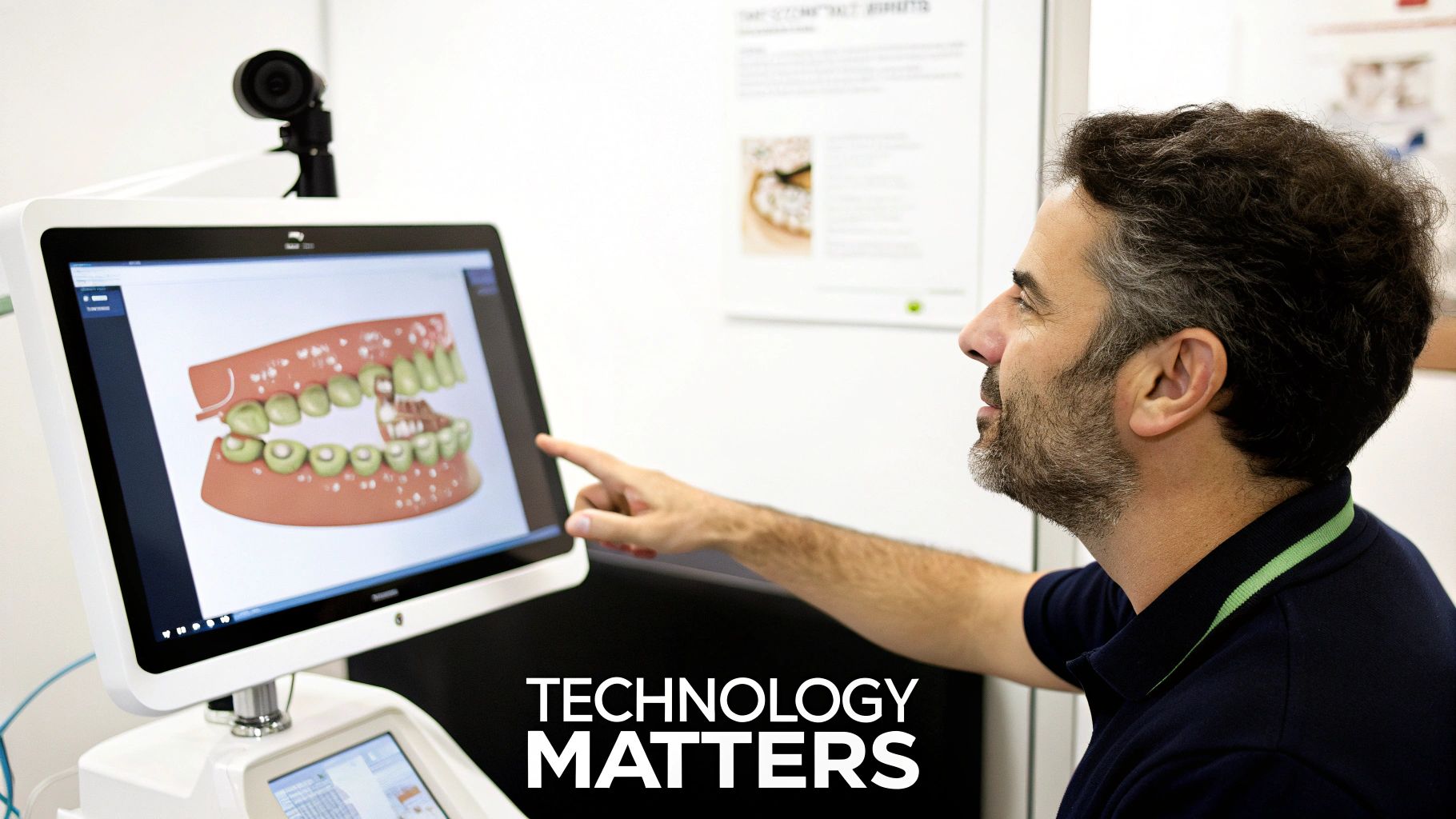
When you’re comparing orthodontic costs, you’re not just looking at aligners versus brackets. You're also looking at the technology that makes the treatment possible. The advanced process behind Invisalign is a major factor in its pricing, but it also delivers an efficiency and predictability that can significantly benefit your overall investment in your smile.
An Invisalign journey begins with a precise 3D digital scan of your mouth. This sophisticated imaging eliminates messy physical molds and provides a perfect blueprint for your entire treatment. Your orthodontist uses this digital model to map out every single tooth movement, and you even get a virtual preview of your final smile before you begin.
This digital-first approach allows for the creation of custom-fit, 3D-printed aligners designed just for you. Each aligner is engineered to apply gentle, targeted pressure, which makes the entire process more comfortable and highly effective for achieving your desired appearance.
Treatment Time and Its Financial Impact
A huge piece of the cost puzzle is the treatment duration. A shorter treatment time often means fewer office visits and, consequently, lower long-term costs. This is where the efficiency of Invisalign's technology really shines.
Many studies and patient experiences show that Invisalign often achieves results faster than traditional braces for mild to moderate cases. Current data shows Invisalign averages around $6,373 per patient, while braces come in at about $6,121—a small difference of less than $300 in many situations. The timeline is key; Invisalign often takes 12 to 18 months, whereas braces might require 18 to 24 months. This shorter duration can reduce your total number of appointments and time spent in the chair. Learn more about these treatment duration findings.
Investing in advanced technology means you are paying for more than just the appliance. You are investing in a more streamlined, convenient, and predictable path to achieving your ideal smile, which benefits both your schedule and your final bill.
Ultimately, this efficiency can be a game-changer for your lifestyle. Fewer check-ups mean less time away from work or school, making the journey to a healthier smile that much smoother.
Predictability and Your Dental Health
The precision of digital planning also minimizes surprises. Since the entire treatment is mapped out from day one, your progress is highly predictable. This lowers the risk of unexpected adjustments or extended timelines that can add extra costs.
The technology behind Invisalign does more than just straighten teeth; it enhances the entire experience. By focusing on a predictable and efficient process, it offers a compelling value that goes beyond the initial price tag, positively impacting your dental health journey and your final investment.
Navigating Insurance and Financing for Your New Smile
Let's talk about one of the most important parts of achieving your dream smile: figuring out how to pay for it. The final out-of-pocket cost for your orthodontic treatment really boils down to your insurance coverage and the financing choices available. The good news is, these options can make investing in your appearance and oral health fit comfortably into your budget.
A common myth is that insurance favors traditional braces over Invisalign, but that’s rarely true anymore. Most dental insurance plans with orthodontic benefits treat both medically necessary treatments equally. This levels the financial playing field, letting you make a decision based on your desired appearance, comfort, and lifestyle—not just the initial price.
Understanding Your Dental Insurance Coverage
If your dental plan covers orthodontics, it usually offers a set dollar amount or percentage toward the total treatment cost, regardless of whether you choose braces or clear aligners. This is a game-changer. Research shows about 92% of orthodontic patients with insurance can get coverage up to $3,000, with the average payout hovering around $1,772 for both Invisalign and braces. Insurers typically won't penalize you for choosing a modern, discreet option to improve your smile.
To get the real story on your benefits, you need to ask your insurance provider a few specific questions:
- What’s my lifetime maximum for orthodontic treatment?
- Is there a waiting period before I can use my orthodontic benefits?
- Does my plan have an age limit for ortho coverage?
- Are there any pre-authorizations needed for Invisalign or braces?
Knowing these answers will give you a clear, accurate picture of your out-of-pocket expenses.
A key takeaway here is that since most insurance plans cover a fixed amount for orthodontics, the final cost difference between Invisalign and braces often shrinks dramatically. This frees you up to choose based on what truly benefits you—comfort, appearance, and convenience.
Exploring Flexible Financing Solutions
Even with solid insurance, you'll likely have a remaining balance. That’s where financing comes in. Several options are available to help you manage this cost without a huge lump sum upfront, making the investment in your health and confidence much more accessible.
Many dental practices, including ours right here at Grand Parkway Smiles, offer solutions to make treatment affordable. A great starting point is our guide on understanding dental insurance and financing options.
Here are the most common choices:
- In-House Payment Plans: We can work with you to spread the cost of your treatment over several months, often with little to no interest.
- Third-Party Financing: Companies like CareCredit act like a credit card specifically for healthcare costs. They frequently offer interest-free promotional periods, giving you the flexibility to pay for your treatment on your own terms.
When you combine your insurance benefits with a smart payment plan, the path to a healthier, more confident smile becomes clear and stress-free.
Choosing a Treatment That Fits Your Lifestyle
Beyond the final numbers on a quote, the best orthodontic treatment is one that fits seamlessly into your daily life. Answering "is Invisalign cheaper than braces" isn't just about money; it’s also about weighing the non-financial benefits of each option. The right choice should boost your confidence and oral health without becoming a daily inconvenience.
Your career, personal habits, and aesthetic goals are all critical pieces of the puzzle. For some, the discreet appearance of Invisalign is a major benefit. For others, the set-it-and-forget-it reliability of braces is exactly what they need for optimal results.
Aesthetics and Professional Confidence
For many adults, especially those in client-facing roles, appearance is paramount. Invisalign’s greatest advantage is that it's nearly invisible. The clear, custom-fit aligners are so subtle that most people won't notice them, letting you speak, smile, and lead meetings without feeling self-conscious about your orthodontic treatment.
This level of discretion is often what encourages adults who've been hesitant about braces to finally move forward. You can improve your smile without it impacting your professional image. While modern ceramic braces are less obvious than metal, they still have visible components—something Invisalign avoids completely.
Daily Maintenance and Oral Health
One of the most significant lifestyle differences is that you can take Invisalign out. Because you remove the aligners to eat, brush, and floss, maintaining excellent oral hygiene is just as easy as it was before treatment. You don’t need special tools to clean around brackets or wires, which significantly reduces the risk of plaque buildup, gum inflammation, and cavities.
This removability directly translates to major benefits for your dental health and daily routine. You can continue to enjoy all your favorite foods without worrying about damaging your orthodontics. For many, this freedom and improved hygiene is a deciding factor.
On the other hand, traditional braces are fixed to your teeth, which demands a more diligent cleaning routine. You have to learn how to brush and floss effectively around the hardware and avoid certain foods to prevent damage. For some patients, however, this structure is a positive, as it removes the temptation to leave aligners out and ensures continuous progress.
To help you visualize these differences, here's a quick comparison of how each treatment might benefit your health and fit your lifestyle.
Lifestyle Fit Invisalign vs Traditional Braces
This table compares Invisalign and braces on key lifestyle factors, helping you decide which treatment best suits your daily routine, career, and personal preferences.
| Consideration | Invisalign | Traditional Braces |
|---|---|---|
| Appearance | Nearly invisible; ideal for professionals and adults. | Visible brackets and wires (metal or ceramic). |
| Diet | No restrictions. Remove aligners to eat anything. | Must avoid hard, sticky, or chewy foods. |
| Oral Hygiene | Easy. Remove to brush and floss as normal. | Requires special tools and extra time to clean. |
| Discipline | High. Must wear 20-22 hours a day and track them. | Low. The appliance does the work continuously. |
| Comfort | Smooth plastic aligners are generally comfortable. | Brackets/wires can irritate cheeks and lips. |
| Convenience | Remove for special events or photos. | Fixed in place for the entire treatment. |
Choosing between the two really comes down to what you're willing to manage and what you value most in your orthodontic journey.
The Responsibility of Removable Aligners
That flexibility with Invisalign comes with a big responsibility. For the treatment to work effectively and give you the best results, you must wear your aligners for the prescribed 20-22 hours per day. Failing to do so can delay your progress and compromise your final, beautiful smile. It requires a level of discipline that is essential for success.
For people who might struggle with consistently wearing and keeping track of their aligners, the non-removable nature of braces can be a hidden benefit. Braces work around the clock, ensuring steady progress toward a healthier smile without requiring daily management. If you want to learn more about how this system works, our detailed guide explains what Invisalign is and how it achieves such incredible results.
Ultimately, the choice comes down to your personal habits and goals. Do you value the freedom and superior hygiene of removable trays and have the discipline to wear them? Or would you prefer a powerful, fixed appliance that requires less daily thought? Your honest answer will point you toward the treatment that truly enhances your life.
Making the Right Investment in Your Smile
Deciding between Invisalign and traditional braces is a huge step toward the healthier, more confident smile you’ve been dreaming of. But the final choice isn't just about finding the "cheaper" option. As we've seen, the total costs are often surprisingly close.
The best decision comes from a holistic view of your specific dental needs, your budget after insurance, and which treatment best supports your lifestyle and oral health goals.
The truth is, neither treatment is universally better or more affordable for everyone. The right choice is the one that fits your unique situation perfectly. For one person, the powerful mechanics of braces might be the only way to correct complex bite issues and improve jaw function. For another, the flexibility and near-invisibility of Invisalign could be priceless for their professional life and simple hygiene routine.
From Research to a Personalized Plan
Reading articles is a fantastic start, but it can only get you so far. To get a real, reliable answer on cost and what your treatment will look like, you must move from online research to a professional consultation. A personalized assessment is the only way to get a precise quote and a plan designed to give you the beautiful, healthy smile you deserve.
During a consultation, a dentist can assess the complexity of your case—the single biggest factor that drives the final price. They can also provide a clear breakdown of all potential costs, including retainers and follow-up visits, so there are no surprises on your journey to a better smile. This one-on-one conversation transforms general price ranges into a concrete plan for your health.
This decision tree infographic is a great way to visualize how factors like your lifestyle, hygiene habits, and personal discipline play a huge role in choosing the best path to your ideal smile.
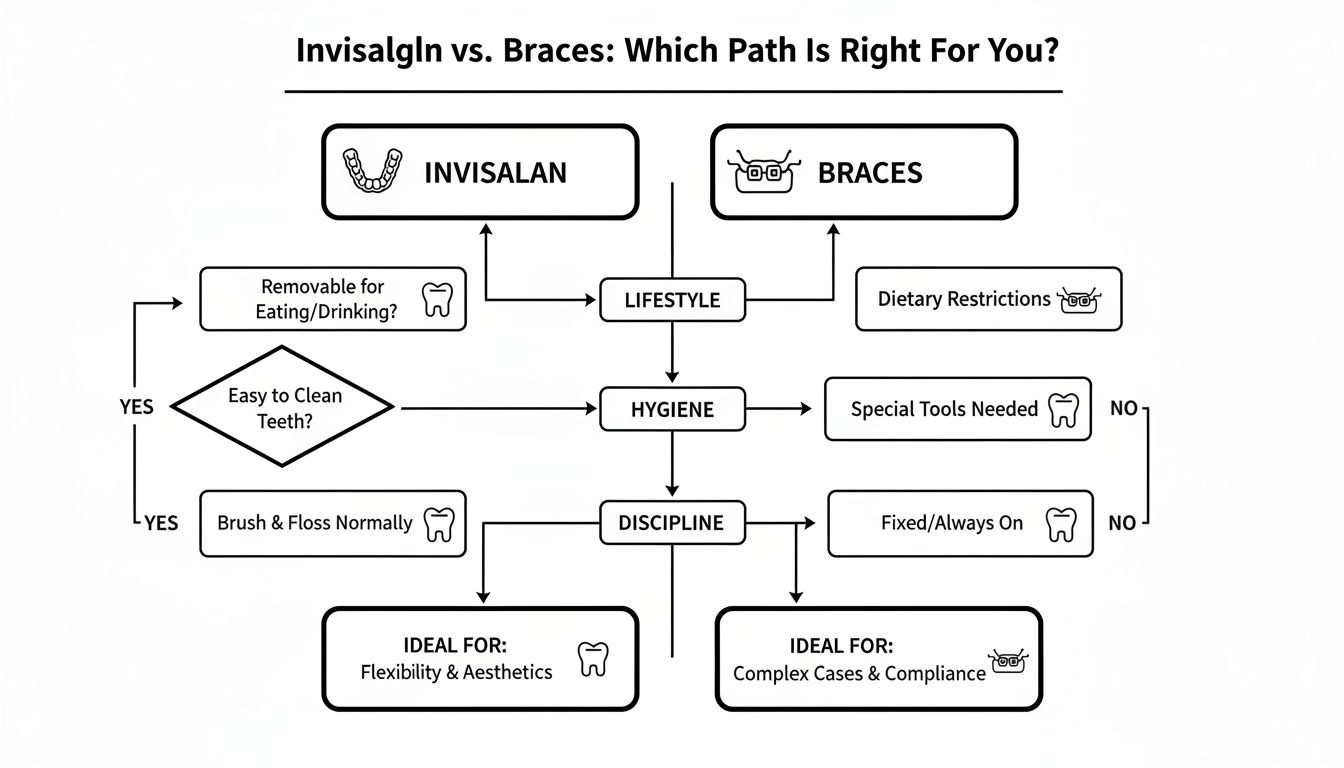
The key takeaway here? The "better" option is completely situational. It all depends on balancing the amazing convenience and aesthetics of removable aligners against the non-negotiable reliability of a fixed appliance.
Your smile is a lifelong investment in your health and self-esteem. Choosing the right orthodontic treatment is about finding the most effective and sustainable path to your goals, not just the lowest initial price.
Making an informed choice means looking at the complete picture—from the first scan to the final retainer that protects your investment. It’s about understanding how your treatment will fit into your daily life, affect your oral health habits, and impact your budget over the entire journey. Investing in a professional consultation is the most critical step you can take toward making a decision you’ll be happy with for years to come.
Are you ready to stop wondering and start your journey to a straighter smile? The expert team at Grand Parkway Smiles is here to provide a personalized consultation, answer all your questions, and create a treatment plan that fits your life and budget. Schedule your appointment today by visiting us at https://dentistkatytx.com.