Composite bonding is a fantastic cosmetic dental treatment where a special tooth-colored resin is used to fix minor issues like chips, cracks, or even small gaps between your teeth. The key benefit is its ability to restore your smile's natural beauty and health, often in just a single visit. This fast, minimally invasive procedure can give you an immediate boost in confidence by enhancing your smile's appearance.
A Sculptor's Approach to a Perfect Smile
Think of your dentist as a sculptor and your teeth as their canvas. Just like an artist uses clay to carefully mend or reshape a sculpture, a durable, putty-like composite resin is used to restore the natural beauty of a tooth. This material is skillfully applied layer by layer, then shaped and polished until it corrects the imperfection and blends in perfectly, creating a flawless, natural-looking smile.
The main benefit of composite bonding is achieving beautiful cosmetic results while preserving your natural tooth structure. Unlike more involved procedures like crowns or veneers, bonding usually requires very little, if any, removal of your original tooth enamel. This conservative approach is a major advantage for your long-term dental health.
Before we get into the nitty-gritty of the procedure, let's take a quick look at what composite bonding involves.
Composite Bonding At A Glance
This table gives you a quick summary of the key aspects of composite bonding, highlighting its benefits for your smile and schedule.
| Aspect | Description |
|---|---|
| Procedure Time | 30-60 minutes per tooth, typically completed in a single visit for immediate results. |
| Anesthesia | Usually not required, making for a more comfortable experience. |
| Pain Level | Minimal to none. The procedure is comfortable and non-invasive. |
| Durability | Lasts 5-7 years on average with proper care, offering a long-term aesthetic improvement. |
| Best For | Fixing minor cosmetic issues like chips, cracks, gaps, and discoloration for a healthier-looking smile. |
| Maintenance | Requires regular dental hygiene and avoiding hard foods or staining habits to maintain its appearance. |
As you can see, it's a straightforward process that offers significant aesthetic rewards without a major time or comfort commitment.
What Dental Issues Can Bonding Fix?
Composite bonding is incredibly versatile and can tackle a whole range of common cosmetic frustrations, significantly improving your smile's appearance and in some cases, its health. Because the resin can be so precisely sculpted and color-matched to your teeth, it’s an ideal fix for:
- Repairing Chips and Cracks: It flawlessly fills in small chips or fractures, making the tooth look whole again and restoring its strength and integrity.
- Closing Gaps: Bonding can be used to close small, unwanted spaces between teeth, giving your smile a more uniform and even appearance for a confidence boost.
- Covering Discoloration: For stubborn stains that don't respond to whitening treatments, bonding provides the tooth with a fresh, bright new surface, enhancing your overall look.
- Reshaping Teeth: It can subtly change the length or shape of a tooth, correcting minor misalignments or making teeth appear more symmetrical and aesthetically pleasing.
From Early Experiments to Modern Artistry
The idea of bonding materials to teeth has come a long way. Before the 1960s, cosmetic fixes were often unreliable. Some of the early materials had failure rates over 30% simply because they didn't stick well to the tooth.
Fast forward to today, and modern composite bonding has completely changed cosmetic dentistry. It's now the go-to for 40-50% of aesthetic procedures in major markets, thanks to its non-invasive nature and dependable, beautiful results. You can actually read more about how these modern materials transformed the field over on Dentistry Today.
This procedure is just one of many ways you can get the smile you've always wanted. If you're curious, you might be interested in exploring the full spectrum of cosmetic dentistry options to find the perfect fit for your goals.
Composite bonding offers a unique combination of artistry and science. It empowers dentists to make precise, beautiful enhancements to a patient's smile in a single appointment, often without the need for anesthesia. It's an immediate confidence booster.
The Step By Step Composite Bonding Procedure
Knowing what to expect during a composite bonding appointment can really help ease any nerves. It shows you just how simple the path to a better, healthier-looking smile can be. The whole thing is a mix of dental science and artistry, and it's all done in a single, comfortable visit. Best of all, you see the beautiful results immediately.
Let's walk through the journey, which always starts with a crucial first step.
Consultation And Precise Shade Matching
Before we even touch a tooth, you and your dentist will have a chat about the aesthetic goals you're hoping to achieve. This is the perfect time to point out that little chip that's been bothering you, a gap you'd like to close, or a stubborn stain. The goal is to ensure the final result is a smile you are proud of.
Next up is the shade matching, which is key to a natural-looking outcome. Your dentist uses a professional shade guide, holding different swatches up to your natural teeth to find the perfect color for the composite resin. This meticulous step ensures the bonded tooth blends in so seamlessly that it looks just like your original enamel, enhancing your smile's appearance perfectly.
Preparing The Tooth For Bonding
With the perfect shade picked out, it's time to get the tooth ready. Unlike more involved procedures like crowns or veneers, this step is incredibly gentle, preserving your natural tooth structure. Anesthesia is rarely required.
Your dentist will lightly roughen, or "etch," the surface of the tooth with a mild conditioning liquid. This creates a microscopic texture that helps the bonding agent form a really strong, lasting connection. This careful prep work is what ensures your composite bonding will hold up for years, protecting the tooth underneath.
Applying And Sculpting The Resin
Once the tooth is prepped, the artistic part begins. A putty-like composite resin is carefully applied right onto your tooth. From there, your dentist skillfully sculpts and shapes the material, often building it up in thin layers to repair damage or create a whole new, more appealing shape.
This is where a dentist's expertise in aesthetics really makes a difference. They'll meticulously mold the resin to fill in chips, close gaps, or even make a tooth look longer, all while ensuring it looks completely natural. They pay close attention to the unique contours and the way light reflects off your other teeth to get a beautiful, harmonious result.
This visual breaks down the main actions of the procedure into three simple phases: applying the resin, sculpting it, and then polishing it to perfection.
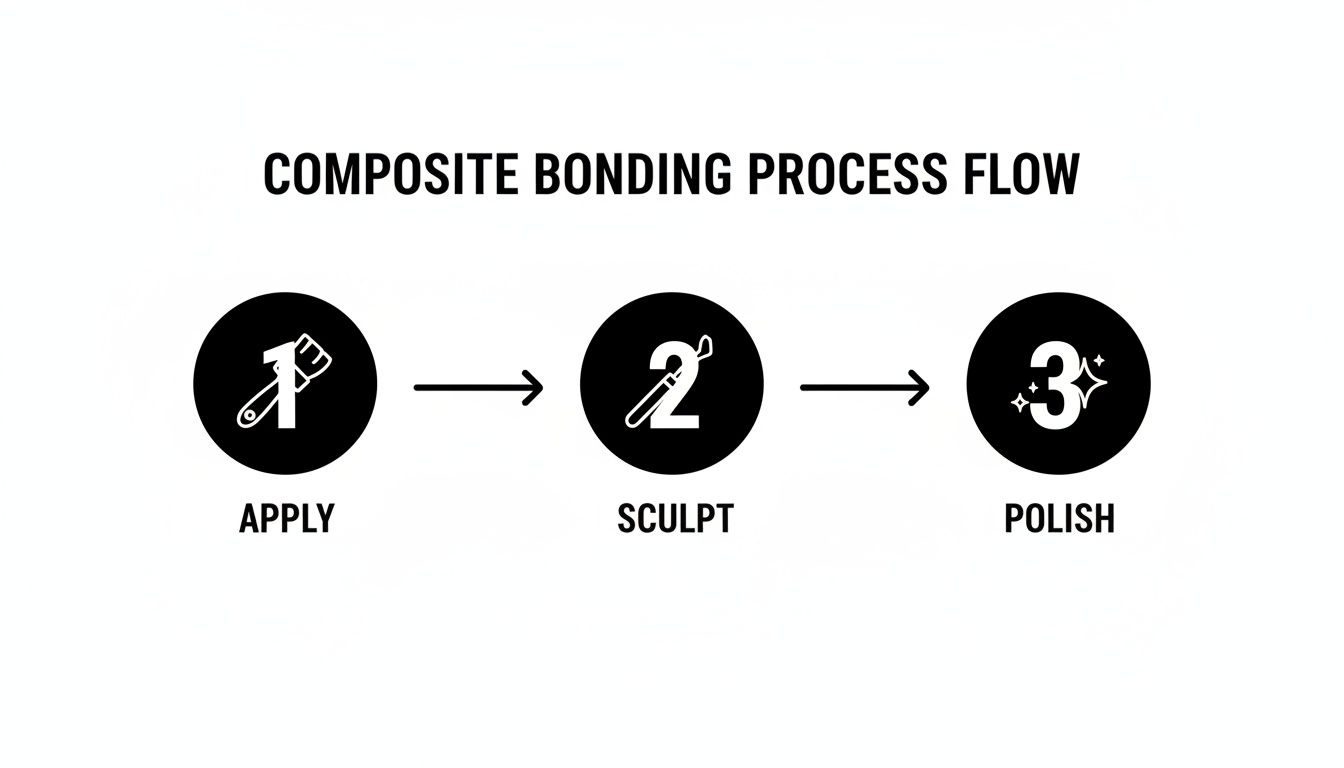
Each step is done with total precision to make sure the final fix is both strong and beautiful, enhancing both the look and health of your tooth.
Curing And Final Polishing
After the resin has been sculpted into the perfect shape, a special curing light is used. This high-intensity blue light is aimed at the resin for just a few seconds, activating a catalyst inside the material and causing it to harden almost instantly. This process, known as photopolymerization, is what creates a solid, durable bond with your tooth.
The last step is what truly perfects the appearance. The hardened resin is carefully trimmed, smoothed down, and polished until it perfectly matches the shine and texture of your natural teeth. You'll leave the chair with a smile that's instantly improved, healthier-looking, and ready to show off.
Who Is a Good Candidate For Composite Bonding?
Composite bonding is a fantastic solution for many people looking to improve their smiles, but is it the right choice for you? This depends on the cosmetic issues you want to fix and your overall dental health. This treatment is most beneficial when used to correct minor imperfections on teeth that are otherwise healthy.
Think of it less like a complete smile overhaul and more like a precision touch-up tool to enhance your appearance. If you've got small chips, little cracks, or slight discoloration, you're likely a perfect candidate. The same goes if you're looking to close small but noticeable gaps between your teeth for a more even, uniform look.
When Bonding Is The Perfect Fit
This procedure is most effective for people who want to correct specific, localized issues, achieving a significant aesthetic improvement without invasive treatment. Ideal candidates usually have:
- Minor Cosmetic Flaws: This covers things like small chips, cracks, or fractures that don't compromise the tooth's overall strength but affect its appearance.
- Good Oral Health: You need a healthy foundation. Any major decay or gum disease has to be addressed first to ensure the longevity of any cosmetic work.
- Slight Gaps Between Teeth: Bonding is a wonderfully artistic way to close small spaces and create a seamless, more attractive smile line.
- Minimal Tooth Misalignment: It can work wonders on the appearance of slightly crooked or oddly shaped teeth, bringing a better sense of symmetry and beauty to your smile.
The real beauty of composite bonding is its ability to make a big aesthetic difference with very little alteration to your natural tooth. It’s all about enhancing what you’ve already got, not replacing it, which is a huge benefit for your long-term dental health.
When Another Treatment Might Be Better
Composite bonding isn't a silver bullet for every dental problem. Some situations call for a different approach to ensure your smile is both beautiful and healthy for the long haul. You might be better off looking at options like porcelain veneers or crowns if you have:
- Major Structural Damage: A large fracture or severe decay needs a much stronger, more durable fix, like a crown, to restore the tooth's health and function.
- Significant Alignment Issues: If your teeth are seriously crooked or crowded, orthodontic treatment is the best first step for both aesthetic and health reasons.
- A Habit of Grinding or Clenching (Bruxism): The intense pressure from grinding can easily chip or wear down the bonding material, compromising its appearance and longevity.
- A Desire for a Full Smile Makeover: For a dramatic and total transformation across many teeth, veneers often provide a more uniform and stain-resistant result.
The science behind this procedure has come a long way since dentists started playing with composite materials back in the 1950s. A huge leap forward came in 1955 when Dr. Michael Buonocore discovered acid-etching, a technique that creates a much better surface for the bonding material to grip onto. To see just how far the technology has come, you can check out the evolution of composite bonding on Manchester Dental Practice.
Comparing Composite Bonding To Porcelain Veneers
When you're ready to upgrade your smile's appearance, composite bonding and porcelain veneers are two popular options. Both can give you a fantastic-looking smile, but they achieve this in very different ways. Understanding the key differences in procedure, cost, and impact on your dental health is the first step in deciding which is right for you.
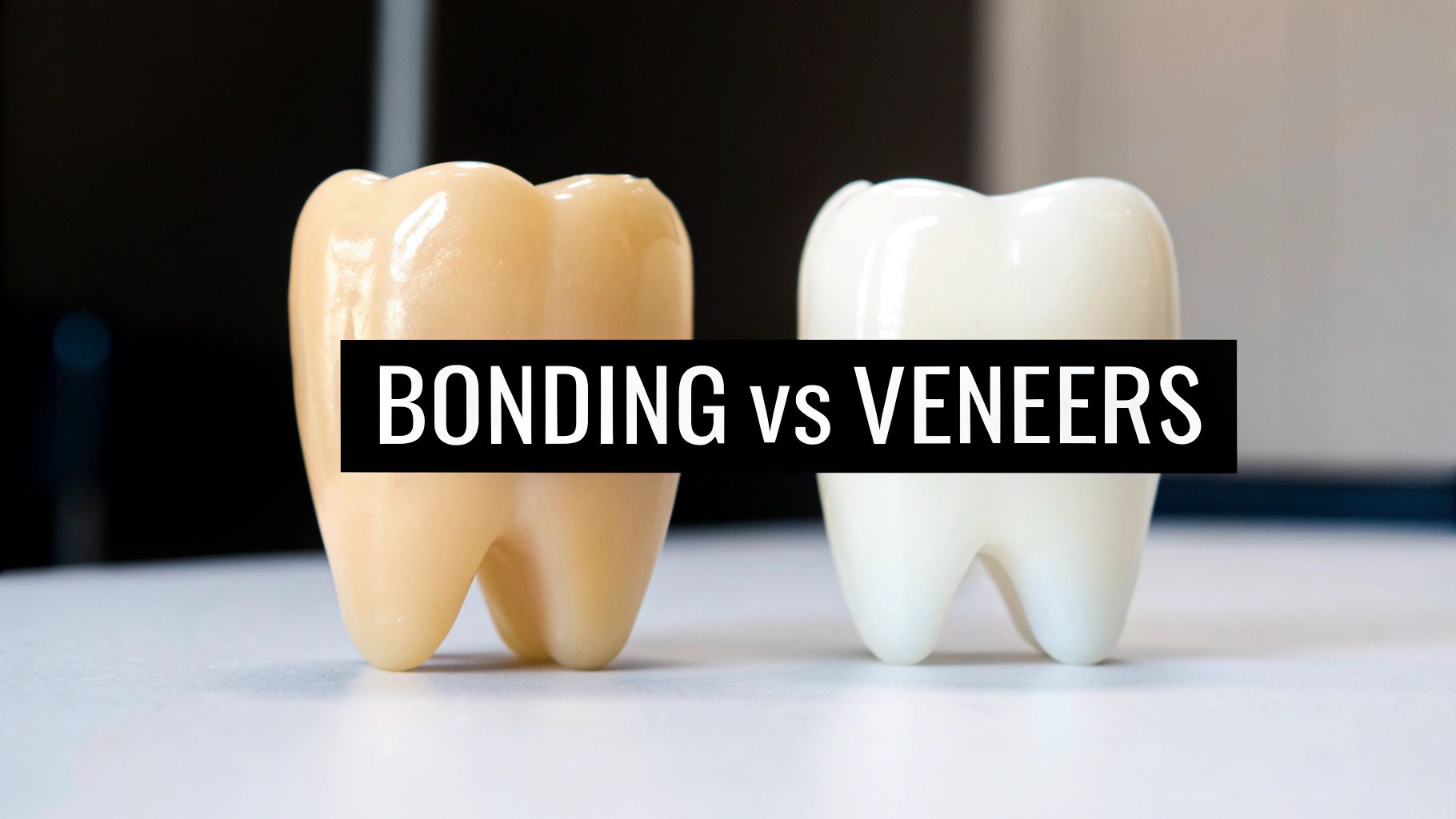
Think of composite bonding as an artistic, quick-fix solution that enhances your smile's appearance immediately. It's a procedure done in the chair, where a tooth-colored resin is skillfully sculpted directly onto your tooth to cover minor flaws. This makes it a great, budget-friendly way to see instant results.
Porcelain veneers are ultra-thin, custom-crafted shells of ceramic bonded to the front of your teeth. The process is more involved and takes a couple of visits, but the benefit is incredible durability and stain resistance for a true smile makeover.
Preservation Versus Permanence
One of the biggest health considerations is how each treatment affects the natural tooth. It really comes down to a choice between preserving your tooth structure with bonding and opting for the more permanent solution of veneers.
A major benefit of composite bonding is that it's a minimally invasive treatment. For most cases, we barely have to touch the natural tooth enamel, if at all. That’s a huge plus for your long-term dental health and also means the procedure is usually reversible.
Veneers, on the other hand, require us to permanently reshape the tooth by removing a very thin layer of enamel to make space for the veneer. While veneers are tougher and last longer, this makes the process irreversible. If you're curious about the details, you can learn more about what dental veneers are and how much they cost in our in-depth guide.
Choosing between bonding and veneers is a personal decision. Bonding offers a quick, affordable, and conservative enhancement, which is great for tooth health. Veneers provide a more durable, stain-resistant, and comprehensive smile makeover.
A Head-to-Head Comparison
Sometimes, the best way to make a decision is to see things side-by-side. Here’s a straightforward comparison table to help you weigh the benefits of each cosmetic treatment for your appearance and dental health.
Composite Bonding vs. Porcelain Veneers: A Head-to-Head Comparison
| Feature | Composite Bonding | Porcelain Veneers |
|---|---|---|
| Treatment Time | One single visit (30-60 minutes per tooth) | Two or more visits over several weeks |
| Cost | More affordable; lower initial investment | More expensive; higher initial investment |
| Durability | Lasts 5-7 years on average | Lasts 10-15+ years on average |
| Stain Resistance | Porous and can stain over time, similar to natural teeth | Highly resistant to staining from coffee, tea, and wine |
| Tooth Alteration | Minimal to no enamel removal; often reversible | Requires permanent removal of a thin enamel layer |
| Appearance | Excellent, natural-looking results for minor fixes | Superior aesthetics with a lifelike, translucent quality |
Ultimately, both are fantastic options, but they serve different needs. The right one for you depends entirely on your aesthetic goals and priorities for dental health.
Modern composite resins, especially the newer supra-nano spherical filled composites, can be polished to an incredible shine that lasts 2-3 times longer than older materials. They also reduce wear by 30-40%, making them much more resilient. In fact, today's success rates for composite bonding are over 90% at the 5-year mark, which shows just how reliable this treatment has become for enhancing your smile.
How To Care For Your Bonded Teeth For Lasting Results
You’ve invested in a beautiful new smile with composite bonding, and now the goal is to keep it looking fantastic for as long as possible. The great news is that taking care of your bonded teeth is simple and fits right into your normal oral hygiene routine. With just a few small tweaks, you can protect the resin from damage and stains, ensuring your smile stays brilliant and healthy for years.
It helps to think of the composite resin like a nice piece of ceramic—it's strong, but not indestructible. Being gentle with your bonded teeth is the key to maintaining their appearance and protecting your dental health.
Your Daily Oral Hygiene Toolkit
Your everyday cleaning habits are your first and best line of defense. Using the right tools and techniques will keep the resin surface smooth and stain-free, which benefits the health of your teeth and gums.
- Choose a Soft-Bristled Toothbrush: This is a must. A soft-bristled brush cleans away plaque perfectly without being abrasive enough to scratch the surface of the bonding material and compromise its appearance.
- Use Non-Abrasive Toothpaste: Many whitening toothpastes contain gritty ingredients that can dull the polish on your bonding. Stick with a gentle, non-abrasive fluoride toothpaste to keep everything clean, shiny, and healthy.
- Floss with Care: Keep flossing every day, but be a little more gentle around the edges where the bonding meets your natural tooth. This prevents plaque buildup, which is crucial for gum health.
Proper at-home care is the most critical factor in how long your composite bonding lasts. Simple, consistent habits protect your investment and keep your smile looking as good as the day you left our office.
Habits To Adopt And Avoid
Beyond daily cleaning, a few mindful changes can make a huge difference in preventing chips, cracks, and stains, preserving the beauty of your smile. Because the composite material is a bit more porous than your natural tooth enamel, it can pick up stains more easily over time.
To keep your smile bright, be mindful of things like coffee, tea, red wine, and dark berries. Simply rinsing your mouth with water right after you have them can help a lot. Also, try to avoid biting directly into very hard foods—like ice, hard candy, or nuts—with your bonded teeth. Small habits, like cutting up an apple instead of biting straight into it, can prevent an accidental chip and protect both the bonding and your natural tooth.
Your Tooth Bonding Questions, Answered
It’s completely normal to have a few questions about how composite bonding will benefit your smile. Getting clear, straightforward answers helps you feel confident and ready.
Let's tackle some of the most common things patients ask us.
Does The Composite Bonding Procedure Hurt?
One of the best benefits of composite bonding is how comfortable the whole process is. Since we're typically just working on the surface of your tooth to improve its appearance, anesthesia is rarely needed.
Most patients report zero pain, just a strange sensation during the etching phase. This makes it a fantastic choice for enhancing your smile, especially if you get a little anxious about dental work.
How Long Does Bonding Last On Front Teeth?
With the right care, you can expect your composite bonding to keep your smile looking great for 5 to 7 years, sometimes even longer. The longevity of the aesthetic results largely comes down to your daily habits.
Steering clear of biting down on very hard things and being mindful of staining foods and drinks is the best way to protect your new, beautiful smile.
The most important thing to remember is that while the resin is durable, it's not indestructible. Good daily care is the best way to protect your investment and keep your bonded teeth looking their best.
Can You Whiten Composite Bonding Material?
This is a really important point for your smile's appearance: you cannot whiten the composite resin material. Unlike your natural tooth enamel, the resin doesn't react to bleaching products.
If you’re thinking about whitening your smile, it's a huge benefit to do it before your bonding appointment. That way, your dentist can perfectly match the color of the resin to your newly brightened teeth for a result that looks completely natural and seamless.
Here at Grand Parkway Smiles, we believe you should feel totally comfortable and informed about your dental care. Our team is always here to answer every single one of your questions.
If you’re ready to see how composite bonding could transform your smile, let's set up a time to chat. You can schedule a consultation with our experienced cosmetic dentists by visiting us at https://dentistkatytx.com.