When your dentist brings up the need for a root canal, it’s completely normal for your mind to jump straight to the cost. The good news? A root canal isn’t just an expense—it’s a critical investment in saving your natural tooth, stopping pain in its tracks, and preserving your beautiful smile. And even better, dental insurance is designed to make this essential treatment much more affordable.
The average root canal cost with insurance usually lands somewhere between $200 and $800 out-of-pocket. That’s a huge relief compared to the uninsured price tag, which can run anywhere from $700 to $1,800.
How Insurance Actually Lowers Your Bill
So, how does insurance slash that price so dramatically? Most dental plans classify a root canal as a major restorative procedure. This is the category for essential treatments that restore the function and health of a damaged tooth, ultimately protecting your overall well-being.
Because it’s considered a necessary procedure to save a tooth and eliminate infection, insurance plans will typically cover a large chunk of the cost—usually between 50% and 80% of the total fee. For patients here in the Katy and Houston area, this coverage is what makes the difference between a manageable co-pay and a daunting full-price bill.
This simple breakdown shows just how much of a difference that coverage makes.
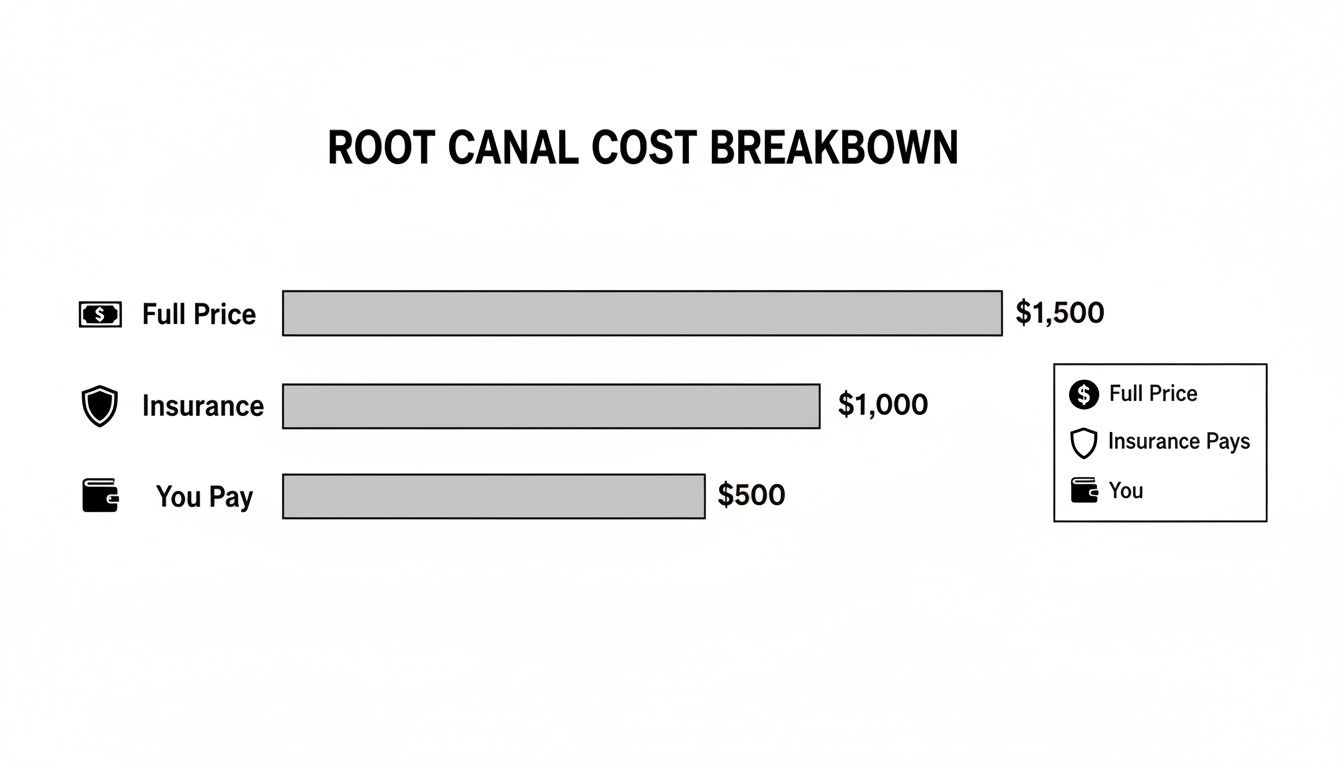
As you can see, the insurance provider shoulders the bulk of the cost, leaving you with a much smaller, more predictable portion to handle.
Of course, the final price tag always depends on a few factors, especially which tooth is being treated. Front teeth are simpler and generally cost less, while molars with their multiple, complex roots will be on the higher end of the spectrum. You can find more helpful details on how insurance and costs interact at credee.com.
A root canal isn't just about fixing a tooth; it's about preserving the foundation of your smile. By saving your natural tooth, you maintain proper chewing function, prevent neighboring teeth from shifting, and avoid the higher costs of extraction and replacement down the road.
Why A Root Canal Is An Investment In Your Health
When you're dealing with a painful, infected tooth, it's completely natural to focus on the cost of fixing it. But before we dive into the numbers and what root canal cost with insurance looks like, it helps to shift your perspective. This procedure isn’t just another dental bill—it's a direct investment in your long-term health, comfort, and the appearance of your smile.
The whole point of a root canal is to save your natural tooth, which is always, without a doubt, the best possible outcome for your dental health. An infected tooth pulp won't just heal on its own. If left alone, it can lead to a painful abscess, deterioration of your jawbone, or even systemic health issues if the infection spreads. A root canal stops all of that dead in its tracks by removing the source of the infection and preserving your tooth.
Preserving Your Smile And Function
Saving your tooth does a lot more than just stop the pain. It keeps your smile's natural alignment and ensures you can chew your food properly and speak clearly. When a tooth is pulled, the neighboring teeth often start to shift and tilt into the empty space. This creates a domino effect that can lead to bite problems, jaw pain, and a change in your facial appearance.
Opting for a root canal instead of an extraction helps you sidestep all those future complications. You get to keep the natural root that stimulates your jawbone, which prevents the bone loss that always happens after a tooth is pulled. This is crucial for preserving your facial structure and maintaining a youthful appearance for years to come.
By treating the problem at its source, a root canal eliminates the infection, protects your overall health, and keeps your original smile intact. It’s a solution that addresses both the immediate pain and the long-term integrity of your dental health.
The True Cost Of The Alternative
The only real alternative to a root canal for an infected tooth is to pull it. While extraction might seem like a cheaper, faster fix at first glance, it often kicks off a series of more complex and expensive treatments later on that can affect both your wallet and your appearance.
Think about it this way:
- Extraction: Sure, the initial cost is lower, but it leaves an obvious gap in your smile that can make you feel self-conscious.
- Replacement: To restore your smile and stop your other teeth from shifting, that gap needs to be filled. This usually means getting a dental bridge or a dental implant, both of which are significantly more expensive than the original root canal.
- Ongoing Maintenance: Bridges and implants aren't always a one-and-done solution; they might need adjustments or even replacement over your lifetime.
When you really compare the one-time cost of a root canal and crown to the ongoing expenses and aesthetic compromises of extraction and replacement, saving your natural tooth is almost always the smarter move for your health and confidence. If you want to get a better handle on the procedure itself, you can learn more about what is a root canal and see how it saves your tooth from the inside out.
What Really Determines Your Root Canal Cost
Ever looked at a treatment estimate for a root canal and wondered why there isn't just one simple, flat price? The final cost depends on the specific details of your tooth's condition. A few key factors come together to determine the final investment needed to save your tooth and restore your smile.
Getting a handle on these variables does more than just clear up the confusion around your estimate. It helps you see the true value in a procedure that doesn't just get you out of pain, but also saves the natural look and function of your smile for years to come. The end goal is always a healthy, pain-free tooth that looks and feels completely natural.
The Biggest Factor: Tooth Location and Complexity
By far, the most significant thing influencing the root canal cost with insurance is which tooth needs help. The anatomy of each tooth is different, which directly impacts the complexity of the treatment.
- Front Teeth (Incisors and Canines): These are the most straightforward. They usually have just a single root canal, making the treatment simpler and quicker. Their location also makes them easier to access.
- Premolars (Bicuspids): Sitting between your canines and molars, these teeth typically have one or two root canals. They’re a step up in complexity from the front teeth, and the price reflects that.
- Molars (Back Teeth): Your large chewing teeth are the most complex. Molars can have three, four, or sometimes even more tiny, curved canals that require specialized skill and time to navigate, clean, and seal properly.
Because of this extra complexity, a root canal on a molar is the most involved type of procedure. This detailed, intricate work is absolutely critical to make sure the infection is 100% gone, which secures the tooth's long-term health and prevents the need for retreatment.
Who Performs The Procedure Matters
Another piece of the puzzle is the professional handling your treatment. While our skilled general dentists perform many root canals right here at our office, some situations call for a specialist to ensure the best outcome for your health.
An endodontist is a dentist who’s gone through several extra years of specialized training focused only on diagnosing tooth pain and performing root canal therapy. We might refer you to an endodontist if your case is particularly tricky—for example, a tooth with a really curved root or a tooth that was treated before and has gotten reinfected. Their fees are often a bit higher due to their advanced equipment and specialized focus, but bringing them in ensures the best possible result for those tough cases.
Additional Procedures: The Crown
Finally, it’s important to remember that the root canal itself is just one step in fully restoring your tooth's health and appearance. After the infection is cleared out, the tooth structure is more brittle. To protect it and restore its full chewing strength and natural look, a dental crown is almost always recommended.
This protective cap is a separate, but totally necessary, procedure that adds to the overall investment in your smile. While it’s true that root canal costs have risen over the years, the good news is that dental insurance has largely kept pace to help make this essential care affordable. You can learn a bit more about how treatment costs have evolved from this article by Magnolia Dentistry. By seeing how all the pieces fit together—from the tooth’s complexity to the final crown—you get a much clearer picture of your treatment plan as a complete solution for your dental health.
How To Maximize Your Dental Insurance Benefits

Think of your dental insurance plan as a valuable tool designed to help you maintain a healthy, confident smile. Learning how to use it effectively is the secret to minimizing your root canal cost with insurance. The goal is to get the most value out of your benefits, making crucial dental care feel much more manageable.
Navigating insurance can feel complicated, but understanding a few key concepts empowers you to predict your costs and make the best decisions for your health. It’s all about keeping your smile healthy without any unwelcome financial surprises.
Decoding Your Dental Insurance Plan
The first step is to translate the insurance jargon. Your policy really boils down to a few core pieces that directly affect how much you pay for a procedure like a root canal. Let’s break them down.
- Deductible: This is a set amount, usually around $50 to $100, that you have to pay yourself before your insurance company starts chipping in. Just think of it as your entry fee for the year's dental work.
- Coinsurance: Once your deductible is met, your plan's coinsurance takes over. This is the percentage of the bill your insurance agrees to cover. For a major procedure like a root canal, they often cover between 50% and 80% of the cost.
- Annual Maximum: This one is important. It's the absolute highest dollar amount your insurance plan will pay out for your dental care in one benefit year. If you hit that cap, any other costs are on you until the plan resets.
Getting a grip on these three things—your deductible, coinsurance, and annual maximum—is the foundation of making your insurance work for you. When you know these numbers, you can anticipate your share of the bill and plan ahead, eliminating financial stress so you can focus on your recovery.
In-Network Vs. Out-of-Network Choices
Where you receive your treatment is just as important as the treatment itself. Your choice between an in-network and an out-of-network dentist can dramatically change your final bill. An in-network practice, like ours at Grand Parkway Smiles, has a contract with your insurance provider to offer services at pre-negotiated, lower rates.
Sticking with an in-network dentist almost always means you'll pay less out-of-pocket and enjoy a smoother, more streamlined claims process. If you go out-of-network, your insurance might cover a smaller chunk of the bill, or you could get stuck paying the difference between the dentist's regular fee and what your plan considers a "reasonable" charge. For a deeper dive, you can learn more by understanding dental insurance and financing options at Grand Parkway Smiles.
The Power of Pre-Treatment Estimates
If there’s one tool that can give you complete financial clarity, it’s the pre-treatment estimate (sometimes called a pre-authorization). Before we even start your root canal, our office can send your complete treatment plan to your insurance company. They’ll review it and send back a document that spells out exactly what they will cover and what your estimated out-of-pocket cost will be.
This estimate confirms you’re eligible, shows how much of your deductible is left, and clarifies the exact coinsurance percentage for your specific procedure. It’s like getting a detailed, official price quote before you commit, giving you total clarity and peace of mind. Taking this one step empowers you to move forward with confidence, armed with a reliable financial map for getting your tooth healthy again.
Making Your Root Canal Treatment Affordable
Even with a good insurance plan helping out, the final out-of-pocket cost for a root canal can seem a bit steep. But it absolutely shouldn't be a roadblock to saving your tooth and restoring your oral health. We have several practical, flexible ways to make sure this essential care fits comfortably into your budget.
The last thing we want is for you to delay treatment because of financial stress. By looking at these options together, we can create a clear financial plan so you can focus on what really matters: getting out of pain, stopping an infection, and keeping your natural smile.
Flexible Payment and Financing Options
For many of our patients, the simplest solution is breaking down their share of the root canal cost with insurance into smaller, more predictable monthly payments. This approach transforms a one-time expense into something much more manageable.
- Third-Party Financing: We work with programs like CareCredit, which is essentially a credit card designed for healthcare needs. They often have special promotional periods with 0% interest, which lets you pay off your balance over several months without any extra finance charges. It’s a very popular way to get the treatment you need now and spread the cost out over time.
- In-House Savings Plans: If you don't have dental insurance, don't worry. Here at Grand Parkway Smiles, we offer our own in-house savings plan. It's not insurance, but a membership that gives you big discounts on procedures like root canals and crowns, making top-quality care much more accessible.
These solutions are all about giving you financial breathing room and control over your healthcare budget, ensuring cost never stands in the way of your well-being.
The most important thing is to not put off a necessary root canal because you're worried about the cost. Waiting can allow the infection to worsen, leading to a painful abscess, tooth loss, and, ultimately, more complicated and expensive procedures to restore your smile later.
Smart Scheduling to Maximize Your Benefits
Here’s a powerful strategy that involves a bit of smart planning around your insurance calendar. Most dental plans come with an annual maximum—the most they'll pay out in a year. This benefit usually resets on January 1st. With some clever scheduling, you can use this to your full advantage.
Let's say you need both a root canal and a crown, and it's getting close to the end of the year. We might be able to split the treatment across two plan years. You could have the root canal itself done in December, using up your remaining benefits for the current year. Then, in January, you come back for the permanent crown, and we can bill that to your freshly reset benefits for the new year.
This little bit of planning can effectively double the amount of insurance money available for your treatment, which can significantly reduce your out-of-pocket costs. Our team excels at this—we can look at your plan’s renewal date and map out a treatment timeline that gets the most out of your coverage, protecting both your tooth and your wallet.
The Grand Parkway Smiles Approach To Care
Figuring out the root canal cost with insurance is a big first step, but the quality of care you receive is what truly makes that investment worthwhile. Here at Grand Parkway Smiles, we combine advanced technology, specialized expertise, and genuine compassion. Our goal is to create an experience that prioritizes your immediate comfort and long-term dental health.
We've built our practice around a collaborative team approach. That means we have specialists, including an in-house endodontist, working together right here. This setup saves you the hassle of external referrals, making your path to a healthy, pain-free smile much smoother and more convenient.
Precision Technology For Better Outcomes
To achieve the best possible results and ensure the long-term health of your tooth, we rely on advanced diagnostic tools that give us a perfectly clear picture of what’s happening inside.
- 3D Cone Beam Imaging (CBCT): Think of this as a major upgrade from standard X-rays. It creates a detailed 3D map of your tooth’s roots and canals. This incredible accuracy allows our team to navigate even the most complex anatomy, leading to a more thorough and successful treatment.
This level of precision isn't just about being high-tech; it's about safeguarding your health. When we can accurately find and remove all the infected tissue, we dramatically improve the tooth's long-term prognosis and help you avoid future complications.
A Commitment To Your Comfort
We understand that dental anxiety is real, and we are dedicated to making your root canal procedure as stress-free and comfortable as possible. Your peace of mind is a crucial part of a successful and speedy recovery.
To help you feel at ease, we offer various sedation options tailored to your comfort level. Whether it’s a mild sedative or something deeper like IV sedation, our focus is on eliminating anxiety so you can relax while we restore your tooth. This compassionate, patient-centered approach is at the very heart of how we practice dentistry.
Your Top Questions About Root Canal Costs, Answered
When you're facing a root canal, it's completely normal to have questions swirling around, especially when it comes to the cost. To put your mind at ease, we've laid out the most common questions our patients ask about root canal costs and how their insurance fits into the picture.
Our goal is simple: to make sure you feel confident and prepared. That means understanding everything from why the procedure is so important for your health to what your final investment will look like.
Is a Root Canal Considered a Major Procedure for Insurance?
Yes, and that's actually good news for you. Dental insurance plans almost always classify a root canal as a major restorative service.
This label means the procedure is recognized as medically necessary to save a tooth, eliminate pain, and clear up an infection that could harm your overall health. Because of this, most insurance plans apply their highest level of coverage for root canals. You'll typically see them cover anywhere from 50% to 80% of the total cost after you've met your deductible, which makes the treatment much more affordable.
How Much Is the Crown After the Root Canal?
This is a fantastic question because the crown isn't just an add-on; it's a critical part of restoring your tooth's health and appearance. The root canal saves the inside of the tooth, but the crown is what protects it from the outside so you can chew confidently and smile naturally for years to come.
A dental crown is technically a separate procedure with its own fee, which usually falls between $800 and $1,800, depending on the material we choose. Just like the root canal itself, your insurance sees the crown as essential for restoring the tooth’s strength and function, so it will typically be covered in that same 50% to 80% range.
What Should I Do if My Insurance Denies Coverage?
Getting a denial letter is frustrating, but don't panic—it's often not the final answer. The first thing to do is let our team take a look. A lot of the time, it's something as simple as a clerical error or the insurance company needing more clinical information from us. We handle these situations every day and can help you file an appeal, providing all the necessary X-rays and documentation to show exactly why the root canal is necessary for your health.
Ready to get a clear, personalized breakdown of your treatment costs and put your dental health first? The team at Grand Parkway Smiles is here to provide expert care and help you maximize your insurance benefits. Schedule your consultation today at https://dentistkatytx.com.