You hear the words “you need a root canal,” and your mind usually jumps to more than the treatment itself. Beyond the treatment, individuals often consider the follow-up visit, the temporary crown, the second round of numbing, and the hassle of rearranging work, school pickup, or family plans.
That’s why patients often ask about a root canal crown same day option. They want the pain handled, but they also want the tooth protected right away and their life back on track.
The good news is that, in the right case, both can happen in one appointment. Just as important, this isn’t only about convenience. A tooth that has had a root canal is weaker than it was before, so restoring it promptly can make a real difference in how well it holds up over time.
The End of Multiple Dental Visits for One Tooth
A common scenario goes like this. You crack a back tooth, or an old filling gives way. The tooth starts throbbing, hot and cold bother you, and chewing on that side becomes a problem. You come in expecting a filling and learn the tooth needs a root canal and a crown.
For many people, the next thought is, “How many appointments is this going to take?”
With older workflows, the answer was often several. A traditional process commonly meant preparing the tooth, taking impressions, wearing a temporary crown, then coming back once the lab-made crown was ready.
Modern digital dentistry changed that. Same-day root canal and crown procedures can be completed in a single visit lasting 1 to 2 hours, while traditional methods often require 2 to 3 visits over 2 to 3 weeks, according to this overview of same-day crowns after root canal treatment.

Why patients care about one visit
This approach helps in ways that matter day to day:
- Less time away from life means fewer scheduling problems.
- One round of treatment often feels mentally easier than stretching the process over weeks.
- A permanent restoration sooner means the treated tooth is protected right away.
There’s also the comfort factor. Many patients dread the in-between stage more than the procedure itself. They don’t like eating around a temporary, worrying that it might come loose, or wondering if the tooth will start hurting again before the final crown goes on.
A root canal removes infection from inside the tooth. The crown protects the outside of the tooth so you can bite and chew with confidence again.
Why this matters for dental health
After a root canal, the inside of the tooth has been cleaned and sealed, but the tooth still needs structural support. If the tooth has a lot of damage or has lost a substantial amount of healthy structure, a crown helps hold everything together.
That means same-day treatment can do two jobs at once. It can relieve pain and restore the tooth’s appearance and strength in a single appointment. For patients who want to keep their natural tooth and avoid drawn-out treatment, that’s a very appealing combination.
How a Digital Crown Is Made While You Wait
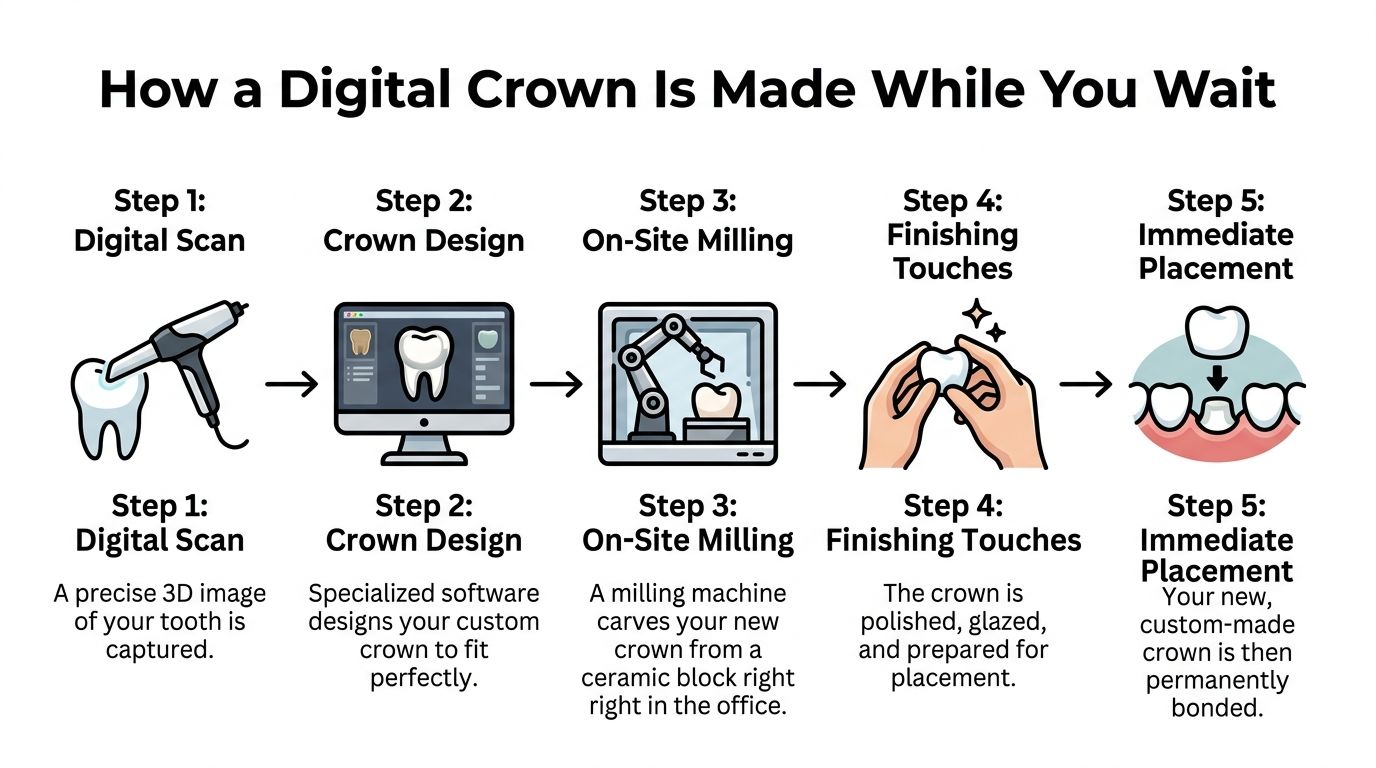
The idea sounds futuristic, but the process is easy to understand. It functions as a custom digital manufacturing system for your tooth. Instead of taking a mold, shipping it to a lab, and waiting, the crown is designed and made in the office during your visit.
Step one uses a digital scan
After the tooth is prepared, the dentist uses an intraoral scanner to capture a detailed image of the tooth and the surrounding bite. Patients usually love this part because it replaces the old putty impression that could feel bulky or messy.
The scan creates a 3D model on the screen. That lets your dentist study the tooth from multiple angles and fine-tune the shape before anything is made.
If you want to see how this kind of workflow fits into modern care, this overview of advanced dental technology, 3D printing, and digital dentistry gives a helpful big-picture look.
Step two designs the crown on a computer
The crown isn’t guessed. It’s digitally designed to match the tooth, your bite, and the space around it.
Patients often get confused on this point. They assume same-day means “pre-made.” It doesn’t. The crown is still custom. The difference is that the design work happens in real time, right there in the office.
Step three mills the crown from strong ceramic
Once the design is approved, an in-office milling unit carves the crown from a ceramic block. These materials aren’t flimsy or temporary. In-office milled crowns are made from high-strength ceramic such as lithium disilicate or zirconia, with flexural strength exceeding 400 MPa, comparable to or greater than many lab-fabricated crowns, as explained in this discussion of same-day root canal and crown treatment.
That’s the part many patients find reassuring. The crown isn’t a shortcut. It’s a durable restoration made from serious restorative materials.
Practical rule: Fast and strong can exist together in dentistry when the office has the right digital tools and the case is a good fit.
The final fit matters
After milling, the crown is tried in, adjusted if needed, polished, and bonded into place. The goal is simple. It should feel natural, look like it belongs in your smile, and let you chew without that “something feels off” sensation.
A good same-day crown shouldn’t look like a quick fix. It should look and function like your tooth got a second chance.
Same-Day Crowns vs Traditional Crowns A Detailed Comparison
Patients usually compare these two options on comfort and time. Dentists compare them on protection too. Both viewpoints matter.
The biggest practical difference is what happens after the root canal is done. With a traditional process, you typically leave with a temporary crown while the final one is made elsewhere. With a same-day process, you leave with the permanent crown already in place.
Side by side differences
| Feature | Same-Day Crown (CEREC) | Traditional Crown (Lab-Fabricated) |
|---|---|---|
| Number of visits | Usually one appointment for the root canal and crown | Usually multiple appointments |
| Time to finish treatment | Permanent restoration placed the same day | Final restoration placed after a waiting period |
| Impressions | Digital scan | Traditional impression or digital scan, depending on office |
| Temporary crown | Usually not needed | Usually needed |
| Comfort | One treatment sequence and no temporary phase | Treatment is spread out, with a temporary between visits |
| Tooth protection | Immediate permanent coverage | Protection depends on the temporary until the final crown is placed |
The temporary crown issue
Same-day treatment offers a real health advantage. Traditional crowns require a temporary for about 2 weeks on average, and up to 20 to 30% may fail or cause sensitivity, according to this review comparing same-day crowns and lab crowns.
That doesn’t mean every temporary causes trouble. Many do fine. But patients often describe the same concerns:
- It feels different when they chew.
- It shifts or loosens and creates anxiety.
- It stays sensitive to temperature or pressure.
- It makes them cautious about what they eat on that side.
A same-day crown removes that in-between stage entirely.
What patients notice most
Some differences are clinical. Others are simple quality-of-life improvements.
- Fewer interruptions because you’re not returning for crown delivery.
- Less uncertainty because there’s no waiting period with a temporary.
- A more complete finish because the tooth is restored at the end of the visit.
When a tooth has already been through enough damage to need a root canal, many patients feel relieved knowing they won’t have to baby it for the next couple of weeks.
Traditional crowns still have an important place in dentistry. They can be the right choice in some situations. But if your case is suitable, a same-day crown often gives you a cleaner, simpler path from pain to recovery.
Are You a Candidate for a Single-Visit Root Canal and Crown
Same-day treatment is a strong option, but it isn’t automatic. The right plan depends on the condition of the tooth, the level of infection, and how much healthy tooth structure remains after the damaged tissue is removed.

Signs you may be a good fit
A single-visit plan may work well when the tooth is stable enough to restore immediately. Dentists also look at whether there’s enough remaining tooth for the crown to grip securely.
That last point matters more than patients realize. A crown needs healthy structure to hold onto. If too much of the tooth is missing above the gumline, the dentist may need to rebuild the foundation first or recommend a different timing strategy.
Common reasons a case may be suitable include:
- The tooth can be predictably restored after cleaning and sealing the canal.
- The surrounding area looks manageable from an infection standpoint.
- There’s enough tooth left to support a crown with confidence.
When waiting is the safer choice
Sometimes the fastest plan isn’t the best long-term plan. If there’s a significant infection, swelling, or uncertainty about how the tooth will settle after treatment, your dentist may recommend a short delay before placing the final crown.
Some dental experts recommend waiting 1 to 2 weeks for crown placement in cases with significant infection, because this can reduce reinfection risks by 20 to 30% according to ADA guidelines, as discussed in this article on whether a root canal and crown can be done the same day.
That kind of recommendation can disappoint patients who hoped to finish everything at once. But it’s a sign your dentist is thinking about healing, not just speed.
A good treatment plan fits the tooth in front of you. It doesn’t force every case into the same timetable.
Questions your dentist is answering behind the scenes
When we evaluate candidacy, we’re usually considering things like:
- How much infection is present
- Whether the tooth is cracked or structurally compromised
- How well the tooth can support a final crown
- Whether immediate sealing and restoration will help or hinder healing
If your dentist says same-day is a good option, that’s based on those details. If your dentist says it’s better to wait, that’s also based on those details. Either way, the goal is the same. Keep the tooth healthy, comfortable, and functional for the long run.
Your Same-Day Procedure A Step-by-Step Patient Journey
Patients usually feel calmer when they know what the visit will feel like. Most same-day appointments move in a steady sequence, and there usually isn’t much mystery once you break it down.
What the appointment feels like
First, you’ll get numb so the tooth and surrounding area are comfortable. If you’re anxious, many patients appreciate discussing calming options ahead of time so they don’t walk in tense and bracing for the worst.
Once you’re comfortable, the dentist performs the root canal by removing the inflamed or infected tissue from inside the tooth, cleaning the inner space, and sealing it. Patients are often surprised that the experience feels more like pressure and movement than pain.
After that, attention shifts from the inside of the tooth to the outside.
What happens after the root canal is done
The tooth is shaped to receive the crown, and a digital scan is taken. You won’t be dealing with messy impression material, and you won’t need to leave wearing a temporary if the case is proceeding as planned.
While the crown is being milled in the office, you may rest in the chair, listen to music, scroll on your phone, or take a short break. Many people find this part oddly satisfying because the visit has a clear finish line.
A typical flow looks like this:
- Numbing and comfort setup so you can relax.
- Root canal treatment to remove infection and save the tooth.
- Tooth preparation and digital scan for the crown.
- In-office milling while the crown is made.
- Try-in and bite adjustment so it feels right.
- Bonding and polishing for the final result.
How you leave the office
You leave with the tooth restored, not halfway restored. That’s the part patients remember most.
Instead of thinking, “I still have to come back for the permanent crown,” you’re done. The tooth is protected, the shape is back, and your smile looks complete again.
For many people, the best part of a same-day visit is psychological. They walk out knowing the problem has been treated and the tooth has been finished.
You may still have mild tenderness afterward, especially from keeping your mouth open for treatment or from the surrounding tissues being worked on. But the usual routine of protecting a temporary and scheduling a delivery appointment is gone.
Understanding Costs and Insurance for Same-Day Crowns
Many patients understand the health benefits, yet they frequently have questions regarding insurance coverage and how the same-day option affects the numbers.
How coverage usually works
In many cases, PPO plans typically cover root canals and crowns at the same rate regardless of visit count, but same-day technology can sometimes involve premiums. In-house savings plans can offset this by offering 20 to 30% discounts and avoiding separate lab fees, according to this guide on same-day root canal costs and coverage.
That’s why two patients can have the same treatment need but different out-of-pocket expectations. Coverage depends on the plan details, not just on the procedure itself.
If you want a broader explanation of crown benefits and common insurance questions, this page on whether dental insurance covers crowns can help you know what to ask before treatment.
What to ask before you say yes
A few simple questions can clear up a lot:
- Is the root canal covered under my plan?
- Is the crown covered at the same benefit level as a traditional crown?
- Is there any additional fee related to in-office crown fabrication?
- Have I met my deductible, and is there a waiting period?
Those questions matter because “covered” doesn’t always mean “fully covered.” It can mean partially covered, subject to a deductible, or applied toward a yearly maximum.
Looking at value, not only price
A same-day crown may or may not be the cheapest line item on paper. But patients often value what it removes from the process:
- No separate lab wait
- No temporary crown stage
- No extra trip back for delivery
- Less disruption to work and family schedules
For some families, that convenience has real financial meaning even beyond the dental fee. Missing fewer hours of work or arranging childcare one less time can matter.
The best approach is to ask for a written estimate before treatment begins. A good dental team can explain what insurance is expected to cover, what portion may remain, and whether savings plans or financing can help make the final decision easier.
Restore Your Smile in One Day at Grand Parkway Smiles
A same-day root canal and crown can do more than save time. It can protect a weakened tooth sooner, restore your bite faster, and help your smile look normal again without a drawn-out process.
That matters if you’re dealing with a visible tooth, a painful back molar, or a damaged tooth that’s making you eat on one side. You want relief, but you also want a result that looks natural and supports long-term dental health.
The key is judgment. Some teeth are excellent candidates for a root canal crown same day approach. Others need a short pause before the final crown is placed. The best outcome comes from choosing the right timing for the specific tooth, not from forcing every case into one model.
At Grand Parkway Smiles, patients benefit from a setting built for integrated care. That includes digital dentistry, 3D imaging, and a team that can evaluate both the root canal side and the restorative side of treatment in one place. For anxious patients, sedation options can also make the experience much more manageable.
If you’ve been told you need a root canal and crown, or you’re dealing with a cracked or painful tooth and want to know your options, the next step is simple. Get the tooth evaluated before it worsens. In many cases, keeping your natural tooth is still very possible, and in the right situation, restoring it in one visit can be an excellent solution.
If you want to find out whether a same-day root canal and crown is right for your tooth, schedule a consultation with Grand Parkway Smiles. Their team in Katy offers advanced digital dentistry, complete specialty care under one roof, and a patient-first approach focused on comfort, function, and a healthy-looking smile.