If you're searching what do dentures look like, you're probably not asking about plastic teeth on a tray. You're asking something more personal. Will they look obvious when you talk? Will your smile look like you? Will other people notice?
Those worries are normal. Individuals generally don't want dentures that merely fill spaces. They want teeth that look believable, feel comfortable, and restore the shape of their smile in a way that doesn't draw attention for the wrong reasons.
Beyond the Myths What Modern Dentures Really Look Like
Many people still picture dentures as bulky, chalky, or unnatural. That image usually comes from old stories, old films, or a relative's denture from decades ago. Modern dentures are different in both appearance and design.

Dentures have a very long history. The earliest known dentures date back to around 700 BC, when the ancient Etruscans made them from human and animal teeth bound with gold wire. In contrast, today's dentures use advanced acrylic resins and digital design to create a much more natural match to real teeth, reflecting over 2,700 years of progress in prosthetic dentistry, as described in this history of dentures.
That matters because the old stereotype didn't come from nowhere. Earlier dentures often fit poorly, looked stiff, and changed the way a person's lips and cheeks sat. People sometimes imagine that same look today, even though modern materials and planning have changed the result.
What most people notice first
When a denture looks natural, people usually don't think "denture." They notice a balanced smile, supported lips, and teeth that suit the face. Good denture design aims for harmony, not perfection.
A natural smile usually doesn't look identical on every tooth. It looks proportioned, soft, and believable in the context of your face.
What modern dentures are trying to copy
A well-made denture is designed to imitate several things at once:
- Tooth color: Not paper-white unless that's the look you want.
- Tooth shape: Rounded, square, or somewhere in between, depending on facial features.
- Gum appearance: Soft pink tones that blend with your natural tissue.
- Smile support: Enough structure to support the lips and reduce a collapsed look around the mouth.
The biggest shift is simple. Dentures aren't made to look like dentures. They're made to look like your teeth would look if they were healthy, complete, and in balance with your face.
The Anatomy of a Natural-Looking Denture
A denture has two main visual parts. Understanding them makes the whole idea less mysterious.
The first part is the teeth. The second part is the gum-colored base that supports them. If either part looks wrong, the entire smile can look artificial.
The teeth
The teeth are the part everyone focuses on first, but shape matters as much as shade. Teeth that are too large can make the smile look bulky. Teeth that are too flat or too uniform can look manufactured instead of natural.
Natural-looking denture teeth are chosen to suit the person's face, age, and smile line. A younger-looking smile may use fuller edges and brighter color. A softer, more mature look may use gentler contours and less brightness.
The base
The base is the pink portion that rests against the gums. Patients often underestimate how important this is. If the base is too thick, too visible, or the wrong color, the denture can look less convincing even if the teeth themselves are attractive.
Think of a denture like a custom portrait. The teeth are the subject, but the base is the background tone that makes the whole image feel real. Both have to work together.
Practical rule: If a denture looks "fake," the problem often isn't just the teeth. It's the relationship between the teeth, the gums, and the way the denture supports the lips.
Why this matters in daily life
A denture doesn't sit in isolation. It changes how your smile appears when you laugh, how your upper lip rests at conversation, and how much tooth shows when your face is relaxed.
That is why natural-looking dentures aren't one-size-fits-all. The most believable result comes from small adjustments in contour, color, and positioning, not from choosing the whitest teeth in the catalog.
A Visual Guide to Different Types of Dentures
A patient often starts with one worried question in the mirror: Will people be able to tell? The answer depends less on the word "denture" and more on the design you choose, how it fits your mouth, and how naturally it moves when you speak and smile.
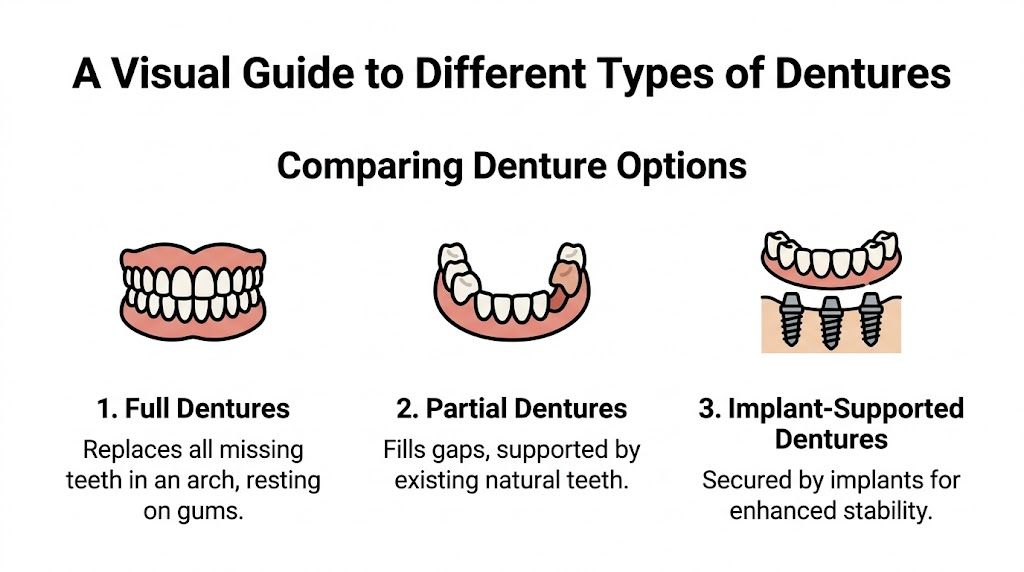
If you'd like a broader overview of options, this page on different types of dentures gives a helpful starting point. For appearance, the key question is simple: what will show in the mirror, and how naturally will it blend with your face?
Full dentures
A full denture replaces all teeth in the upper arch, lower arch, or both. In visual terms, it creates a complete smile and also restores some of the support that missing teeth once gave the lips and cheeks.
An upper full denture usually includes more gum-colored base because it covers a larger area. A lower full denture is often less visible from the front, but it has to work around the tongue and the movement of the lower jaw. That means the esthetic success of a lower denture is tied closely to stability. If it shifts when you talk, it can look less natural even if the teeth themselves are well shaped.
Partial dentures
A partial denture replaces some missing teeth while your natural teeth stay in place. The visual goal is continuity. A well-made partial should make the smile look complete, not patched together.
This type can be one of the most artistic to design because the denture teeth have to match real neighboring teeth in shape, color, and position. Some partials use clasps around nearby teeth for support. Those clasps may be visible, especially when you laugh widely, so careful planning matters. The design should hold the denture securely while keeping metal display to a minimum whenever possible.
Immediate dentures
An immediate denture is inserted right after teeth are removed. For many patients, that means they never have to go through a healing period without visible teeth.
It helps to view an immediate denture as a temporary cosmetic first step. Your mouth changes shape as the gums heal and the bone settles, so the denture that looks good on day one often needs adjustment, relining, or replacement later to keep the smile looking natural. That part surprises many patients. The first denture is often part of the journey, not the final version.
Implant-supported dentures
An implant-supported denture attaches to dental implants rather than resting only on the gums. Visually, this often creates the most stable look because the denture is less likely to lift, rock, or shift during everyday movement.
That stability affects appearance in ways patients notice right away. The smile can look more confident in conversation. The teeth can appear to sit more naturally because there are no visible clasps. In many cases, the overall result feels closer to natural teeth, both in the mirror and in motion.
Quick comparison
| Type | What you see in the mirror | Best visual strength |
|---|---|---|
| Full denture | A full row of replacement teeth and gum-colored base | Restores a complete smile and facial support |
| Partial denture | Replacement teeth blended among remaining natural teeth | Keeps natural teeth and closes visible gaps |
| Immediate denture | A complete smile placed right after extractions | Avoids a period without visible teeth |
| Implant-supported denture | Teeth with no visible clasps and less movement | Creates a steadier, more natural-looking smile |
Crafting Your Smile With Advanced Materials and Colors
The part many patients worry about most is easy to understand. They do not want teeth that look flat, too white, or obviously false. A natural-looking denture is built by layering small visual choices, much like matching paint, texture, and shape in a portrait so the final result looks lifelike instead of generic.
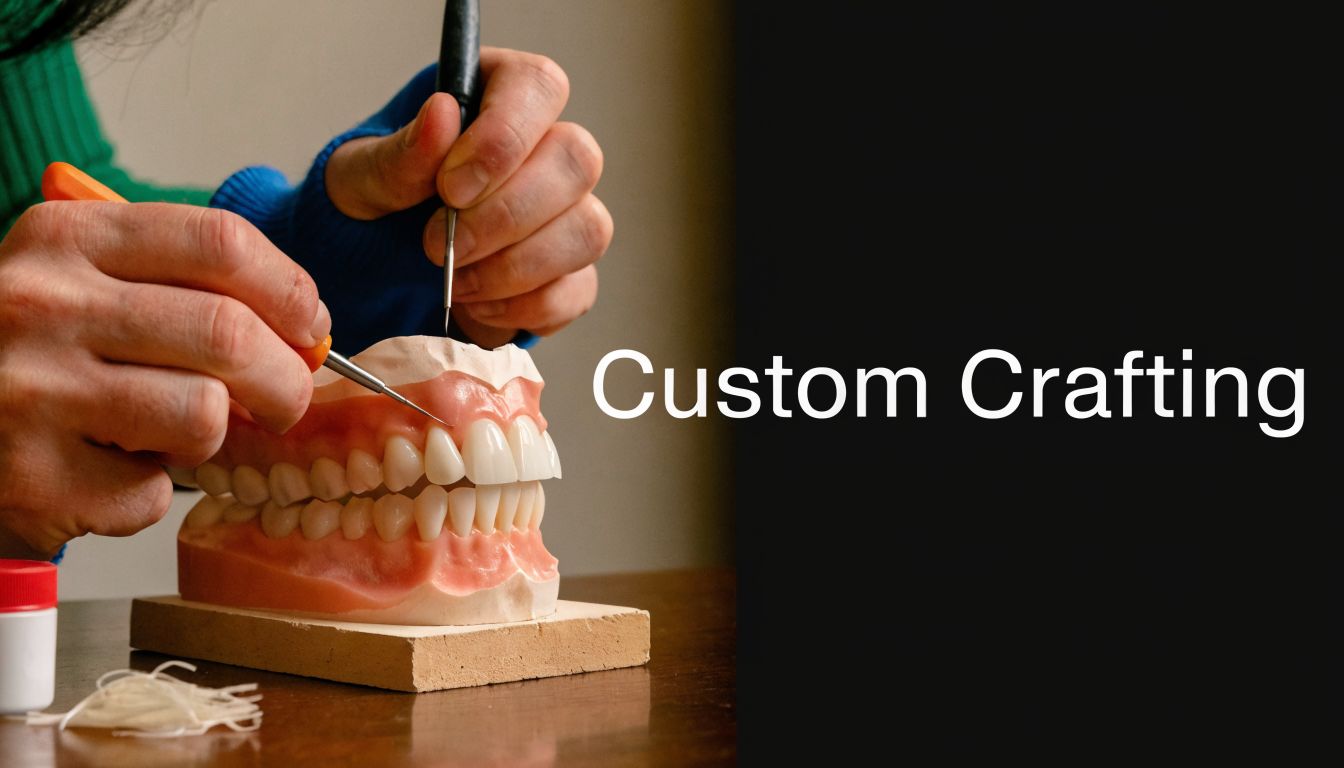
Modern dentures are made from materials chosen for both appearance and daily wear. The replacement teeth are often made from porcelain or high-impact acrylic resin. The gum-colored base is usually made from pink-tinted PMMA acrylic resin. Each material reflects light a little differently, and that matters because natural teeth and gums are never one flat shade from top to bottom.
Why teeth don't all look the same
Natural enamel has depth. Light passes through it, bounces back, and creates the soft variation you see in real teeth. Porcelain can mimic some of that glass-like translucency. Acrylic teeth are lighter, bond well to the denture base, and are often a practical choice for many designs.
The right material depends on the person. Bite forces, smile line, facial features, and the type of denture all affect that decision. A good result is less about picking the fanciest material and more about choosing the one that will look believable in your mouth.
Shade selection matters just as much. Real teeth usually have slight differences near the edges, between the front teeth and back teeth, and close to the gumline. Denture teeth that copy those subtle changes tend to look calmer and more natural in conversation.
Why the pink base matters so much
Patients often focus on the teeth first. Dentists and lab technicians also study the gums, because the base frames the entire smile.
Pink-tinted PMMA can be adjusted to better match a person's natural gum tone. The surface can also be shaped with gentle contours and light texture so it resembles living tissue more closely. If the base is too smooth, too bulky, or the wrong pink, even beautiful teeth can look artificial.
That is why good denture esthetics usually come from restraint. Teeth should suit the face. The gum portion should support the smile without drawing attention to itself. Small choices often create the most convincing result.
How digital workflows improve the look
Digital planning has changed the visual journey for many patients. Instead of relying only on hand-shaped estimates, the dentist and lab can use scans, photographs, bite records, and design software to preview how tooth size, position, and gum contours may look before the final denture is delivered.
That process helps in a very practical way. If a front tooth is slightly too long or the smile line looks too straight on screen or in a try-in, those details can be corrected before the final version is made. Patients often find this reassuring because they can see that denture esthetics are designed, not guessed.
CAD/CAM workflows can also produce an accurate fit with tolerances under 50 microns, which can reduce the clicking and movement many people associate with older dentures (https://pmc.ncbi.nlm.nih.gov/articles/PMC11008955/).
That precision affects appearance, not only comfort. A denture that stays steady during speech tends to look more like natural teeth because the eye is not catching extra motion. At Grand Parkway Smiles, digital dentistry and 3D imaging are used as part of restorative planning, which helps the team evaluate smile balance, lip support, and facial appearance before the final fit.
How a Well-Made Denture Should Look and Feel
A denture can look nice on a model and still feel wrong in a real mouth. A successful result has to do both. It should appear natural when you speak and smile, and it should sit in a way that doesn't constantly remind you it's there.
At first, you might notice the denture because it's new. Your tongue is learning where the teeth are. Your cheeks are adapting. Certain words may feel strange for a short time. That doesn't mean the denture looks bad or that something has gone wrong.
What a healthy fit usually looks like
A well-made denture should sit snugly against the gums. It shouldn't rock dramatically, click every time you talk, or create obvious movement when you laugh. The teeth should show in a way that suits your face, not like a row of oversized caps.
Just as important, the denture should support the lips and cheeks. When teeth are missing, the lower part of the face can start to look sunken. Properly positioned dentures restore that support and help the mouth area look fuller and more balanced.
What patients often confuse during the adjustment period
Some people expect dentures to feel exactly like natural teeth on day one. That's not realistic. Others assume any awareness means a poor fit. That's also not quite right.
A better way to think about it is this:
- Early days: You notice the appliance and may speak more carefully.
- After adjustment: The denture feels more familiar and your speech becomes easier.
- With a strong fit: The smile looks steady, the lips feel supported, and eating becomes more comfortable.
If your denture looks natural when you're sitting still but lifts or shifts when you talk, the issue is usually fit, not just appearance.
Implant-supported dentures often feel more secure because they are anchored. Traditional removable dentures can still look excellent, but they depend more heavily on the shape of the mouth and the quality of the fit.
The Visual Transformation Restoring Your Facial Profile
The most meaningful change from dentures often isn't the teeth themselves. It's the way the entire lower face regains structure.

When teeth are missing, the lips can lose support. The corners of the mouth may turn inward. The space between the nose and chin can seem shorter or collapsed. A thoughtfully made denture fills that lost space and helps the face look more like itself again.
What changes people often notice
The transformation is usually subtle in the best way. Friends may say you look healthier, less tired, or more like yourself without realizing exactly why.
Common visual improvements include:
- More lip support: The upper and lower lips look less folded inward.
- A softer mouth area: Fine lines around the mouth may look less severe because the tissues are supported.
- A more balanced profile: The chin, lips, and nose appear more proportionate.
That facial support often changes confidence just as much as the smile does. People speak more freely. They stop covering their mouth when laughing. They become more willing to be photographed.
Some patients also ask about polishing the overall look of their smile once their dentures are in place. If you're exploring simple ways to brighten their smile naturally, that can be a useful general resource for understanding stain prevention and smile care habits.
Begin Your Denture Journey at Grand Parkway Smiles
If you're in Katy or the greater Houston area, the process usually starts with a consultation and a close look at how your smile, gums, bite, and facial profile work together. Denture treatment isn't just about replacing teeth. It's about choosing a design that restores appearance and function in a way that fits your life.
A modern workflow often includes digital records, shade selection, try-ins, and adjustments based on how the denture looks while you speak and smile, not just how it appears on a model. That visual step matters. A denture has to look right in motion.
You can learn more about the sequence of appointments and what to expect from this guide to the denture process. For many patients, understanding the steps makes the decision feel less intimidating.
If you're nervous, that's okay. That's a normal reaction. The key is working with a team that pays attention to the small details that make dentures look natural, feel stable, and restore confidence rather than just replacing missing teeth.
If you're ready to talk through your options, schedule a consultation with Grand Parkway Smiles. A personalized evaluation can help you see what your denture could look like, how it would fit, and which approach makes the most sense for your smile.