
When your dentist says it's time to get your wisdom teeth out, one of the first things you probably think about is the cost. It's a valid concern. The final bill can swing from as low as $75 for a straightforward removal to over $4,175 for the surgical extraction of all four teeth.
That large price range highlights one key fact—there's no single, flat fee. The cost is a direct reflection of your unique dental health needs. Understanding what goes into that number is the first step toward planning for this important procedure, which is a crucial investment in your long-term oral health and the appearance of your smile.
Your Quick Guide to Wisdom Tooth Extraction Costs
Thinking of wisdom tooth removal as just another bill misses the bigger picture. It's truly an investment in your long-term dental health. Addressing problematic wisdom teeth now can save you from significant future issues—like painful infections, cysts, and even the misalignment of your other teeth, which can spoil a straight smile.
By being proactive, you're protecting your smile's health and appearance, helping yourself avoid much more complex and expensive dental work down the line. This guide will break down the costs so you know exactly what to expect.
Understanding the Price Spectrum
So, why the huge price range? It all comes down to the complexity of your case. A wisdom tooth that has fully erupted through the gums is relatively simple to remove. But one that's stuck under the gumline or trapped in the jawbone—what we call an "impacted" tooth—requires a more advanced surgical approach to protect your oral health.
Think of it like this: a simple extraction is like pulling a weed from soft garden soil. An impacted tooth is more like digging out a large, stubborn rock buried deep underground. The latter requires more time, specialized skill, and advanced tools for a safe and successful outcome.
These differences are reflected in the national averages. A simple extraction of a fully erupted tooth might only run $75 to $200. However, surgical extractions for impacted teeth are more involved and can range from $225 to over $1,000 per tooth, depending on how deeply they are embedded in bone.
When you add it all up, getting all four wisdom teeth removed without insurance could land anywhere between $1,200 and $4,175. For a deeper dive into dental costs, Dentillo.com is a great resource.
This table gives you a quick snapshot of what to expect for each type of extraction.
Estimated Wisdom Tooth Extraction Cost Per Tooth Without Insurance
This table provides a quick summary of typical cost ranges for different types of wisdom tooth extractions, helping you quickly identify the potential expense.
| Extraction Type | Average National Cost Range Per Tooth |
|---|---|
| Simple Extraction (Erupted Tooth) | $75 – $200 |
| Surgical (Soft Tissue Impaction) | $225 – $600 |
| Surgical (Full Bony Impaction) | $413 – $1,041 |
As you can see, the more complex the situation, the higher the cost to ensure a safe and effective procedure.
The chart below helps visualize these starting costs for simple, surgical, and multi-tooth procedures.
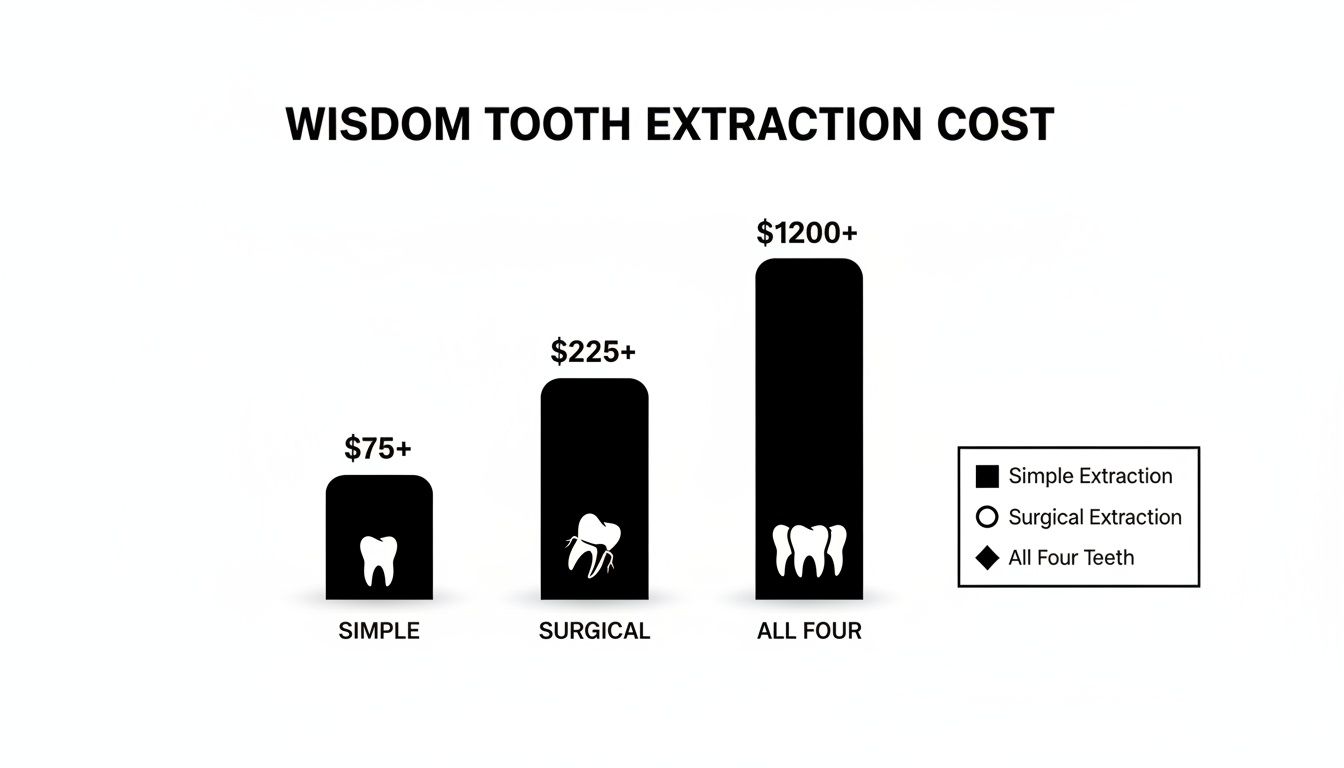
As the infographic makes clear, surgical removal costs significantly more than a simple pull because of the advanced techniques required to protect your jawbone, nerves, and adjacent teeth, ensuring a positive long-term outcome for your smile.
What Really Drives the Cost of Your Procedure

That final number on your bill isn't just pulled out of a hat. It’s a direct reflection of the specific, personalized care your smile needs to thrive. Every person’s mouth is different, and the complexity of your procedure is the single biggest factor that shapes the overall cost.
Think of it like a car repair. Fixing a simple flat tire is one thing; rebuilding the whole engine is something else entirely. Dentistry works the same way. The details of your case—how the tooth is positioned, what's around it—determine the tools, time, and level of expertise needed for a safe and successful outcome that benefits your oral health for years.
Simple vs. Surgical Extraction: The First Big Difference
Right off the bat, the most fundamental cost driver is the type of extraction you need. This all comes down to one question: is your wisdom tooth fully erupted, or is it trapped?
-
Simple Extraction: This is for a tooth that has fully emerged from the gums and is completely visible. It’s a much more straightforward procedure, often handled by a general dentist, and lands on the lower end of the wisdom tooth extraction cost spectrum. Because it’s more direct, the fee is lower.
-
Surgical Extraction: This becomes necessary when a tooth is impacted, meaning it's stuck under the gum line or inside the jawbone. Here, the surgeon has to make an incision to even get to the tooth. Sometimes, a tiny bit of bone might need to be removed, or the tooth might be broken into smaller pieces to get it out safely. This just takes more skill, time, and specialized gear.
A surgical extraction is naturally more involved and costs more, but it’s a crucial approach designed to protect the surrounding nerves and bone, preventing a whole host of future problems that could compromise your dental health.
The Complexity of Tooth Impaction
Just to add another layer, not all impacted teeth are created equal. How a tooth is stuck is a huge factor in the final price tag. The more blocked it is, the more delicate and intricate the surgery becomes to ensure a safe outcome.
A soft tissue impaction is the simplest type of impaction. This means the tooth has made it past the jawbone but is still covered by gum tissue. The surgeon just needs to make a small incision in the gums to access it.
On the other hand, a bony impaction is a bigger deal. This is when the tooth is either partially or fully trapped inside the jawbone itself. Getting it out requires carefully removing some bone to expose the tooth. A full bony impaction, where the tooth is completely submerged in bone, is the most challenging—and therefore most expensive—scenario.
A full bony impaction requires a high degree of surgical skill to safely remove the tooth without damaging nearby nerves or adjacent molar roots. This level of precision is a critical investment in your future oral health and the stability of your smile.
Anesthesia and Sedation Options
Your comfort is a top priority, and your choice of anesthesia plays a big part in both your experience and the final bill. While some numbing is always included, other options can add to the total, ensuring a stress-free procedure.
The main choices are:
- Local Anesthesia: Just a numbing injection right at the extraction site. It's the most basic and least expensive option, usually included in the base price of a simple extraction.
- Nitrous Oxide: You might know this as "laughing gas." It helps you relax and feel at ease but doesn't put you to sleep. This adds a moderate cost to your procedure.
- IV Sedation: This is administered through a vein and puts you in a "twilight sleep." You're technically conscious but so deeply relaxed that you likely won't remember a thing. It’s a fantastic choice for anxious patients or complex surgeries and adds a more significant cost because it requires specialized monitoring and expertise.
Think of IV sedation as an investment in a totally stress-free experience, which can make a world of difference during a more complex surgery and lead to a more positive overall outcome.
Diagnostic Imaging Needs
Before any procedure, we need a crystal-clear picture of what’s going on under the surface to ensure the best possible result. For simple extractions, standard 2D X-rays are usually all that’s needed and are often part of an initial consultation.
However, for tricky bony impactions—especially when a tooth is dangerously close to a major nerve—a Cone Beam CT (CBCT) scan might be recommended. This 3D imaging gives a super-detailed map of the tooth, its roots, nerve pathways, and the jawbone. While it does add to the upfront cost, this advanced tool is absolutely vital for planning the surgery, minimizing risks, and ensuring the safest possible outcome. It's a perfect example of how investing a little more at the start protects your health for the long run.
How Dental Insurance Can Reduce Your Final Bill
Trying to figure out dental insurance can feel like a puzzle, but it's hands-down your best tool for lowering the wisdom tooth extraction cost. Once you get a handle on a few key terms, that confusion turns into confidence, and you'll be able to get the most out of your benefits.
Think of your insurance plan as a financial partner in your oral health. Most PPO plans see wisdom tooth removal for what it is: a medically necessary procedure, not an optional cosmetic tweak. Because of that, they're ready to share the cost with you, helping you sidestep future pain, infections, and damage to your other teeth that could affect your smile's appearance.
Decoding Your Dental Plan
To really maximize your savings, it helps to speak the same language as your insurance company. These three terms are the ones that directly affect how much you'll end up paying.
- Deductible: This is a set amount you have to pay for covered services before your insurance plan kicks in. It’s like an annual entry fee you pay once to unlock your benefits for the year.
- Co-insurance: Once your deductible is met, your insurance typically doesn't cover 100% of the bill. Co-insurance is the percentage of the cost you're still responsible for. For instance, if your plan has an 80/20 split for surgery, they’ll cover 80%, leaving you to pay the remaining 20%.
- Annual Maximum: This is the absolute ceiling on what your insurance will pay for your dental care in a single plan year. If you hit this limit, you'll be responsible for any further costs until your plan resets.
Getting a grip on these three pieces of the puzzle allows you to estimate your final bill with far more accuracy. It makes the whole process feel much more predictable.
The Power of a Pre-Treatment Estimate
One of the most valuable moves you can make is to request a pre-treatment estimate (sometimes called a pre-determination). This is a formal request our office sends to your insurer before your surgery.
Your insurance company will review the whole plan—the type of extraction, the sedation, everything—and send back a breakdown of exactly what they’ll cover and what your estimated portion will be. This isn't a bill; it's a financial roadmap that prevents any nasty surprises down the line.
Requesting a pre-treatment estimate is the single best way to clarify your coverage. It provides a clear, documented breakdown of your expected out-of-pocket wisdom tooth extraction cost, giving you complete financial peace of mind before scheduling your surgery.
This simple step gets everyone on the same page and helps you budget for this important investment in your dental health. If you want to dive deeper into how different plans work, you can check out our detailed guide on navigating dental insurance.
Asking the Right Questions
Our financial coordinator is your best advocate. They deal with insurance plans all day, every day, and can help you make sense of your specific coverage.
When you come in for your consultation, be ready with these questions:
- Are you in-network with my insurance plan? In-network dentists have pre-negotiated rates, which almost always means lower costs for you.
- Can you submit a pre-treatment estimate for me? This confirms they'll do the legwork to get you a clear cost breakdown.
- What is my estimated co-insurance for a surgical extraction? This is crucial for calculating your share of the procedure's cost.
- How much of my annual maximum will this procedure use? Knowing this helps you plan for any other dental work you might need for the rest of the year.
Armed with these answers, you can move forward with confidence. You're not just getting rid of pain—you're protecting the alignment and health of your entire smile for years to come.
Making Your Procedure Affordable, Even Without Insurance
Let's be honest, even with a decent insurance plan, the out-of-pocket costs for a procedure like wisdom tooth removal can feel like a major hurdle. Just thinking about the bill can be stressful, but it's critical that financial worries don't stand in the way of protecting your oral health. Taking care of problematic wisdom teeth now is a direct investment in preventing serious pain, infection, and damage to your other teeth down the road.
The good news is, there are several practical and accessible ways to make the wisdom tooth extraction cost manageable for almost any budget. These options are designed to break down what feels like a large one-time expense into predictable, smaller monthly payments, ensuring you can get the care you need to maintain a healthy, beautiful smile.
Third-Party Financing for Predictable Payments
One of the most common ways people manage healthcare costs is through third-party financing programs. You can think of them as specialized medical credit cards that let you pay for the procedure upfront and then pay off the balance over time with a structured monthly plan.
Programs like CareCredit are a staple in dental offices for this exact reason. They often have promotional financing deals, like 0% interest if the balance is paid off within a set period (like 6, 12, or 18 months). This approach turns a potentially overwhelming bill into a series of smaller, interest-free payments that are much easier to fit into a monthly budget.
This strategy empowers you to put your health first without having to drain your savings account. You get the immediate relief of a healthy, pain-free mouth while spreading the financial impact out over a more comfortable timeline.
Using Pre-Tax Dollars to Your Advantage
Another powerful tool for managing medical expenses is a tax-advantaged savings account, which many employers offer. These accounts let you set aside money from your paycheck before taxes are taken out, which can lead to some pretty significant savings on health-focused procedures.
There are two main types you can use for your wisdom tooth extraction:
- Health Savings Account (HSA): If you have a high-deductible health plan, you're likely eligible for an HSA. It’s essentially a personal savings account just for medical costs. The money you put in is tax-deductible, it grows tax-free, and any withdrawals for qualified medical expenses are also tax-free. It's a triple-win.
- Flexible Spending Account (FSA): An FSA is another employer-sponsored account that lets you earmark pre-tax dollars for healthcare. These funds are usually "use-it-or-lose-it" within the plan year, which makes them absolutely perfect for a planned procedure like wisdom tooth removal.
By using an HSA or FSA, you're essentially paying for your dental care with a 20-30% discount, depending on your personal tax bracket. It's one of the smartest and most efficient ways to lower your out-of-pocket costs for essential procedures that improve your health.
In-House Dental Savings Plans
For patients who don't have any dental insurance at all, many practices offer a great alternative: an in-house dental savings plan. This isn't insurance, but rather a membership program you can join for a yearly fee. In exchange, you get significant discounts on a whole range of services, including wisdom tooth extractions.
These plans are designed to be straightforward and transparent. You won't find any deductibles, annual maximums, or frustrating waiting periods. You just pay the membership fee and get immediate access to reduced pricing. It’s a direct path to making essential dental care more affordable, ensuring cost is never a barrier to a healthy smile.
Exploring these options gives you a clear roadmap for getting the dental care you need without the financial strain. You can learn more by checking out the dental financing options available at Grand Parkway Smiles or by speaking with our financial coordinator, who can help find the perfect solution for your situation.
The True Value of Investing in Your Oral Health

It’s natural to get hung up on the numbers, but the real conversation around wisdom tooth removal should be less about cost and more about long-term value. Think of this procedure as essential maintenance for your mouth—an investment that pays off big time in your health, comfort, and even your appearance for years to come.
Putting off the procedure because of the initial wisdom tooth extraction cost might feel like you're saving money today, but it often sets the stage for much bigger, more expensive problems down the road. In dentistry, an ounce of prevention is absolutely worth a pound of cure.
The Dangers of Delaying Necessary Care
Ignoring impacted wisdom teeth isn't a minor issue; they are active threats lurking in your jaw. They can act like ticking time bombs, quietly causing damage until they erupt into a full-blown emergency that demands urgent and costly attention.
When these teeth don't have enough room, they can grow sideways, shoving against your second molars. This constant pressure can damage the roots of neighboring teeth, create pockets that are impossible to clean (leading to decay), and even start a chain reaction of shifting that can ruin years of orthodontic work and spoil a beautiful, straight smile.
On top of that, partially erupted wisdom teeth are notorious for causing painful, recurring infections called pericoronitis, which can lead to major swelling, jaw stiffness, and intense pain that disrupts your life.
Avoiding More Complex and Costly Procedures
Getting a problematic wisdom tooth out proactively helps you sidestep a future filled with serious dental drama. The consequences of waiting too long can be severe, often requiring treatments far more invasive than a planned extraction.
Here are a few common problems that come from neglected wisdom teeth:
- Chronic Pain and Infections: Constant discomfort and swelling that can make eating, talking, and sleeping a nightmare.
- Damage to Adjacent Teeth: Crowding and pressure can cause decay or even dissolve the roots of healthy molars, potentially leading to root canals or the extraction of those teeth, too.
- Cyst Formation: In some cases, a fluid-filled sac—a cyst—can form around an impacted wisdom tooth. These cysts can grow aggressively, destroying the surrounding jawbone and teeth and requiring major surgery to fix.
By dealing with wisdom teeth early, you’re investing in the stability of your entire smile. You're protecting the health of your other molars, preserving the integrity of your jawbone, and keeping the alignment you’ve worked so hard to achieve.
Addressing impacted wisdom teeth proactively isn't just about avoiding future pain; it's a strategic decision to prevent more complex, invasive, and significantly more expensive dental surgeries down the road. It's an investment in the long-term health and stability of your entire jaw.
While looking for ways to manage the cost is smart, the value of having local, expert care can’t be overstated. For instance, dental tourism might look tempting on the surface, with costs overseas sometimes being 70% to 90% lower than in the U.S. But that path comes with a lot of homework—you have to intensely research clinic standards, and it adds the complexity of travel and follow-up care.
For patients here in the Katy and Houston area, a local practice like Grand Parkway Smiles provides immediate access to advanced 3D imaging and, most importantly, continuity of care. This ensures any post-op issues are handled quickly by the team you already know and trust, with no geographical hurdles. You can find out more about the considerations for international dental care.
Common Questions About Wisdom Teeth Removal Costs
Even after we’ve walked through all the details, it’s completely normal to have a few more questions pop up. When you’re planning for any kind of procedure, feeling clear and confident is what matters most. Understanding every part of the wisdom tooth extraction cost isn’t just about budgeting—it’s about empowering you to make the best decisions for your long-term health.
Let's tackle some of the most common questions we hear from patients. Our goal here is to clear up any lingering confusion so you can move forward feeling informed, prepared, and ready for this important investment in your smile.
Is It Cheaper to Remove All Four Wisdom Teeth at Once?
Yes, almost always. Taking care of all four wisdom teeth in a single appointment is much easier on your wallet. Think of it like bundling services—you get a better value by doing everything at once.
Scheduling one surgery for all four teeth means you only pay one time for several big-ticket items.
- Single Anesthesia Fee: You only have one charge for IV sedation or whatever anesthesia option you choose.
- One-Time Facility Fee: The cost for preparing and using the surgical room is only applied once.
- Consolidated Surgeon Fees: The surgeon’s overall fee is typically lower per tooth compared to what you’d pay for four separate surgeries.
Beyond the money you save, it’s also just more efficient. You only have to plan for one recovery period, which means less time off from work or school. It’s a move that’s smarter for both your budget and your schedule.
Can Medical Insurance Cover Wisdom Tooth Extraction?
It's not the norm, but sometimes medical insurance will cover wisdom tooth removal. This usually only happens in very specific and complex situations where the problem is considered "medically necessary" and goes beyond a typical dental issue.
For instance, your medical plan might step in if an impacted wisdom tooth has caused a large cyst or tumor that's damaging your jawbone. It could also apply if there's a severe, body-wide infection or if the extraction is part of a larger treatment, like repairing a jaw fracture.
But for the vast majority of cases—even for tricky surgical removals of fully impacted teeth—your dental insurance plan will be your primary source of coverage. It’s always smart to check with both your medical and dental insurance providers. Our office can give you the right diagnostic codes and paperwork to help you get a clear pre-authorization.
What Is Included in My Wisdom Tooth Extraction Quote?
A good, trustworthy quote should be completely itemized, leaving no room for surprises. When a dental office gives you a detailed estimate, it’s a great sign that they’re committed to being transparent about the investment you're making in your health.
Typically, a complete quote for your procedure will include:
- The Surgeon's Fee: This is for the doctor’s expertise, skill, and time performing the surgery.
- Anesthesia Costs: This covers the fee for your chosen level of sedation, from local anesthetic to IV sedation.
- Facility or Materials Fees: This covers the use of the sterile surgical suite and any one-time-use materials.
- Diagnostic Imaging: The cost for your initial X-rays or a 3D CBCT scan is often included in the consultation or total price.
- Follow-Up Visits: Post-op checkups to make sure you're healing well are almost always part of the initial fee.
It's really important to ask if the cost of prescriptions (like pain relievers or antibiotics) or potential extras, like a bone graft, are included in the initial quote or will be billed separately. Don't ever hesitate to ask for a complete breakdown—a clear picture of your wisdom tooth extraction cost is the first step to a stress-free experience.
Why Does an Oral Surgeon Cost More Than a General Dentist?
The price difference between an oral surgeon and a general dentist comes down to a major difference in specialized training and experience. Many fantastic general dentists can handle simple extractions, but an oral surgeon is a specialist who has gone through years of an intense, hospital-based surgical residency after dental school.
This advanced training gives them the unique skills to handle the most difficult cases with incredible precision and safety. When you choose an oral surgeon, you're investing in a specialist’s expertise for a few key reasons:
- Complex Impactions: Surgeons are the experts at removing teeth that are stuck deep in the jawbone or wrapped around critical nerves.
- Advanced Anesthesia: Oral surgeons are licensed to administer every level of sedation, including deep sedation and general anesthesia, which guarantees a comfortable and anxiety-free procedure.
- Surgical Skill: Their deep training prepares them to manage any unexpected complications, minimizing risks and leading to a smoother, more predictable recovery.
Ultimately, seeing an oral surgeon for a complex extraction is an investment in the highest possible standard of care. That specialized skill helps protect the health of your jaw and nearby nerves, delivering the best outcome for your well-being.
At Grand Parkway Smiles, our team includes an in-house oral surgeon, and we're dedicated to providing care that is safe, comfortable, and completely transparent. If you have more questions or you’re ready to schedule a consultation to talk about your wisdom teeth, we invite you to contact our Katy, TX office today. We'll provide a clear, itemized treatment plan and help you explore all your payment and financing options. Your journey to a healthier smile starts here.
Learn more and book your appointment at https://dentistkatytx.com.