Think of a dental implant as a small post that acts like a new tooth root. For that implant to restore your smile for years to come, it needs to be anchored securely in a dense, healthy jawbone. A bone graft is a procedure we use to rebuild or add bone to your jaw, creating a strong base where it has become too thin or soft.
This is often the first, most crucial step to make sure your implant has enough support to be successful—much like laying a solid foundation before you build a house for a beautiful, permanent smile.
Building a Foundation for Your Future Smile
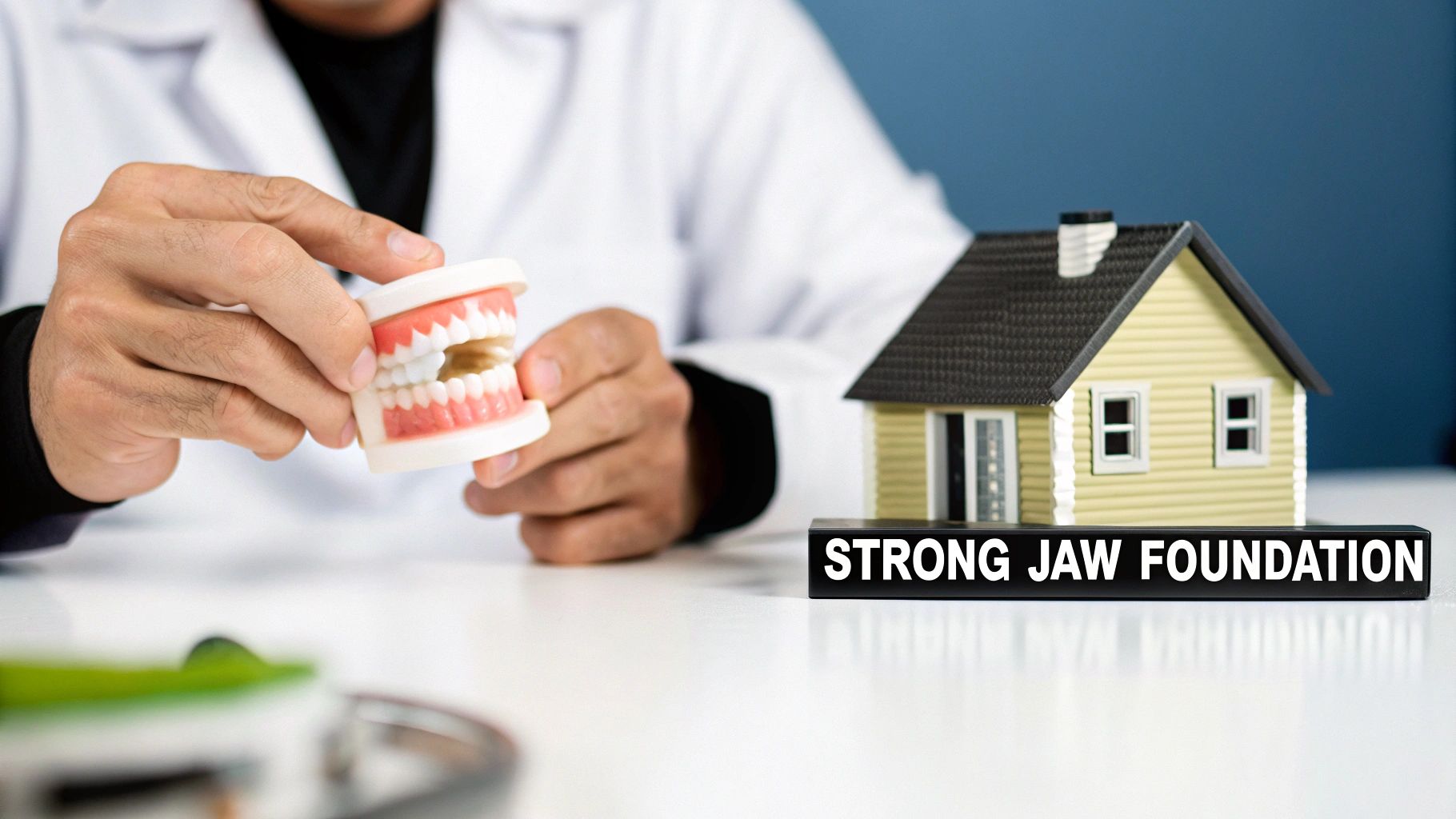
When the jawbone doesn't have the volume or strength it needs, an implant simply won't have the support to function correctly or look natural. This is where bone grafting becomes essential. It’s a very common and highly successful procedure designed to restore the jawbone's integrity, paving the way for a beautiful new tooth.
This process essentially reconstructs the site, getting it ready to firmly hold a new dental implant. Without this vital step, an implant placed in weak bone could become unstable or even fail, putting both your investment and your long-term dental health at risk.
Why a Strong Jawbone Matters for Your Smile
A dense jawbone is the unsung hero of a beautiful, functional smile. It doesn't just hold your teeth in place; it also gives your lower face its shape and structure, supporting a youthful appearance. Unfortunately, bone loss is a common problem that can happen for a few key reasons.
- After a Tooth Extraction: When a tooth is removed, the jawbone in that area no longer gets the stimulation it needs to maintain its mass. Over time, it starts to shrink, which can affect your facial profile.
- Advanced Gum Disease: Periodontitis can actively destroy the very bone that supports your teeth, leading to weakness, instability, and potential changes in your appearance.
- Facial Trauma or Injury: An injury can damage the structure and density of the jawbone, compromising the foundation for a healthy smile.
Bone grafting isn't just about preparing for an implant; it's a restorative procedure that actively promotes better long-term oral health. It rebuilds what was lost, paving the way for a permanent solution that looks and feels just like a natural tooth.
Ultimately, bone grafting is the key that unlocks the possibility of a permanent, beautiful smile for so many people. It directly addresses the underlying problem of bone loss, ensuring your dental implant has the rock-solid foundation it needs for decades of confident chewing, speaking, and smiling.
Why Your Jawbone Might Need a Helping Hand
For a dental implant to last a lifetime, it needs to lock securely into the jawbone. This natural fusion process, called osseointegration, is what creates that rock-solid foundation for your new tooth. But here's the catch: if the jawbone doesn't have enough height, width, or density, this crucial step simply can't happen, preventing you from getting the best possible aesthetic and functional result.
So, what causes the bone to weaken? The most common reason is a natural process called bone resorption. It helps to think of your jawbone with a "use it or lose it" attitude. When you have a natural tooth, its root is constantly working, stimulating the surrounding bone and keeping it strong and healthy. The moment a tooth is lost, that stimulation vanishes. In response, the body starts to dissolve, or resorb, that unused bone tissue, causing it to shrink.
A surprising amount of bone loss can happen within the first year after a tooth is pulled. Taking action sooner rather than later often means a less extensive grafting procedure is needed to get your smile back on track and preserve your facial structure.
This is exactly why needing a bone graft is such a normal and common part of the dental implant journey. It’s not a complication; it's a solution that directly reverses the effects of bone loss, restoring your jaw's health and appearance.
Common Causes of Jawbone Deterioration
While resorption after losing a tooth is the main culprit, a few other things can also compromise your jawbone's strength and make a graft necessary for a successful implant.
Here are a few other factors that can come into play:
- Advanced Gum Disease (Periodontitis): This serious infection isn't just about your gums. It's an aggressive disease that actively attacks and destroys the very bone that holds your teeth in place, impacting the health and stability of your entire smile.
- Facial Trauma or Injury: An accident that involves a blow to the mouth or jaw can easily fracture or crush the bone. This can leave a defect that has to be rebuilt to restore both function and your natural appearance before an implant can be safely anchored.
- Long-Term Denture Wear: Traditional dentures are designed to rest on top of the gums, which means they don't provide any of that direct stimulation to the jawbone underneath. Over many years, this leads to slow but significant bone loss, which is why dentures often become loose and the shape of a person's face can change over time.
In every one of these situations, the goal of a bone graft is the same: to rebuild a strong, stable foundation. It's the essential groundwork that guarantees your new dental implant has the solid support it needs to function properly, let you chew with confidence again, and preserve your natural facial structure.
Exploring Different Types of Bone Grafts
Once we’ve determined that a bone graft is the best way to build a solid foundation for your implant, the next step is deciding on the right material. Believe it or not, not all bone grafts are created equal.
The choice really comes down to your specific situation—things like how much bone we need to rebuild, where in your jaw we're working, and your overall health. Our goal is always the same: to set your future dental implant up for success and give you a beautiful, lasting result. Understanding the different options can help you feel much more comfortable and confident about the process.
The whole reason we're talking about grafting is to solve the problem of jawbone loss. As you can see below, this usually happens for a few key reasons.
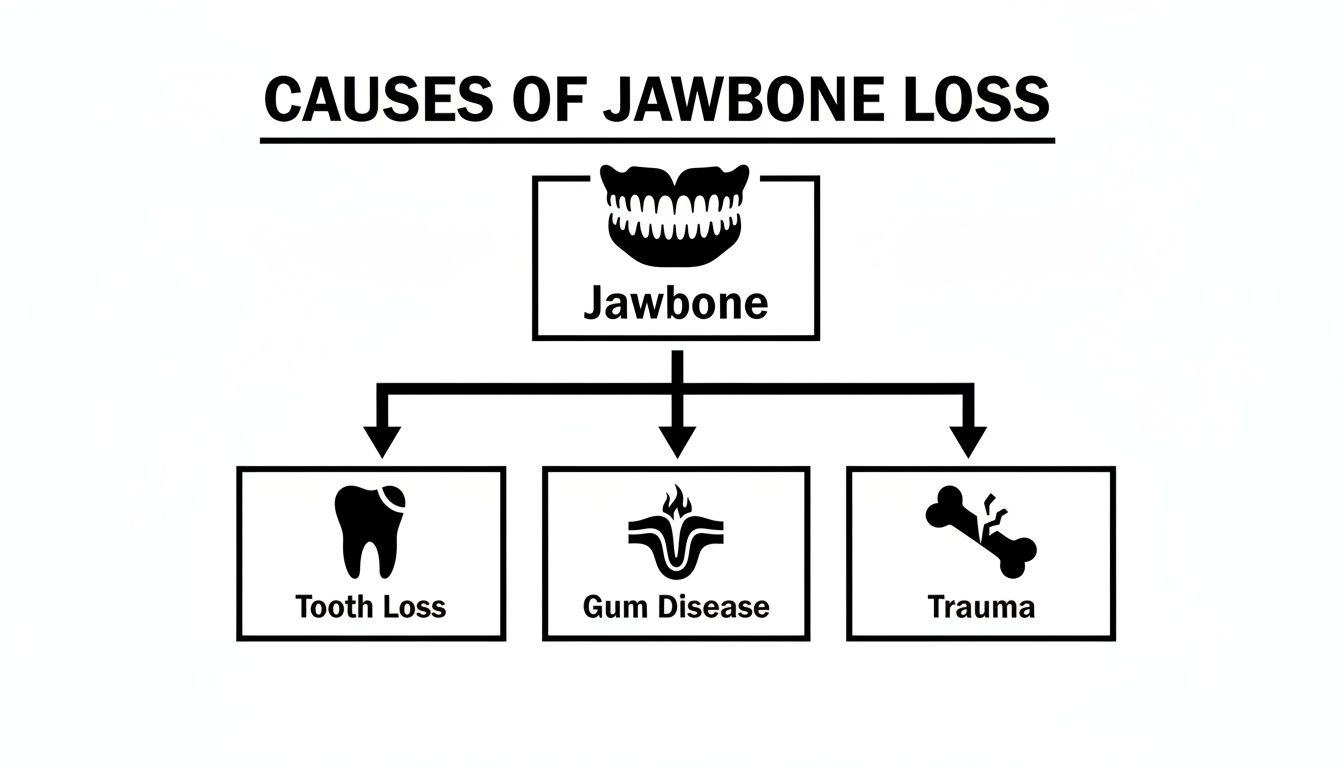
Whether it's from a lost tooth, gum disease, or an injury, a weakened jaw just can't support an implant properly. That’s where these materials come in, rebuilding the area to restore your oral health.
Autografts: Using Your Own Bone
An autograft is often called the "gold standard" in bone grafting, and for good reason. For this procedure, we take a small piece of bone from another part of your body—usually your chin, another spot in your jaw, or sometimes the hip.
Because the bone is your own, it contains living cells that your body recognizes. This dramatically lowers the risk of rejection and kick-starts the healing process, making it an incredibly reliable way to restore your jaw’s natural strength for optimal implant success.
Allografts: Sourced from Human Donors
An allograft uses bone from a human donor that has been carefully screened, sterilized, and prepared by a licensed tissue bank. Think of it as a framework, or scaffold, that encourages your own bone to grow into and eventually replace the graft material, restoring your jaw to its healthy state.
A huge plus here is that you don't need a second surgical site to harvest bone, which can make for an easier recovery. It’s a very safe and common way to rebuild bone, especially for procedures like a vertical sinus lift where we might need a bit more volume to support the implant.
Xenografts and Alloplasts: Other Trusted Sources
Beyond using human bone, there are two other excellent options that give us even more flexibility to achieve the best outcome for your smile.
- Xenograft: This material comes from an animal source—most often a cow—and is processed to make it completely safe and compatible for use in humans. It acts as a fantastic placeholder, holding the space while your natural bone grows in and around it.
- Alloplast: These are synthetic, lab-made materials. They’re created from biocompatible substances that are designed to mimic the structure of your own bone, providing a reliable scaffold for new growth without using any human or animal tissue.
To help you see how these options stack up, here’s a quick comparison.
Comparing Bone Graft Materials For Dental Implants
| Graft Type | Source | Key Advantage | Best For |
|---|---|---|---|
| Autograft | Your own body (e.g., jaw, hip) | Contains living bone cells for faster, more predictable healing. The "gold standard." | Large defects where maximum regenerative potential is needed. |
| Allograft | Human donor (tissue bank) | Avoids a second surgical site, reducing patient discomfort. | Socket preservation, sinus lifts, and ridge augmentation. |
| Xenograft | Animal (usually bovine) | Slow resorption rate, providing a long-lasting scaffold for new bone growth. | Creating and maintaining space for bone to fill in over time. |
| Alloplast | Synthetic (lab-made) | No risk of disease transmission. Completely sterile and man-made. | Patients who prefer a non-biological source; filling smaller defects. |
Each of these materials has a proven track record. The choice simply depends on finding the perfect fit for your specific dental needs to ensure the best possible outcome for your implant and your overall oral health.
And the results speak for themselves. One study looking at 112 grafted sites found that while xenografts were the most common choice (used 40.2% of the time), the overall success rate for all grafts was an incredible 92.8%. Even better, the implant survival rate in those grafted sites was 95.5%.
What to Expect During the Bone Grafting Procedure
Knowing what happens during a bone graft can go a long way in easing any nerves you might have. It's not an intimidating surgery, but rather a precise and carefully planned procedure designed to rebuild the foundation for your future smile with very little discomfort. Our whole process is built around your comfort and getting the best possible result for your dental health.
The journey actually starts well before the day of the procedure. During your first consultation, we map out every single step with incredible accuracy, which is where modern dental technology really shines.
Precision Planning with 3D Imaging
For a graft to be successful, we first need a perfectly clear picture of your jawbone's current state. We use advanced 3D cone-beam computed tomography (CBCT) scans to create a detailed, three-dimensional model of your jaw. This amazing imaging lets us see the exact height, width, and density of your bone from every possible angle.
This isn't just a fancy picture; this level of detail is absolutely critical. It helps us pinpoint exactly where the bone is thin and figure out the precise amount of graft material we'll need to rebuild it for a beautiful, stable result. Think of it like a perfect architectural blueprint before starting construction—it takes all the guesswork out of the equation and makes the procedure as efficient as it can be.
The Grafting Process Step by Step
On the day of your procedure, our number one priority is making sure you are completely comfortable and relaxed. We offer a range of sedation options, from mild sedatives to IV sedation, to ensure you have a stress-free and pain-free experience.
The actual surgical steps are quite straightforward, and we focus on minimally invasive techniques to help you heal faster:
- Numbing the Area: First things first, we completely numb the surgical site with a local anesthetic. You won’t feel any pain during the procedure, maybe just a little pressure or movement.
- Creating Access: Your surgeon will then make a small, precise incision in the gum tissue. This gently exposes the area of the jawbone that needs to be strengthened.
- Placing the Graft: The carefully chosen bone grafting material is placed right where it's needed, building up the deficient area to the ideal shape and volume for your future implant.
- Protecting the Site: We often place a special dissolvable membrane over the graft. This acts like a protective shield, keeping the new bone material safe and encouraging your body's natural bone-building cells to get to work.
- Closing the Incision: Finally, the gum tissue is put back in place, and the site is closed with a few small stitches.
The entire procedure is typically done in just one appointment. The goal is always a smooth, efficient surgery that prepares your jaw for a dental implant that can restore your smile for decades to come.
Your Guide to a Smooth Recovery and Aftercare
Once your bone grafting procedure is wrapped up, the real work begins as your body starts to heal and build new bone. Following our aftercare plan is the single best thing you can do to make sure recovery is smooth, comfortable, and ultimately successful. When you know what’s coming, the whole process feels much less intimidating.
Think of this phase as creating the perfect environment for that new bone to thrive. It’s a journey that takes a few months, but every step you take is critical for getting that strong foundation needed for your future dental implant.
What to Expect Day by Day
The first few days are when you'll need to be the most mindful. Most of our patients are pleasantly surprised by how manageable recovery is, with any discomfort being pretty mild.
- First 24-48 Hours: You can expect some minor swelling and a little discomfort around the surgical area. This is totally normal and a sign your body is healing. We’ll make sure you have what you need to manage it, usually with pain medication and cold packs on the outside of your cheek.
- The First Week: Sticking to a soft food diet is non-negotiable. Think smoothies, yogurt, mashed potatoes, and lukewarm soups. It is absolutely vital to avoid chewing anywhere near the graft site to protect it while it settles in.
Taking it easy is your new job for a little while. Avoid any heavy lifting or intense workouts for the first week. Anything that gets your blood pressure up can negatively affect the surgical site.
Nurturing Your New Foundation
As the weeks roll by, your body is performing a quiet miracle, transforming the graft material into a solid, living part of your jaw. We’ll have you come in for follow-up appointments during this time so we can check on your progress, often using imaging to see exactly how that new bone is forming.
This is also a great time to learn about ways you can support your body's natural healing power. For example, we often use Platelet-Rich Fibrin (PRF) to give recovery a boost with your body's own growth factors. You can learn more by checking out our guide on what PRF is in dentistry.
Your commitment to aftercare has a direct impact on how soon you can get your dental implant. On average, it takes 4 to 9 months for the graft to fully mature and become part of you. Once we confirm the new bone is dense and strong, you’ll finally be ready for the last step—placing the dental implant that will complete your new, beautiful smile.
Will a Bone Graft Actually Work? Success Rates and Long-Term Benefits
Whenever you're thinking about a dental procedure, two big questions always come up: "Will it work?" and "Will it last?" When it comes to bone grafting, the answers are a resounding yes. This procedure is an incredibly reliable step that sets the stage for a dental implant that can last a lifetime, giving you amazing value for both your health and your smile.
The whole point of a bone graft is to build a rock-solid foundation for a dental implant, and today's dental technology has made this more predictable than ever. When a graft is done by an experienced team, it has an exceptional track record, putting you on the path to a permanent fix for tooth loss.
A Predictable Path to a Permanent Smile
Sure, there's always a tiny risk of things like infection with any surgery, but these issues are rare and very manageable with good aftercare. What's far more common is a successful graft that heals up perfectly, becoming a seamless part of your natural jawbone. This isn't just wishful thinking; it’s backed by solid clinical results.
For patients who don't have enough jawbone for an implant, bone grafting is a true game-changer. Success rates regularly hit 90% to 98%, depending on the specific type of graft and the patient's health. In fact, one long-term study that followed 80 different bone grafts found a perfect 100% success rate for the grafts themselves. The implants placed afterward? They had an incredible 97.2% survival rate. You can read more about these successful bone grafting outcomes to see just how dependable this procedure is.
The Lasting Impact on Your Health and Appearance
A successful bone graft does a lot more than just get your jaw ready for an implant. It delivers some profound, long-term benefits that go way beyond simply filling a gap in your smile.
- Get Back to Eating What You Love: Once that implant is secure in the new, strong bone, you can eat your favorite foods with total confidence. This restores not only your diet but also your quality of life.
- Stop Future Bone Loss in Its Tracks: The dental implant stimulates the new bone just like a natural tooth root would, which puts a stop to the resorption process. This is huge—it protects the integrity of your jaw for years and years, preventing future dental health issues.
- Support Your Facial Structure: By rebuilding and preserving your jawbone, you're also maintaining your natural facial contours. This helps you avoid that sunken-in look that can happen after tooth loss, keeping your appearance more youthful and vibrant.
At the end of the day, a bone graft is an investment in a durable, healthy, and confident future. It’s the foundational step that makes a permanent, natural-looking smile a real possibility.
Answering Your Top Questions About Bone Grafting
Making a big decision about your dental health can feel overwhelming. To help you feel more confident and clear about the process, we've gathered answers to the questions we hear most often from patients just like you.
Is Bone Grafting for Dental Implants Painful?
We know this is often the very first question on everyone's mind. The procedure itself is done with local anesthesia, so you won’t feel a thing while we’re working. For patients who feel anxious, we also have sedation options available to make sure you're completely relaxed and comfortable.
Afterward, any discomfort is usually mild—many patients say it feels similar to other routine dental work. This is easily managed with the medication we'll prescribe, ensuring your recovery is as comfortable as possible.
How Long Until I Can Get My Implant After a Bone Graft?
This is where patience really pays off for a successful, lifelong implant. Generally, you can expect a healing time of 4 to 9 months.
This isn't just downtime; it's an active healing phase where your body is busy turning the graft material into a solid, dense part of your own jawbone. This new bone needs to be strong enough to securely anchor your implant for decades of confident smiles. We'll keep a close eye on your progress with imaging to know the exact right moment for your implant placement.
Your body’s ability to integrate the new bone is the most important factor. This healing phase is what ensures the final implant has the unshakeable foundation it needs to restore your chewing function and appearance.
Will My Dental Insurance Cover Bone Grafting?
Insurance coverage for bone grafting can be tricky and varies quite a bit between plans. The good news is that many plans do cover at least a portion of the cost, especially when the procedure is considered medically necessary to restore your ability to chew after losing a tooth and improve your overall dental health.
Our team has years of experience working with insurance providers. We can help you dig into the specifics of your plan and understand what’s covered. We'll work with you to maximize your benefits and go over any financing options, making your path to a fully restored smile as affordable as possible.
Ready to take the next step toward a permanent, healthy smile? The expert team at Grand Parkway Smiles is here to create a personalized treatment plan that restores both function and confidence. Learn more and schedule your consultation at https://dentistkatytx.com.