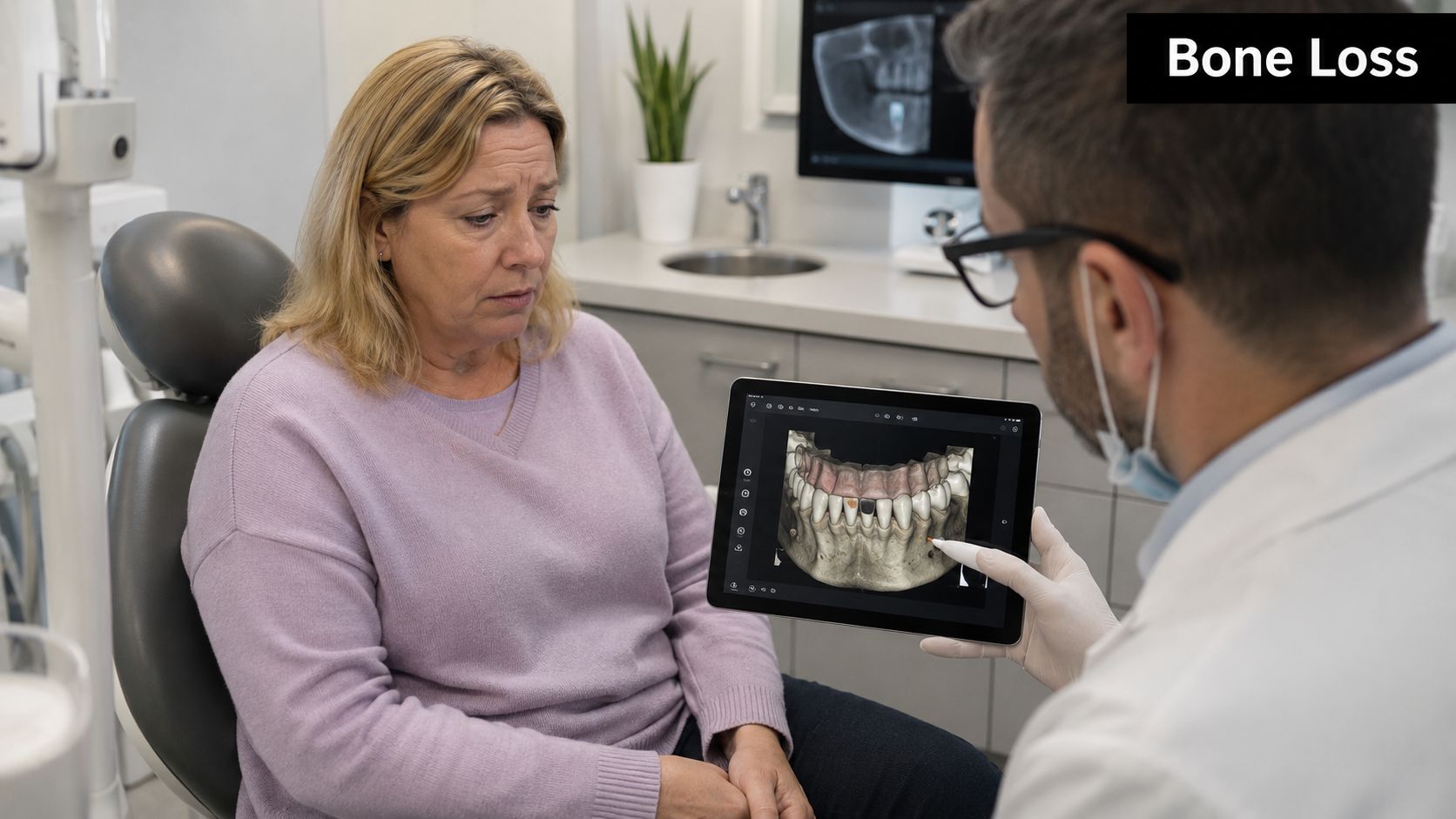
A patient walks into a Katy dental consultation ready for an implant, expecting to leave with a clear next step. Then the dentist reviews the scan and explains that the jawbone isn't thick or tall enough to hold the implant safely.
That moment can feel discouraging, but it's also common. After a tooth is lost, the surrounding bone starts to shrink because it no longer gets the stimulation from the tooth root, and that shrinkage can leave too little bone for a stable implant foundation.
Ridge augmentation surgery rebuilds that missing bone so the implant has something strong to anchor into. For many patients, it's the step that turns “not yet” into a predictable path toward a functional, natural-looking smile.
Introduction: When Dental Implants Need Extra Support
A missing tooth can leave more behind than a gap in your smile. In the months after extraction or tooth loss, the jaw ridge often narrows and lowers, which is why a patient who feels “ready” for an implant may learn that the site still needs preparation first.
That doesn't mean the implant plan is off the table. It means the bone has to be rebuilt so the final result has a stable base, the same way a house needs a solid foundation before the walls go up.
The evidence behind this approach is strong. A major 2003 systematic review of localized ridge augmentation and preservation included 18 studies, with 13 studies on guided bone regeneration covering 1,741 patients and 5 studies on distraction osteogenesis covering 92 patients. The review concluded that implant survival in augmented sites was highly predictable and broadly similar to survival in native bone, which helped establish ridge augmentation as a dependable part of implant dentistry, not an experimental extra step (PubMed review).
For patients, that matters because the goal is not just to place an implant. The goal is to build a foundation that supports chewing, comfort, and appearance for the long term. When the ridge is restored properly, the implant can sit in a more natural position, which helps the final tooth look and function more like the one that was lost.
Practical rule: If the bone can't support the implant today, augmentation often makes the site ready for tomorrow.
What Ridge Augmentation Surgery Is and When It Is Needed
The alveolar ridge is the part of the jawbone that surrounds and supports the teeth. When a tooth is present, its root helps stimulate the bone and keep it fuller. When the tooth is gone, that stimulation stops, and the ridge can gradually resorb.
That change can cause two different problems. The ridge may become too narrow, which is a horizontal deficiency, or too short, which is a vertical deficiency. Either one can make implant placement difficult, because an implant needs enough bone around it to stay stable and heal well.
Why the bone changes after tooth loss
Tooth loss is the most obvious trigger, but it isn't the only one. Periodontal disease can damage the bone that once held the teeth, and trauma can remove or crush the ridge in an area that once had healthy support. The longer the ridge goes without stimulation, the more likely the bone is to shrink.
A simple way to think about it is this, a dental implant is like a post in the ground. If the ground is too thin or too shallow, the post won't stand the way it should.
The implant doesn't just need space, it needs a well-shaped bone bed around it.
In a systematic review of horizontal ridge augmentation, the mean horizontal bone gain at reentry was 3.4 to 5.0 mm, and staged implant success rates ranged from 96.8% to 100% with survival rates from 93.5% to 100% (systematic review). A more recent 2023 systematic review and meta-analysis of horizontal ridge split procedures included 35 studies and reported a mean ridge gain of 3.06 mm, with 2.99 mm after sensitivity analysis, plus a 98.17% implant survival rate across 4,446 implants (meta-analysis).
Those numbers show why ridge augmentation is often discussed before implant placement. It's not about adding complexity for its own sake, it's about creating enough bone to support both the implant and the final crown in a way that looks and feels right.
Types of Graft Materials and Surgical Approaches
Ridge augmentation uses more than one material, and the surgeon does not choose blindly. The decision depends on how much bone is missing, where the ridge sits, and how much support the site needs while it heals. That is why the material, the membrane, and the closure plan all have to work together.
Autogenous bone comes from the patient's own body. Clinicians often favor it because it brings living bone cells with it, and review literature supports combining it with bone substitutes, barrier membranes, and primary closure to improve the regenerative response (review). Allogeneic grafts come from human donor material, xenografts come from animal-derived sources, and synthetic grafts are made to act as a framework for new bone growth.
Matching the material to the case
Some ridges need a block graft, a solid piece of bone used when the ridge has lost more shape or volume. Other sites work better with particulate grafts, which are small granules that can fill and contour around an irregular defect more easily. A barrier membrane is often placed over the graft so soft tissue does not grow into the space too early, because bone heals best when the graft stays stable and protected. That is also why many clinicians plan the closure carefully from the start, rather than treating it as an afterthought.
Why the membrane matters: it gives bone a quiet, protected space to rebuild.
PRF, or platelet-rich fibrin, uses a patient's own blood to create a healing concentrate that may support early tissue comfort and recovery. It is usually an adjunct, not the main grafting material, and it can be added when the surgical team wants extra biologic support without changing the basic graft plan.
For patients who want a clearer explanation of the materials before surgery, this guide on what bone grafting means for dental implants is a useful companion read. For clinicians planning the procedure, surgical guide options for dentists can help with site control and placement strategy.
| Graft Type | Source | Predictability | Healing Time | Typical Use Case |
|---|---|---|---|---|
| Autogenous bone | Patient's own body | High | Often faster biologically | Complex defects, when the surgeon wants living bone support |
| Allogeneic bone | Human donor | High | Depends on defect and technique | Common ridge defects where extra donor surgery is avoided |
| Xenograft | Animal-derived | High | Gradual remodeling | Space maintenance and contour support |
| Synthetic graft | Man-made material | Variable by case | Depends on material and site | Smaller defects or mixed graft approaches |
| Block graft | Solid bone piece | High when well stabilized | Requires protected healing | Wider or more structural ridge defects |
| Particulate graft | Granules | High when properly contained | Depends on coverage and stability | Contouring and fill around irregular defects |
The Ridge Augmentation Surgical Process from Consultation to Healing
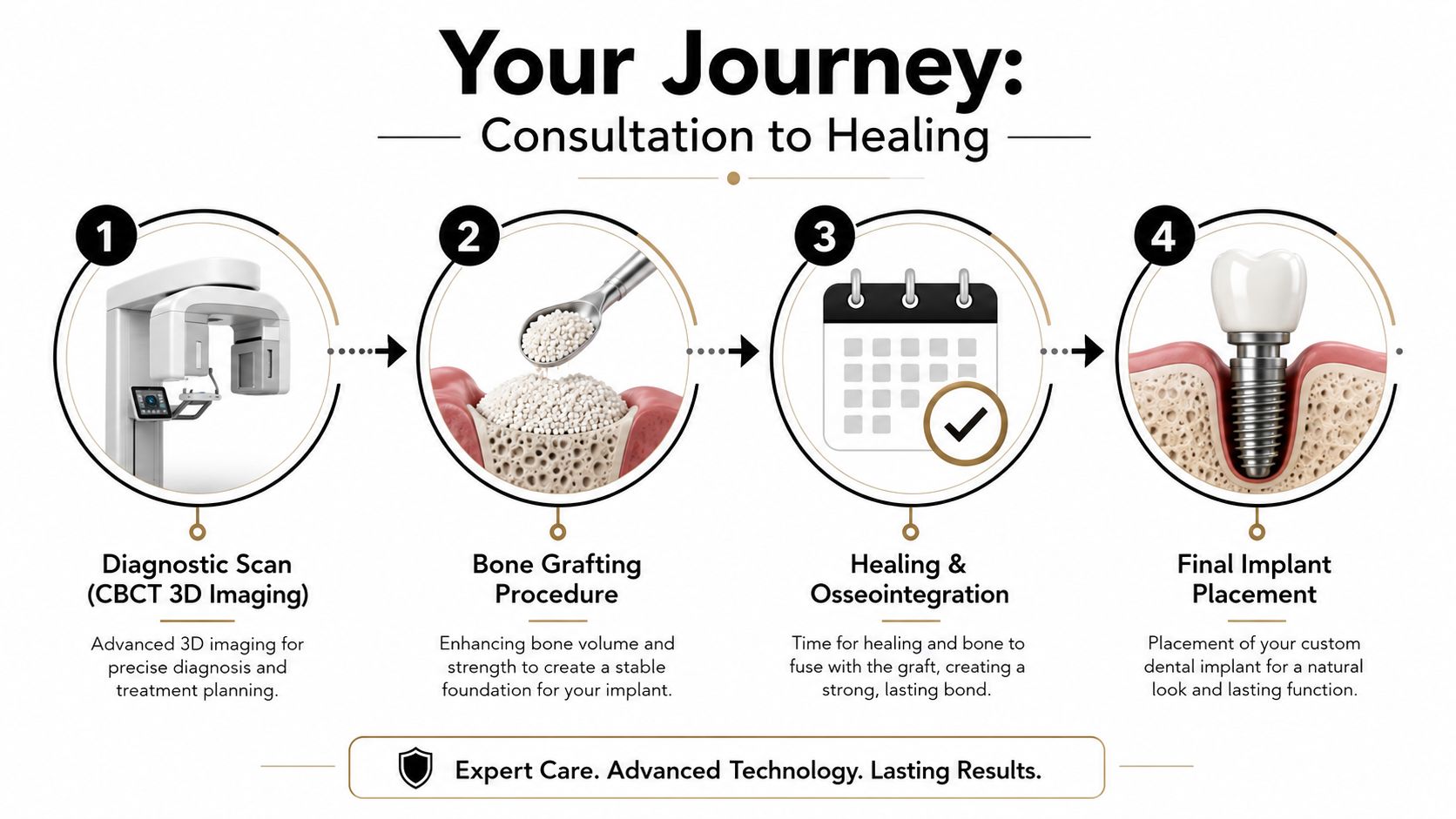
A ridge augmentation visit usually starts long before any graft material is placed. The first step is CBCT-based planning, because a 3D scan lets the surgeon measure the defect, map nearby anatomy, and estimate how much graft support the ridge needs before treatment begins (CBCT planning overview). A ridge can look acceptable from the outside and still be too thin on the scan for safe implant placement, so the image helps prevent guesswork.
During surgery, the area is numbed, the gum tissue is opened with a small incision, and the graft material is placed where bone is missing. If the case calls for it, the graft is stabilized and covered with a membrane so the site can heal without soft tissue growing into the space too soon.
What patients usually feel and why staging helps
Many patients are relieved by how controlled the procedure feels once the area is numb. Sedation can also be discussed for anyone who feels anxious, and that conversation is usually easier when it happens before the appointment instead of in the chair. Healing is staged because bone needs time to mature before an implant can be placed into the ridge with confidence.
That timing depends on the graft type and the biology of the site. As noted earlier, grafts that include autogenous bone generally heal more quickly than sites that rely on other materials alone, so the waiting period is often planned around what was placed and how much support the ridge needs.
A surgeon may also use surgical guide options for dentists to carry the plan into the operating room with more precision. For patients, that usually means fewer surprises, clearer positioning, and a procedure that follows the roadmap laid out at consultation.
Recovery is part of the treatment, not an afterthought. The first days are about protecting the graft, keeping the area clean, and following instructions closely, since habits such as smoking, poor oral hygiene, or skipping follow-up care can make healing less predictable. For a fuller explanation of what healing usually looks like after surgery, this guide to dental bone graft healing is a useful companion read.
The overall sequence is straightforward, even though the biology underneath it is not. The ridge is scanned, the graft is placed, the site heals, and the implant is added only when the bone is ready.
Recovery, Sedation Options, and What Influences Success
Most patients want the same three answers after surgery. How sore will I be, how long will I be out of routine, and what can I do to help this succeed? Those are fair questions, and the honest answer is that recovery is usually manageable when the site is protected and instructions are followed closely.
Swelling and discomfort tend to be most noticeable in the first 48 hours, then ease as the tissue settles. Many patients return to normal activities within a few days to a week, and soft foods are usually recommended early so the graft area isn't stressed while it's healing.
Good healing is usually quiet healing. Less pressure, less irritation, better protection.
Sedation choices for nervous patients
Patients who feel tense about surgery often do better when the comfort plan is discussed ahead of time. Common options include oral conscious sedation, IV sedation, and general anesthesia, depending on the complexity of the procedure and the person's anxiety level. In a practice setting like Grand Parkway Smiles, those options can make a long appointment feel much more tolerable.
The evidence on outcomes is reassuring. A 2024 systematic review and meta-analysis found an overall implant survival rate of 99.1% across augmentation techniques, with 99.7% for GBR and 98.7% for ridge split (meta-analysis). That's a strong reminder that bone augmentation can be highly reliable when the site is selected and managed well.
The 2025 survey/review of real-world augmentation practice points to several modifiable risk factors. Smoking was identified as a major issue, appearing in 58.46% of complications, while poor oral hygiene was present in 77.21% and poor compliance in 73.53% (survey/review). The same review also noted that clinicians commonly use ridge preservation and often face dehiscence or wound-healing problems.
A retrospective study of 221 staged ridge augmentations found 88.2% had no complications overall, with complication-free rates of 92.1% for allogeneic blocks and 80.0% for autogenous blocks. It also found that smoking, vertical gain greater than 2.55 mm, and over-contouring were strongly associated with complications (retrospective study).
That's the part patients can act on. Don't smoke, keep the site clean, and follow every healing instruction closely. Those choices matter.
For a more detailed patient-focused overview of the healing phase, see this guide on dental bone graft healing.
Cost, Financing, and Alternative Options
Ridge augmentation costs vary because the procedure itself varies. The final fee depends on how complex the defect is, how much graft material is needed, whether the surgeon uses CBCT-guided planning, and how much specialized experience the provider brings to the case. A full estimate usually needs an in-person consultation with 3D imaging, because the scan shows what can't be judged accurately from the outside.
Patients often ask whether there's a way to avoid grafting altogether. Sometimes there is, depending on the anatomy and how much bone loss is present.
When grafting isn't the only path
Some people with major bone loss may be candidates for zygomatic or pterygoid implants, which anchor into the cheekbone or skull-adjacent structures instead of relying on the jaw ridge. Those options don't replace augmentation for every case, but they can be part of the specialist conversation when the jawbone is too limited for standard implant placement.
A good consultation doesn't push one answer, it compares the options that fit your anatomy.
Financing also matters, because many patients are planning for more than one step in their smile restoration. PPO insurance may help when benefits apply, and some practices offer in-house savings plans or third-party financing to spread out the cost. That can make the decision feel less all-or-nothing, especially when the goal is restoring function and appearance with a stable implant foundation.
If you're comparing approaches, think in terms of long-term fit rather than speed alone. A site that needs grafting now may give a better implant result later, while a different anatomy may call for an alternate implant design that avoids grafting entirely.
Why Grand Parkway Smiles Approach Makes a Difference
Ridge augmentation works best when the imaging, surgery, and final implant plan all point in the same direction. That's where a multidisciplinary setting helps, because prosthodontics, oral and maxillofacial surgery, and implant dentistry can all evaluate the same CBCT data and build one coordinated plan.
Grand Parkway Smiles also uses PRF to support healing and offers IV sedation for patients who are anxious about surgical care. Same-day consultations can help patients leave with a clearer idea of the sequence, the recovery expectations, and the financial outline before they decide how to move forward.
The value of that coordination is easy to see if you look at how patients choose complex care online. Clear communication, transparent visuals, and a calm treatment experience make a difference, which is why UPQODE's dental design work is a useful example of how strong presentation can support patient trust before someone ever walks in the door.
Grand Parkway Smiles brings together modern technology, a broad surgical and restorative skill set, and more than 100 years of combined clinical expertise to guide patients through complex treatment without rushing the decision. For someone who's nervous about surgery, that combination can make the next step feel manageable instead of overwhelming.
If you're wondering whether ridge augmentation surgery could make your dental implant possible, Grand Parkway Smiles can help you sort out the details with imaging, a clear treatment plan, and comfort-focused care. Visit Grand Parkway Smiles to schedule a consultation and find out what your ridge can support.