Think of a dental bone graft as the essential first step in rebuilding a strong foundation for your future smile, especially if you're considering dental implants. It’s a lot like preparing solid ground before you build a house; this procedure makes sure your jaw is healthy and strong enough to support your new teeth for the long haul, ensuring a beautiful, long-lasting result.
It's a highly successful procedure that gets the ball rolling on a natural, biological process of bone regeneration, paving the way for a complete smile transformation.
Rebuilding Your Smile From the Ground Up
When you lose a tooth—whether from an injury, decay, or an extraction—it sets off a chain reaction that can affect both your oral health and your appearance. The bone that used to hold that tooth root in place no longer gets the stimulation it needs to stay strong and dense. Over time, that part of the jawbone can shrink or resorb, creating a weak spot that can't support a dental implant and can even alter your facial structure.
A dental bone graft tackles this problem head-on by restoring that lost bone volume, which is crucial for both function and aesthetics.
The procedure itself involves placing a specialized bone grafting material into the socket or the area of the jaw that needs reinforcement. This material acts like a scaffold, giving your body's own bone-building cells a framework to latch onto. These cells then get to work, generating new, healthy bone tissue right where it's needed. This amazing process creates a permanent, living part of your jaw, ready to support a beautiful new tooth.
The Purpose Behind the Procedure
Understanding the "why" behind your bone graft can make the healing journey feel much more manageable and meaningful. The main goals are all about restoring your smile's health and appearance:
- Create a Solid Foundation: Dental implants need a certain amount of bone height and width to be stable. A graft builds up this necessary support structure, which is critical for the long-term success and durability of your new smile.
- Preserve Facial Structure: Jawbone loss can sometimes lead to a sunken look in the cheeks and lips, making you appear older. By restoring that bone volume, a graft helps maintain your natural facial contours, supporting a more youthful and healthy appearance.
- Enable Future Restorations: Whether you're planning for a single implant or a full set of new teeth, a bone graft opens the door to the most durable, functional, and natural-looking tooth replacement options available.
Setting Expectations for Success
The dental bone graft healing process is a well-established and predictable journey toward a healthier mouth. Thanks to modern techniques and materials, the procedure has become incredibly reliable. In fact, clinical evidence shows remarkable consistency over the last two decades.
A huge 15-year retrospective study published in 2023 found a staggering 98.3% success rate for the grafts themselves. Even better, the implants placed into that new bone achieved a 97.2% survival rate. Those are numbers that give you real confidence in your investment toward a better smile.
This procedure isn't just about filling an empty space; it’s about actively regenerating your jaw to bring back both function and appearance. It's the essential groundwork that makes a complete smile transformation possible, giving you back the ability to chew, speak, and smile with total confidence.
You can learn more about how this all comes together by checking out our guide on bone grafting for dental implants. The next sections will give you a clear roadmap of exactly what to expect as you recover and get one step closer to your ideal smile.
The Week-by-Week Healing Timeline
Let's be honest, hearing you need a bone graft can sound a little intimidating. But understanding what's actually happening in your jaw—and when—can take a lot of the anxiety out of the equation. Think of it less like a mystery and more like a carefully planned construction project for your new smile. Your body has an incredible blueprint for healing, and our job is to give it the right materials and support to build a strong foundation for your future implant.
This timeline is your road map. It shows the key phases of your healing journey, from the day of your procedure all the way to a fully healed jawbone, ready and waiting for your new tooth.
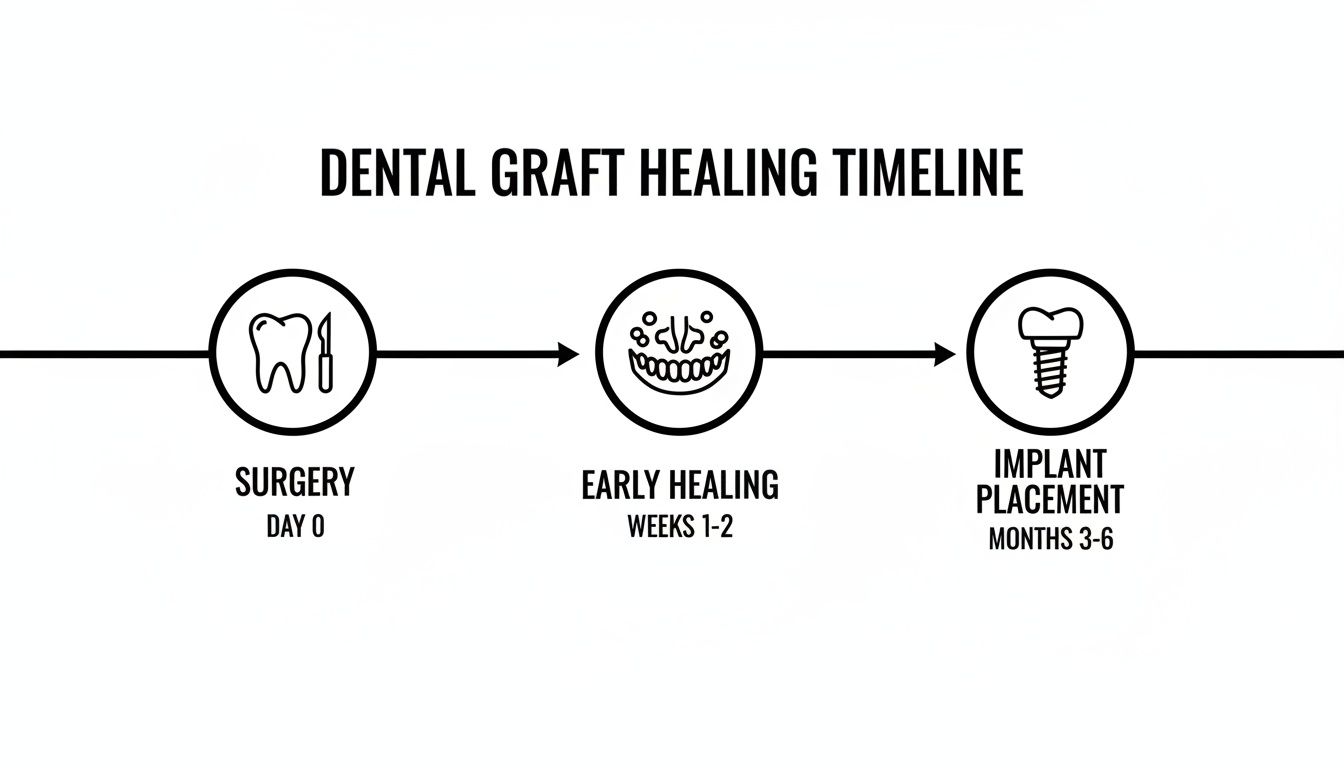
As you can see, this isn't a one-and-done event. It’s a process where each step methodically builds on the success of the last one, all leading to a beautiful and functional outcome.
The First 48 Hours: Your Body's First Response
Right after your surgery, your body's first responders kick into gear. The first two days are all about managing the initial inflammation, which is a totally normal and necessary part of healing. You can expect some swelling, maybe a little bruising, and discomfort. That’s just your body sending healing resources to the area to begin the repair process.
Your main job here is simple: protect the site. A stable blood clot needs to form, as it’s the cornerstone of the entire healing process. Pain is usually at its peak now but should be well-controlled with the medication we prescribe. Don't be alarmed if you notice a few tiny, sand-like graft particles in your mouth; a small amount is expected. For now, focus on rest and gentle care.
Week One: Soft Tissue Healing Takes Center Stage
During the first week, the focus shifts to your gums. Swelling and discomfort should start to fade a little more each day as your gums work to heal over the bone graft. This is a critical moment for your oral health. Your gum tissue is creating a protective barrier, sealing off the graft material from bacteria in your mouth to prevent infection.
You’ll be sticking to a soft-food diet to avoid putting any pressure on the area. Following your hygiene instructions—like using a prescribed mouthwash—is vital to keep things clean without disturbing the delicate new tissue. By the end of this week, you should feel a whole lot better as your gums close up over the site, creating a healthy environment for the bone to grow.
The goal of this initial phase is to create a closed, protected environment for the bone graft material. Think of your gums as a "biologic bandage" that shields the underlying scaffold while your body begins the deeper work of bone regeneration.
The First Month: Initial Bone Integration Begins
From week two through the end of the first month, the real magic starts happening under the surface. Your gums might look mostly healed, but your body is now busy building a network of new blood vessels into and around the graft material. This process, called angiogenesis, is like building supply roads to the construction site. It's essential for bringing in the cells and nutrients needed for new bone.
During this time, your body’s bone-building cells (osteoblasts) arrive and start laying down a soft, immature bone matrix onto the graft scaffold. You won't feel any of this, but it’s the most critical step in transforming that graft into your own living bone. It is absolutely vital to avoid chewing or putting any pressure on the site during this period. Bumping it could disrupt this fragile process and set your healing back. Your check-ins at Grand Parkway Smiles will help us make sure everything is on track for a successful outcome.
The Full Maturation Period: 3 to 9 Months
This is the final and longest phase of the project, where patience really pays off for your future smile. The soft bone created in the first month slowly hardens, remodels, and integrates with your jaw. It’s a slow transformation into the dense, strong bone we need to securely place a dental implant. How long this takes can vary quite a bit, depending on a few key things:
- Type of Graft: Different materials integrate at different speeds.
- Graft Size: A bigger site naturally needs more time to rebuild.
- Your Body's Healing Capacity: Your overall health plays a huge role in how quickly your body regenerates.
Over these months, your body gradually absorbs the original graft material and replaces it with your own brand-new bone. It’s a steady process that results in a solid, unified jawbone. We'll use imaging like 3D CBCT scans to confirm when the bone has hit the perfect density and volume. Rushing this stage isn't an option; letting your body finish its work is the key to the long-term success and stability of your future smile.
Essential Aftercare for a Smooth Recovery
Think of your surgery as the first big step, but your actions afterward are what truly seal the deal for a healthier smile. Just like fresh concrete needs time to set and cure, your bone graft needs a calm, protected environment to heal properly. Following our aftercare plan is the single best thing you can do to make sure your dental bone graft healing is smooth, fast, and successful, leading to the best possible aesthetic result.

These aren't just arbitrary rules. Every instruction is designed to support the delicate biological work happening in your jaw, setting the stage for a rock-solid foundation for your future dental implants and a beautiful, healthy smile.
Managing Pain and Swelling
It's completely normal to have some swelling and discomfort right after your procedure. That’s just your body's natural response kicking into gear, and it’s a good sign that the healing process has started. We’ll send you home with a clear pain management plan to keep you comfortable.
To get a handle on swelling, apply an ice pack to the outside of your cheek for 20 minutes on, then 20 minutes off for the first 24-48 hours. This simple trick helps constrict the blood vessels and can dramatically reduce inflammation and bruising. Keeping your head propped up with pillows, even when you sleep, also helps bring the swelling down, promoting faster healing.
Your Guide to Eating After a Bone Graft
What you eat directly impacts the surgical site. For the first few days, you'll need to stick to soft, cool foods that don't require much, if any, chewing. This is all about preventing pressure and irritation that could damage the delicate graft or disturb that all-important protective blood clot.
Here are a few safe and easy food ideas to get you started:
- Smoothies and Shakes: Just remember to drink them from a glass, not a straw. The suction can disrupt healing.
- Yogurt and Applesauce: Perfect because they're easy to swallow with zero chewing involved.
- Soups: Make sure they're lukewarm, not hot. Anything too hot can irritate the sensitive gum tissue.
- Mashed Potatoes or Avocado: These are great for getting some nutrients without putting any stress on the graft.
As you start to feel better, you can slowly work softer solid foods back into your diet, like scrambled eggs, oatmeal, or well-cooked pasta. Just stay away from anything hard, crunchy, or spicy until we give you the green light at your follow-up visit. This careful approach protects the site and ensures the best healing.
Oral Hygiene for a Healing Mouth
Keeping your mouth clean is absolutely essential for preventing infection and ensuring optimal healing. For the first 24 hours, don't do any rinsing, spitting, or brushing right near the surgical area. This gives that vital blood clot time to form and stabilize.
After that first day, you can start gently rinsing with your prescribed antimicrobial mouthwash or a simple warm saltwater solution (about half a teaspoon of salt in a glass of warm water) after you eat. When you go back to brushing your other teeth, be extremely careful to avoid the graft site. And definitely don't use an electric toothbrush near the area until it's fully healed. A clean environment is a healthy environment for new bone to grow.
The most important rule in early healing is "no suction." This means absolutely no smoking and no drinking through straws. The negative pressure created by suction can easily dislodge the blood clot, leading to a painful complication called a dry socket and delaying your healing.
Your commitment to these aftercare steps is essential for the long-term health and beauty of your smile. We see it time and again: patient compliance has a massive impact on long-term success. Studies show that patients who follow professional maintenance protocols can slash their implant failure risk by 80%. On the flip side, smokers increase their risk by 2.6 times. You can discover more about the factors influencing implant success and see how your actions right now contribute to a positive outcome. Taking an active role ensures you get the strong, healthy smile you've been working toward.
Factors That Influence Your Healing and Final Outcome
Just like no two smiles are the same, every patient’s healing journey is unique. The speed and quality of your dental bone graft healing come down to a mix of your body's own internal environment and the choices you make during recovery.
Think of the bone graft like a brand-new seed you've just planted. Whether it grows into a strong, healthy structure depends entirely on the quality of the soil and the care it gets along the way.
Knowing what these factors are is empowering. It helps you understand why your timeline might look different from someone else’s and really drives home the critical role you play in getting the best possible result for your smile. Here at Grand Parkway Smiles, we consider all these elements from day one to set you up for success.
The Impact of Lifestyle Choices
Your daily habits can either support your body’s healing powers or slow them down. There’s a direct line between your lifestyle and your recovery, especially when it comes to blood flow—the lifeline for your healing graft and future oral health.
The two biggest players here are smoking and alcohol.
- Smoking: Nicotine is a major problem because it constricts your blood vessels. This drastically cuts down the flow of oxygen and key nutrients to the surgical site, essentially starving the delicate new cells that are trying to form bone. This seriously increases the risk of both infection and graft failure.
- Alcohol: Drinking too much can hinder your immune system and interfere with the bone-building process. It also dehydrates you, which is the last thing you want when your body is trying to heal.
Making positive changes, even temporarily, can make a huge difference in the final appearance and health of your smile. Quitting smoking before and after your procedure is honestly one of the single best things you can do to protect your investment in your oral health.
How Systemic Health Conditions Play a Role
Your overall health and your oral health are completely intertwined. Certain medical conditions can affect your body's inflammatory response and its ability to regenerate bone, which is why close teamwork between your dentist and your doctor is so important for a successful outcome.
Uncontrolled diabetes, for instance, can be a major hurdle. High blood sugar levels can slow down circulation and make it harder for your white blood cells—your body’s infection fighters—to do their job. This creates an environment where healing is sluggish and the risk of complications goes way up. Other conditions, like osteoporosis or autoimmune disorders, can also affect the bone regeneration cycle.
It’s not about having perfect health; it’s about managing your health well. By working with your medical team to get conditions like diabetes under control, you’re creating a biological environment that’s ready for successful healing, ultimately leading to a healthier smile.
Advanced Techniques to Boost Healing
While your lifestyle and health are crucial, modern dentistry has a few tricks up its sleeve to give your body a helping hand. At Grand Parkway Smiles, we use advanced techniques that work with your body’s own healing systems to speed up recovery and improve the quality of the new bone, ensuring a better foundation for your future smile.
One of the most effective tools we have is Platelet-Rich Fibrin (PRF). It's a simple but powerful procedure where we draw a small amount of your own blood and spin it in a centrifuge. This concentrates your body's natural growth factors and healing proteins into a membrane, which we then place right at the graft site.
Think of PRF as a supercharged healing patch made from your own biological material. It releases a steady stream of growth factors that promote better healing:
- Speed up soft tissue healing, helping your gums close over the site much faster for a better aesthetic outcome.
- Promote new blood vessel formation, bringing more oxygen and nutrients right where they're needed.
- Reduce inflammation and discomfort, which makes your initial recovery a lot smoother and more comfortable.
By harnessing your body's innate power to heal, PRF helps make the dental bone graft healing process more predictable and efficient. It's an incredible way to pave the way for a stronger, healthier foundation for your future dental implants.
How Advanced Technology Improves Bone Grafting
Modern dentistry has come a long way from the old-school methods. Today, we rely on incredible tools to make your dental bone graft more precise, predictable, and ultimately, more successful. This isn't just about fancy gadgets; these advancements directly lead to a better healing process and a stronger foundation for your future smile.
Think of it like this: you could build a house with a hand saw and a measuring tape, but using laser-guided equipment ensures every cut is perfect. We take the same high-precision approach to rebuilding your jaw for a flawless result.
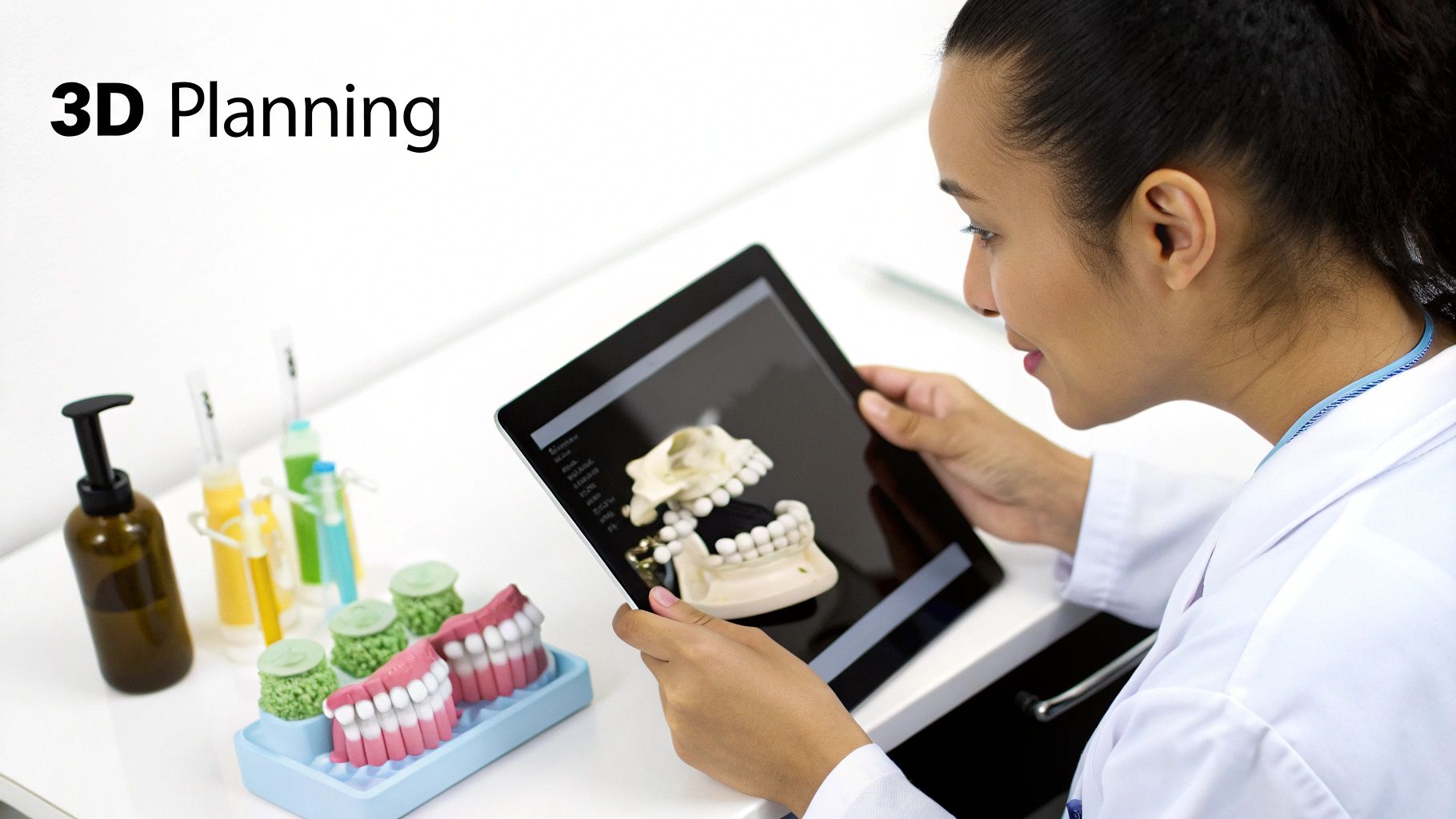
At Grand Parkway Smiles, our process starts with an incredibly detailed blueprint of your jaw using 3D Cone Beam Computed Tomography (CBCT). This imaging technology gives us a crystal-clear, three-dimensional look at your bone structure, nerve pathways, and sinuses. Unlike a flat 2D X-ray, a CBCT scan lets us measure your bone volume down to the millimeter, pinpointing exactly where you need reinforcement. This meticulous planning makes the procedure efficient and minimally invasive, setting you up for optimal dental bone graft healing from the very beginning.
Choosing the Perfect Graft Material
With a precise plan in hand, we then select the ideal material to rebuild your jaw. This material acts as a biological scaffold, creating a framework that encourages your own body’s cells to grow new, healthy bone. It's a bit like putting up a trellis for a vine—it provides the support and structure needed for natural growth to take over.
The choice of material is a critical one, and we base our decision on your unique anatomy, the size of the area needing repair, and your overall health goals to ensure the best possible aesthetic and functional outcome.
- Autografts: This is bone taken from another area of your own body, like your chin or hip. It's often considered the gold standard because it contains your own living cells, which nearly eliminates any risk of rejection and sparks robust new bone growth.
- Allografts: Sourced from a human donor, this bone is rigorously screened and sterilized by a tissue bank. It serves as an excellent framework for your body to build upon, but without needing a second surgical site.
- Xenografts: This type of graft uses bone from an animal source, most commonly a cow. Its mineral structure is surprisingly similar to human bone, making it a reliable and widely used scaffold that your body remodels over time.
- Synthetics: These are man-made materials, engineered in a lab to mimic the structure of natural bone. They offer a safe and effective alternative, completely avoiding the need for any donor tissue.
Driving Predictable and Lasting Results
Pairing precise imaging with advanced materials has completely changed the game for bone grafting. The results are more predictable, which is great news for your oral health and the final look of your smile. We use our clinical experience to select the best option for your specific situation to achieve a beautiful, long-lasting result.
Research backs this up. Certain materials, like autologous block grafts and composite grafts, have shown impressive performance, with success rates often topping 90% and implant survival rates reaching as high as 96.7% over several years.
By integrating advanced technology into every step, we transform bone grafting from a simple repair into a highly predictable regenerative procedure. This commitment to precision ensures the new bone is strong enough to support dental implants, restore facial contours, and give you a healthy, functional smile that lasts a lifetime.
To give your healing an extra boost, we often supplement these procedures with biological helpers like Platelet-Rich Fibrin (PRF). You can learn more about PRF in dentistry in our detailed guide. All these tools and materials work in harmony to create a superior foundation, making your journey toward a new smile as smooth and successful as possible.
Common Questions About Bone Graft Healing
Even with the best instructions, it's natural to have questions pop up during your recovery. Feeling informed is a huge part of a stress-free healing process, so we've put together answers to some of the most common questions our patients ask about their dental bone graft healing journey.
Getting clear answers helps build your confidence and lets you know the difference between a normal healing sign and something that needs our attention.
How Much Pain Is Normal After a Dental Bone Graft?
It's completely normal to feel some discomfort after any surgical procedure, and a bone graft is no different. The key thing to know is that the pain should be manageable and follow a predictable pattern. You'll likely notice the most soreness in the first 48 to 72 hours—this is when your body's natural inflammatory response is kicking into high gear.
This initial ache should be easily handled by the pain medication we prescribe. Many of our patients find they can switch over to an over-the-counter option like ibuprofen after just a few days. The most important thing is that the pain should gradually get better after day three.
The direction the pain is heading is what matters most. Normal healing means soreness that consistently improves over the first week. Pain that suddenly gets worse, becomes severe, or throbs uncontrollably is not typical and is a good reason to give our office a call.
To give your recovery a calm start, we also offer IV sedation at Grand Parkway Smiles, ensuring you are completely comfortable and pain-free during the actual procedure itself.
When Can I Get My Dental Implant After a Bone Graft?
This is the question everyone looks forward to asking! It means you're already thinking about the final, exciting step of restoring your smile. The answer, however, is all about patience. Generally, you can expect to wait 4 to 6 months before we can place an implant. In more complex situations, this might stretch to 9 months or even a bit longer.
This waiting period isn't random—it's the time your body needs to work its magic. During these months, the graft material is slowly transforming from a simple scaffold into your own living, solid bone. This maturing process is absolutely critical for creating the dense foundation needed to support a dental implant for a lifetime.
The exact timeline really depends on a few things:
- The size and location of the bone graft.
- The specific type of graft material we used.
- Your body's unique healing ability and your overall health.
We’ll keep a close eye on your progress with follow-up appointments and advanced imaging to pinpoint the exact moment your new bone is strong enough and ready for your beautiful new implant.
What Should I Do If I See Sand-Like Particles in My Mouth?
Finding tiny, gritty particles in your mouth during the first few days can be a little unsettling, but it's usually nothing to worry about. These are typically just minuscule pieces of the bone graft material that weren't fully tucked under the gums or the protective membrane.
A small amount of this "washout" is quite common and won't affect the final outcome of your graft. The vast majority of the material is secure and already starting the important work of integrating with your body.
If this happens, just gently rinse your mouth with your prescribed mouthwash or a warm saltwater solution. Avoid any vigorous swishing or spitting. That said, you should contact us if you notice a large amount of particles escaping, or if it happens along with other symptoms like bleeding that won't stop or a sudden spike in pain.
How Do I Know If My Bone Graft Is Failing?
While bone graft failure is quite rare—especially when you follow the aftercare instructions carefully—it’s important to recognize the warning signs. Knowing what to look for allows you to act fast so we can resolve the issue and keep your smile goals on track. Your body is pretty good at letting you know when something is off.
Please call us at Grand Parkway Smiles right away if you experience any of these symptoms:
- Pain That Worsens: If your pain doesn't improve after the first week or suddenly gets much worse.
- Persistent Swelling: Swelling that doesn't start going down after 5-7 days or begins to increase again.
- Pus or Discharge: Any sign of pus, a bad smell, or a foul taste coming from the surgical area is a strong indicator of an infection.
- Graft Exposure: If you can see the graft material or the membrane underneath as your gums seem to pull away from the site.
These are not part of the normal dental bone graft healing process. Catching any complications early is the key to getting your recovery back on track for a successful result and a healthy, beautiful smile.
Ready to build a strong foundation for your future smile? The expert team at Grand Parkway Smiles is here to guide you through every step of the process with advanced technology and compassionate care. Schedule your consultation today by visiting us at https://dentistkatytx.com.