If you're nervous about an upcoming dental procedure, the idea of sedation can be both comforting and a little mysterious. One of the first questions we always hear is, "What does IV sedation actually feel like?" It's a great question, and understanding the answer is the first step toward a stress-free appointment that helps you achieve your dental health goals.
Patients almost always describe the experience as a profound sense of calm that gently washes over them. It’s not like being knocked out cold for surgery. A much better way to think of it is as a 'twilight sleep'—you're technically conscious, but you feel completely detached and worlds away from the dental procedure itself, allowing your dentist to focus on restoring your smile.
The "Twilight Sleep" Experience Explained
During this twilight state, you’ll be deeply relaxed and wonderfully indifferent to the sights, sounds, and sensations happening around you. For many people, one of the most surprising effects is how time seems to just fly by. An entire appointment, even a longer one dedicated to transforming your smile, can feel like it was over in just a handful of minutes.
This carefully controlled state of relaxation is all about your comfort. It’s what allows us to help you achieve your dental health and cosmetic goals without fear getting in the way. It opens the door for people to finally get complex treatments like dental implants or a full smile makeover done, leading to a healthier, more confident appearance.
A State of Deep, Conscious Relaxation
How does it work? The sedation medication, typically a trusted drug like midazolam, gets to work quickly, creating a peaceful feeling and melting away anxiety. While you’re still able to respond to basic instructions, you become much less aware of your surroundings, which allows our dental team to work efficiently to improve your oral health.
The proof is in the experience. Patient satisfaction with this method is incredibly high.
A study that included 84 patients found that satisfaction scores for IV sedation averaged 5.25 on a 6-point scale, which points to a overwhelmingly positive experience. Patients consistently report a powerful calming effect, having little to no memory of the procedure, and feeling minimal discomfort.
That amnesic effect—not being able to form new memories during the procedure—is a game-changer for so many. It means you won’t have to remember the specific details, sounds, or feelings of the dental work. For anyone with a long-standing dental phobia, this is often the key that finally unlocks the door to getting the healthy, beautiful smile they’ve always wanted. You can read more about the research behind patient satisfaction with IV sedation and see the data for yourself.
To make it even clearer, let's look at the main sensations people feel during their appointment.
Key Sensations During IV Sedation
Here’s a simple breakdown of what you can expect to feel from the moment the sedation begins.
| Sensation or State | What It Feels Like for You |
|---|---|
| Rapid Onset of Calm | Almost instantly, you'll feel a pleasant warmth and tranquility spread through your body. |
| Sense of Detachment | You'll be aware on a very basic level but will feel completely unconcerned with the work being done. |
| Amnesia (Memory Loss) | You will likely have little to no memory of the appointment once the medication wears off. |
| Time Distortion | A longer procedure might feel like it only took a few short minutes to complete. |
Ultimately, knowing what to expect from IV sedation is the first step toward realizing you don't have to let fear control your oral health. It’s a safe, proven, and effective tool for turning what could be an anxious dental experience into one of peaceful comfort, all while you move closer to your ideal smile.
Your IV Sedation Journey From Start to Finish
It helps to know that the whole IV sedation process isn't some big mystery. It's actually a very predictable and safe journey we've designed completely around your comfort, letting you get the dental care you need without any of the stress. Let's walk through exactly what it's like from your point of view.
The process actually starts before we even begin the sedation. One of our trained team members will gently place a very thin, sterile tube into a vein, usually in your arm or on the back of your hand. You'll feel a tiny pinch, a lot like when you get a routine blood test—and that’s honestly the most you'll feel of the whole setup.
The Gentle Onset of Calm
Once that IV line is ready, the sedation medication is started. It works quickly; most people feel the effects within just a few minutes. Patients often tell us it feels like a warm, gentle wave of relaxation that starts in their arm and just spreads through their whole body.
This isn't a sudden or jarring feeling at all. It's more like sinking into the most comfortable recliner you can imagine after a really long day. Your worries and anxieties just seem to melt away, replaced by a deep sense of calm.
As the medication really kicks in, the world around you will start to feel a bit distant. The normal sounds of the dental office will fade into the background, and you'll find you're completely unconcerned with what's happening around you. That's exactly the goal—to create a peaceful bubble between you and the dental work.
This feeling of deep calm is what makes it possible for your dentist to perform more extensive work, like placing several dental implants or even doing a full mouth reconstruction, all in one stress-free appointment. That means fewer visits for you and a quicker path to your best smile.
Entering the "Twilight" State
During the actual procedure, you'll be in that "twilight" state we mentioned. This is really the heart of the IV sedation experience. You're not completely asleep; you can still respond to a simple request like, "turn your head a little." But you'll be so deeply relaxed that you're completely detached from the procedure itself.
One of the biggest benefits here is the amnesic effect. The specific medications we use temporarily stop your brain from forming new memories of the treatment. It's why most patients remember very little, if anything, about the dental work afterward. For anyone with real dental phobia, this is huge—it prevents creating new bad memories tied to dental care.
Many people also feel a strange sense of time distortion. A procedure that might take an hour or more to perfect your smile can feel like it was over in just a handful of minutes. This makes even long appointments feel incredibly short and easy.
This timeline shows you the main phases of your sedation journey, from the calm beginning to the peak relaxation state and the easy finish.
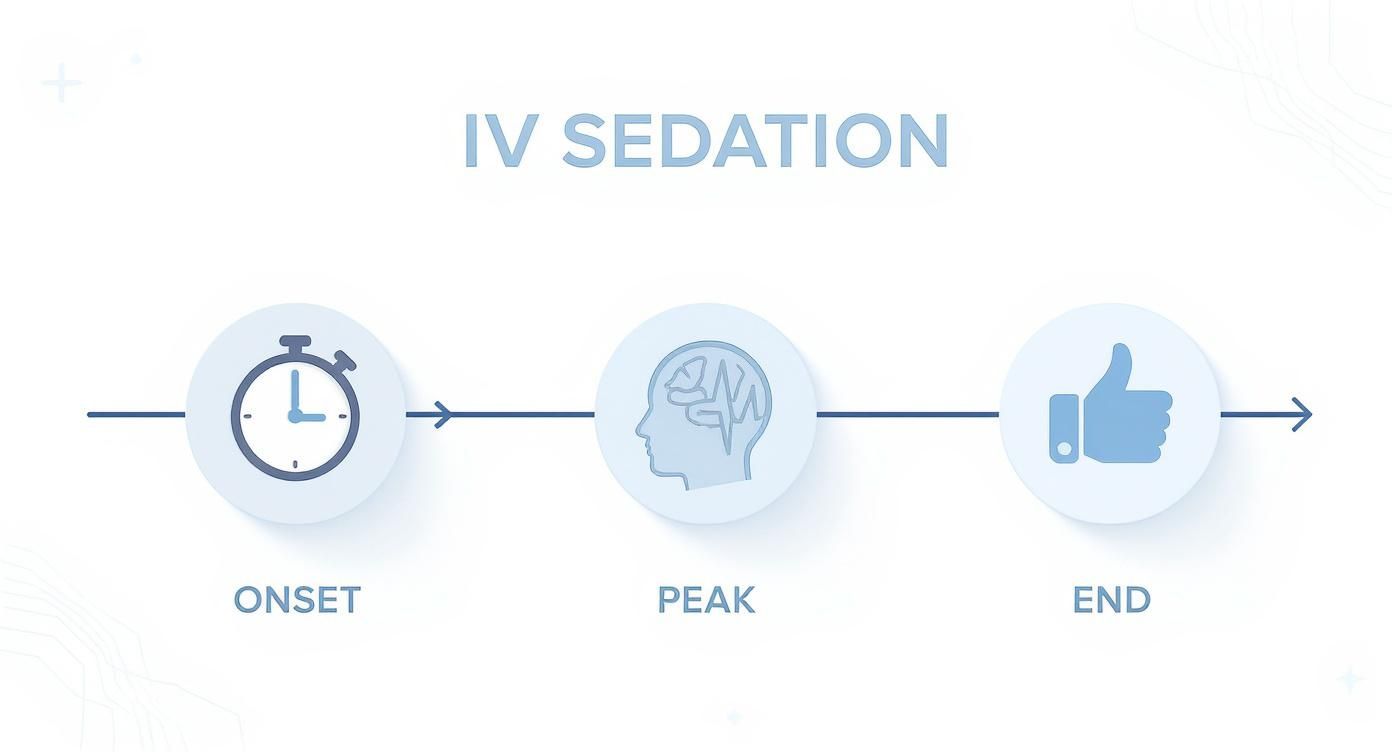
As you can see, the whole thing is a controlled process, designed for a smooth and comfortable experience that leads to excellent dental results.
Gently Waking Up
Once your dental work is all done, we simply stop the medication. There's no sudden jolt back to reality. Instead, you'll slowly and comfortably wake up, much like you would from a really good, deep nap.
You'll probably feel a bit groggy and sleepy, but you'll be comfortable. The most common thing we hear from patients is that they feel rested and are shocked the procedure is already over. With almost no memory of the treatment, the entire experience feels more like a peaceful dream, making it possible to get the healthy, beautiful smile you deserve without any of the anxiety.
How IV Sedation Creates a Calm Dental Experience
Ever wonder how IV sedation pulls off that feeling of deep, peaceful calm? It’s not magic, but it’s a pretty incredible process. The dream-like state you drift into is the result of a precise, carefully managed medication working with your body’s own chemistry, all designed to make your dental care feel effortless.
Medications like Midazolam go to work on your central nervous system. Think of your brain as having "worry centers"—the parts responsible for kicking off feelings of anxiety and fear. These sedation medications simply turn down the volume on those areas, hushing the nerve signals that tell your body to be stressed.
It's a lot like putting a pair of high-end, noise-canceling headphones on your brain’s anxiety circuits. The world around you, including the sounds and sensations of the dental procedure, just fades into the background. This allows you to rest in a state of profound tranquility while your dentist works on improving your oral health.
The Power of Anterograde Amnesia
One of the biggest perks of this process is an effect called anterograde amnesia. It sounds complicated, but the concept is simple and has a massive impact on your experience. Basically, the medication temporarily stops your brain from creating new memories while it's active.
This is the main reason why, after your appointment, you’ll likely have little to no memory of the treatment itself. You weren't unconscious or "knocked out." Instead, your brain's record button was just paused for a little while. This is a game-changer for anyone with dental phobia, as it prevents the formation of new stressful memories tied to getting dental care.
A study looking at 100 dental patients who received IV sedation with midazolam found that 91% felt the sedation was completely sufficient for their procedure. What's interesting is that about half of them could recall bits and pieces of their appointment, which really shows you're in a conscious "twilight" state with significant memory loss, not completely out. You can read more about this dental sedation research if you're curious.
This amnesia is a key reason IV sedation feels so easy. It effectively erases the details of the procedure from your memory, leaving you with just the positive result: a healthier, happier smile.
More Than Just Comfort—It's About Efficiency, Too
This deep state of relaxation isn't just for your peace of mind; it also makes a huge difference in the quality and efficiency of your dental work. When you're completely relaxed and still, your dentist can work with greater precision and focus. This often allows them to complete more complex or lengthy procedures in a single, consolidated appointment.
For you, that translates into some fantastic advantages for your dental health and appearance:
- Fewer Appointments: Instead of booking multiple visits for things like several implants or a full smile makeover, we can often get it all done in one go.
- Faster Results: Getting more work done in one session means you see your final, beautiful results much, much sooner.
- Improved Outcomes: A calm, still patient allows your dentist to concentrate fully on the technical details, which leads to better, more predictable results for your smile.
Ultimately, IV sedation is an incredible tool that removes the barriers standing between you and optimal dental health. It creates an environment where you can get the care you need without the stress, and it helps our team deliver the absolute best results possible. This blend of comfort and efficiency makes it a priceless option for anyone ready to improve their smile.
Is IV Sedation the Right Choice for Your Dental Health?
Figuring out what IV sedation feels like is one thing, but the real question is, "Is this the right tool for me?" For a lot of people, the answer is a definite yes. IV sedation isn't just about feeling comfortable; it's what opens the door to better dental health for people who feel stuck behind a wall of fear or physical pain.
Think of it like a sturdy bridge over a canyon of anxiety. On one side is the dental care you need, and on the other is the healthy, confident smile you deserve. IV sedation is the safe path that lets you cross without having to worry about the long drop down.
Who Benefits Most From IV Sedation?
While just about anyone can choose sedation, it’s a real game-changer for certain folks. It directly tackles the hurdles that keep people from getting the dental care they need, leading to incredible improvements in both their oral health and self-confidence.
You might be the perfect candidate if any of this sounds like you:
- You Have Severe Dental Anxiety or Phobia: For some, the fear is so overwhelming that even picking up the phone to make an appointment is a huge challenge. IV sedation makes it possible to finally get years of needed dental work done in a calm, peaceful state.
- You Have a Low Pain Threshold: If you're highly sensitive to pain, the mix of deep relaxation from IV sedation and local anesthetic makes the entire experience completely pain-free, allowing for necessary treatments to proceed smoothly.
- You Have a Very Sensitive Gag Reflex: A strong gag reflex can turn even a simple procedure into a struggle for both you and your dentist. Sedation calms this reflex, letting us work smoothly and efficiently to improve your dental health.
To really dig into whether this is the perfect solution for you, our detailed guide can help you explore if IV sedation is right for your specific needs. This resource helps you think through your own comfort levels and treatment goals.
Unlocking Complex and Cosmetic Dental Transformations
Maybe the biggest advantage of IV sedation is its power to let us complete a huge amount of dental work in a single visit. So many patients dream of a full smile makeover or need a full-mouth reconstruction but get overwhelmed just thinking about how many appointments it would take.
IV sedation makes these large-scale treatments possible in one visit. By creating a state of deep relaxation, it allows the dental team to work efficiently for a longer period, condensing what might have taken months of appointments into a single day.
This is a massive benefit for procedures that dramatically improve your smile's health and appearance, like:
- Full-Mouth Reconstruction: This involves rebuilding or replacing most of the teeth in your mouth, which takes a lot of time in the dental chair.
- Multiple Dental Implants: Placing several implants at once becomes a comfortable and streamlined process.
- Complete Cosmetic Smile Makeovers: Procedures like placing a full set of porcelain veneers can be done efficiently while you rest easy.
- Challenging Physical Conditions: For people with TMJ or other issues that make it hard to keep their mouth open, sedation relaxes the jaw muscles, removing that physical barrier to care.
When thinking about ways to handle dental anxiety, some people also look into other complementary methods. While they aren't a substitute for professional sedation, some find it helpful to look into at-home relaxation techniques, such as managing anxiety with weighted blankets, to create a general sense of calm in their day-to-day lives. In the end, IV sedation removes the obstacles of time, fear, and discomfort, empowering you to finally get the healthy, beautiful smile you deserve.
Comparing IV Sedation to Other Dental Options
When you're trying to figure out if IV sedation is the right fit for your dental work, it's really helpful to see how it stacks up against the other options out there. Making a choice you feel good about is the first step toward a comfortable, stress-free treatment. Let's walk through how IV sedation compares to nitrous oxide (laughing gas) and oral sedation pills.
Think of it like a toolbox—each tool is designed for a specific job. The best one for you will depend on your own comfort level, how complex your dental procedure is, and how significant the change to your smile will be.
Nitrous Oxide (Laughing Gas)
Nitrous oxide is the lightest and mildest form of sedation we use. You simply breathe it in through a small, comfortable mask placed over your nose, and it creates a feeling of light-headedness and relaxation. Some people even feel a little giddy or euphoric.
It works incredibly fast, but it also wears off almost as soon as the mask is removed. That's a big plus because it means you can safely drive yourself home afterward. It's the perfect choice for taking the edge off during routine procedures like cleanings or fillings, but it doesn't provide the deep calm needed for more involved treatments.
Oral Conscious Sedation
With oral conscious sedation, you take a prescribed pill about an hour before your appointment. This method offers a much deeper level of relaxation than laughing gas and is a great option for patients who feel moderate dental anxiety. You'll feel very drowsy and at ease, but you will still be awake and able to respond.
The main downside here is the lack of precision. Once you've taken the pill, the dose is set and can't be adjusted during the procedure. This makes the effects a bit unpredictable, as everyone metabolizes medication differently.
The real game-changer with IV sedation is its precision and control. Since the medication goes directly into your bloodstream, it gets to work in minutes, and our team can adjust the level in real-time. This means your sedation is perfectly customized to your needs from the beginning to the end of your appointment.
Why IV Sedation Stands Out
That ability to fine-tune your sedation level moment-by-moment is what truly sets IV sedation apart. This control is absolutely critical for ensuring you're completely comfortable during more complex treatments, like placing several dental implants or doing a full smile makeover.
It allows for a much deeper state of relaxation—often called "twilight sleep"—and has a powerful amnesic effect. Most patients have little to no memory of the procedure afterward, which is a huge relief for anyone with dental fears. This precision allows your dentist to work efficiently without interruption, leading to a better outcome and a healthier smile. To get an even more detailed look, check out our guide on IV sedation vs. oral sedatives.
Comparing Dental Sedation Methods
To make things even clearer, here's a side-by-side comparison of the most common sedation options used in dentistry. This should help you quickly see the key differences.
| Feature | Nitrous Oxide ('Laughing Gas') | Oral Conscious Sedation | IV Sedation |
|---|---|---|---|
| Level of Sedation | Light: Creates a mild, floaty feeling. | Moderate: Induces a drowsy, very relaxed state. | Moderate to Deep: Provides a "twilight sleep" with deep calm. |
| Onset Speed | Immediate: Works within 2-3 minutes. | Slow: Takes 30-60 minutes to take effect. | Immediate: Works within 1-2 minutes. |
| Adjustability | Excellent: Can be adjusted instantly. | None: Dose is fixed once the pill is taken. | Excellent: Can be adjusted in real-time. |
| Memory Effect | None: You remember the entire procedure. | Mild Amnesia: You may have hazy memories. | Strong Amnesia: Little to no memory of the procedure. |
| Recovery Time | Immediate: Effects wear off in minutes. | Long: Requires a driver and several hours of rest. | Long: Requires a driver and 24 hours of rest. |
Ultimately, choosing the right sedation is all about matching the method to your procedure and your personal needs. For anyone looking to make significant improvements to their dental health with absolutely zero stress, the controlled and profound calm of IV sedation is often the best path forward.
How to Prepare for Your IV Sedation Appointment
Knowing what IV sedation feels like is a huge step toward a comfortable dental visit, but understanding how to prepare for your appointment is just as important. Think of it less like following a strict set of rules and more like partnering with your dental team. When you take these simple steps, you're helping us make sure the entire process is as smooth, safe, and effective as possible.

This proactive approach makes the day of your procedure feel predictable and calm, getting rid of any last-minute stress. It’s like packing your bag the night before a big trip—with everything in order, you can just relax and focus on the destination. In this case, that destination is a healthier, happier smile.
Your Pre-Appointment Checklist
We've broken down the essential pre-appointment instructions to make things super easy. Following these guidelines is absolutely critical for your safety and for the sedation to work as intended.
-
Arrange Your Ride Home: This is a non-negotiable first step. You will be in no condition to drive after receiving IV sedation. You’ll need to have a responsible adult friend or family member bring you to the office, drive you home, and stay with you for a few hours afterward.
-
Follow Fasting Instructions: We’ll ask you to avoid all food and drink, including water, for at least six to eight hours before your appointment. An empty stomach is crucial to prevent any potential complications while you're sedated.
-
Dress for Comfort: Go for loose-fitting, comfortable clothing for your appointment. It's also a big help if you wear a top with short sleeves or sleeves you can easily roll up. This makes it much easier for our team to place the IV line without any hassle.
These steps are all designed with one goal in mind: creating the safest possible environment for your care. They ensure that from the moment you arrive, our focus is entirely on your comfort and the procedure ahead.
What to Expect During Your Recovery
Once your dental work is finished, the recovery process begins. That groggy feeling from the sedation will stick around for several hours, so planning for a full day of rest is essential. Knowing what to expect makes this part much more manageable.
You should plan to head straight home and take it easy for the rest of the day. Avoid any strenuous activity and just focus on letting your body recover.
Your main job for 24 hours after sedation is simply to rest. That means no driving, no operating any kind of machinery, and definitely no making important legal or financial decisions until the medication has fully cleared your system.
The benefits of a positive IV sedation experience can be long-lasting. Research shows that patients often report higher long-term satisfaction with IV sedation compared to other methods. One study even found that patients' satisfaction scores improved significantly over three years after their procedure, which really highlights the positive psychological impact of feeling safe and comfortable. You can read more about these long-term sedation satisfaction findings and see how it helps people feel good about their dental care for years to come.
Finally, make sure you follow all the post-op instructions we give you. This will include tips on staying hydrated with clear liquids and sticking to soft foods until any local numbness wears off. By taking these simple steps, you'll ensure a smooth recovery and protect the beautiful results of your dental work.
Common Questions About Dental IV Sedation
Even after learning how IV sedation works, it's totally normal to have a few last-minute questions. Getting straight answers is the final step to feeling confident and ready to finally get your dental health back on track, without the fear. We've put together the most common questions we hear from our patients right here in Katy and Houston to give you that peace of mind.
Each answer is designed to be clear and direct, tackling the big worries about safety, consciousness, and what happens after the procedure.
Is IV Sedation Safe for Dental Work?
Yes, it is extremely safe when it's handled by a properly trained and certified dental professional. Your well-being is our absolute top priority, which is why we keep a close eye on your vitals—heart rate, blood pressure, and oxygen levels—for the entire duration of your appointment.
The medications themselves are well-understood and have been used safely in dentistry for a long, long time. Plus, the dose isn't a one-size-fits-all guess; it's carefully calculated just for you and can be adjusted on the fly to make sure you're perfectly safe and comfortable as we work to improve your smile.
Will I Be Completely Unconscious?
No, you won’t be completely "out." You'll still be conscious enough to respond to simple questions from your dentist. This is actually why it’s called "conscious sedation." You’ll just be in a state of incredibly deep relaxation, what many people call a "twilight sleep."
In this state, you're so calm and comfortable that you likely won't remember much, if anything, about the dental work afterward. It gives you the amazing benefit of feeling completely unaware of the procedure without the risks associated with general anesthesia.
This lets you get the treatment you need for a healthier smile, all while in a peaceful state, free from the anxiety that might have been holding you back.
Will I Feel Any Pain During the Procedure?
You will not feel any pain. IV sedation is fantastic for getting rid of anxiety and making you feel detached from what’s going on, but it isn't actually a painkiller. That's why it's always paired with a local anesthetic.
Before any work starts, your dentist will completely numb the specific area of your mouth being treated. This powerful combination ensures you are both mentally at ease from the sedation and physically pain-free from the anesthetic. It creates the perfect, stress-free conditions to get your smile in top shape.
How Long Does the Recovery Take?
The main sedative effects usually wear off within an hour or two after your procedure is finished. However, you should definitely plan on feeling a bit groggy, drowsy, or just tired for the rest of the day.
It is absolutely essential that you have a responsible adult drive you home and hang out with you for a few hours. We tell all our patients to plan on taking it easy and relaxing for a full 24 hours. After that period of rest, the vast majority of people feel completely back to normal.
At Grand Parkway Smiles, our team is dedicated to ensuring your comfort and safety every step of the way. If you've been putting off necessary dental work due to anxiety, IV sedation can help you achieve the healthy, beautiful smile you deserve. Schedule your consultation with our experienced Katy dental team by visiting us at https://dentistkatytx.com.