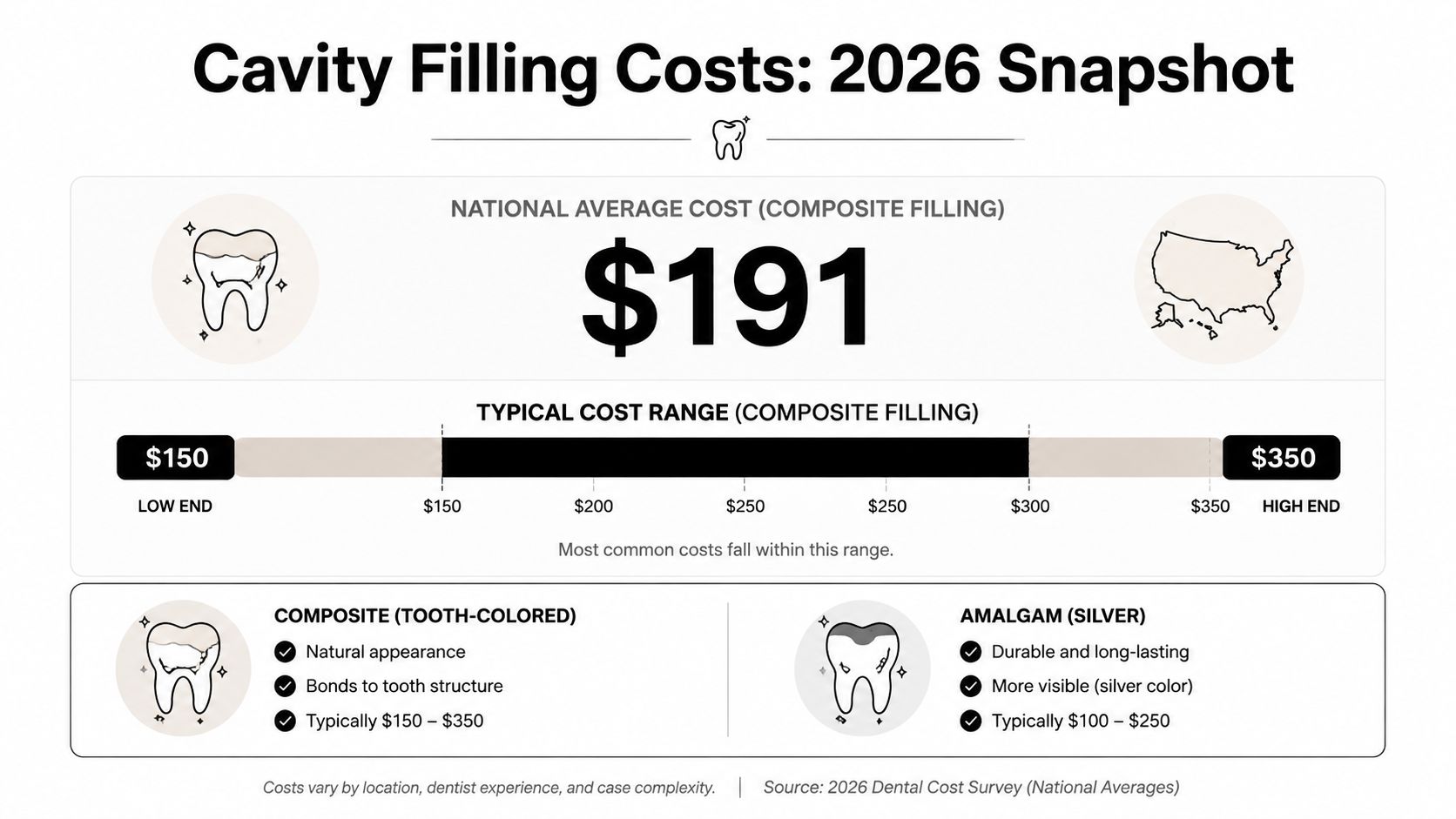
A single-surface composite filling in the United States typically costs about $191, while the national range is roughly $100 to $1,150 per tooth, depending on the material and size. A small repair may stay near the lower end, but a large restoration using porcelain or another premium material can move sharply higher.
That spread is why online averages can mislead families in Katy and the greater Houston area. The cost of filling a cavity depends less on the word “filling” and more on what the dentist must rebuild. Material, surface count, tooth location, decay depth, insurance, and the need for additional procedures all shape the final estimate.
The smart move is simple: ask your dentist to identify the number of surfaces, the proposed material, the insurance-allowed fee, and your expected patient portion before treatment begins.
What a Cavity Filling Actually Costs in 2026
A single-surface composite resin filling averages about $191, while amalgam averages about $160 in the United States. Across materials and restoration sizes, the cost can run from roughly $100 to $1,150 per tooth, with gold around $400 and porcelain near $1,150. GoodRx's cavity-filling cost guide shows why one online average cannot serve every patient.
Those figures describe different repairs. A one-surface cavity needs less preparation and material than decay extending across several surfaces of a molar. That surface count is the trap behind many confusing averages. A “per-tooth” price may represent one small surface, while your Katy family's estimate reflects two, three, or more surfaces, plus the tooth's location and your PPO plan's allowed fee.
A front-tooth composite filling can also require careful shaping and shade matching. A back-tooth restoration must withstand heavier chewing and may take more work to isolate and shape.
Use the average as a starting point, not a promise
Before approving treatment, ask four direct questions:
- Which material: Composite, amalgam, gold, porcelain, and other materials have different prices and uses.
- How many surfaces: A one-surface filling is not priced like a restoration involving several sides of the tooth.
- Which tooth: Front teeth demand cosmetic attention, while molars can be harder to isolate and shape.
- How deep is the decay: A shallow cavity may need only a filling. Deeper damage may require added protection or another restoration.
Ask for the surface count, material, insurance-allowed fee, and expected patient portion in writing. That estimate matters more than a national average.
Budget for prevention too. Review the guide to 2026 professional cleaning cost so routine care stays in your dental budget.
Practical rule: Never approve a filling based on a per-tooth average alone. Ask for the surface count and material in writing.
How Filling Material Changes the Final Price
Material changes both the invoice and how the restoration looks and performs. The right choice depends on the tooth's location, how much structure was lost, chewing pressure, appearance goals, and your budget. A lower price can make sense for a back tooth, while a tooth visible when you smile may justify paying more for a natural color.
| Material | Typical Price Range | Best Use |
|---|---|---|
| Composite resin | About $150 to $450 | Visible teeth and patients seeking a natural appearance |
| Amalgam | About $100 to $300 | Budget-conscious repairs, especially where strength matters |
| Glass ionomer | Not specified in the verified pricing data | Selected situations near the gumline or in children |
| Gold | Around $400 in the cited national comparison | Durable restorations when appearance and budget allow |
| Porcelain or inlay restoration | About $650 to $2,800 | Larger or premium cosmetic restorations |
The composite, amalgam, porcelain, and inlay ranges come from Stellar Dental's filling price discussion. As noted earlier, GoodRx places gold around $400 and porcelain near $1,150 at the high end. Those figures are comparison points, not a Katy quote. Your PPO plan may reduce the allowed fee, but your share still depends on the material, surface count, deductible, and remaining benefits.
Composite resin
Composite resin is often the practical choice for a visible tooth because it can be matched to natural enamel. It avoids a metallic spot during speaking or smiling. Wagner Langston Family Dentistry explains the appearance benefit of composite fillings.
Composite commonly costs more than amalgam. On front teeth and other visible areas, that added cost can buy a result that blends into your smile. Composite also bonds to tooth structure, which can support a conservative restoration when the tooth is suitable for it.
Amalgam
Amalgam remains a useful lower-cost option for selected back-tooth repairs. Its metallic appearance makes it a poor fit for many smile-line teeth, but molars face heavy chewing. If strength and price matter more than color, ask whether amalgam is appropriate for that tooth.
Glass ionomer
Glass ionomer serves a narrower purpose. A dentist may consider it near the gumline or for certain pediatric restorations because of its handling characteristics and fluoride release. It is not a universal substitute for composite or amalgam. Ask what clinical reason supports the recommendation.
Gold and porcelain
Gold can provide durability, but its premium price and distinctive appearance limit its appeal. Porcelain or an inlay can offer strong cosmetic results, though laboratory work and added complexity place these restorations at the top of the price range. Ask for the surface count and your PPO patient portion before choosing a premium material.
Hidden Drivers Behind Your Filling Bill
The surface count is the detail that makes online filling averages misleading. A quote “per tooth” may cover one surface, two surfaces, or several. More surfaces mean more preparation, material, shaping, and chair time, so the tooth count alone does not tell a Katy family what it will pay after PPO coverage.
A cavity limited to the biting surface is a smaller job than decay spreading onto the front and side of a molar. That difference can move a composite restoration into a higher price range. Independent pricing data commonly places composite around $150 to $450, amalgam around $100 to $300, and premium porcelain or inlay restorations around $650 to $2,800 per tooth. Stellar Dental provides those material ranges and highlights the importance of surface count.
The variables your estimate should identify
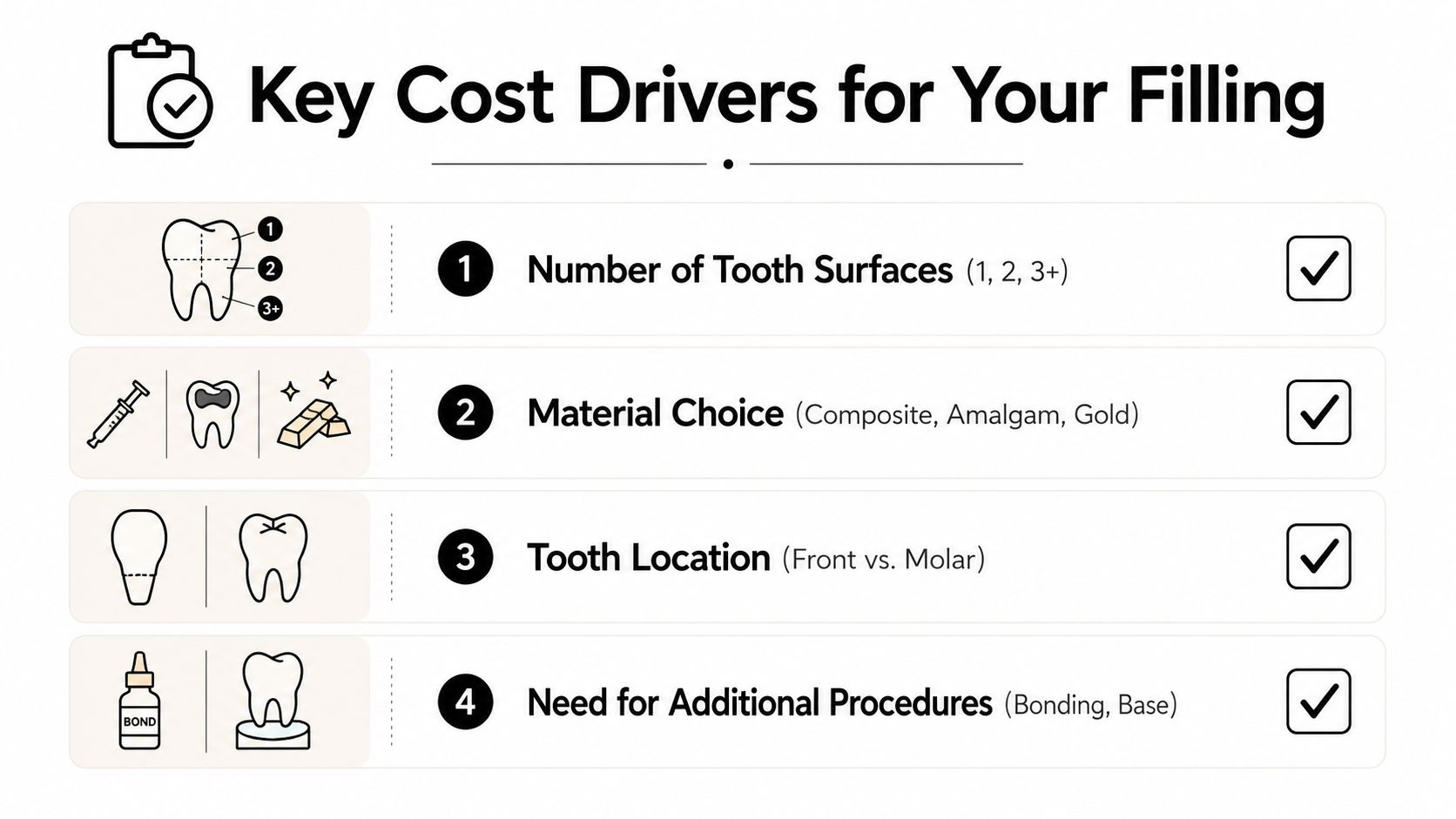
- Surface count: Ask whether the filling is one-surface, two-surface, or multi-surface. This is often the largest hidden difference between an online average and your actual estimate.
- Tooth location: A front tooth may require careful contouring, while a molar can be harder to reach, isolate, and restore.
- Decay depth: Deeper decay may call for a liner, base, or other protective step before the filling is placed.
- Anesthesia and imaging: Local anesthetic, X-rays, or diagnostic work may be billed separately or included in the visit.
- Tooth condition: Cracks, weakened cusps, or too little remaining structure may make a direct filling unsuitable and lead to a larger restoration.
Do not accept “this tooth is more complicated” as a complete explanation. Ask, “How many surfaces are involved, what material do you recommend, and which parts of the estimate does my plan cover?”
Ask before treatment: “Is this still a filling, or does the tooth need a larger restoration because too much structure is missing?”
That question protects your tooth and your budget. A filling can restore function and seal decay only when enough healthy structure remains to support it.
How Insurance and Financing Reshape Your Out-of-Pocket Cost
Insurance changes the bill through the plan's allowed fee, coverage category, deductible, network rules, and annual maximum. The dentist's regular fee and your final patient responsibility aren't necessarily the same number.
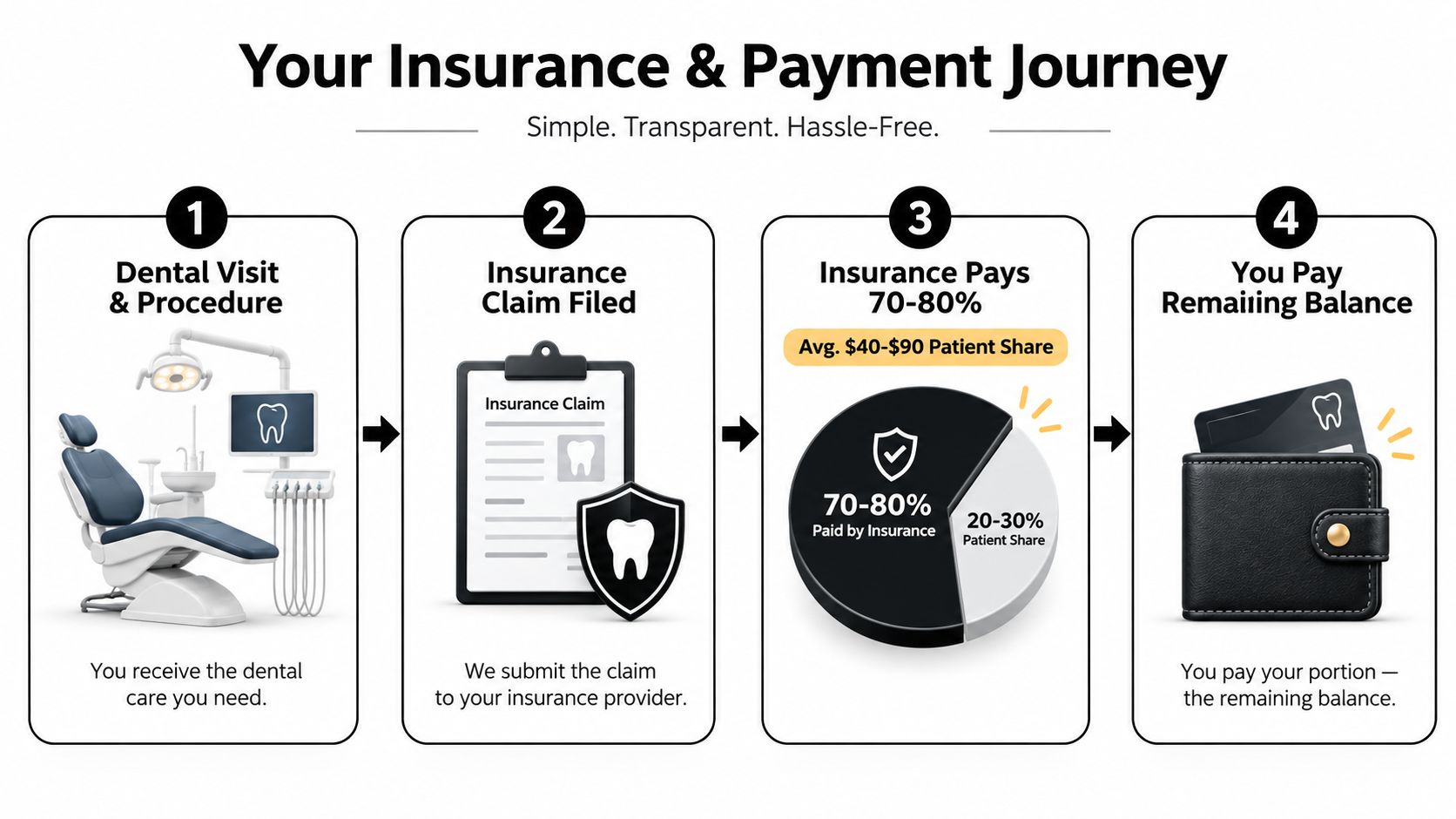
A typical PPO example can make the process easier to understand. Suppose a Katy family receives a $250 filling estimate, has a $50 deductible, and carries a plan that covers 70% to 80% of the allowed fee for a basic procedure. Depending on whether the deductible has already been met, the allowed fee, and the plan's specific rules, the family might see a patient share in the commonly cited $40 to $90 range for a routine composite filling. These figures are plan examples, not a guarantee for every policy, and the coverage assumptions are summarized in the supplied billing infographic.
What can change that example
An out-of-network office may not accept the same negotiated fee as an in-network provider. Your plan may also apply a deductible first, limit coverage for certain materials, or leave less available under the annual maximum. A composite filling may be covered differently depending on the tooth and the plan's rules.
Before scheduling, request a pre-treatment estimate. Give the office your insurance information and ask them to confirm:
- The procedure code and number of surfaces.
- The insurer's allowed fee.
- Your deductible status.
- The estimated plan payment.
- Your expected balance.
- Whether the material is covered at the same level as a basic alternative.
For patients without insurance, an in-house savings plan can reduce listed fees in exchange for a membership arrangement, while third-party financing can divide a larger balance into scheduled payments. Review the practical details of dental insurance and financing options at Grand Parkway Smiles before choosing a payment route.
Money rule: A low office fee can still produce a high patient balance if the provider is out of network or your annual benefit is nearly used.
What Happens During the Filling Visit
A filling visit follows a clear sequence, and understanding it makes the appointment easier to manage. The dentist examines the tooth and may take an X-ray to see whether decay remains in the outer structure or reaches deeper areas. That evaluation also determines whether a basic filling is suitable.
The team numbs the area with local anesthetic. After the tooth is comfortable, the dentist removes the decayed portion, cleans the prepared space, and checks that enough healthy structure remains to hold the restoration.
How a composite filling is placed
For composite resin, the dentist prepares the tooth so the material bonds securely. The composite goes in layers, with a curing light hardening each layer. The dentist then shapes the restoration to follow the tooth's natural contours.
The finishing work affects both comfort and function. The dentist checks your bite, removes any high spot, smooths rough edges, and polishes the surface. You should be able to chew normally without noticing the filling whenever you close your mouth.
Tooth-colored composite blends with natural enamel, so it avoids the visible metallic appearance associated with amalgam. It suits patients who want decay repaired without an obvious dark or silver area. Ask whether composite fits the tooth's location and condition rather than choosing it by appearance alone.
When you shouldn't wait
Call the office promptly if a tooth aches at night, reacts strongly to hot or cold, or loses a filling before travel. Delayed treatment can give decay or a fracture time to extend beyond the point where a basic filling will work, potentially changing the treatment and cost.
Dental anxiety also deserves attention before the visit. Ask about comfort measures when scheduling. Grand Parkway Smiles explains the steps involved in filling a cavity, and its practice information describes local anesthesia, IV sedation, and same-day emergency visits. Confirm which options are appropriate for your appointment, and request the expected patient balance before treatment begins.
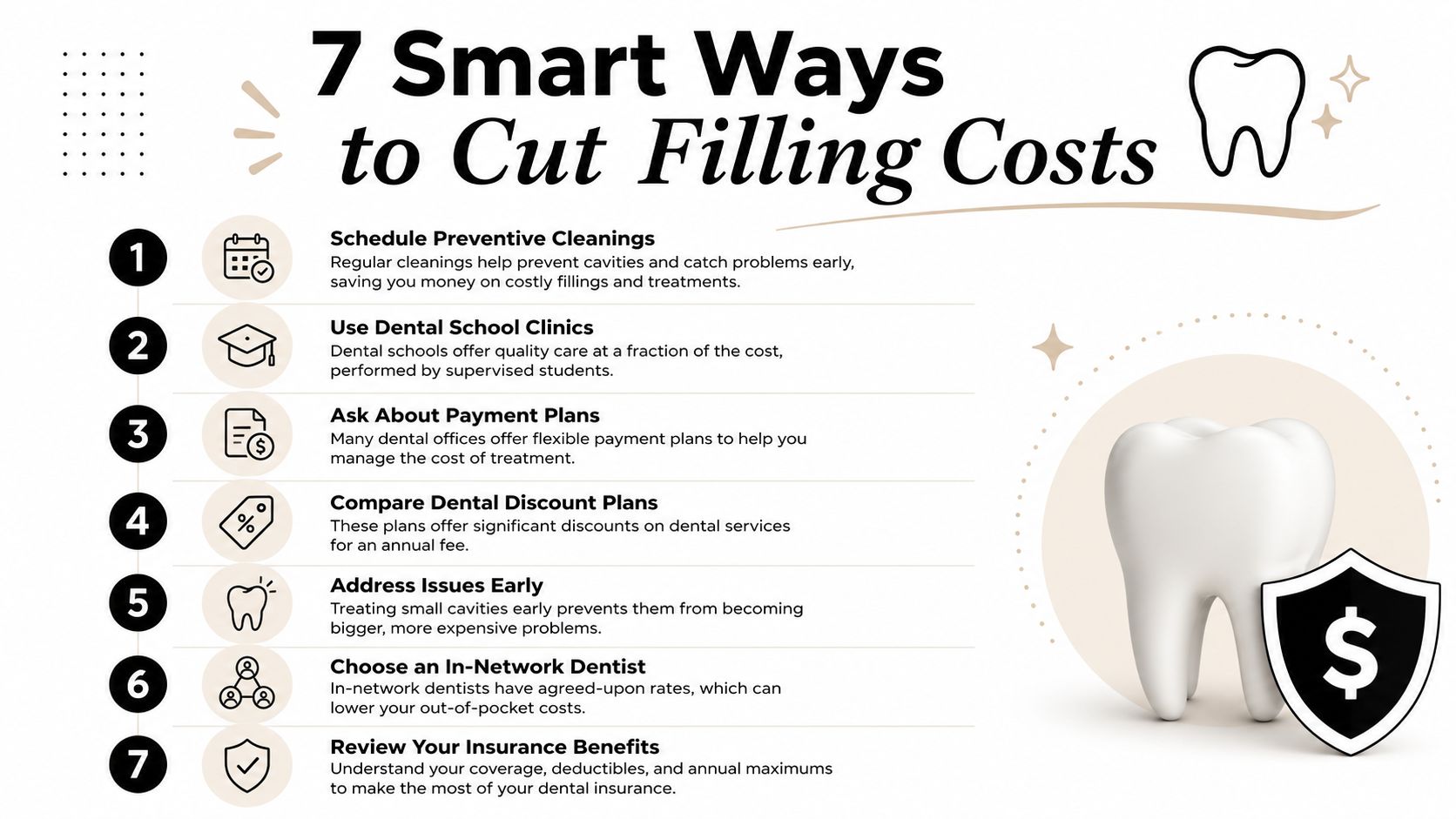
Smart Ways to Lower Your Filling Costs
The best savings strategy is prevention, but practical planning matters too. Use these seven moves to reduce surprises without choosing a material that doesn't fit the tooth.
Schedule preventive cleanings: Regular examinations and cleanings help dentists identify small areas of decay before they become larger restorations. For families, consistent preventive appointments are easier to budget than urgent treatment.
Ask about clinically suitable materials: If the cavity is in a visible area, ask whether composite is appropriate. If it's in a back tooth, ask whether a less expensive material can meet the functional need without compromising the restoration.
Use your PPO benefits deliberately: Ask the office how your plan's preventive benefits and annual maximum work. Timing cleanings and restorative treatment should follow your plan's rules, not an arbitrary calendar.
Use FSA or HSA funds: If you have access to a flexible spending account or health savings account, ask your plan administrator whether the treatment qualifies. Pre-tax funds can reduce the effective cost of eligible care.
Compare uninsured payment options: An in-house membership or savings plan may be useful when traditional dental insurance isn't available. Compare the enrollment fee, included services, exclusions, and discounted treatment fees before signing up.
Consider financing for larger plans: Third-party financing can spread a larger restorative balance across scheduled payments. Read the agreement carefully, especially interest, promotional terms, and consequences of missed payments.
Request a written estimate: A transparent estimate should identify surfaces, material, procedure fees, insurance assumptions, and the expected balance. If the office can't explain the estimate, don't proceed until you understand it.
The strongest financial argument for early treatment is structural preservation. A small cavity generally requires less repair than a tooth with extensive decay, fracture, or loss of supporting structure. Waiting doesn't make the underlying problem cheaper.
Families should also compare convenience with price. A dental school clinic may offer lower fees, but appointment availability, treatment selection, and the time required can differ from a private office. The right choice depends on urgency, complexity, and the total cost of delaying care.
Common Myths About Filling Costs
Myth one says silver is always cheaper over the long term
Amalgam can have a lower initial price than composite, but “cheaper” doesn't answer the clinical question. A silver-colored restoration may be a poor cosmetic fit for a visible tooth, while composite may better match enamel and blend into the smile. The right comparison includes appearance, tooth location, remaining structure, and the dentist's recommendation.
Myth two says the quoted office fee is your final bill
The office fee is only one part of the calculation. PPO network adjustments, deductibles, allowed fees, material rules, and remaining annual benefits can change what you owe. Ask for a pre-treatment estimate and verify the patient portion before the procedure.
Myth three says a filling lasts forever
A filling restores damaged structure, but it isn't a lifetime guarantee. Chewing pressure, new decay, wear, leakage, fracture, and changes around the restoration can eventually require repair or replacement. Continue brushing, cleaning between teeth, and attending examinations after the filling is placed.
Patient takeaway: Choose a restoration by balancing clinical need, appearance, durability, and total cost. The lowest initial price isn't always the lowest-cost decision for the tooth.
Your Next Move Toward a Healthy Smile
Start with the treatment plan, not the advertised average. Ask your dentist to state the surface count, material, tooth location, diagnostic fees, insurance estimate, and expected out-of-pocket balance in plain language.
Then act while the problem remains suitable for conservative repair. A filling can restore chewing function, protect the remaining tooth structure, and improve appearance when a tooth-colored material is appropriate. Prompt care also helps you avoid a larger restorative problem, which can affect comfort, bite, and the health of nearby teeth.
Pricing systems can produce very different patient experiences. In England, the public NHS system uses a fixed Band 2 charge of £76.60, and that fee covers fillings as part of one course of treatment rather than charging per filling, according to NHS filling cost information. Private U.S. care works differently, so Katy families need an individualized estimate rather than a comparison with a single national number.
If you have tooth pain, a lost filling, visible decay, or an overdue examination, contact a dental office and ask for a clear treatment and payment plan. Don't let uncertainty about the bill become the reason a manageable cavity progresses.
Grand Parkway Smiles provides examinations, tooth-colored fillings, emergency visits, sedation options, and flexible payment approaches for patients in Katy and the greater Houston area. Visit Grand Parkway Smiles to request an appointment and receive a personalized estimate before treatment.