You're standing at the bathroom sink with a new denture in one hand and a fizzy cleaning tablet in the other. The prosthesis feels expensive, unfamiliar, and surprisingly delicate. You may be wondering whether toothpaste, dish soap, baking soda, or a tablet is the safest way to clean it before breakfast.
That hesitation makes sense. Denture cleaning products aren't interchangeable, because acrylic, metal, flexible materials, and digitally fabricated bases can respond differently to abrasion, chemicals, and soaking time. The right routine protects more than appearance. It helps control odor, preserve comfort and fit, and reduce the biofilm that can irritate the tissues beneath a denture.
Why Cleaning Dentures the Right Way Changes Everything
On a new denture patient's first morning at home, the easiest mistake is reaching for a familiar product. Toothpaste is already beside the sink, dish soap is in the kitchen, and a whitening product may seem useful for stains. Yet dentures aren't natural teeth. Their surfaces can be more vulnerable to scratching, chemical exposure, and roughness than tooth enamel.
A denture collects plaque, stains, and calculus much like natural teeth do. The American College of Prosthodontists recommends daily soaking and brushing with an effective, nonabrasive denture cleanser because biofilm can contain bacteria and fungi associated with denture-related stomatitis. The ADA's denture guidance also emphasizes cleaning the appliance and maintaining the mouth around it.
Practical rule: The purpose of denture cleaning is biofilm removal, not aggressive whitening.
What starts as a cleaning problem
Suppose a patient rinses the denture but rarely brushes the tissue-facing surface. Food debris and biofilm remain along the gumline. Within time, that residue can contribute to an odor that mouthwash only masks. The appliance may look acceptable from the front while the underside stays coated.
The next problem can be inflammation. A red, tender area beneath the base may make the patient wear the denture less often or adjust how they chew. If the denture begins to move because the tissues are sore or the fit has changed, comfort and function suffer together. A patient learning the basics of how dentures work may find it easier to understand why the base, gums, and remaining teeth all need separate care.
Surface damage creates another chain reaction. Abrasive products can create microscopic roughness, and rougher surfaces hold plaque and staining more readily. Research cited in the Indian Journal of Dental Research reports that plaque accumulation increases when denture-base roughness rises above 0.2 μm in the study's discussion of surface roughness. Once stains settle into damaged areas, routine brushing may no longer restore the original appearance.
Why product matching matters
A tablet may be convenient for a conventional acrylic full denture but unsuitable for a soft liner if used outside its instructions. A brush may be safe for acrylic yet require extra care around delicate attachments. A metal partial needs a formula that won't corrode its framework.
Readers who want a broader overview of appliance choices can also review dentures in Fair Lawn explained, especially when comparing removable designs and their maintenance needs. The most reliable approach is simple: identify the material first, then choose a nonabrasive mechanical cleaner and a compatible soaking product.
The Five Main Types of Denture Cleaning Products
A cabinet full of products isn't necessary. A small routine that covers mechanical cleaning, chemical soaking, and safe handling is all that's required. These five categories address different jobs.
Denture cleaning products at a glance
| Product Type | How It Works | Cost Tier | Best For |
|---|---|---|---|
| Effervescent tablets | Dissolve in water and chemically loosen debris, stains, and microbial buildup | Low to moderate | Conventional acrylic dentures and compatible partials |
| Denture creams or pastes | Provide a low-abrasion polishing action during brushing | Low to moderate | Acrylic bases and routine surface cleaning |
| Specialty denture brushes | Use shaped, soft bristles to remove biofilm mechanically | Low | Full dentures, partials, and tissue-facing surfaces |
| Ultrasonic cleaning units | Use cavitation in liquid to dislodge material from small crevices | Moderate to high | Appliances needing extra cleaning support, when manufacturer-compatible |
| Adhesive cleansers or removers | Soften and dissolve adhesive residue | Low to moderate | Dentures worn with creams, powders, or strips |
Effervescent tablets are the convenience option. You place the appliance in a container with the prepared solution, allow the product to work for its labeled time, and rinse thoroughly. They can reach spaces a brush misses, but prolonged or inappropriate soaking may affect soft liners, certain flexible materials, or finishes.
A denture brush is inexpensive and essential, but it's only effective when you clean every surface. Use the larger head for broad areas and the smaller head around clasps, grooves, and the gingival edge. A toothbrush designed for enamel contours may not give you the same control.
Ultrasonic units can add another layer of cleaning. They're useful for loosening biofilm from micro-crevices, but they don't replace daily brushing or cleaning the mouth itself. Think of the device as a helper, not a complete routine.
Denture creams and pastes should polish gently. Products that are too abrasive can dull acrylic and leave the surface more receptive to plaque and stains. Adhesive removers are more specialized. They handle residue well, but they don't replace a cleanser for the entire appliance.
Most stable routines combine a denture brush with a compatible soaking product, while an ultrasonic unit may be added when a dental professional recommends it. Before buying, check whether your denture is conventional acrylic, metal-reinforced, flexible, implant-supported, or digitally fabricated.
How Each Cleaner Works on Biofilm and Stains
A new denture can look clean while still carrying a thin biofilm, the sticky layer that holds bacteria, food debris, and stains against its surface. Each cleaner removes that layer differently. A brush uses contact, a tablet changes the cleaning solution, and an ultrasonic unit moves liquid through small spaces. Matching the method to the denture material and the deposit gives you better control than choosing a product by brand name alone.
Tablets loosen what brushing leaves behind
Effervescent tablets work somewhat like a dish-cleaning tablet formulated for a dental appliance. Their ingredients may create oxygenating or oxidizing activity that loosens organic debris and helps lift surface stains. Some disinfecting solutions use sodium hypochlorite. A U.S. FDA 510(k) record for CHLOR-XTRA describes sodium hypochlorite 3% and 6% solutions, with a 2009 clearance date, showing the development of formal, specialized denture disinfectants in the FDA record.
Chemical soaking can reduce microbial load, yet it does not work equally well on every deposit or organism. In an edentulous-patient study, overnight soaking in 0.5% sodium hypochlorite produced denture-biofilm results of 8.3% ± 13.3, compared with 18.2% ± 14.9 for water and 18.2% ± 16.6 for alkaline peroxide in the controlled clinical study. These findings do not make a stronger solution suitable for every home. Concentration, material compatibility, thorough rinsing, and professional guidance all matter, especially with metal components, flexible materials, or soft liners.
Brushes remove the film by contact
A denture brush works like a small upholstery brush. Its bristles physically break apart the sticky layer holding bacteria, food particles, and discoloration to the appliance. Angled heads and varied brush lengths help reach the gingival side, tooth spaces, clasp areas, and polished outer surfaces.
Brushing matters because soaking cannot reliably remove hardened calculus. Excessive pressure or an abrasive paste can also scratch the surface, leaving more places for plaque and stains to collect. Research on complete dentures found that soaking combined with brushing worked better than water rinsing, while brushing alone outperformed the chemical method used in that trial in the comparative study.
Pastes polish, while ultrasonics vibrate
Denture creams and pastes are made to clean with less abrasion than ordinary toothpaste. They can remove loose deposits and surface discoloration, but they will not dissolve thick calculus or repair scratches. For appearance concerns, safe ways to whiten dentures should begin with checking the denture and its material before using stronger polishing methods.
Ultrasonic units work like gentle jewelry cleaners. Cavitation bubbles form and collapse in the liquid, creating movement that can dislodge biofilm from narrow spaces a brush may miss. The appliance still needs suitable rinsing and brushing, and the unit must be approved for its materials.
Adhesive removers have one focused purpose. Their solvent-like ingredients soften residue so you can avoid scraping or forcing the prosthesis. They help after adhesive use, but they do not remove every fungal deposit, calculus buildup, or nicotine stain from the appliance.
A Safe Daily and Weekly Cleaning Routine
A good routine should feel repeatable, not complicated. Keep a denture brush, nonabrasive cleanser, storage container, and compatible soaking product together so the sequence becomes automatic.
Morning care
- Remove and rinse the denture under lukewarm running water. Never use hot water, which can distort some denture materials.
- Place a folded towel in the sink or work over a bowl of water. This reduces the chance of damage if the appliance slips.
- Apply denture cleanser to a soft-bristled denture brush.
- Brush every surface gently, including the gumline, tooth spaces, clasps, and the tissue-facing base.
- Rinse thoroughly before wearing the denture.
- Clean your mouth separately. Brush remaining natural teeth, gums, tongue, and the palate gently as appropriate for your denture design.
After meals, rinse the denture and your mouth when possible. That quick rinse removes loose food before it dries and bonds to the appliance.
Evening care
After removing the denture, rinse it first. Brush it over the towel or water-filled basin, then prepare a fresh solution using lukewarm water and the cleanser's instructions. Some products specify a short soak, while others allow overnight immersion, so follow the label rather than assuming every tablet works the same way.
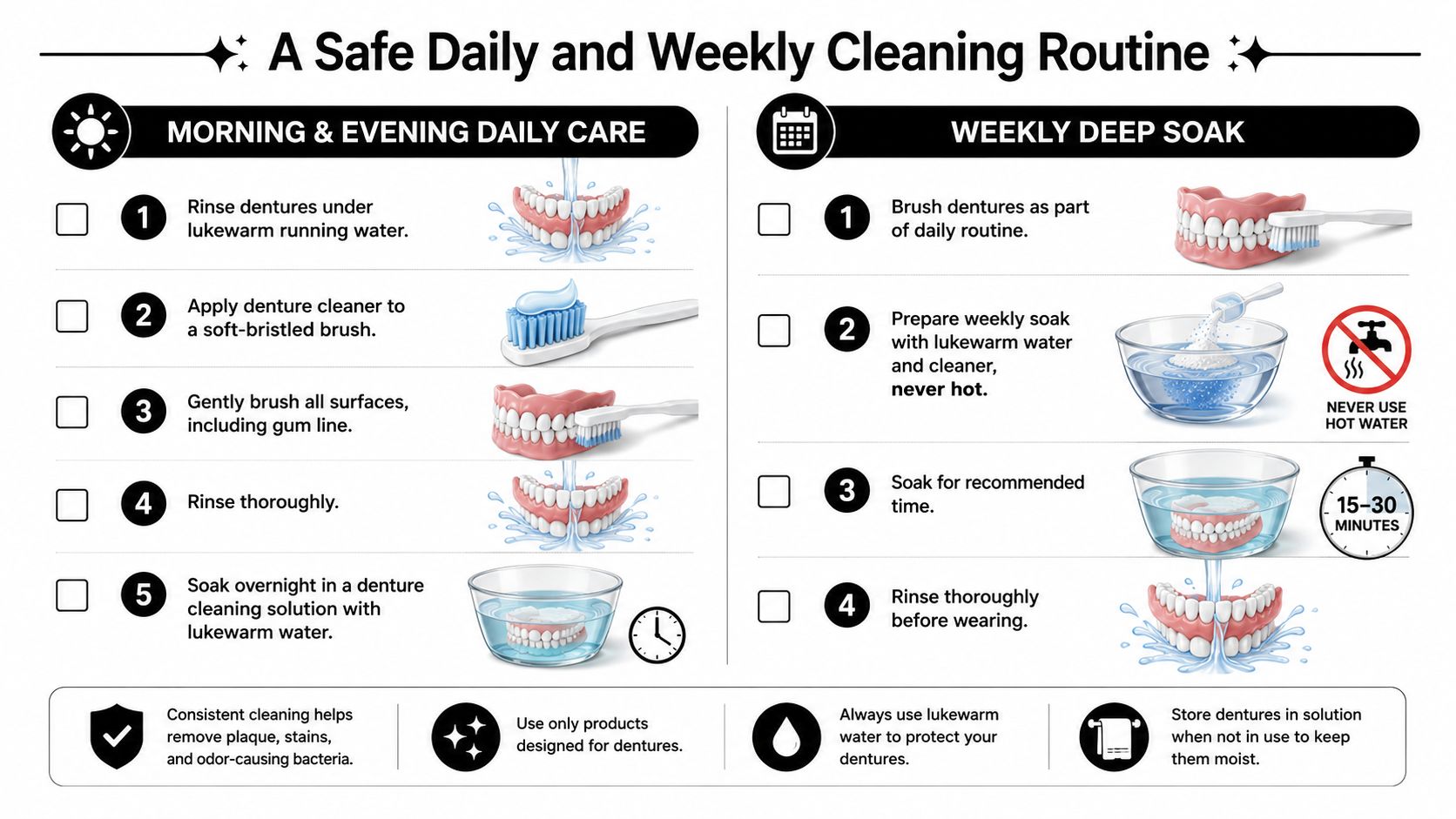
Rinse the appliance thoroughly before putting it back in your mouth. Keep the storage container clean as well. A detailed dentures guide from Aspiring Smiles Dental and Braces can provide another practical reference for handling, brushing, soaking, and storage.
Weekly and monthly checks
Set aside a weekly slot for a deeper soak or an ultrasonic cycle if the unit and denture manufacturer allow it. A longer soak can help loosen deposits, but it doesn't justify using a stronger chemical or extending the time beyond the product's instructions.
Once a month, inspect the appliance under good light:
- Look for cracks or chips around the base and teeth.
- Check for calculus-like buildup near the gum seal.
- Examine attachments, clasps, locator areas, or bars for residue or looseness.
- Notice changes in color, odor, or fit that persist after cleaning.
Matching Products to Acrylic, Metal, and Digital Dentures
The safest cleaner depends on the material's surface and the way the appliance was fabricated. Roughness is not merely cosmetic. A rougher base can retain more plaque, which makes both hygiene and appearance harder to maintain.
A 2025 meta-analysis found that milled digitally fabricated denture bases were significantly more resistant to cleanser-related color and microhardness changes than conventional and 3D-printed bases. For color stability, the standardized mean differences were 0.76 versus conventional and 2.35 versus 3D-printed bases. For hardness, the values were 0.58 versus conventional and 2.20 versus 3D-printed bases in the meta-analysis.
Those findings don't make digital dentures immune to damage. They show why a product that seems harmless on one base may not be appropriate for another. Read the appliance instructions and ask the dental office about soft liners, flexible nylon, metal frameworks, and attachments.
Denture material vs safe cleaning products
| Denture Material | Best Cleaning Products | Products to Avoid | Special Care Notes |
|---|---|---|---|
| Conventional acrylic | Soft denture brush, nonabrasive paste, compatible effervescent soak | Standard whitening toothpaste, harsh abrasives, hot water | Focus on preserving a smooth surface |
| Cobalt-chromium partial | Partial-denture formula, soft brush, careful rinsing | Chlorine bleach and unapproved corrosive solutions | Clean around clasps without bending them |
| Flexible partial | Gentle brush and manufacturer-approved cleanser | Strong oxidizers, aggressive abrasives, unapproved prolonged soaks | Flexible materials may discolor or change surface texture |
| Milled digital base | Soft brush and compatible cleanser | Unapproved harsh chemicals or abrasive polishing | Follow the fabricator's care guidance |
| Three-dimensional printed base | Gentle, approved cleanser and careful brushing | Unapproved strong oxidizers and excessive soaking | Confirm compatibility because surface response can differ |
| Implant-supported overdenture | Noncorrosive appliance cleanser and manual detail brushing | Corrosive products around locator caps or bars | Remove the prosthesis as directed and clean attachments separately |
Acrylic usually needs abrasion control. Metal needs corrosion control. Digital and printed bases need formulation-specific care. Flexible partials demand even more caution because their material can respond differently to chemicals and friction.
Readers comparing treatment choices may also benefit from comparing implants vs dentures, but whichever option you wear, the cleaning product should match the actual prosthesis rather than the product's marketing language.
Do Homemade and Natural Denture Cleaners Really Work
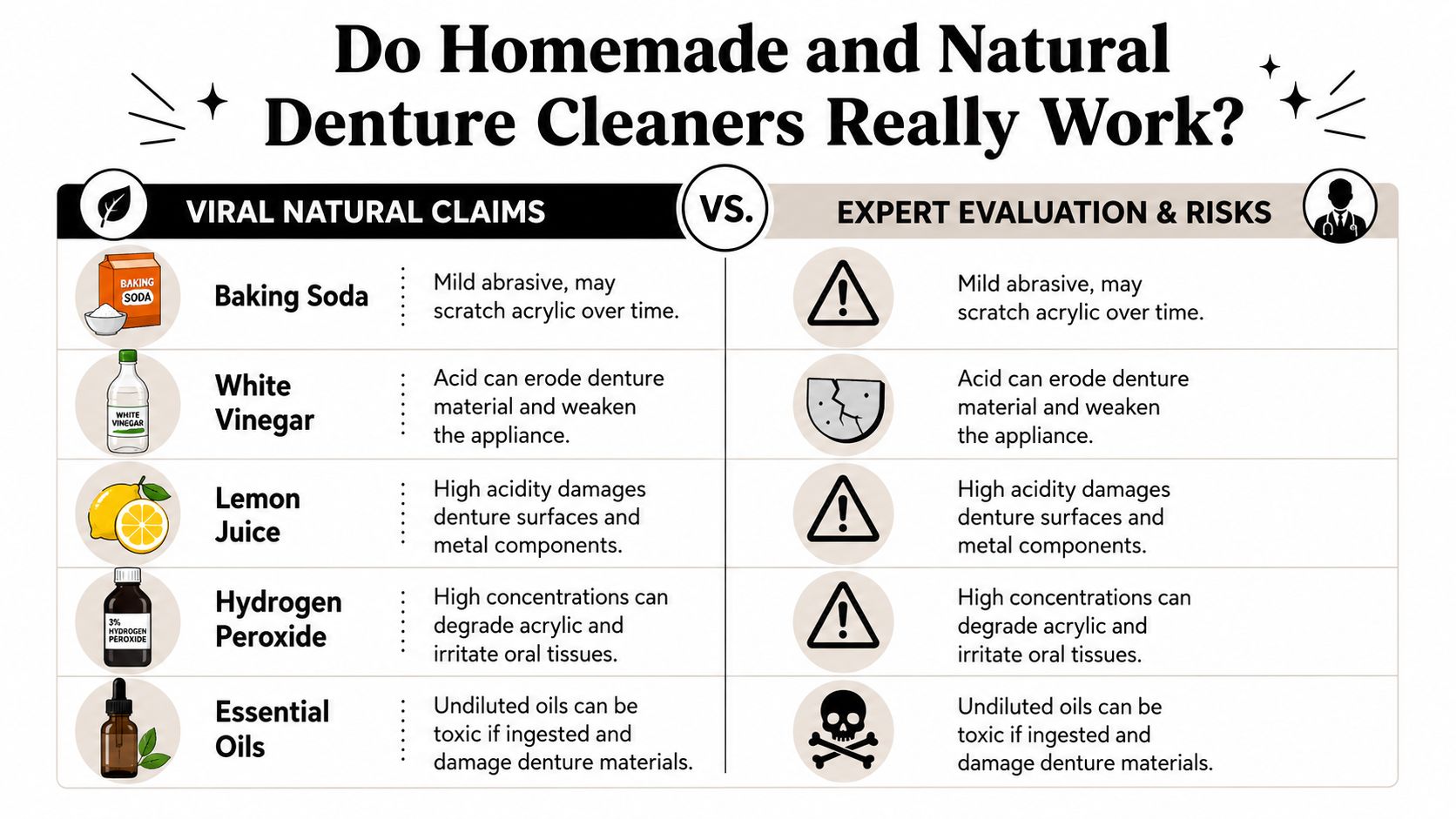
“Natural” doesn't automatically mean denture-safe. Baking soda, vinegar, lemon juice, hydrogen peroxide, and essential oils circulate widely as homemade solutions, but each can create a different problem when used too often or at the wrong concentration.
Commercial cleansers generally perform better for stain removal than natural alternatives. A 2026 systematic review found that chemical cleansers, including sodium hypochlorite, chlorhexidine, and effervescent peroxide tablets, achieved 80% to 100% CFU reduction against Candida in most studies, compared with 40% to 85% for nonchemical agents as summarized in the evidence review.
What the common remedies can do
Baking soda may help with odor as an occasional supplement, but its particles can act as a mild abrasive. Repeated scrubbing can create the surface roughness that encourages future staining and plaque retention.
White vinegar is acidic. Repeated soaking may affect denture materials and can be especially concerning around metal components. Lemon juice is more acidic still, and it can damage surfaces, metal parts, and soft relining materials.
Hydrogen peroxide deserves careful distinction. A diluted, short disinfection approach may have limited relevance in some circumstances, but concentrated or prolonged exposure can affect acrylic and irritate oral tissues. Essential oils should not be treated as disinfectants because they smell fresh. Undiluted oils can irritate tissues, may be unsafe if swallowed, and can interact with appliance materials.
A sensible home-use boundary
Safe occasional supplements may include a thorough lukewarm-water rinse, gentle brushing with a denture-safe product, and limited odor-control measures approved by your dental team. These actions support a routine, but they don't replace a compatible cleanser.
Avoid substituting homemade mixtures for proper cleaning when you're dealing with persistent biofilm, Candida concerns, calculus, deep staining, a soft liner, metal framework, or implant attachments. If you've already used an acidic or concentrated mixture, rinse the denture well and ask a dental professional whether the appliance needs inspection.
Red Flags That Mean You Need a Dentist Soon
A denture can look clean and still fail to fit comfortably. Warning signs often point to a problem beneath the visible surface, such as biofilm trapped under a reline, hardened calculus near the seal, a damaged base, or changes in the supporting tissues.
Symptoms that shouldn't be brushed aside
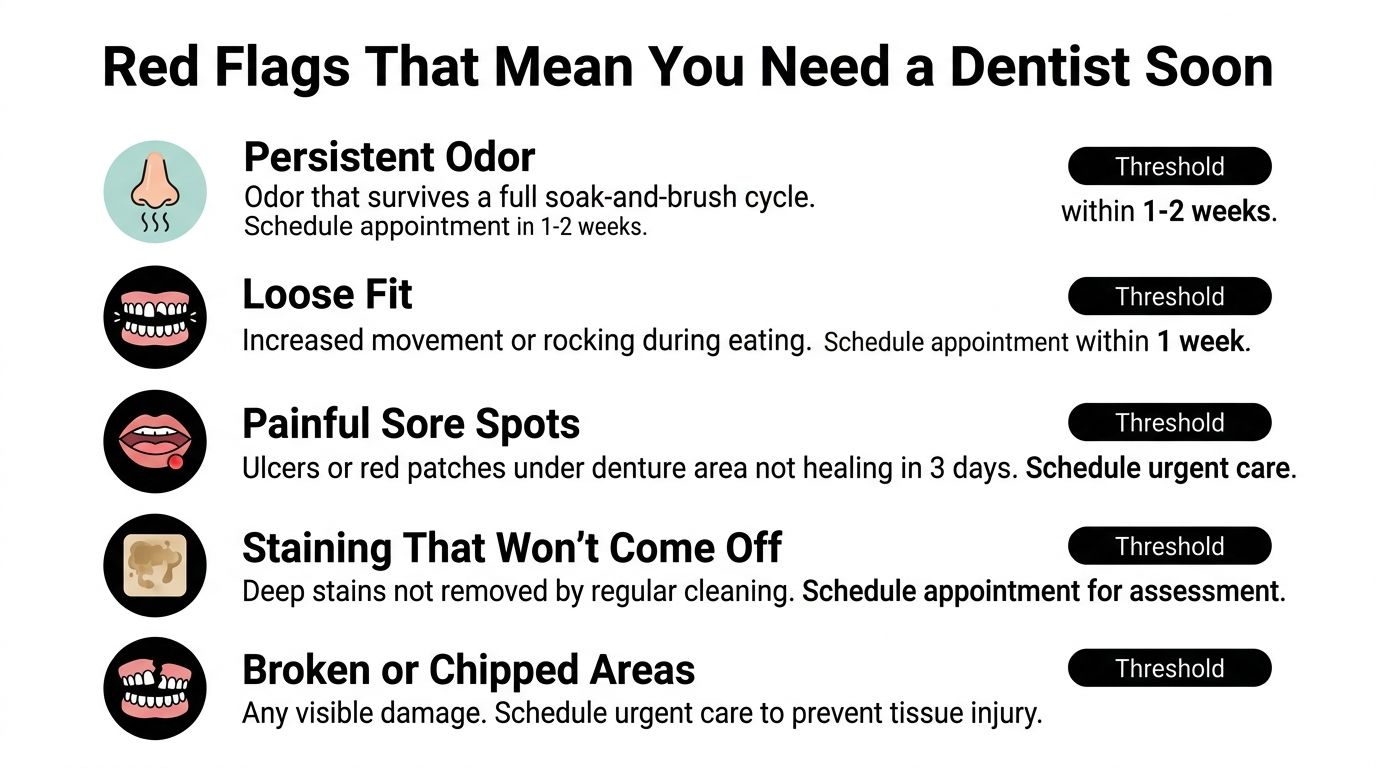
Persistent odor after a complete brush and soak suggests that residue may remain in scratches, cracks, a reline, or an attachment area. Schedule an assessment rather than covering the smell with mouthwash.
Sore spots or red patches beneath the base can reflect pressure, poor fit, trapped biofilm, or denture-related stomatitis. Remove the appliance as directed by your dental team and arrange care if the area doesn't settle.
Looseness or rocking after a period of stable fit deserves attention. A moving denture can rub tissue, make chewing less secure, and signal that the appliance or supporting anatomy needs evaluation.
Calcium-like crust, dark staining that brushing can't lift, or a cracked acrylic edge usually needs professional cleaning, polishing, repair, or replacement assessment. Scraping the deposit at home may scratch the surface or bend a clasp.
Clicking or pain around implant abutments is especially important. Clean the removable prosthesis, but don't pry at locator caps or bar attachments. Contact the dental office so the implant components and surrounding tissues can be checked.
Choosing the right appointment window
For ongoing comfort problems, staining, odor, or a gradually changing fit, schedule a dental review within one to two weeks. Call within 24 to 48 hours for swelling, bleeding, sudden looseness, or suspected peri-implantitis.
Seek urgent attention for a visible break, sharp edge, significant swelling, or pain that prevents normal eating. Stop experimenting with homemade cleaners and bring the denture to the appointment. The clinician can examine both the prosthesis and the tissues it rests against, which home cleaning can't do.
Quick Answers to Common Denture Cleaning Questions
Are effervescent tablets safe for partial dentures with metal clasps?
Yes, when the product is specifically formulated for partial dentures and the label permits use with metal. Avoid chlorine bleach on cobalt-chromium frames because it can corrode or discolor metal. Rinse the partial thoroughly before wearing it.
Can ultrasonic cleaners damage implant-supported overdentures?
An ultrasonic cleaner may be suitable for the acrylic prosthesis when the manufacturer and dental professional approve it. It doesn't replace removing the overdenture as instructed and manually brushing the locator caps, O-rings, bar, and surrounding areas underneath.
How long should a denture soak?
Use the product's labeled timing. A routine daily soak may be 15 to 30 minutes, while a weekly deep soak may be overnight when the product and appliance allow it. If you use a waterproof overnight storage case, prepare fresh compatible solution, keep the denture fully covered, and rinse it thoroughly before insertion.
Can I use regular toothpaste?
Regular toothpaste can be too abrasive for denture acrylic, especially whitening formulas. Choose a nonabrasive denture paste or a cleanser recommended for your material.
Should I clean the denture and my mouth separately?
Yes. Brush the denture with its dedicated brush, then clean your natural teeth, gums, tongue, palate, and implant areas according to your dental team's instructions. Cleaning only the appliance leaves biofilm in the mouth.
If your denture has persistent odor, sore areas, staining, looseness, or attachment concerns, Grand Parkway Smiles can assess the appliance, supporting tissues, and overall fit while discussing a practical home routine. Visit Grand Parkway Smiles to request denture care guidance or an appointment in Katy and the greater Houston area.