Let's get right to it—the number one question on everyone's mind: does getting veneers hurt? The honest answer is that getting veneers is a surprisingly comfortable procedure. Modern cosmetic dentistry has come a long way, and our first priority is always a pain-free experience that delivers outstanding results for your smile's health and appearance. We use incredibly effective local anesthesia to make sure you feel little to no discomfort while we work.
Unpacking the Veneer Experience
I get it. The thought of any kind of dental work can bring on a wave of anxiety. But when you understand what the veneer process actually involves, you’ll see why it’s considered a minimally invasive and comfortable way to achieve a total smile makeover.
Unlike more intense procedures like crowns, getting veneers only involves touching the very outer surface of your teeth. The goal isn’t to overhaul your tooth structure; it’s simply to create the perfect, smooth foundation for your beautiful, natural-looking veneers to bond to. This gentle approach is key to improving your smile's appearance while preserving your natural tooth health.
Why It Is a Comfortable Procedure
The main reason patients have such a smooth and painless experience is simple: local anesthesia. Before we even think about starting the preparation work, we completely numb the area. That means you won't feel a thing as we gently reshape a tiny bit of the enamel to ensure a perfect fit and a seamless look.
The research backs this up completely. Over 95% of patients report little to no pain during the actual veneer procedure. In fact, a 2023 study found that 98% of patients rated their discomfort as a flat zero on a 10-point scale. The focus of modern techniques is on ensuring your comfort while you invest in your smile's future.
When you combine this minimal tooth alteration with really effective numbing, what many people fear will be a tough day at the dentist turns into a straightforward and stress-free appointment on the path to a healthier, more confident appearance.
"Think of tooth preparation for a veneer like lightly buffing a fingernail before applying polish. The goal is to create a smooth, receptive surface, not to aggressively change the structure. It’s a delicate process designed for a flawless and comfortable fit."
To give you an even clearer picture of what to expect, we've broken down the typical sensations you'll feel during each step of the journey.
Veneer Procedure Discomfort Levels at a Glance
This quick table gives you a realistic look at what to expect, phase by phase. As you can see, the parts of the procedure where any real work is done are handled under anesthesia, keeping you comfortable throughout your transformation.
| Procedure Stage | What to Expect | Typical Pain Level (0-10 Scale) |
|---|---|---|
| Consultation & Smile Design | This is just a conversation about your aesthetic goals, with photos and digital scans. No dental work happens here! | 0 |
| Tooth Preparation & Impressions | The area is completely numbed, then a tiny layer of enamel is removed. You won't feel this part. | 0 (due to anesthesia) |
| Bonding the Final Veneers | Your custom veneers are permanently attached. This final step is quick and typically requires no anesthesia at all. | 0-1 |
Ultimately, the entire process is designed with your peace of mind as the top priority. From the initial chat to the final reveal, we make sure you're relaxed and informed every step of the way toward achieving your ideal smile.
Your Veneer Journey From Consultation to Final Smile
Understanding the whole veneer process can really help demystify the experience and put you back in the driver's seat of your smile transformation. When you know what to expect at each stage, it becomes clear why modern cosmetic dentistry is so focused on making your journey comfortable and pain-free.
From that first design chat to the final placement, every single step is planned out with your comfort in mind, all while aiming for that stunning final look. The entire process kicks off not with a dental tool, but with a simple conversation about your aesthetic and health goals.
Stage 1: The Smile Design Consultation
Your journey begins with a relaxed consultation where we just talk about your goals for your smile. This is your time to share exactly what you'd like to change—whether it's stubborn discoloration, annoying chips, gaps, or even slight crookedness. We'll take some digital scans and photos to create a super-precise model of your teeth.
There is absolutely no dental work or discomfort at this stage. Think of it more like a creative session where we design your future smile together, making sure the final result perfectly complements your facial features and gives you the beautiful, healthy-looking smile you desire.
Stage 2: Tooth Preparation and Impressions
Once you've given the thumbs-up to your new smile design, we'll schedule the prep appointment. This is the part that prompts the big question: "Does it hurt to get veneers?" And the answer is a definite "no," all thanks to some really effective local anesthesia. Before we do anything, the area is completely numbed so you won’t feel a thing.
The preparation itself is incredibly minimal. We gently remove a tiny layer of enamel—usually just 0.3 to 0.5 millimeters—from the front surface of your teeth. To give you some perspective, that's often thinner than a contact lens.
It's a lot like lightly buffing a nail before you apply polish. The goal isn't to drastically change the tooth, but just to create the perfect surface so the veneer can bond strongly and seamlessly. This is the key to making sure the final result looks natural, not bulky.
After this gentle prep, we take precise impressions of your teeth. These molds head off to a master dental lab where your custom porcelain veneers will be meticulously handcrafted. You’ll leave this appointment wearing a set of beautiful temporary veneers, which protect your teeth and give you a sneak peek of your amazing new smile. If you want to dive deeper into the basics, you can learn more about dental veneers and their costs in our guide.
This visual breaks down the key steps, all designed for your comfort, from numbing to the final sparkling result.
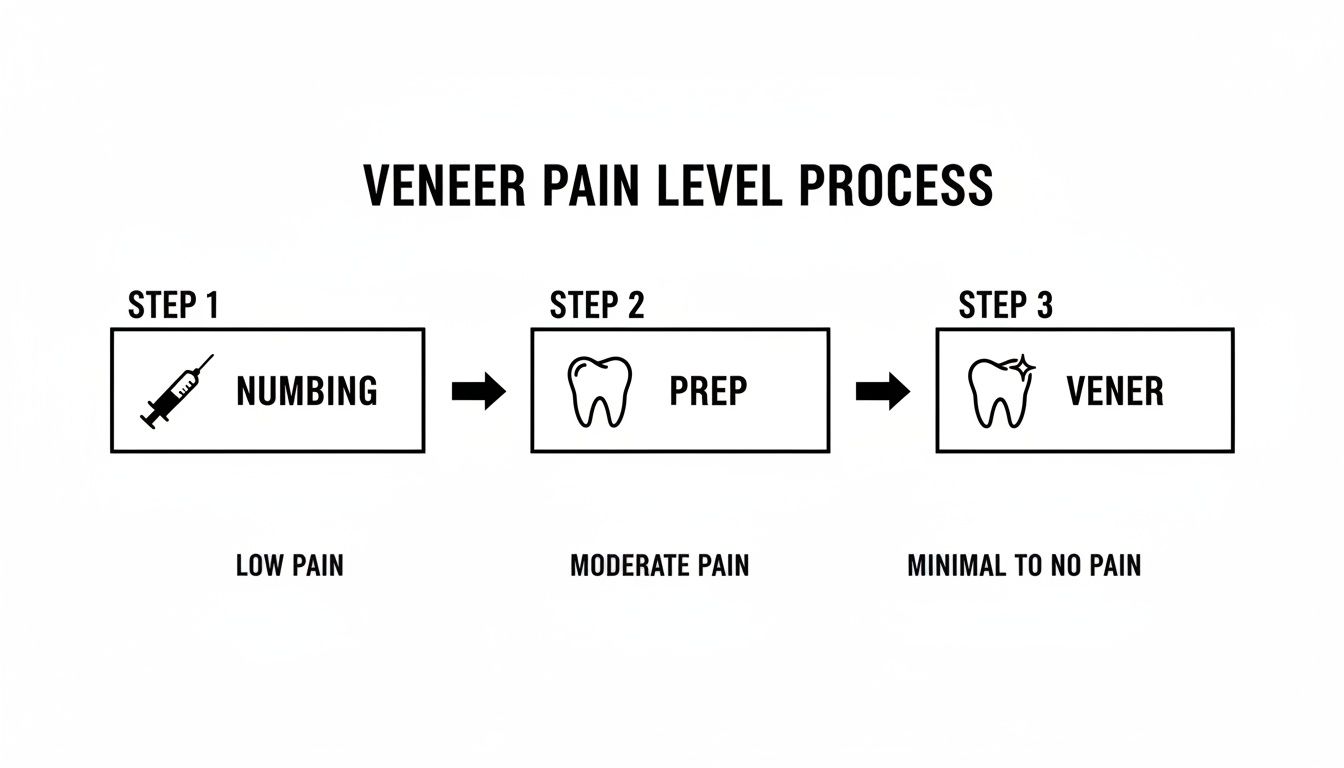
As you can see, the anesthesia makes the prep phase completely comfortable, leading right into a painless final placement.
Stage 3: Bonding Your Final Veneers
About two to three weeks later, you'll come back for the most exciting part: placing your permanent veneers. We'll first remove the temporaries and then carefully check the fit, shape, and color of your custom-made veneers.
Once we both agree they are absolutely perfect, we'll permanently bond them to your teeth using a powerful dental adhesive and a special curing light. This last step is quick, straightforward, and usually doesn't require any anesthesia. You'll walk out of our office ready to show off your brand-new, confident smile to the world.
So, Does Preparing the Teeth Hurt? Let's Break It Down
The thought of having your natural teeth altered, even a tiny bit, is probably the biggest source of jitters when you're thinking about veneers. It’s easy to picture some aggressive, old-school grinding, but the reality is so much more gentle and precise. Modern cosmetic dentistry isn't about removing tooth structure; it's about preserving it to enhance your smile's beauty and function.
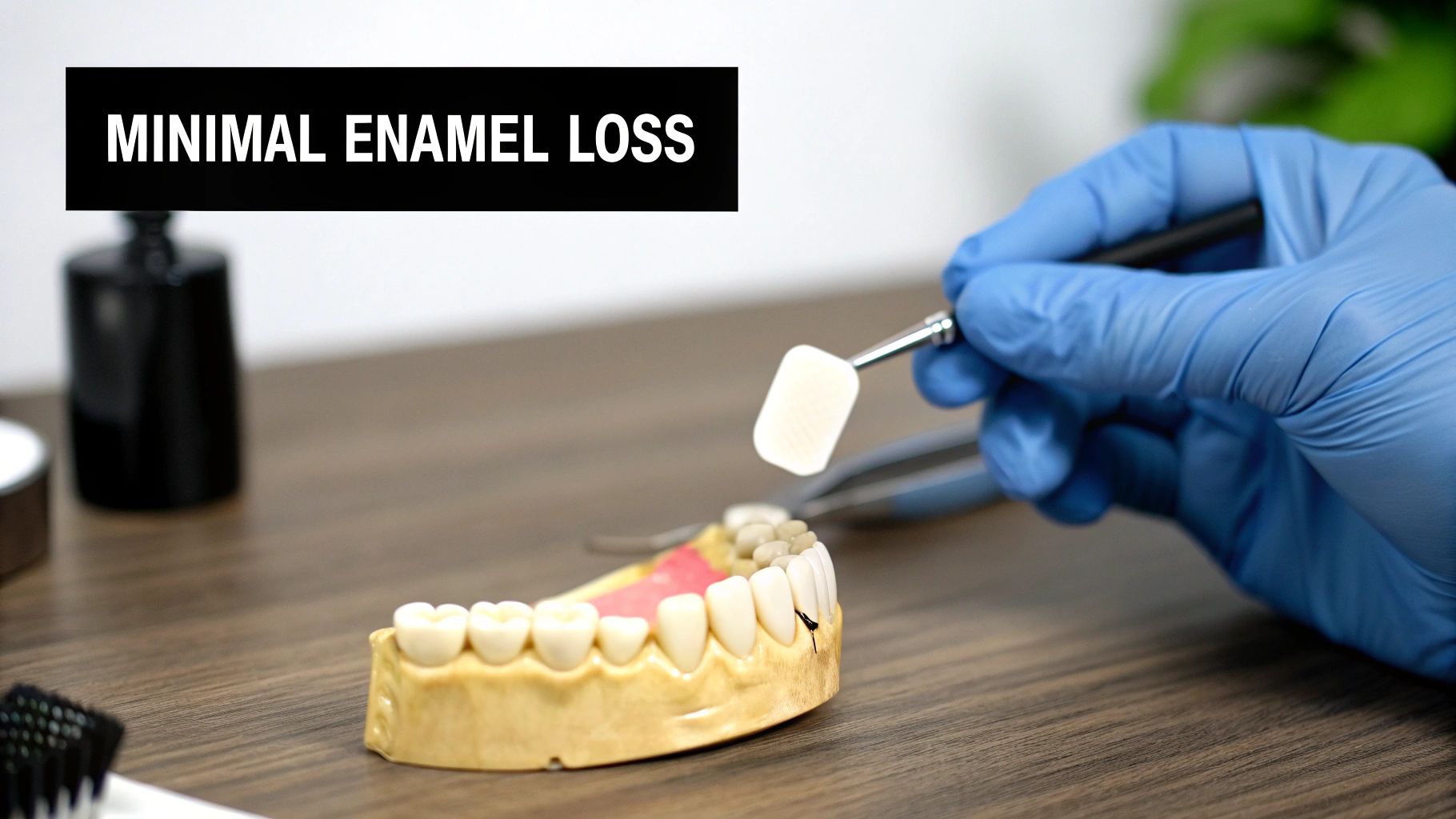
This focus on preservation is exactly what makes the whole process comfortable. The real key is understanding just how little preparation is actually needed.
The Gentle Science of Getting Ready for Veneers
To get a tooth ready for a veneer, a dentist removes a wafer-thin layer of enamel from the front. And when we say thin, we mean it. We're talking about an incredibly small amount—typically between 0.3 and 0.5 millimeters. To give you some perspective, that's often less than the thickness of a contact lens.
This step is super important for achieving the best aesthetic and health outcomes:
- It makes room for the veneer. This is what lets the final restoration sit perfectly flush with your other teeth, so you avoid that bulky or "Chiclet" look and achieve a natural appearance.
- It creates the perfect bonding surface. Gently texturing the enamel gives the dental adhesive something to grip onto, creating a powerful, long-lasting bond that secures your new smile and protects the underlying tooth for years.
Because we're only working on the outermost layer of the tooth, we don't get anywhere near the sensitive inner pulp where the nerves live. And before we even begin, we use a highly effective local anesthetic to completely numb the area. You genuinely won't feel a thing. This one-two punch of minimal alteration and total numbing is why the prep stage is a breeze.
One of the biggest myths about veneers is that removing that tiny bit of enamel causes lasting pain. The numbers tell a very different story: only about 8-12% of patients feel any mild sensitivity afterward, and it usually goes away on its own within 1-3 days. That sensitivity just comes from the temporary exposure of the layer beneath the enamel, and again, we're talking about removing a layer thinner than a human hair.
Let's Ditch the "Filing Down" Myth for Good
That outdated picture of teeth being aggressively "filed down" to little nubs? That just doesn't apply to modern veneers. Not at all.
That kind of heavy-duty work is for dental crowns, which are designed to cover the entire tooth, often for restorative health reasons. Veneers are a much, much more conservative cosmetic fix designed to enhance appearance.
Think of it like preparing a wall for a new coat of paint. You wouldn't knock the wall down, right? Of course not. You'd just sand it lightly to make sure the paint goes on smooth and looks flawless. Preparing a tooth for a veneer works on the exact same principle. It’s all about creating the perfect canvas for your new smile, not demolishing the structure underneath. This careful, conservative approach keeps your natural teeth strong and ensures a beautiful, long-lasting result.
Managing Dental Anxiety for a Stress-Free Makeover
We get it. Even when a procedure is designed to be comfortable from the start, we know that dental anxiety is a very real and powerful feeling. For so many people, just the thought of sitting in the dental chair is the biggest hurdle standing between them and their dream smile.
If that sounds like you, modern sedation dentistry is the key. It can turn a potentially stressful appointment into a completely relaxed, positive, and even pleasant experience, allowing you to get the cosmetic dental care you want without fear.
Our goal is to make sure your journey to a new smile is as comfortable emotionally as it is physically. When we manage anxiety effectively, you can stop worrying about the "what ifs" and start getting excited about the incredible benefits of your new smile.
How Sedation Creates a Truly Pain-Free Experience
Sedation dentistry isn't about being "put to sleep" like you would be for major surgery in a hospital. Think of it more like entering a state of deep, peaceful relaxation during your veneer procedure.
You'll reach a calm, almost dream-like state where you're still conscious but completely at ease. In fact, many patients tell us they have little to no memory of the treatment afterward—a huge plus for anyone with a serious dental phobia.
Here at Grand Parkway Smiles, we offer options like IV sedation to provide a superior level of comfort. Administered by a highly trained professional, it gives us precise control over your relaxation level from start to finish, ensuring you feel absolutely no anxiety or discomfort.
This approach is a perfect fit for several types of patients:
- Those with moderate to severe dental anxiety or phobia.
- Anyone who has had a negative dental experience in the past.
- Patients who need a lot of work done in a single, efficient visit.
- People with a strong gag reflex or who find it difficult to sit still for long periods.
By addressing anxiety head-on, sedation dentistry removes the last barrier standing between you and the beautiful, confident smile you deserve. It transforms the experience from something you have to endure into a calm, quiet step toward your aesthetic goals.
Is Sedation Dentistry the Right Choice for You?
If your question "does it hurt to get veneers?" is tied to a deeper fear of dental work in general, then sedation is an excellent solution. A great candidate is anyone whose anxiety is preventing them from getting the cosmetic care they truly want and need.
During your consultation, we'll sit down and have a real conversation. We’ll review your medical history and talk about your anxiety levels to determine if sedation is a safe and appropriate option for you.
Safety is, and always will be, our absolute top priority. Our team is extensively trained in administering and monitoring sedation, and we follow strict protocols to ensure your well-being throughout the entire procedure.
You can learn more about how our approach to sedation dentistry eases anxiety and enhances dental procedures in our detailed guide. Ultimately, our mission is to create a path for every single patient to get a healthy, stunning smile without any of the stress or fear.
What to Expect During Your Recovery
Once your final veneers are bonded, the hardest part is over. Now, it's all about letting your smile settle in. The first few days are really just an adjustment period as your teeth and gums get used to their beautiful new surfaces. Knowing what’s normal will help you feel confident as you ease into your new look.
The most common thing patients mention is some mild, temporary sensitivity. Think of it as your teeth getting acquainted with their new neighbors. This isn't a red flag or a sign something is wrong; it's a completely normal part of the process as the bond between the veneer and your natural tooth fully cures and settles.
Navigating the First Few Days
This initial sensitivity usually shows up as a little zing when you eat or drink something with an extreme temperature. That first sip of hot coffee or a bite of ice cream might feel a bit more intense than you're used to. This is typically very mild and fades fast within the first few days, rarely sticking around for more than a week.
Most people are back to their normal routine the very next day. Any discomfort is usually so minor that it doesn’t get in the way of work or your daily life. The main thing is to just be a little gentle with your new smile for a short while to ensure the best long-term results.
To keep things as comfortable as possible, here are a few simple tips that make a big difference:
- Grab a desensitizing toothpaste: Products made for sensitive teeth are fantastic for calming everything down quickly.
- Avoid temperature extremes: For a few days, maybe stick to lukewarm coffee and skip the ice-cold drinks. Your teeth will thank you.
- Go for softer foods: Give your bite a little time to adjust. Try to avoid super hard or crunchy things like nuts or hard candy for the first 24-48 hours.
- Keep up your hygiene, gently: You should still brush and floss like normal to maintain your oral health, but use a soft-bristled toothbrush and be easy around your gum line.
You might also notice your gums are a little tender or puffy right after your appointment. It’s a lot like how they feel after a deep cleaning. This is just their reaction to having the new veneers placed and usually calms down in a day or two.
A Smooth and Simple Recovery Roadmap
When it's all said and done, the recovery from getting veneers is incredibly straightforward. Unlike more complex dental procedures, there’s no real downtime to worry about. The slight sensitivity some people feel is just a small, temporary step on the way to a smile you'll have for years to come.
By following these easy aftercare tips, you can handle any minor sensations with no problem. Before you know it, you'll forget the veneers are even new. All you'll see is that stunning, confident smile looking back at you in the mirror, and your focus will shift from the brief adjustment to simply enjoying the incredible benefits of your investment.
Got Questions About Veneer Discomfort? Let's Talk.
Even after mapping out the whole veneer journey, it's completely normal to have a few lingering questions about how everything will feel. So, let's tackle the most common concerns head-on. This quick guide is here to give you straightforward answers, helping you feel totally at ease and excited about your new smile.
How Long Will My Mouth Be Numb After the Prep Work?
That numb feeling you get during the tooth preparation appointment comes from the local anesthetic. Trust me, it's your best friend during this step—it’s what makes the whole process comfortable and pain-free.
This sensation will slowly fade over a few hours once your appointment is done. For most of our patients, the numbness is completely gone within 2 to 4 hours. Everyone's metabolism is a little different, so the exact timing can vary. We always suggest you steer clear of hot drinks or chewy foods until you have all the feeling back; it’s an easy way to avoid accidentally biting your tongue or cheek.
Will I Need Strong Painkillers for Recovery?
It’s almost unheard of for a patient to need prescription-strength pain medication after getting veneers. The recovery is famously smooth and easy. Any discomfort you might feel is typically very minor and doesn't stick around for long.
If you notice any slight sensitivity or your gums feel a little tender, standard over-the-counter pain relievers like Tylenol or Advil are more than enough to handle it. Honestly, though, most people find they don’t need any medication at all. The entire benefit of veneers is achieving a stunning new smile without significant downtime or discomfort.
The overwhelming majority of patients tell us that any sensitivity they feel is minor and gone within a couple of days. It’s less about actual pain and more about just getting used to the amazing new veneers on your teeth.
Are the Temporary Veneers Uncomfortable?
While our master lab ceramist crafts your permanent porcelain veneers, you'll wear a set of temporaries. Their job is to protect your prepared teeth and keep your smile looking great in the meantime, preserving both comfort and appearance.
Temporary veneers aren't uncomfortable, but they'll definitely feel a bit different from your natural teeth. Since they're made from a dental resin and aren't bonded as securely as your final set, you’ll just need to be a little careful with them. Try to avoid super sticky or hard foods to make sure they stay put. They do a fantastic job of preventing sensitivity and letting you go about your life with a confident smile.
Does the Final Bonding Appointment Hurt?
This is the best part! The final bonding appointment is usually the most exciting visit, and it's a completely painless experience. During this appointment, we'll gently remove your temporaries, give your teeth a final cleaning, and then permanently bond your gorgeous, custom-made porcelain veneers into place.
We typically don't even need to use any anesthetic for this step. You might feel some light pressure as we carefully position and secure each veneer, but there's no pain involved at all. It’s a simple, comfortable process that ends with the big reveal of your finished, brilliant smile, boosting your appearance and self-confidence.
Ready to see how a comfortable, pain-free veneer procedure can completely change your smile? The expert team at Grand Parkway Smiles is here to walk you through every step and design a plan just for you. Schedule your free consultation today and take the first step toward the confident, beautiful smile you've always wanted.