If the thought of a dental chair makes your heart race, you’re not the only one. The real key to overcoming dental anxiety is finding what works for you—a mix of understanding your triggers, having an open conversation with your dental team, and exploring the modern comfort options available today.
This guide is designed to give you real-world techniques to feel more confident and in control, making your appointments easier and paving the way for the healthy, beautiful smile you deserve.
Your Path to a Fear-Free Dental Visit Starts Here
Dental anxiety is a huge concern, affecting more than one in five Americans so intensely that they avoid necessary dental care. While it’s an understandable reaction, this avoidance often creates a vicious cycle where small, easily fixable cosmetic or health issues snowball into much bigger problems that can impact your confidence and well-being.
The good news? You can absolutely break that cycle.
Learning how to overcome dental anxiety isn't about flipping a switch and making fear vanish overnight. It’s about building a personal toolkit of strategies that empower you to manage those feelings and finally achieve your oral health goals. When you can approach a dental visit calmly, you open the door to a world of benefits, from a brighter smile to better overall health.
Why Facing Dental Fear Matters for Your Health and Appearance
Putting off dental care because of anxiety can have serious consequences for both your health and your appearance. A tiny cavity that could have been handled with a simple, tooth-colored filling might progress until it needs a root canal or even an extraction. Gum disease, if left untreated, can lead to tooth loss and has even been linked to other systemic health issues.
Putting off dental work doesn't make the problem disappear; it simply delays the solution and often complicates it. The most effective step you can take for your long-term oral health is to address the anxiety itself.
By actively working to manage your fears, you are taking a massive step toward keeping your smile vibrant and healthy. This proactive approach ensures you get timely preventive care, which is always simpler and less invasive than complex restorative treatments down the road.
Focusing on the Positive Outcomes
Shifting your focus from the fear of the procedure to the benefits of the outcome can be a powerful motivator. Think about what you really want for your smile. Are you hoping to brighten your teeth for an upcoming wedding? Do you want to fix a damaged tooth so you can finally chew comfortably again? Maybe you're just looking forward to the confidence that comes with a healthy, pain-free smile.
Here are a few positive outcomes to visualize:
- Enhanced Confidence: A healthy, attractive smile can be a game-changer in social and professional settings.
- Improved Overall Health: Taking care of issues like gum disease reduces your risk for other health complications.
- Pain-Free Living: Timely treatment for cavities or infections gets rid of persistent toothaches and discomfort for good.
- Long-Term Savings: Preventive care and early treatment are far less expensive than the complex procedures required to fix neglected problems.
Focusing on these real-world benefits helps reframe the dental visit as a positive, necessary step toward a better quality of life. This guide will give you the tools you need to make that step a calm and successful one.
Understanding the Roots of Your Dental Anxiety

Before you can learn how to overcome dental anxiety, you first have to figure out what you're really up against. That feeling of dread isn't a one-size-fits-all experience; it’s a deeply personal reaction tied to specific thoughts and memories. By figuring out why the thought of a dental visit sends your stress levels soaring, you can start to take apart that fear piece by piece.
This is truly the most important first step. It shifts a vague, overwhelming feeling into a solvable problem. Pinpointing your specific triggers is a huge move toward getting the consistent dental care that’s so vital for your long-term health and the appearance of your smile.
Identifying Your Specific Triggers
Dental fear rarely just appears out of thin air. It almost always stems from a specific experience or a mix of smaller anxieties that have snowballed over time. Taking a moment for some honest self-reflection can often reveal the real source of your stress.
For so many people, a bad experience—especially one from childhood—can cast a very long shadow. Maybe a procedure was painful, or you felt like your concerns weren't being heard. That memory can forge a powerful link in your mind between dental care and discomfort, making every future appointment feel threatening before you even walk in the door.
Another huge trigger is the fear of losing control. When you're leaned back in a dental chair, it’s easy to feel vulnerable. You might worry about not being able to speak up, not knowing what's coming next, or feeling trapped if you get uncomfortable. That sense of helplessness is a major source of anxiety for many patients.
Finally, embarrassment about the state of your teeth is a real and incredibly common issue. You might worry about being judged for cavities, gum issues, or just not having a "perfect" smile. This fear can be so strong that it stops you from getting the very care that would solve those problems and give you back your confidence.
The Power of Acknowledging Your Fear
Once you’ve put a name to your triggers, you can start tackling them head-on. Simply identifying your fear robs it of much of its power. Instead of fighting some big, scary monster called "anxiety," you're now dealing with something concrete, like, "I'm anxious because I'm afraid it will hurt" or "I'm worried about feeling embarrassed."
This clarity is everything. It lets you work with your dentist to create a comfort plan that’s built just for you, allowing you to get the care you need. For instance:
- If your trigger is a painful memory: We can talk about modern pain management and sedation options that will ensure you stay comfortable from start to finish.
- If you fear losing control: We can agree on a simple hand signal you can use anytime you need to pause the procedure for a break. No questions asked.
- If embarrassment is holding you back: Please remember, our team is here to help you, not judge you. Our only goal is to improve your health and help you get a smile you absolutely love.
The crucial takeaway is this: Your feelings are completely valid. Understanding where they come from is the foundation for moving past them. It empowers you to advocate for your needs and work as a team with your dentist.
Psychological strategies have also made incredible progress in helping patients manage these fears. For example, Cognitive-behavioral therapy (CBT) has been shown to be highly effective. Some studies found that up to 70% of patients see a major drop in dental anxiety after treatment. Another recent study revealed that CBT programs led to a 60% improvement in patient-reported anxiety, proving that these techniques can genuinely reshape how you respond to dental care. You can read the full research about these anxiety reduction findings to learn more.
Actionable Strategies for a Calm Appointment
Feeling prepared can make a world of difference in reducing your anxiety before you even walk through our doors. When you take control with a few simple, proactive steps, you can completely change your mindset. It’s about turning a dreaded appointment into just one more manageable step toward the healthy, confident smile you deserve.
The goal here is to shift your perspective from being a passive patient to an active partner in your own dental care. And that process starts long before you ever sit in the dental chair.
Strategic Scheduling and Preparation
One of the easiest yet most effective ways to lower your stress is to be strategic about when you book your visit. If you know you're always in a frantic rush on Fridays, don't schedule your appointment then. Instead, pick a low-key time, like a quiet Tuesday morning, when you won't feel the pressure of other commitments breathing down your neck.
Before your visit, put together a personal 'comfort kit.' This small step can make a huge difference in helping you feel grounded and secure during your appointment.
Your kit could include things like:
- Headphones and a Playlist: Bring your phone with noise-canceling headphones and a playlist you've already made. It could be calming music, a podcast you love, or an audiobook that will pull you into another world.
- A Stress Ball or Fidget Toy: Sometimes, just having something to squeeze or fiddle with is the perfect physical outlet for all that nervous energy.
- A Comforting Item: This could be anything that helps you feel centered—a small, smooth stone you carry, a favorite scent on a cotton ball, you name it.
Mastering Communication with Your Dental Team
Open, honest communication is your single most powerful tool for overcoming dental anxiety. Your dental team truly wants you to be comfortable, but we can't read your mind. Voicing your fears isn't a sign of weakness at all; it’s an act of self-advocacy that always leads to better, more compassionate care.
When you call our office to schedule, you can use a simple script to set the stage. Try saying something like this:
"I'd like to book an appointment, and I just want to let you know that I deal with significant dental anxiety. Could you please make a note of this in my file and maybe suggest a dentist who is especially good with nervous patients?"
That one simple statement does two crucial things: it immediately informs the team of your needs and gives us the chance to prepare for your visit accordingly. Once you arrive, you can continue that open dialogue directly with your dentist. Explain your specific triggers, whether it's the sound of the drill or a deep-seated fear of pain. This information helps them tailor their entire approach to keep you comfortable. For some extra ideas, you can explore non-sedation behavioral techniques to feel more in control. Check out our detailed guide on managing dental anxiety without sedation for more tips.
The Global Impact of Patient Education
This focus on communication and education isn't just a "feel-good" strategy; it's a clinically proven method for reducing fear. All around the world, patient education has been shown to be a cornerstone in the fight against dental anxiety. While up to 61% of people report some level of dental fear, targeted educational approaches have been shown to slash that figure.
A 2022 study found that when clinics provided educational sessions, high dental anxiety dropped from 29% to 12.5% in children and from 15% to 8.3% in parents. That really highlights the power of knowledge. By arming yourself with practical tools, you're not just getting through an appointment—you're fundamentally changing your relationship with dental care for the better.
Many effective approaches exist to manage these feelings, and exploring different ways to reduce anxiety without medication can empower you with coping mechanisms that work both here and in your daily life. These strategies put you firmly in the driver's seat, paving the way for a more positive experience and, ultimately, better oral health.
In-Office Comfort And Modern Sedation Options
So, you’ve made it to your appointment. That’s a huge step! Now, let's focus on making your time in the dental chair as comfortable and stress-free as possible. Modern dentistry isn't just about fixing teeth; it's about caring for the person, too. We have a whole range of options, from simple mind-over-matter techniques to advanced clinical sedation, that can completely change your dental experience for the better.
The whole point is to move past the fear so you can get the care you need for a healthy, confident smile. By understanding what's available, you and our team can work together to create a calm, supportive environment that’s just right for you.
This visual guide breaks the process down into three simple, manageable phases to help you feel prepared and in control from start to finish.
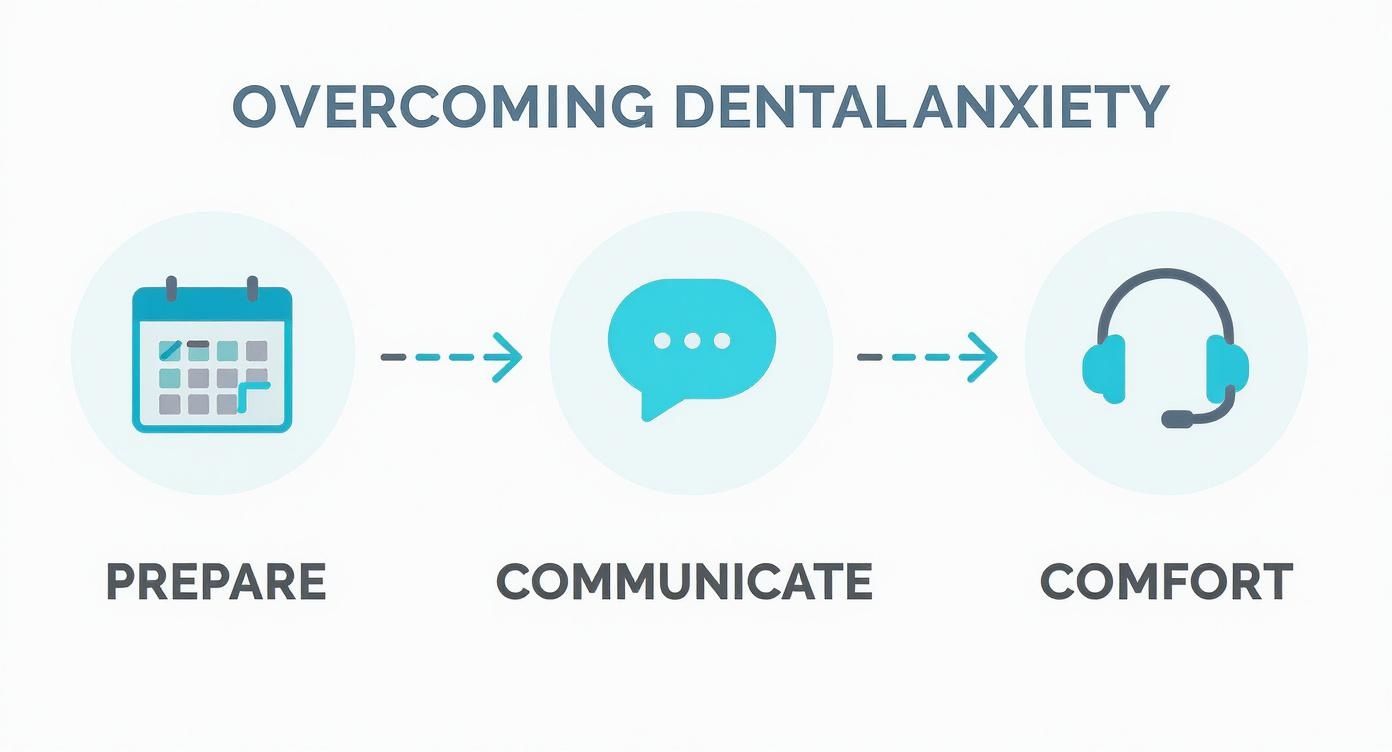
It really comes down to this: feeling comfortable is a result of proactive preparation and open, honest communication.
Simple In-Chair Comfort Techniques
Before we even talk about sedation, there are some surprisingly effective non-clinical tricks that can make a massive difference. These are all about giving you back a sense of control and making you physically comfortable during your treatment.
One of the most powerful tools is simply agreeing on a hand signal with your dentist. Just raising your hand to say "stop" gives you the power to pause the procedure at any moment, for any reason. Knowing you can take a break whenever you need one is a game-changer for reducing that feeling of being trapped.
A few other things we find really help patients relax include:
- Requesting a Weighted Blanket: The gentle, deep pressure from these blankets has an incredible calming effect on the nervous system, kind of like a reassuring hug.
- Bringing a Distraction: Pop in some noise-canceling headphones and listen to your favorite music, a podcast, or an audiobook. It’s a great way to tune out the sounds of the dental office and let your mind wander somewhere else.
- Asking for a Walk-Through: If the unknown is what makes you anxious, just ask your dentist to explain each step before they do it. This "tell-show-do" approach gets rid of any surprises and keeps you in the loop.
When you actively participate in your comfort plan, you're no longer just a passive patient. You become an empowered partner in your own health. These small tweaks can have a huge impact on how you feel about your visit.
Understanding Your Clinical Sedation Options
For those times when simple comfort measures aren't quite enough, modern sedation dentistry offers incredibly safe and effective solutions. These options are designed to help you reach a state of deep relaxation, allowing your dentist to work efficiently while you remain completely at ease. This efficiency means you get the best possible results for your smile.
Sedation has become essential for helping patients with more intense fear. In fact, statistics show that about 12% of adults have a dental phobia so severe it keeps them from getting any care at all. The good news is that sedation techniques have been shown to reduce anxiety in over 80% of patients who use them. One study even found that 85% of patients who received nitrous oxide reported a significant drop in anxiety.
You can learn more in our detailed guide about how sedation dentistry eases anxiety and enhances dental procedures.
To help you and your dentist decide what’s right for you, we’ve put together a simple comparison of the options we offer at Grand Parkway Smiles.
Comparing Your Sedation Dentistry Options
This table breaks down the different levels of sedation available. It's designed to help you understand each method so you can choose the best option for your anxiety level and the type of procedure you need.
| Sedation Method | Level of Sedation | How It's Administered | Best For | Recovery Time |
|---|---|---|---|---|
| Nitrous Oxide | Mild | Inhaled through a nose mask | Patients with mild to moderate anxiety, shorter procedures, or those who need to drive themselves home. | Wears off within minutes after the procedure. |
| Oral Sedation | Moderate | A prescribed pill taken before appt. | Patients with moderate to severe anxiety. You'll feel very drowsy and may not remember much of the visit. | Effects last for several hours; you need a designated driver. |
| Intravenous (IV) Sedation | Deep | Administered directly into a vein | Patients with severe phobia, long or complex procedures, or a strong gag reflex. It provides a "twilight sleep." | Effects last the rest of the day; you need a driver and escort. |
Choosing the right sedation is a personal decision, and our team is here to talk through every detail with you to ensure you feel confident and comfortable with your choice.
Nitrous Oxide (Laughing Gas)
Also known as "laughing gas," nitrous oxide is a very mild sedative you breathe in through a small, comfortable mask placed over your nose. It works almost instantly to create a feeling of calm and well-being. Some people describe it as a light, floaty, or tingling sensation. The best part is you remain fully conscious and can talk to your dentist the entire time.
A huge advantage of nitrous oxide is that the effects disappear almost as soon as the mask is removed. This means you are perfectly safe to drive yourself home after your appointment. It’s a fantastic choice for people with mild anxiety or for shorter, less involved treatments.
Oral Sedation
With oral sedation, you’ll take a prescribed sedative pill about an hour before you come into the office. This approach leads to a deeper state of relaxation than nitrous oxide. While you'll still be awake and able to respond, you'll feel very drowsy and often have little to no memory of the procedure afterward.
This is a great option for patients with moderate to severe anxiety. Because the sedative affects your coordination and alertness, you absolutely must have someone drive you to and from your appointment. The effects will wear off gradually over the next few hours.
Intravenous (IV) Sedation
IV sedation is the deepest level of conscious sedation we offer right here in our office. The sedative is delivered directly into your bloodstream through a vein, which gives your dentist precise control over your level of sedation throughout the entire procedure. This method puts you into a profound state of relaxation often called "twilight sleep."
Patients who choose IV sedation are technically conscious, but they are typically completely unaware of the procedure and won’t remember it later. This makes it the best choice for anyone with severe dental phobia, those undergoing complex or lengthy treatments like full mouth reconstruction, or patients who have a very strong gag reflex. Due to the deep sedation, you will need a responsible adult to drive you home and stay with you for the rest of the day.
Helping Children and Teens Manage Dental Fears
Dental anxiety isn't something that just appears in adulthood. For many, the seeds are planted during childhood, which is why creating a positive, comfortable relationship with the dentist from a young age is so critical. A foundation of trust can stop those fears from ever taking root and set your child up for a lifetime of good oral health.
The way a child sees the dentist's office is heavily influenced by the adults around them. When you use the right language and model calm behavior, you can frame the dentist as a helpful friend who keeps their smile strong, not a source of fear.
Setting the Stage for a Positive Experience
Your approach as a parent can completely change your child's attitude. In fact, research shows that more than one in four parents say their child feels anxious about dental visits, especially between the ages of 6 and 12. The good news? You have a huge amount of influence over that experience.
It all starts with how you talk about the dentist at home. Always use simple, positive, and encouraging language.
- Avoid negative words: Steer clear of words like "pain," "shot," "hurt," or "scary." Instead, you can say the dentist is going to "count your teeth," "check your smile," or "look for sugar bugs."
- Don't share your own fears: If you struggle with dental anxiety yourself, be very careful not to project that onto your child. They are incredibly perceptive and will pick up on your stress, so model the calm, confident behavior you want them to feel.
- Focus on the benefits: Explain that the dentist helps keep their teeth strong so they can eat all their favorite foods and have a "superhero smile." This connects the visit to a positive outcome they can actually understand and get excited about.
The Power of Tell-Show-Do
One of the most effective techniques we use in pediatric dentistry is called "tell-show-do." It's a simple, three-part method designed to eliminate the fear of the unknown—a major anxiety trigger for kids. This approach builds trust and makes everything feel predictable and safe.
Here's how it works in a real-world scenario, like a routine dental cleaning:
- Tell: First, the dentist explains what they’re going to do in simple, kid-friendly terms. For example, "I'm going to use my special tooth-tickler to make your teeth sparkly clean."
- Show: Next, they'll demonstrate the tool. They might turn on the prophy polisher and let the child feel the gentle vibration on their finger, so they know it doesn't hurt.
- Do: Only after the child understands and feels comfortable does the dentist actually perform the action on their teeth, often narrating as they go.
This method empowers children by keeping them informed and feeling in control, turning a potentially scary situation into something interesting and manageable.
Creating a Child-Friendly Environment
A dental office designed with kids in mind can make all the difference. Small touches help create an environment that feels fun and welcoming, rather than clinical and intimidating. Something as simple as letting a child bring a favorite stuffed animal or blanket from home can provide a familiar source of comfort.
A positive first dental experience is one of the greatest gifts you can give your child's long-term health. It establishes a pattern of trust and cooperation that will prevent minor issues from becoming major problems down the road.
At Grand Parkway Smiles, our team is specially trained to work with children. We use these techniques to build rapport and make every visit a positive one. By starting dental visits early—ideally by their first birthday—we can help your child become familiar and comfortable with our office. This early start focuses on prevention, ensuring their smile stays healthy and bright right from the beginning.
Still Have Questions About Dental Anxiety? Let's Talk.
Even after learning about all the different ways we can help, it's completely normal to have a few more questions rattling around. In fact, it’s a good thing—it means you’re taking this seriously.
We’ve put together this little Q&A to tackle some of the most common worries we hear from patients. Think of it as a conversation to help you feel fully prepared and, hopefully, a little more at ease. Knowing what to expect is half the battle.
Is It Normal To Be This Afraid of the Dentist?
Absolutely. If you’re nervous about seeing a dentist, you are in very good company. Research suggests that over 20% of Americans feel enough dental fear to put off necessary appointments. So no, you are definitely not alone.
This kind of anxiety can come from anywhere—a bad experience as a kid, a sensitive gag reflex, or just the feeling of not being in control. The first step is just acknowledging that your fear is real and shared by many. Our team has helped hundreds of patients who started out feeling just like you, and our goal is to make every visit a positive step forward toward better health.
What If I’m Embarrassed About My Teeth?
This is probably the number one concern we hear, and it’s a tough one. It creates a cycle where you feel too embarrassed to get the very care that would help you feel confident again. Please, hear us when we say this: our team is here to help you, not to judge you.
Our only focus is your health and helping you love your smile. We’ve seen it all, and every situation is just an opportunity for us to help someone improve their quality of life. What we see isn't the condition of your teeth; we see the courage it took for you to walk through our door. That’s what earns our respect every single time.
Your oral health is just one part of your overall health. Our job is to be your partner in getting it back on track in a supportive, shame-free environment.
Will It Hurt?
This is the million-dollar question, isn't it? Thanks to modern dentistry, the answer is overwhelmingly no. With highly effective local anesthetics, most procedures—even things that sound scary like root canals—can be done with little to no discomfort at all. We always make sure you're completely numb before we even think about starting.
For anyone with extra sensitivity or a deep-seated fear of pain, sedation dentistry is a game-changer. Options like nitrous oxide or oral sedation can get you to a state of deep relaxation where you’re completely comfortable from start to finish. Your comfort is our absolute priority, as it allows us to perform procedures with precision for the best possible outcome.
How Can I Stop a Gag Reflex Triggered by Anxiety?
A sensitive gag reflex is a real physical response to stress, and it can make dental work feel impossible. The good news is, we have several tried-and-true ways to manage this together.
A few simple tricks can make a world of difference:
- Nose Breathing: Concentrating on slow, deep breaths through your nose is surprisingly effective at calming the reflex.
- Numbing Sprays: We can use a topical spray to numb the soft palate, which often quiets that sensitive trigger.
- Sedation: This is the most reliable solution. Sedation dentistry—from nitrous oxide to IV sedation—relaxes your entire body, including the gag reflex, making treatment a breeze.
Just give us a heads-up about this concern when you book, and we’ll have a plan ready for you.
Can I Get All My Dental Work Done in One Visit?
For many people, the thought of spreading treatment over multiple visits is the biggest source of anxiety. The great news is that with IV sedation, we can often get everything done in a single, relaxed appointment.
IV sedation allows you to drift into a peaceful "twilight sleep." You'll be comfortable and unaware for an extended period, which gives our team the time needed to perform several procedures at once. It’s a fantastic way to take care of years of dental needs without the stress, getting you back to a healthy smile faster than you thought possible.
Ready to finally get the care you need without the fear? The team at Grand Parkway Smiles is here to support you with compassionate dentistry and modern comfort. Schedule your consultation today and let's work together to leave dental anxiety behind for good.