When you’re dealing with a badly damaged or infected tooth, you’re often faced with a tough choice: root canal vs extraction. We almost always recommend saving your natural tooth with a root canal. This procedure is all about preserving the health, look, and function of your smile. Pulling a tooth should really be a last resort, as it kicks off a much more complicated and expensive process of replacing it.
The Decisive Moment: Saving vs Removing Your Tooth
Deciding between a root canal and an extraction is one of the most important calls you can make for your long-term dental health and appearance. While pulling a painful tooth might seem like a quick fix, it often starts a domino effect of future dental problems. The main goal in modern dentistry is to save your natural tooth, and for good reason—it’s the best way to maintain the health and beauty of your smile.
Why Saving Your Tooth Matters
Your natural teeth do more than just chew food; they play a vital role in maintaining the structure of your jaw and the alignment of your smile. When a tooth is saved, its root stays in the jawbone, continuing to stimulate it. This healthy stimulation prevents the bone loss that always happens after an extraction, which is crucial for preserving your facial structure and the stability of surrounding teeth.
Plus, a root canal eliminates the source of your pain—the infected nerve—while leaving your functional tooth right where it belongs. This means you can keep chewing, speaking, and smiling naturally, without needing an artificial replacement. With today's advanced techniques, the procedure is comfortable and has an incredibly high success rate, ensuring a healthy, pain-free outcome.
The core principle is simple: nothing looks, feels, or functions as well as your natural tooth. Preserving it with a root canal is a definitive treatment that ends the problem, whereas an extraction is the start of a new, more involved restorative journey.
This guide will walk you through a detailed comparison of both paths, helping you understand the procedures, what recovery looks like, and the long-term impact on your dental health and appearance.
To get started, here's a quick side-by-side look at the two options. This table breaks down the essential differences to help you see the bigger picture.
At a Glance: Comparing Root Canal and Extraction
| Key Factor | Root Canal Therapy | Tooth Extraction |
|---|---|---|
| Primary Goal | Save the natural tooth and restore its health and function. | Remove a tooth that is beyond saving. |
| Oral Health Impact | Preserves jawbone integrity and natural bite alignment. | Leads to bone loss and potential teeth shifting. |
| Treatment Journey | A restorative procedure, often followed by a crown for strength. | A surgical procedure requiring tooth replacement. |
| Aesthetic Result | Maintains your natural tooth and seamless smile. | Creates a gap that requires a prosthetic tooth. |
As you can see, these two paths lead to very different outcomes for your smile. One focuses on restoration and preservation, while the other involves removal and replacement.
Understanding Modern Root Canal Therapy
Let's be honest, just hearing the words "root canal" can make a lot of people nervous. It’s a procedure with a pretty bad reputation, often imagined as something painful and outdated. But the reality of modern root canal therapy couldn't be more different. Today's techniques aren't designed to cause pain—they're designed to relieve it, bringing your tooth back to full health.
The whole point of a root canal is to save your natural tooth, which is always the best path forward for your overall dental health and the appearance of your smile.
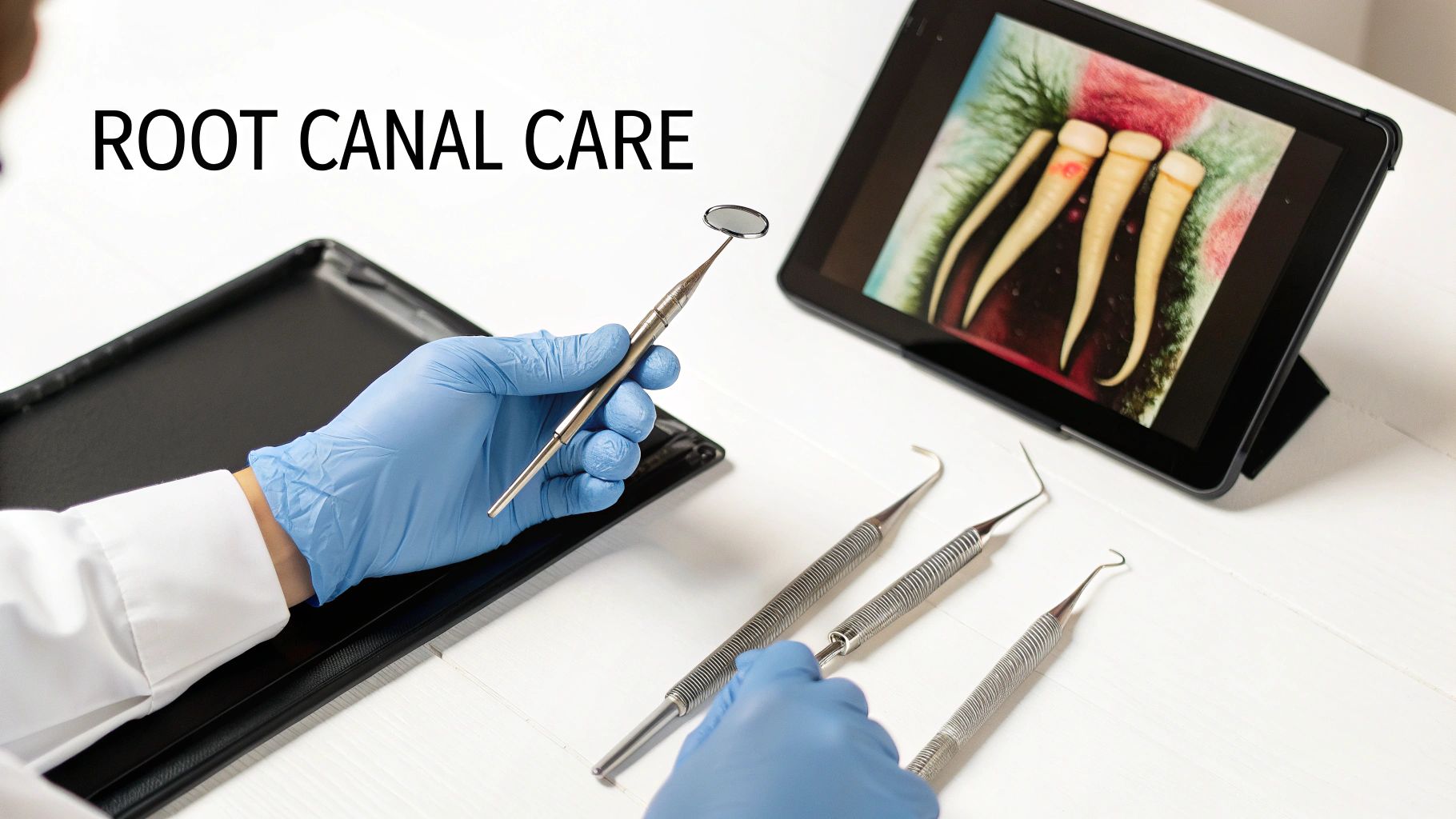
This treatment becomes the go-to solution when the soft tissue inside your tooth's root, called the pulp, gets infected or seriously inflamed. This can happen because of deep decay, a crack or chip in the tooth, or even from having repeated dental work done on the same tooth over the years. A root canal gets right to the source of the problem, preserving your tooth’s structure so you can keep on using it and smiling with confidence.
What the Procedure Actually Involves
Think of a root canal as being more like getting a very thorough, detailed filling rather than undergoing major surgery. It's a meticulous process focused on cleaning out the infection and sealing the tooth to protect it for the future, restoring it to a healthy state.
Here's a breakdown of the steps, which are all aimed at full restoration:
- Accessing the Infection: First, your dentist will numb the area completely so you won't feel a thing. Then, they'll create a tiny opening in the crown of your tooth to get to the infected pulp chamber inside.
- Cleaning and Disinfecting: The inflamed or infected pulp is gently removed. Next, the inner chambers of the tooth—the root canals themselves—are carefully cleaned, shaped, and disinfected to make sure every trace of bacteria is gone.
- Filling and Sealing: Once the canals are sterile and dry, they’re filled with a biocompatible, rubber-like material. This completely seals the tooth from the inside out, preventing any new infection from getting back in.
- Final Restoration: The last step is protecting the tooth with a permanent restoration, which is usually a custom-made dental crown. This strengthens the tooth, prevents it from fracturing, and restores its full chewing power, making it look and feel just like your other teeth.
This entire process doesn't just put an end to agonizing tooth pain; it also stops the infection from spreading into your jawbone or to neighboring teeth, protecting your overall health. For a deeper dive into the procedure, you can check out our complete guide on root canals.
The Long-Term Benefits of Saving Your Tooth
When you opt for a root canal instead of just pulling the tooth, you're making a smart investment in the long-term health and beauty of your entire mouth. Keeping your natural tooth is critical for everything from proper chewing and clear speech to maintaining the natural alignment and appearance of your smile.
A root canal is not just about saving one tooth; it's about preserving the natural ecosystem of your mouth. It prevents the chain reaction of problems—like shifting teeth and jawbone loss—that begins the moment a tooth is extracted.
Thanks to modern techniques, this procedure has become incredibly reliable and beneficial. Forget the old myths you've heard. Studies show that over 93% of patients who have a root canal keep their natural tooth for 10 years or more. This is a huge benefit for your health, as it also helps preserve the jawbone structure that naturally starts to shrink away after an extraction.
Choosing a root canal means you're choosing to keep your smile intact, protect your jaw’s alignment, and give your tooth a new lease on life.
The Reality of Tooth Extraction and What Comes Next
We always fight to save a natural tooth. It's almost always the best path forward for your long-term health and appearance. But sometimes, a tooth is just too far gone. A severe fracture might run deep below the gum line, or decay could have hollowed out so much of the structure that a filling or crown simply won't work. In these cases, a tooth extraction isn't just an option—it’s a necessary step to restore oral health.
Choosing extraction, however, isn't the end of the story. It’s really just the beginning of a new chapter in your dental health. The procedure itself is quite routine. We make sure the area is completely numb, and then the tooth is carefully removed from its socket. The real conversation starts with what happens after the tooth is out, because that’s what truly shapes the future of your smile and health.
The Immediate Aftermath: More Than Just a Gap
The first thing you’ll notice is the gap. It's right there when you smile, and you might feel a little self-conscious. But the impact goes much deeper than just appearances. Under the surface, a quiet chain reaction begins, one that can destabilize the very foundation of your bite and long-term dental health.
It all starts with the neighboring teeth. Without the tooth next to them for support, they start to do what's natural: they drift and tilt into the empty space. This shifting throws off your bite's alignment, which can make chewing difficult, cause uneven wear on your other teeth, and even lead to jaw pain down the road. The tooth in the opposite jaw might also start to "super-erupt," growing longer because it has nothing to bite against, which only adds to the problem.
The Hidden Consequence: Jawbone Resorption
The most serious long-term issue after an extraction is something called jawbone resorption, which has significant health and cosmetic consequences. Your tooth roots do more than just hold your teeth in place; they constantly stimulate the jawbone, sending signals to your body to keep it strong and dense. When a tooth is gone, that stimulation stops cold.
Without that vital signal, the body starts to resorb the bone in that area, essentially letting it melt away. Studies show a significant amount of bone loss can happen within the first year of an extraction. This doesn't just impact the empty socket; it weakens the support for the perfectly healthy teeth nearby, putting them at risk, too.
An extraction stops the immediate pain, but it kicks off a structural problem. Think of a tooth root like a load-bearing pillar in a building. When you remove it, the surrounding structure eventually feels the strain.
Over time, this bone loss can even change the look of your face. As the jaw shrinks, it can cause a sunken appearance in your cheeks or around your lips, making you look older than you are. This is exactly why dealing with the gap isn't just a cosmetic choice—it's critical for preserving your oral health and facial structure. A decision to extract is also a commitment to replace. Options like dental implants, bridges, or dentures are the tools we use to restore function, stop teeth from shifting, and halt the destructive process of bone loss, ensuring your smile stays healthy and stable for years to come.
A Head-to-Head Comparison for Your Decision
Making the call between a root canal and an extraction means looking past the immediate toothache. You have to consider the ripple effects on your smile, your health, and your wallet down the road. We'll break down this critical root canal vs extraction decision by comparing the factors that really matter, from the chair-side experience to the long-term impact on your appearance and well-being.
The Treatment Journey
A root canal is a definitive treatment, usually wrapped up in one or two visits. We go in, remove the infected tissue, seal the tooth, and place a crown to bring it back to full strength and beauty. The goal is preservation—solving the problem while keeping your natural tooth right where it belongs. It’s a complete solution that restores your smile.
An extraction, on the other hand, is just the first step in what can be a much longer journey. Once the tooth is gone, the real planning begins. You're now looking at potential bone grafting, implant surgery, and then finally getting a crown. This path is almost always longer, involving more appointments and procedures from start to finish to restore your smile.
Recovery and Comfort
One of the greatest benefits of a root canal is the immediate relief it brings. The whole point is to get rid of the source of that throbbing pain—the inflamed nerve. Sure, you might have some mild tenderness for a day or two, but it’s usually nothing more than what you'd feel after a standard filling.
An extraction is surgery, and the recovery reflects that. You'll be taking care of an open socket, trying to avoid complications like a dry socket, and you can expect more noticeable swelling and discomfort as it heals. The initial healing takes longer and requires more careful attention than a root canal, making the root canal a more comfortable path to a healthy tooth.
Long-Term Oral Health and Appearance
This is where the two paths really split, impacting your smile and facial structure for years. A root canal saves your natural tooth root. That root continues to stimulate the jawbone, keeping it strong and dense. This helps maintain your natural facial structure and prevents the bone loss that always follows an extraction. Your smile stays seamless because it's still your tooth.
Pulling a tooth kicks off a process called bone resorption. Without the tooth root to keep it active, the jawbone in that area starts to shrink. This doesn't just weaken the support for the teeth next door; it can also lead to a sunken look over time, subtly changing the shape of your face and making you appear older.
This chart shows the domino effect that starts the moment a tooth is pulled, highlighting why replacement isn't just a suggestion—it's essential for your health and appearance.
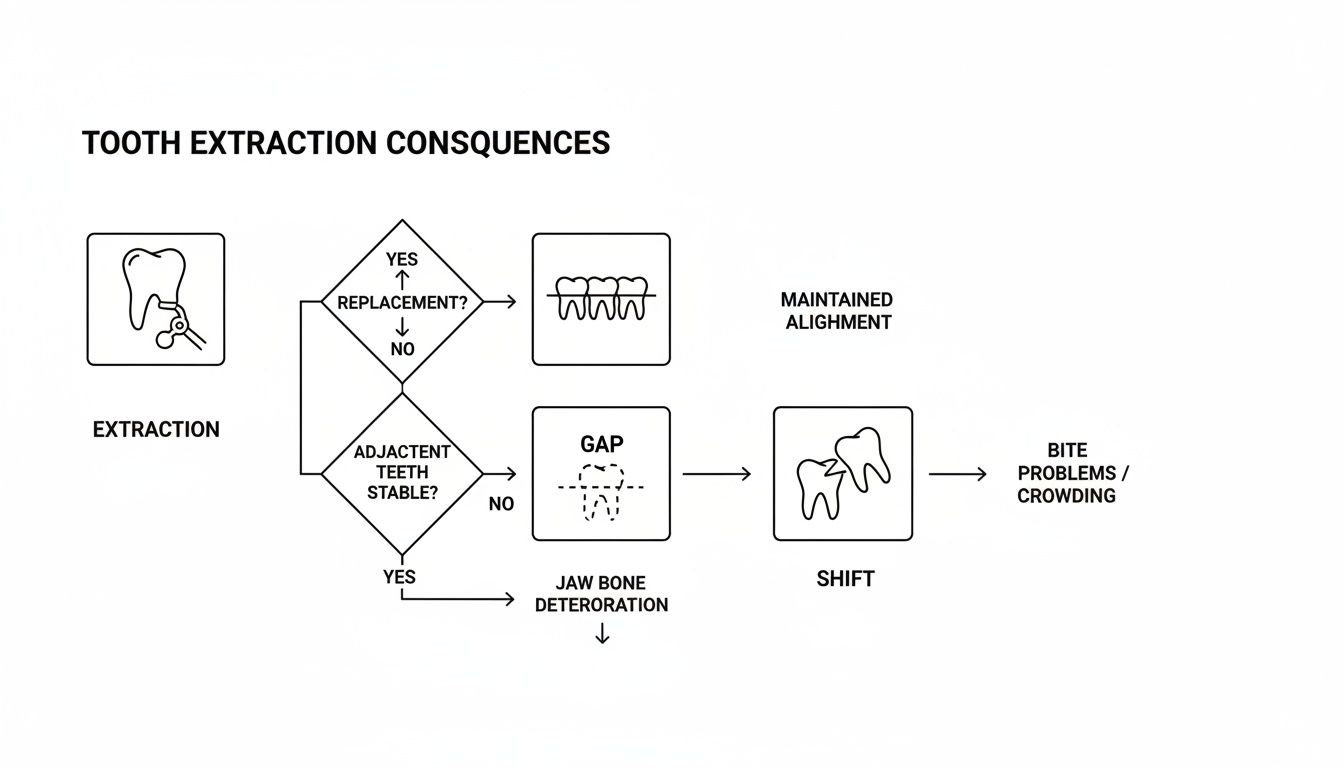
As you can see, an extraction sets off a chain reaction. Teeth start to shift, and the jawbone deteriorates unless you step in with a replacement.
A root canal is a treatment that stops a cascade of dental problems. An extraction is a procedure that starts one, making a comprehensive replacement plan a necessity, not an option, to protect your smile.
The True Financial Investment
On paper, an extraction looks cheaper than a root canal and crown. But that's a misleading comparison because it ignores what has to come next for your dental health. The "true cost" of an extraction includes the procedure itself, a likely bone graft to prevent bone loss, a dental implant, and the final crown. When you add it all up, the total cost is almost always significantly higher than just saving the tooth in the first place.
Think about longevity, too. When you weigh a root canal vs extraction, look at the survival stats. Research shows that teeth with root canals have about a 90% survival rate at 5 years and can last for decades. This durability makes keeping your tooth a smart investment, helping you avoid more complex and expensive work later on. You can read more about the long-term success of root canals and bone preservation to get the full picture.
Ultimately, choosing a root canal is a proactive move to keep your smile in its natural, healthy state. It saves your tooth, protects your jawbone, and offers a more direct—and often more affordable—path to lasting dental health and a beautiful smile.
Why Replacing a Missing Tooth Is Not Optional
Thinking about getting a tooth pulled is a big decision, but it's important to realize that the extraction itself isn't the end of the story. In fact, it's just the start of a new chapter in your dental health. You might be tempted to just leave the gap, thinking it’s a minor cosmetic issue, but that small space can kick off a cascade of serious functional and structural problems throughout your entire mouth.
Let's be clear: replacing a missing tooth isn't some optional upgrade you can put off. It's a critical investment in your long-term health, confidence, and appearance. The consequences of doing nothing are just too significant to ignore, affecting everything from the way you eat to the actual shape of your face.
The Chain Reaction of Drifting Teeth
Think of your teeth as a tightly-knit team. They all work together, leaning on each other to stay in position and share the forces of chewing. When one team member is gone, that delicate balance is shattered. The neighboring teeth, without their partner to hold them in line, will naturally start to tilt and drift into the empty space.
This gradual shift throws your whole bite out of whack, a problem dentists call malocclusion. An off-kilter bite can trigger a host of other issues that impact your health and appearance:
- Chewing Problems: You might find yourself avoiding your favorite crunchy or chewy foods because it just doesn't feel right to chew on that side anymore.
- Uneven Wear and Tear: The remaining teeth have to pick up the slack, taking on more pressure than they were ever meant to. This leads to them wearing down much faster.
- Higher Risk of Decay: As teeth tilt, they create new nooks and crannies that are a nightmare to clean, making them perfect hiding spots for plaque and bacteria.
It doesn't stop there. The tooth directly across from the gap can start to "super-erupt." With nothing to bite against, it will slowly grow out of its socket, exposing the sensitive root and making your bite alignment even worse.
Jawbone Deterioration and Facial Changes
The most serious consequence of a missing tooth happens out of sight, deep within your jaw, with major impacts on your appearance. Your tooth roots do more than just anchor your teeth; they actively stimulate the jawbone every time you bite down. This constant stimulation is a signal to your body to keep that bone strong and dense.
When a tooth is pulled, that area of the jawbone loses its job. Without the root stimulating it, the body starts to resorb the bone tissue, essentially letting it melt away. You can lose a significant amount of bone density in just the first year after an extraction.
This bone loss weakens the very foundation supporting your healthy, neighboring teeth, putting them at risk down the road. Over time, this can lead to noticeable changes in your facial structure. As the jawbone shrinks, it can cause your cheeks and lips to look sunken in, creating a prematurely aged appearance.
This is exactly why having a replacement plan is so crucial. Modern solutions like dental implants are designed to act like a natural tooth root. They fuse with the jawbone, providing that vital stimulation needed to stop bone loss in its tracks. By planning for a replacement, you're not just filling a gap—you're protecting the entire structure of your mouth and face. To get a better idea of what's involved, you can learn more about the costs of replacing a missing tooth and explore your options in our comprehensive guide.
So, How Do You Choose? Let's Talk It Through
Making the call between a root canal and an extraction can feel overwhelming, but it's not a decision you have to make on your own. The best results always come from a real partnership between you and your dentist, where we blend our clinical experience with what matters most to you. It’s all about finding a solution that doesn't just fix the immediate problem but sets you up for a healthy, confident smile for years to come.
A good decision starts with getting a crystal-clear picture of what's going on with the tooth. These days, we have amazing tools that go way beyond a simple X-ray, giving us a highly accurate look inside.
What Advanced Imaging Tells Us
To really know if a tooth is a good candidate for a root canal, we turn to advanced imaging like Cone Beam Computed Tomography (CBCT). Think of it as a 3D model of your tooth, its roots, and the bone around it. This lets us spot hidden fractures, map out complicated root systems, and see just how far an infection has spread—details that are impossible to catch otherwise.
That level of clarity is everything. It helps us see if the tooth has a strong enough foundation to be restored or if the damage is just too severe, making an extraction the smarter, more predictable choice for long-term health. An informed decision is always built on solid evidence like this.
Your Goals, Your Treatment Plan
At the end of the day, this is your tooth and your smile. Our job is to lay out the options for you, explaining the real-world pros and cons of each one based on your unique situation. We’ll talk through a few key things:
- Your Long-Term Health: Whenever possible, saving your natural tooth is our top priority. It helps keep your jawbone strong and your bite aligned just right.
- Your Aesthetic Goals: We’ll discuss how a root canal or an extraction (and the replacement that follows) will affect the look of your smile, both now and down the road.
- Your Financial Picture: We'll give you a transparent breakdown of the costs, including not just the procedure itself but the long-term investment needed for tooth replacement if you go with an extraction.
We want to build a treatment plan that makes you feel confident and in control. It's a team effort, where our clinical know-how meets your personal priorities to get the best possible outcome for your health and your smile.
When a tooth can be saved, the evidence is compelling. Millions of teeth are successfully saved by root canal therapy every single year. In fact, studies show success rates hitting as high as 97%, especially when the tooth is properly protected with a crown afterward. One major review found an 86% overall success rate for endodontic treatments. Critically, it also showed that teeth without a crown were 6.2 times more likely to eventually be pulled.
To see how a crown protects your investment, you can learn more about the research on endodontic success rates. This isn't just a procedure; a root canal is the first and most important step in a complete, lasting restoration.
Root Canal vs. Extraction: Your Questions Answered
Deciding between saving a tooth and having it pulled is a big deal, and it's totally normal to have a few questions rattling around even after you've weighed the options. This choice impacts your health, your smile, and your wallet.
To give you some clarity before you chat with your dentist, we've put together answers to the most common questions we hear from our patients at Grand Parkway Smiles.
Is a Root Canal More Painful Than an Extraction?
Let's bust this myth right now. The whole point of a modern root canal is to get you out of pain, not cause more of it. It’s designed specifically to stop the miserable, throbbing ache that comes with a deep tooth infection.
Thanks to great local anesthesia, the procedure itself feels about as exciting as getting a regular filling. Any discomfort afterward is usually minor and easily handled with something like ibuprofen. An extraction, on the other hand, especially a surgical one, often means more significant soreness and a longer healing time for the socket. The biggest feeling you'll have after a root canal is relief from pain.
Which Option Costs More in the Long Run?
Looking only at the initial price tag, an extraction seems cheaper. But that’s a very shortsighted view of your dental health. Taking a tooth out is just step one; you absolutely have to replace it to avoid a domino effect of other dental problems down the road.
When you add up the costs of the extraction, a bone graft (which is almost always needed to keep your jaw from shrinking), a dental implant, and a crown to go on top, the total bill is almost always much higher than just saving your natural tooth with a root canal in the first place. Financially, preserving your own tooth is the smarter long-term play.
Think of it this way: are you paying to save one tooth, or are you paying to remove one tooth and then build a brand new one from the ground up?
How Long Do Root Canals Last Compared to Implants?
Both are fantastic, long-term solutions built to last. A tooth that's had a successful root canal and is protected with a quality crown can easily last you a lifetime if you take good care of it.
Dental implants are also incredibly durable and can last for decades. The real difference is biological. A root canal saves your own tooth and root, which is the most natural way to keep your jawbone strong and your smile intact. While an implant also does a great job of preserving bone, it's still a surgical replacement. The decision usually comes down to whether your natural tooth is salvageable—because keeping what you were born with is always the ideal goal for your health and appearance.
What Happens If I Do Not Replace an Extracted Tooth?
Leaving a gap in your smile is asking for trouble. It kicks off a chain reaction that goes far beyond just looks, affecting your overall oral health and even the shape of your face.
- Teeth Shifting: The neighboring teeth will start to lean and drift into the open space. This throws your bite out of alignment and creates new nooks and crannies where plaque can hide.
- Jawbone Deterioration: Without a tooth root to stimulate it, the jawbone in that area starts to dissolve. This process is called resorption, and it's not reversible.
- Changes in Appearance: As the bone melts away, it weakens the support for the teeth next to it. Over time, this bone loss can actually change your facial structure, leading to a sunken-in or prematurely aged appearance.
This is exactly why having a replacement plan is a non-negotiable part of any extraction. You're not just filling a gap; you're protecting the health and integrity of your entire smile.
At Grand Parkway Smiles, our team is here to help you make the right choice for your health, not just for today, but for years to come. We use the latest diagnostic tools to figure out the best path forward and offer a full suite of restorative and surgical options right here in our office. Schedule a consultation today to talk through your options with our experienced Katy dentists.