For most people, the initial healing after wisdom teeth removal takes about a week, but getting back to 100% can take a bit longer. Following your aftercare plan is the most important step toward a speedy, comfortable recovery and protecting your long-term dental health. Think of the next few days as a roadmap—one that leads to a healthier, pain-free smile by preventing future issues like crowding and infection.
Your Day-By-Day Wisdom Teeth Recovery Timeline
Getting your wisdom teeth out is a rite of passage for many, and knowing what to expect during recovery helps you prepare for the healing journey ahead. While everyone’s body heals at its own pace, the process generally follows a predictable pattern. The first few days are the most critical for setting yourself up for a successful recovery, ensuring the procedure provides its full benefit of improving your overall dental health.
During this time, your main goals are simple: manage any discomfort, keep the swelling down, and protect the delicate blood clot that forms in the empty socket. This clot is like a natural bandage, shielding the underlying bone and nerves. Protecting it is your top priority to avoid complications and ensure the procedure improves your oral alignment and long-term health.
The General Healing Arc
So, what does this look like in practice? Most patients find the initial healing phase lasts about 3-4 days, which is when many feel up to returning to work or school. You can expect bleeding and discomfort to be at their peak in the first 24 hours. Swelling tends to hit its high point around the 48-72 hour mark before it starts to go down.
By the time you hit the one-week mark, your gums are usually well on their way to healing, and you can start reintroducing more normal foods with only minor soreness. A successful recovery is the final step in creating a healthier oral environment, free from the risks of impacted teeth.
This visual timeline breaks down the key stages, showing you what to expect from day one through the first week.
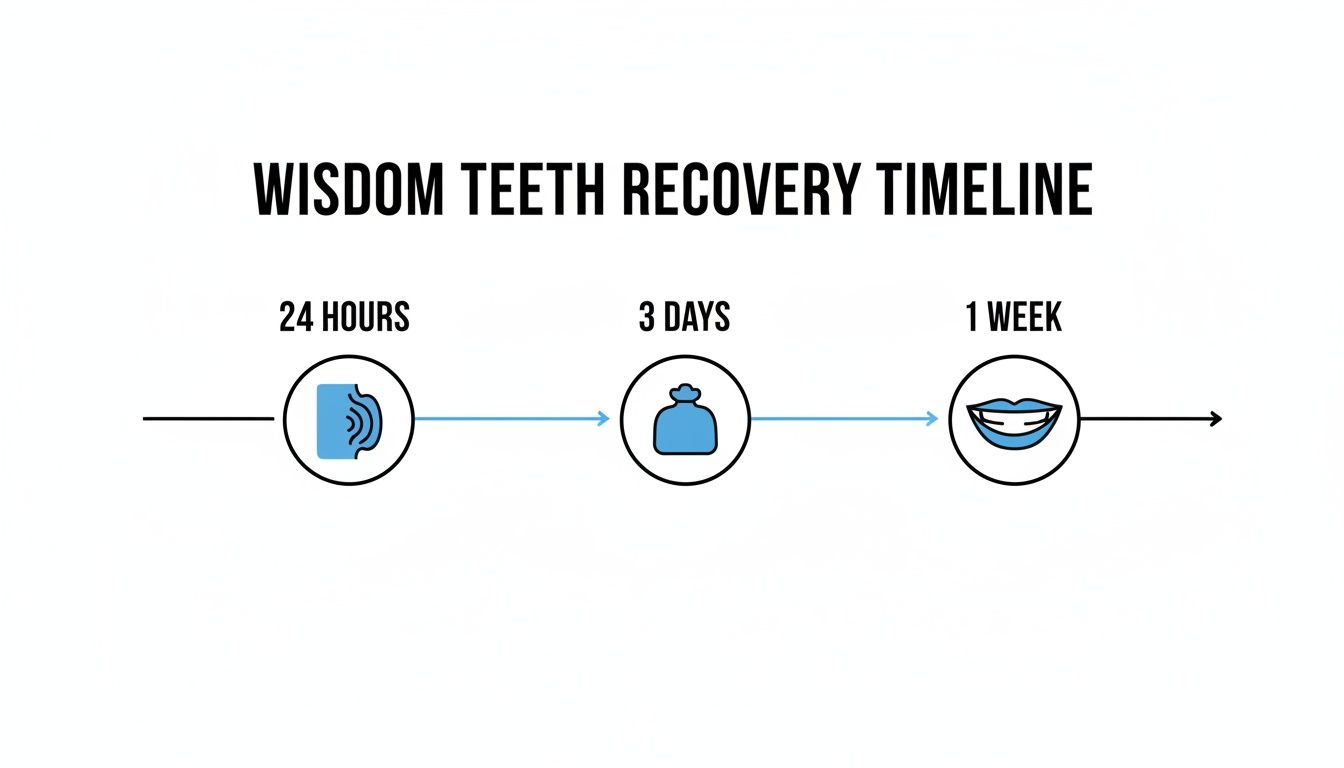
As the graphic shows, the most intense symptoms are front-loaded into the first few days, with things getting much better by the end of that first week. To help you navigate this period, we've put together a simple at-a-glance timeline.
Wisdom Teeth Recovery At-A-Glance Timeline
This table breaks down what you can generally expect day-by-day and week-by-week.
| Timeframe | Common Symptoms | Key Aftercare Actions |
|---|---|---|
| First 24 Hours | Bleeding, pain, swelling begins. Drowsiness from anesthesia. | Rest! Bite on gauze, use ice packs, take prescribed pain meds. Stick to liquids. |
| Day 2-3 | Swelling and discomfort often peak. Minor bruising may appear. | Continue ice packs, switch to warm salt water rinses. Keep eating soft foods. |
| Day 4-7 | Swelling and pain start to noticeably decrease. Jaw stiffness improves. | Gradually introduce more solid (but still soft) foods. Continue gentle rinses. |
| Week 2 | Most discomfort, swelling, and bruising should be gone. Stitches may dissolve. | You can usually resume normal diet and light exercise. Keep sockets clean. |
| Week 3-4 | Sockets continue to heal and close. Minor tenderness may linger. | Maintain good oral hygiene around the sites. |
| Month 2-6 | The bone and gum tissue completely fill in the sockets. Full recovery. | Full return to all normal activities. Sockets are fully healed. |
Remember, this is a general guide. For more specific steps tailored to your procedure, you can always review our detailed instructions after a tooth extraction.
Ultimately, a successful recovery is the final step in addressing problematic teeth that could cause future pain, crowding, or infection. You're paving the way for a healthier, more comfortable smile.
Navigating The Critical First 72 Hours
The first three days after your wisdom teeth are removed are, without a doubt, the most important for a smooth recovery. How you handle this initial period really sets the stage for how the next few weeks will go. Your main jobs are to manage discomfort and protect the surgical sites. Think of the empty socket like a delicate garden bed where new tissue is trying to grow; you need to create the perfect, undisturbed environment for that healing to begin.
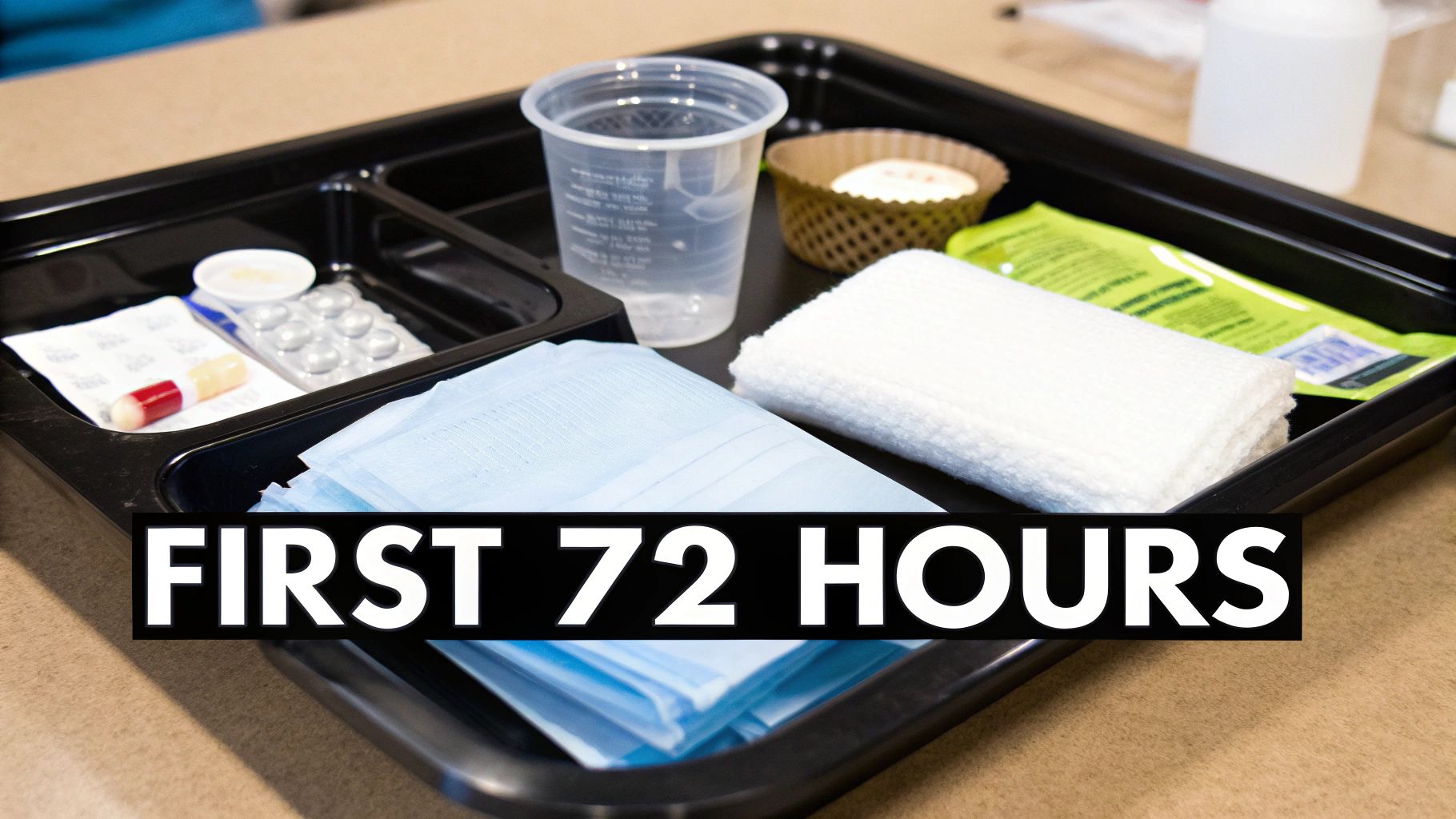
During these first few hours, your body is working hard to form a protective blood clot over the extraction site. This clot is nature’s own bandage, shielding the bone and nerves underneath. Following our aftercare instructions to the letter is your best defense against complications like a dry socket. It’s what helps you heal faster and keeps the surrounding teeth and gums healthy.
Managing Discomfort and Swelling
Let's be realistic: some pain and swelling are a normal part of the process, usually hitting their peak around the second or third day. The goal isn't to make them disappear completely, but to keep them managed so your body can focus on healing without extra stress.
Your first priority should be controlling the swelling. Applying ice packs to your cheeks in 20-minute intervals is incredibly effective for the first 24-48 hours. It's a simple step, but it helps constrict blood vessels, which reduces inflammation and can even minimize bruising.
When it comes to pain, it's all about staying ahead of it. Don't be a hero. Take your prescribed pain medication or recommended over-the-counter options on schedule, especially before the local anesthetic fully wears off. If you wait until the pain becomes severe, it's much more difficult to get it under control.
Protecting the Surgical Site
How you care for the extraction site itself is vital. Gentle but consistent care is the key to preventing infection and, most importantly, protecting that crucial blood clot. This ensures the procedure's long-term benefit of a healthier mouth without complications.
A stable blood clot is the absolute foundation of a successful recovery. If you dislodge it, you can end up with a painful condition called dry socket, which will significantly set back your healing time and mean more trips to the dentist.
To protect this healing foundation, stick to these key steps:
- Control Bleeding: Bite down gently but firmly on the gauze pads we provide. You'll likely need to change them out every 30-45 minutes for the first a few hours, until the bleeding slows to a light ooze.
- Avoid Suction: This is a big one. Do not use straws, smoke, or spit forcefully. Any of these actions can create negative pressure in your mouth and easily pull the blood clot right out of the socket, wrecking the healing process.
- Rest and Elevate: Plan to take it easy for the rest of the day after your surgery. When you lie down, prop your head up with extra pillows so it's elevated above your heart. This simple trick helps reduce both swelling and bleeding.
By sticking to these steps, you're not just passively waiting to get better—you're an active participant in your own recovery. You're creating the best possible conditions for your body to repair itself, setting yourself up for a comfortable, beautiful smile in the long run.
What Determines Your Personal Healing Speed
Ever wonder why your friend was back to normal in three days while another person took over a week to feel like themselves again? The truth is, there’s no single, universal answer to "how long does wisdom teeth recovery take?" Everyone's healing journey is unique.
Several key factors influence the pace of your recovery, turning it into a personal timeline rather than a one-size-fits-all experience. Understanding what these are helps you set realistic expectations. It also puts you in the driver's seat, allowing you to focus on what you can control—like proper aftercare—to help your body heal and get you back to smiling comfortably.
The Role of Age in Recovery
Age is one of the biggest players in how quickly you'll heal. Think of it like a young tree mending a broken branch faster than an old oak; younger patients often bounce back much more quickly. The bone in a teenager's jaw is less dense and the tooth roots aren't as fully formed, which can make the extraction itself a lot smoother. This is a key benefit of having the procedure done early.
As we get older, our jawbone becomes more calcified and rigid. This can make extractions more of a challenge and naturally extend the healing time. On top of that, the body's natural repair mechanisms just tend to slow down a bit with age.
This isn't just an observation—it's backed by extensive research. Data from thousands of patients shows that those over 21 often face a longer recovery, needing more days to manage pain and requiring more medication than teenagers. After age 25, the numbers are even more telling, showing a 1.6 times higher rate of dry socket and a 6.5 times increased risk of nerve injury. You can read more about the findings on wisdom teeth timing to understand how age impacts the healing process.
Complexity of the Extraction
Not all wisdom teeth extractions are created equal. The state of your teeth before the surgery plays a massive role in your recovery timeline. A simple extraction, where the tooth has fully come through the gums, is a world away from a complex surgical removal of an impacted tooth.
Think of it like this: pulling a small plant with shallow roots from soft soil is easy, with minimal disturbance. But digging out a deep, tangled root system from rocky ground takes more effort and leaves a much bigger hole to fill.
An impacted tooth is one that's stuck under the gum line, often growing in at a strange angle. Removing it usually means your surgeon needs to make an incision in the gums and sometimes remove a small piece of bone just to get to the tooth. This is why addressing impacted teeth is so important for your long-term dental health, as it prevents future pain and misalignment of your other teeth.
Here at Grand Parkway Smiles, your surgeon will use 3D imaging to get a crystal-clear picture of your wisdom teeth's exact position. This allows for meticulous surgical planning to minimize trauma during the procedure, which in turn helps support a smoother, faster recovery for you.
So, what are the big-picture items that can speed up or slow down your healing? While everyone is different, a few factors consistently influence recovery. Here’s a quick breakdown of what to expect and how our team at Grand Parkway Smiles addresses each one to give you the smoothest experience possible.
What Affects Your Recovery Time?
| Factor | Impact on Recovery | How Grand Parkway Smiles Helps |
|---|---|---|
| Age | Younger patients (teens/early 20s) generally heal faster due to less dense bone and undeveloped roots. Older patients may experience a longer recovery. | We recommend evaluation in the mid-to-late teens to plan for removal at the optimal time, making recovery easier. |
| Tooth Impaction | Fully erupted teeth are easier to remove. Impacted teeth (stuck in the jaw) require more complex surgery, leading to more swelling and a longer healing time. | Our surgeons use advanced 3D imaging (CBCT scans) to precisely plan the surgery, minimizing tissue trauma and promoting a quicker recovery. |
| Smoking/Vaping | Nicotine constricts blood vessels, slowing healing and significantly increasing the risk of painful complications like dry socket. | We provide clear pre- and post-op instructions on avoiding nicotine to protect the healing site and ensure a smooth recovery. |
| Overall Health | Pre-existing conditions like diabetes or autoimmune disorders can slow the body's natural healing process. | We conduct a thorough medical history review to tailor your care plan, ensuring your health is managed safely throughout the process. |
| Following Aftercare | Sticking to your aftercare plan (soft foods, gentle cleaning, rest) is crucial. Ignoring it can lead to infection or other setbacks. | You'll receive detailed, easy-to-follow aftercare instructions. Our team is also just a phone call away to answer any questions. |
Ultimately, knowing these factors helps you and your surgeon create the best possible plan. While you can't change your age or how your teeth are growing, you can control your aftercare. By partnering with our experienced team, you’re setting yourself up for the best outcome and a healthier smile.
The Right Foods And Activities For A Smooth Recovery
What you eat and how active you are after getting your wisdom teeth out can make a huge difference in how quickly you heal. Think of your body as putting all its energy into repairing the surgical sites; your job is to give it the right fuel and avoid any extra strain. This is your game plan for life after surgery, designed to help you heal up right and secure the long-term benefits of the procedure.

For the first 24 hours, stick exclusively to cool liquids. Things like broth, seedless smoothies, and milkshakes are perfect. The main goal here is to get some nutrients without messing with the fragile blood clots that are absolutely essential for healing.
Your Post-Surgery Meal Plan
As you get through the first week, you can slowly start to expand your diet. The trick is to stick with soft, easy-to-eat foods that don’t require a lot of chewing. This protects the extraction sites from getting irritated and stops food from getting stuck where it shouldn't, allowing your mouth to heal properly.
Think of your diet as a gradual ramp-up. Starting with liquids and slowly moving to softer solids gives that delicate gum tissue the time it needs to heal properly, which cuts down your risk of pain and complications.
Here’s a simple timeline to help you pick the right foods while you recover:
- Days 1-2: Liquids and super soft, smooth foods only. Good choices include yogurt, applesauce, pudding, ice cream, and creamy soups (just make sure they’re lukewarm, not hot).
- Days 3-5: You can start bringing in foods with a bit more substance, but still, no heavy chewing. Scrambled eggs, mashed potatoes, oatmeal, and soft-cooked fish are great additions at this stage.
- Days 6-7: As the soreness starts to fade, you might feel ready for things like well-cooked pasta, soft bread, or steamed veggies. Just listen to your body—don’t push it.
Throughout this whole process, there are a few definite no-gos. Do not use a straw, because the suction can easily dislodge the blood clot. You’ll also want to steer clear of anything crunchy, spicy, or acidic that could irritate your healing gums. For a few more ideas, you might want to check out our guide to the best foods to eat after dental surgery.
A Guide To Safe Physical Activity
Rest is just as critical as your diet, especially in those first few days. How long your wisdom teeth recovery takes is directly tied to how much you let your body rest up. Strenuous activity gets your heart rate and blood pressure up, which can lead to more bleeding, swelling, and pain at the surgical sites. Proper rest is essential for achieving a healthy outcome.
Plan on being a couch potato for at least 2-3 days after your procedure. That means no gym, no jogging, and no heavy lifting. Even simple things like bending over or doing household chores can put unwanted pressure on the healing sockets. After the first couple of days, you can slowly reintroduce light activities like walking, but avoid anything that leaves you feeling winded. Most people are advised to wait at least a full week before getting back to their normal exercise routine.
How To Spot And Prevent Common Complications
It's completely normal to worry a little about complications after surgery. But here’s the thing: knowing what to look for is the single best tool you have for a smooth, healthy recovery. The vast majority of wisdom teeth removals go off without a hitch, but being able to spot the early signs of a problem means you can act fast.
Think of it this way: the goal is to stop issues before they even start and to know when a symptom is just part of normal healing versus a sign you should give us a call. This ensures your recovery progresses smoothly, securing the dental health benefits of the procedure.
Identifying A Dry Socket
One of the most talked-about complications is dry socket, technically called alveolar osteitis. It happens when that crucial blood clot in the empty tooth socket gets knocked out or dissolves too soon. When that protective layer is gone, the underlying bone and nerves are exposed. It isn't an infection, but it can be incredibly painful.
The tell-tale sign of a dry socket is a severe, throbbing pain that usually kicks in 3 to 5 days after your surgery. What makes this pain different is that it often radiates up toward your ear and isn’t touched by your prescribed pain medication. You might also notice a bad taste in your mouth or even see the bone in the socket.
To keep that clot in place, be extra strict about these rules for the first week:
- No Straws: The suction is a prime suspect for dislodging the clot.
- No Smoking or Vaping: Besides slowing down your body's healing ability, the physical act can pull the clot right out.
- Gentle Rinsing: Avoid any vigorous swishing or spitting. When you rinse, just let the water gently fall out of your mouth.
Recognizing Signs Of An Infection
While not as common as dry socket, an infection needs quick attention to protect your overall health. An infection looks and feels very different from the normal healing process.
Normal healing means swelling that peaks around day three and then starts getting better. Your pain should also gradually decrease each day. If your symptoms suddenly get worse after a few days of improvement, that’s a red flag.
Keep an eye out for these warning signs, especially after the first 3-4 days:
- Swelling, pain, or redness that gets worse instead of better.
- A persistent fever or just feeling generally unwell.
- Pus or a foul-smelling discharge coming from the extraction site.
- Trouble swallowing or opening your mouth wide.
If you experience any of these, don't just wait and see—contact our office right away. Complications can really stretch out the wisdom teeth recovery timeline. For example, a dry socket can add days or even weeks of discomfort, while an infection might need antibiotics and extra treatment. These problems can turn a typical 2-3 day recovery into a week or more, especially with more complex cases. To get more perspective, check out this great resource on how complications impact recovery from Oral Surgery Associates of North Texas. By being proactive and sticking to your aftercare plan, you protect your healing and make sure you get the real benefits of the procedure—a healthier mouth free from pain and crowding—without any unnecessary delays.
Your Wisdom Teeth Recovery Questions Answered
Even with the best aftercare plan, questions are going to pop up as you heal. It’s completely normal to wonder, "Is this supposed to be happening?" We get it. This section is all about answering the most common questions we hear from patients, giving you straightforward answers to help you feel confident and at ease.
Knowing what to expect takes the mystery out of the healing process. It lets you focus on resting and helps you tell the difference between normal healing and something that might need our attention. This knowledge empowers you to take control of your recovery and look forward to a healthier smile.
When Can I Return To Work Or School
This is one of the first things everyone wants to know, and the answer really depends on what you do every day. For most people with a desk job or school classes, heading back in 3 to 4 days is a pretty realistic timeline. By then, the worst of the swelling and discomfort is usually behind you, making it easier to sit and focus.
However, if your job involves heavy lifting, a lot of physical activity, or even constant talking, you should seriously consider taking a full week off. Pushing yourself too soon gets your heart rate and blood pressure up, which can trigger more bleeding and swelling at the surgery sites. Unfortunately, this can set your healing back and just make the whole recovery process longer.
The golden rule here? Listen to your body. Feeling a bit tired is one thing, but if you're dizzy, wiped out, or feel a spike in pain when you get back to your routine, that’s your body telling you it needs more rest.
How Long Will The Swelling And Bruising Last
Swelling is your body's natural reaction to surgery—it's a sign that your immune system is on the job, working hard to repair everything. You'll probably see the swelling peak around the 48 to 72-hour mark before it starts to slowly go down. For most people, the really noticeable swelling is gone within about a week.
Bruising doesn't always happen, but it's not unusual, especially if the extraction was a bit more complex. If you do get a bruise on your cheek or jaw, it might hang around a little longer than the swelling, sometimes for up to 10 days. Don't be surprised if it changes colors—from dark blue or purple to green and then yellow as it fades away completely.
What Should I Do If I Suspect A Dry Socket
The biggest red flag for a dry socket is the timing and type of pain. Normal healing pain gets better day by day. Dry socket pain is different—it’s a severe, throbbing pain that usually kicks in 3 to 5 days after your surgery, often right when you thought you were turning a corner. The other key sign is that this pain typically isn't touched by your prescribed medication.
If you experience this kind of escalating pain, please don't try to tough it out. Call our office right away. A dry socket is very treatable, but it won't get better on its own and requires professional care. Getting help quickly is the fastest way to find relief and get your healing back on track.
Is It Normal For Nearby Teeth To Feel Sore
Yes, it’s actually pretty common for the teeth right next to the extraction site to feel a little tender, sensitive, or even slightly loose. There are a couple of reasons for this. For one, the whole surgical area is inflamed, and that inflammation can put some pressure on the neighboring teeth and the tiny ligaments that hold them in place.
Also, the extraction procedure itself involves some pressure in that general area. The good news is that this soreness is temporary. It should fade away as the main site heals and the swelling goes down. If the pain in your other teeth is intense or isn't getting better after about a week, it’s worth mentioning at your follow-up or giving us a call.
At Grand Parkway Smiles, our commitment to your health doesn't end when the surgery is over. We’re here to support you every step of the way through recovery. If you have any questions that we didn't cover here, or if something just doesn't feel right, please don't hesitate to reach out to our team. Schedule your consultation or follow-up visit with us today.