The cost of getting your wisdom teeth removed in the Katy area can run anywhere from $225 to $600 per tooth. The final number on your bill really boils down to one main thing: is it a simple extraction or a more involved surgical procedure designed to protect your long-term dental health?
Your Guide to Wisdom Teeth Removal Costs in Katy

Trying to figure out the potential cost of wisdom teeth removal is usually the first step people take, and it's a smart one. Think of it like a car repair—the final price isn't just one flat fee. It's a combination of different factors, like how complex the procedure is, what kind of anesthesia you'll need, and of course, what your insurance covers. Our goal here is to give patients in Katy and the greater Houston area a clear, reliable starting point for this important investment in their smile.
Putting off this very common procedure because you're worried about the cost can unfortunately lead to bigger, more expensive problems down the road. We're talking about pain, infections, or even damage to the neighboring teeth that could ruin your smile's alignment. It's better to think of it as a proactive investment in your future comfort and oral health. By getting ahead of problematic wisdom teeth now, you can often prevent the need for more invasive treatments later and keep your smile healthy and beautiful.
A Quick Look at Local Cost Estimates
The biggest factor influencing the price is whether your wisdom tooth is fully visible (what we call erupted) or if it's stuck under the gums (impacted). A simple pull of an erupted tooth is much different from a surgical procedure to remove an impacted one that could be threatening the health of other teeth.
For a clearer picture of what to expect, we've put together a table with typical out-of-pocket costs you might see in the Katy area.
Estimated Cost of Wisdom Teeth Removal Per Tooth in Katy TX
| Extraction Type | Average Cost (Without Insurance) | Average Cost (With PPO Insurance) |
|---|---|---|
| Simple Erupted Tooth | $225 – $400 | $75 – $200 |
| Surgical Impacted Tooth | $350 – $600 | $150 – $350 |
Note: These are estimates. Your actual cost will depend on the specifics of your case and your insurance plan's coverage details, including deductibles and co-insurance.
As you can see, insurance can make a significant difference, but even without it, understanding the baseline helps you plan. To get a broader perspective, you can also explore detailed cost breakdowns of wisdom tooth removal expenses on buzzrx.com.
Investing in wisdom teeth removal is not just about alleviating current pain; it's about safeguarding your long-term oral health, preserving the alignment of your smile, and preventing future complications.
This guide will break down all the things that go into your final bill, making sure you have the complete picture to make a smart decision for a healthier, pain-free smile.
The Hidden Costs of Ignoring Problematic Wisdom Teeth
Thinking about the price tag for wisdom teeth removal is smart, but that’s only half the story. The real question you should be asking is: what’s the cost of doing nothing? Putting off the procedure often means swapping a manageable, one-time investment in your health for a future filled with painful, complicated, and much more expensive dental emergencies.
Think of an impacted wisdom tooth as a quiet bully in the back of your mouth. It can shove against your other molars, damaging their roots, causing decay, or even messing up your bite. Over time, all that pressure can undo years of orthodontic work, shifting your beautifully straight teeth and wrecking your smile's appearance.
Worsening Problems and Rising Expenses
Ignoring the early warning signs doesn't make the problem go away. In fact, it's a recipe for turning small issues into full-blown dental crises that can affect your overall health and confidence. For instance, a tooth that only partially breaks through the gums can create a small flap of tissue. This flap is a perfect trap for food and bacteria, often leading to a painful infection called pericoronitis.
It can get worse than just infections, too. Cysts can form around an impacted tooth, and if they're left alone, they can seriously damage your jawbone and the teeth around them. Fixing these problems requires a lot more than a simple extraction and can compromise the health and look of your smile. The fallout could include:
- Costly Root Canals: To save an adjacent molar that got damaged or infected.
- Extensive Jaw Surgery: To remove cysts or repair bone damage.
- Orthodontic Treatment: To re-align teeth that have shifted from the crowding and pressure, restoring your smile's appearance.
These are much more invasive and significantly more expensive procedures than just getting your wisdom teeth out when they first become a problem.
You should see wisdom teeth removal as an investment in preventative care. It's about protecting your long-term dental health, keeping your smile straight, and avoiding the physical and financial pain of emergency dental work down the road.
This proactive approach makes a lot of sense, especially when you consider that most cases aren't straightforward. Data shows that 75-80% of extractions involve impacted teeth, and a whopping 90% of young adults need them removed to head off future health issues. You can learn more about the prevalence of wisdom teeth complications from CareCredit.
Ultimately, the upfront cost of removal is a small price for long-term peace of mind and a healthy, stable smile. Understanding all the reasons for a wisdom teeth extraction can really highlight why it's such a valuable investment in your health.
What Factors Actually Determine Your Final Bill
That final number on your bill for wisdom teeth removal is rarely just one flat fee. Instead, the total cost comes from several key pieces that all add up. Think of it like a custom service—your final price is shaped by the specific work needed to protect your dental health and keep your smile looking great for the long haul.
Breaking down these components helps you see exactly what you’re paying for. It turns a single, mysterious number into a clear list of services that are essential for a safe and comfortable procedure that benefits your oral health.
The Complexity of Your Extraction
The biggest factor by far is the condition of your wisdom teeth. Are they fully grown in and easy to get to, or are they impacted—stuck under the gumline or even in the jawbone?
- Simple Extraction: This is for a tooth that has completely emerged from the gums. It’s a pretty straightforward procedure, a lot like removing any other tooth, which helps keep the cost on the lower end while still resolving potential crowding.
- Surgical Extraction: This is what’s needed for impacted teeth. The surgeon often has to make a small incision in the gum tissue, and sometimes even remove a tiny bit of bone to access the tooth. This extra work is crucial for preventing future damage to adjacent teeth and maintaining your jaw's health.
Sometimes a tooth is only partially impacted, meaning it has just barely broken through the gum. These cases usually fall somewhere in the middle. Each level of complexity demands a different game plan, which directly affects the time, skill, and resources involved.
The difference between a simple and surgical extraction is like the difference between trimming an easy-to-reach branch and digging out a deep tree root. One is right there on the surface, while the other requires more delicate work to remove it safely without harming anything around it.
This is why dealing with impacted teeth early is so important for your dental health. As this infographic shows, leaving them be can lead to some serious headaches down the road.
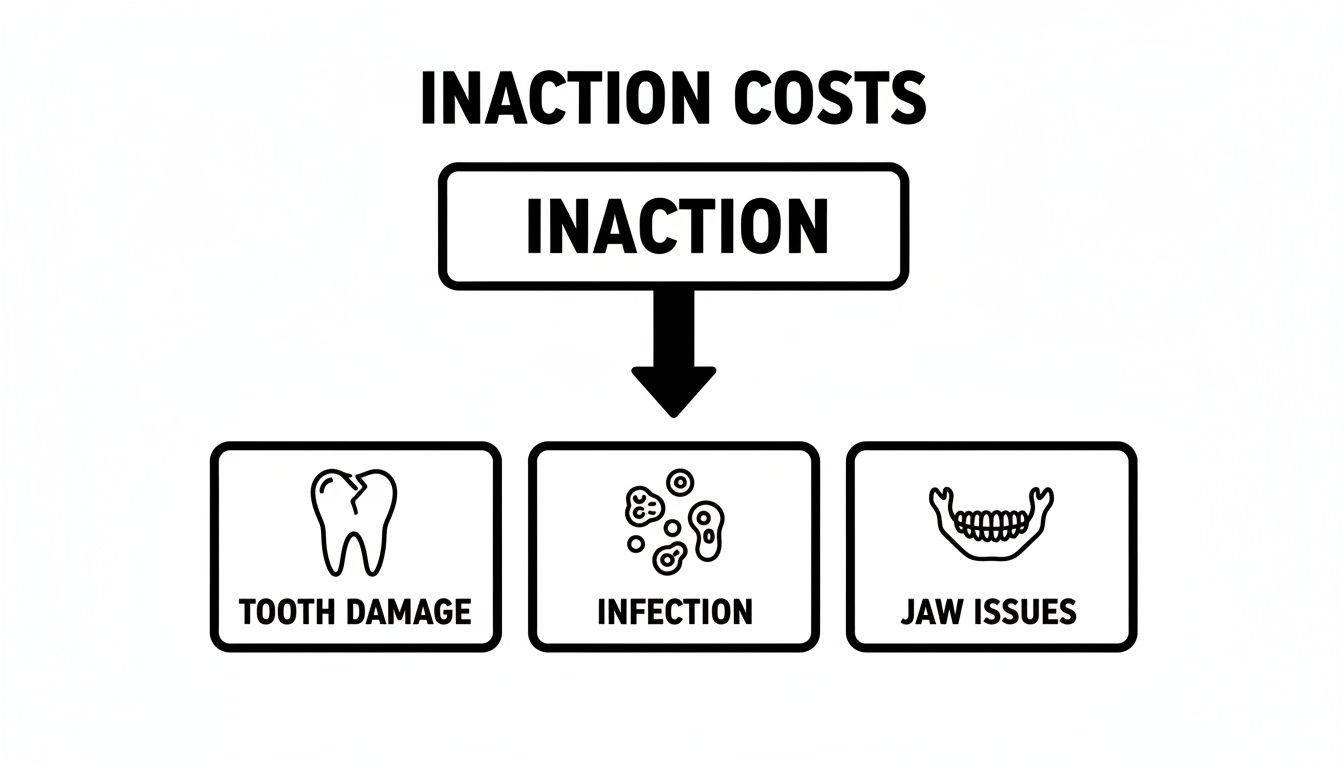
Putting off removal isn't just about avoiding a procedure; it's about preventing real problems like damage to neighboring teeth, painful infections, and other jaw complications that can affect your overall health.
Anesthesia and Diagnostics
Your comfort during the procedure and the surgeon's ability to plan it out are also major parts of the final bill. These elements are key to a successful outcome for your oral health.
Anesthesia Choices:
Your choice of sedation is key to having a pain-free experience. Local anesthesia, which just numbs the area, is the most budget-friendly option. However, many people prefer IV sedation to stay completely relaxed and essentially sleep through the surgery. This requires specialized monitoring from the team, which adds to the cost but makes a huge difference in patient comfort and reduces anxiety.
Essential Imaging:
Before any work starts, your dentist needs a clear map of what’s going on inside your jaw. Standard X-rays or more advanced 3D cone-beam CT (CBCT) scans are used to see the exact position of your teeth, their roots, and how close they are to important nerves. These diagnostics are usually billed separately but are absolutely vital for a safe and predictable surgery. They help prevent complications and ensure your oral health is protected every step of the way.
How Dental Insurance Can Lower Your Cost
Trying to figure out dental insurance can feel like putting together a puzzle, but once you see how the pieces fit, it becomes clear just how much it can lower the bill for wisdom teeth removal. Think of your plan as a financial partner, one that’s there to protect both your health and your wallet from the full impact of necessary dental work. It’s a crucial tool for keeping a healthy smile within your reach.
Most dental plans do cover wisdom tooth extractions, but how much they’ll pay really comes down to how the procedure is classified. Insurance companies usually split extractions into two buckets: simple and surgical. A simple removal of a tooth that has already erupted might get covered at a high rate, like 80%. But a more involved surgical extraction for an impacted tooth? That might be covered at 50%, reflecting its importance for preventing more serious health issues.
Understanding Your Plan's Key Terms
To get a realistic idea of your final bill, you need to get familiar with three core parts of your dental plan. These terms all work together to figure out what you'll actually pay out-of-pocket for this important health procedure.
- Deductible: This is the flat amount you have to pay yourself before your insurance company starts chipping in. If your plan has a $50 deductible, you'll cover that first.
- Co-insurance: Once you've met your deductible, your insurance pays a certain percentage, and you pay the rest. If your plan covers 80% of the cost, your co-insurance is the other 20%.
- Annual Maximum: This is the absolute highest dollar amount your insurance plan will pay for all your dental care within a single plan year.
This structure is what directly shapes your final cost. Looking at insurance data, a simple extraction with 70% coverage often leaves a patient with a copay of around $50-$100. For those complex surgical cases, however, reimbursement can drop to 40-50%. This means patients could be looking at a $150-$250 out-of-pocket cost for each tooth.
A pre-treatment estimate is your best friend when it comes to financial planning. We send your proposed treatment plan to your insurance provider, and they send us back a detailed breakdown of exactly what they’ll cover. This step gets rid of any surprises and lets you budget with total confidence for your procedure.
In some less common situations, an extraction might be considered medically necessary—think of a severe infection or cysts that are affecting your jawbone. In these cases, your medical insurance might actually step in to provide some coverage. It never hurts to check both your dental and medical plans.
For a deeper dive, check out our guide on understanding dental insurance and financing options at Grand Parkway Smiles.
Making Your Wisdom Teeth Removal Affordable

It's completely normal to feel a bit of sticker shock when you see the potential cost of wisdom teeth removal. That worry is a common feeling, but please don't let it become a roadblock to protecting your long-term oral health. Taking care of problematic wisdom teeth now is a smart investment in a future free of pain, which contributes to a healthier smile and overall well-being.
Fortunately, there are several practical and accessible ways to manage the expense. Even if you have limited insurance or none at all, you have options. These solutions are designed to make essential dental care fit into your life, ensuring you can move forward with treatment confidently.
In-House Dental Savings Plans
One of the most direct ways to bring down your out-of-pocket cost is with an in-house dental savings plan. Think of it less like traditional insurance and more like a membership to your dentist's office. You pay a low annual fee and, in return, get access to significant discounts on all sorts of services, including wisdom teeth removal.
This is a fantastic option for patients without dental insurance because you can forget about the usual headaches. There are no deductibles, no frustrating waiting periods, and no annual maximums to worry about. It’s a simple, straightforward approach to making your procedure more affordable, allowing you to prioritize your dental health without financial stress.
Financial flexibility empowers you to prioritize your health. By exploring different payment avenues, you can get the care you need now and prevent more serious—and expensive—dental issues later.
Third-Party Financing Options
Another really popular solution is third-party financing. Companies like CareCredit have been a game-changer for many of our patients. It essentially works like a credit card, but one that’s dedicated specifically to health and wellness expenses. This lets you break up the total cost of your procedure into smaller, much more manageable monthly payments.
The best part? Many of these financing plans offer 0% interest promotional periods. This gives you a window of time to pay off the balance without any extra fees tacked on. It’s a great tool that puts immediate dental needs within financial reach, so you don't have to delay a necessary procedure that protects the health and alignment of your entire smile.
Common Questions About Wisdom Teeth Removal Costs
Working through the financial side of wisdom teeth removal always brings up a few key questions. We get it. To help you plan with total confidence, we’ve put together some clear, straight-to-the-point answers to the things our patients ask most about this beneficial procedure.
Is It Cheaper to Remove All Four Wisdom Teeth at Once?
Yes, it is almost always smarter and more affordable to have all four wisdom teeth taken out in a single appointment. From a health perspective, this is the most efficient approach. You only pay once for fixed costs like anesthesia, the surgeon's time, and using the surgical suite.
If you split the procedure into multiple visits, you end up paying for all of those things again and again. Not only does this drive up the total price, but it also means going through recovery more than once. Getting it all done at the same time consolidates your healing period, meaning less time off from work or school. It’s a single, efficient investment that gets you back to feeling great and smiling confidently much faster.
Why Does an Oral Surgeon Cost More Than a General Dentist?
This is a great question. After finishing dental school, an oral surgeon goes on to complete years of intensive, hospital-based training in both surgery and anesthesia. This advanced education prepares them for highly complex situations, like teeth that are deeply impacted or dangerously close to sensitive nerves in the jaw, ensuring the procedure protects your long-term health.
While your general dentist is more than capable of handling a simple, straightforward extraction, the surgeon’s higher fee is a direct reflection of their specialized skills needed to safeguard your health and smile.
You're investing in a higher level of expertise that ensures a safer procedure and a lower risk of complications, especially for difficult cases. This is a direct investment in the long-term health and stability of your jaw and smile.
Does the Quoted Cost Include My Follow-Up Visits?
Typically, the initial quote you receive will cover the surgery itself, the anesthesia, and one standard follow-up appointment to make sure you're healing up nicely. This follow-up is a key part of the process, ensuring your recovery is on track for the best possible health outcome. That said, it's always a good idea to confirm exactly what’s included with the office staff before you commit.
Sometimes, complications like a dry socket can pop up, and any extra appointments or treatments needed to fix it might come with an additional charge. We always recommend asking for a detailed breakdown of your treatment plan so there are no surprises on your journey to a healthier mouth.
Are X-rays and Consultations Included in the Surgery Price?
Usually, the initial consultation and any imaging—like panoramic X-rays or a 3D CBCT scan—are billed separately from the actual surgery. These diagnostics are the essential first step toward a successful outcome. They allow the surgeon to map out your specific anatomy and build a personalized treatment plan that’s safe and effective for you.
It's also worth noting that your dental insurance might cover these diagnostic steps at a different rate (often a higher percentage) than the surgical procedure itself. The consultation fee covers the surgeon’s expert time to properly evaluate your case and plan the best path forward for your dental health.
At Grand Parkway Smiles, we believe clear communication is just as important as excellent clinical care. If you have more questions about the cost of wisdom teeth removal, our team is here to provide a detailed estimate and walk you through your payment options. Schedule your consultation today by visiting us at https://dentistkatytx.com.