Losing teeth changes more than your smile. Meals become cautious. Photos get avoided. Speech can feel less reliable. Many people searching for dental implants dentures are trying to solve all of that at once, while also sorting through terms that sound similar but mean very different things.
That confusion is normal. Some options are fully removable. Some are fixed. Some use implants to hold a denture more securely. The right choice depends on how you want your teeth to feel, how much maintenance you can live with, and what your mouth can support safely.
Restoring Your Smile and Confidence
If you're missing several teeth, or all of them, the decision usually comes down to three broad paths: traditional dentures, individual dental implants, or implant-supported dentures. Each can improve appearance. Each can restore some level of function. But they don't feel the same in daily life, and they don't ask the same things from you over time.

For many patients, the emotional part matters just as much as the mechanical part. They want to smile without thinking about it. They want teeth that don't move during dinner. They want a face that still looks like them. Tooth replacement isn't only about filling a gap. It's about restoring comfort, health, and confidence in a way that fits real life.
Modern dentistry has moved sharply toward implant-based treatment. In nationally representative data from 1999 to 2000, 0.7% of U.S. adults with missing teeth had a dental implant, and by 2015 to 2016 that figure had risen to 5.7%, more than an eightfold increase, reflecting a major shift toward implants as a preferred fixed option for function, bone preservation, and long-term stability, according to this national implant prevalence study.
The three main directions
| Option | How it stays in place | Main strength | Main limitation |
|---|---|---|---|
| Traditional dentures | Rests on the gums, often with suction or adhesive | Non-surgical tooth replacement | Can move, rub, or feel less secure |
| Dental implants | Anchored in bone like artificial roots | Most natural feel for single or multiple teeth | Requires surgery and healing |
| Implant-supported dentures | Denture attaches to implants, sometimes removable and sometimes fixed | Much more stability than conventional dentures | Maintenance depends on the attachment design |
Many patients begin by asking, "Which option looks best?" A better first question is, "Which option will let me eat, speak, clean, and live comfortably every day?"
A good treatment plan doesn't start with a product. It starts with your priorities. Some people want the least invasive route. Others want the strongest bite and the most secure feel. Both are reasonable. The important part is knowing what each path delivers.
Defining Dentures Implants and Hybrid Solutions
Before comparing them, it helps to strip the jargon away. Most of the confusion around dental implants dentures comes from the fact that people use one phrase to describe several very different restorations.
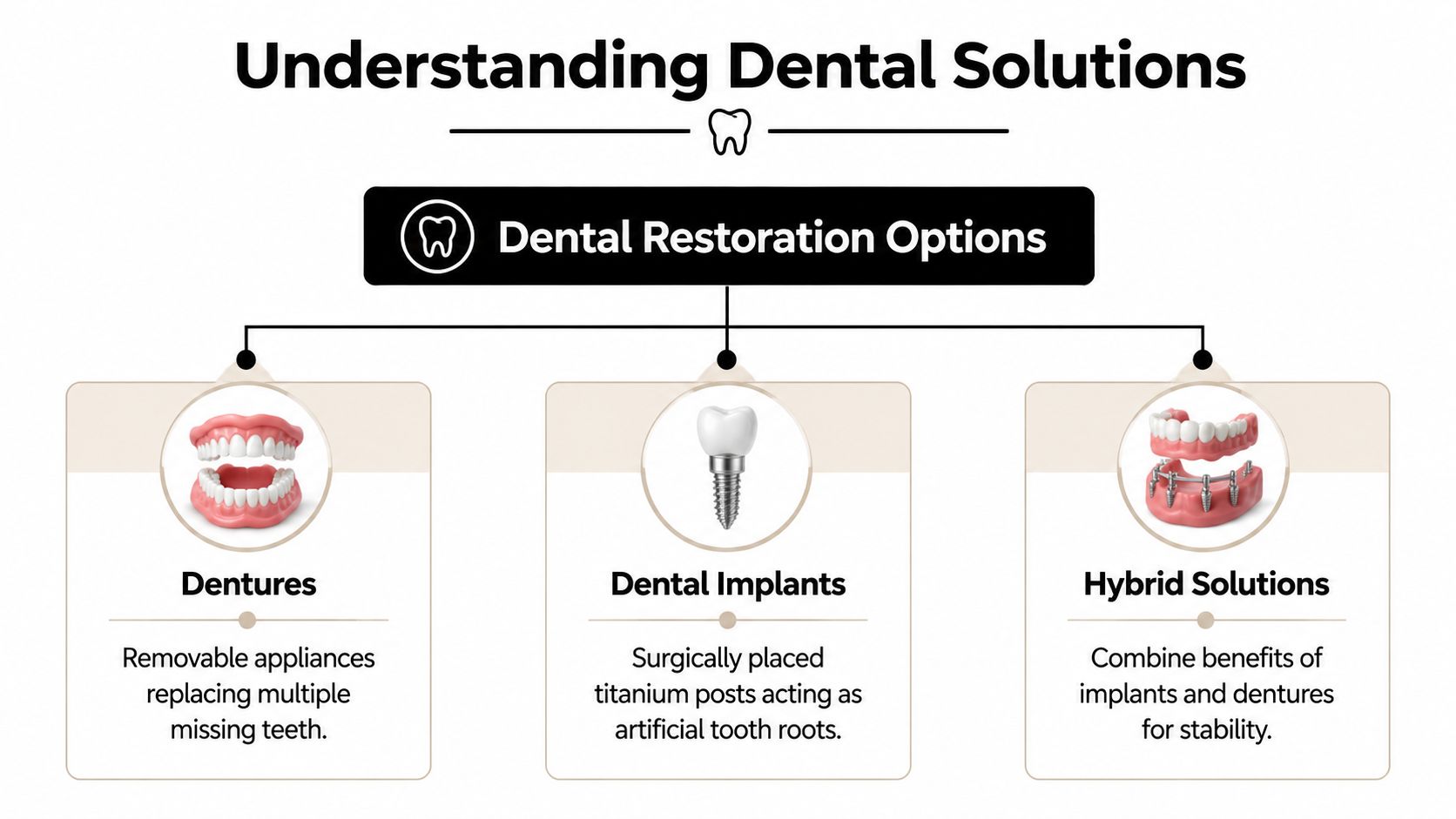
Traditional dentures
A traditional denture sits on top of the gums. It replaces several missing teeth or a full arch of teeth, and you remove it for cleaning. Upper dentures often rely on suction from the palate. Lower dentures are usually harder to stabilize because the tongue, cheeks, and moving lower jaw can dislodge them.
This option can improve appearance quickly. It can also restore basic chewing and speech better than having no teeth at all. But because it rests on soft tissue rather than anchoring into bone, patients often notice movement, pressure spots, and a bulky feel.
Dental implants
A dental implant is a titanium post placed into the jawbone to act as an artificial tooth root. After healing, it supports a crown, bridge, or larger restoration. The key difference is support. Instead of sitting on the gums, the restoration is supported by bone.
That matters because bone support changes how a tooth replacement feels. It can look more natural at the gumline, stay stable while chewing, and avoid the looseness many denture wearers dislike.
Hybrid solutions
A hybrid solution sits between those two categories. This usually means a denture or full-arch prosthesis connected to a smaller number of implants. Some of these restorations "snap in" and can be removed by the patient. Others are fixed in place and removed only by a dentist for maintenance.
For many people, this is the practical middle ground. They don't want a loose conventional denture, but they may not need or want a separate implant for every missing tooth. If you want a closer look at how that balance works, implant-supported dentures that combine function and aesthetics are a useful example of the category.
Where All on 4 fits
All-on-4 style treatment belongs in the hybrid full-arch world. It uses strategically placed implants to support a complete upper or lower set of teeth. Depending on the design, the restoration may be fixed or part of a removable overdenture approach. Patients often hear the brand-style term first and assume it means only one thing. It doesn't. The exact prosthesis design still matters.
The phrase "implant denture" can describe two very different experiences: a denture you remove at home, or a full-arch prosthesis that stays in place until your dentist removes it.
That distinction affects comfort, cleaning, repair visits, and long-term expectations. It isn't a detail. It's one of the biggest decision points.
A Detailed Comparison of Function Feel and Long-Term Value
Definitions help, but daily life is where the differences become obvious. The strongest comparison isn't just fixed versus removable. It's how each option performs when you're eating lunch, laughing with friends, cleaning your teeth at night, or trying not to think about your mouth at all.
Side by side comparison
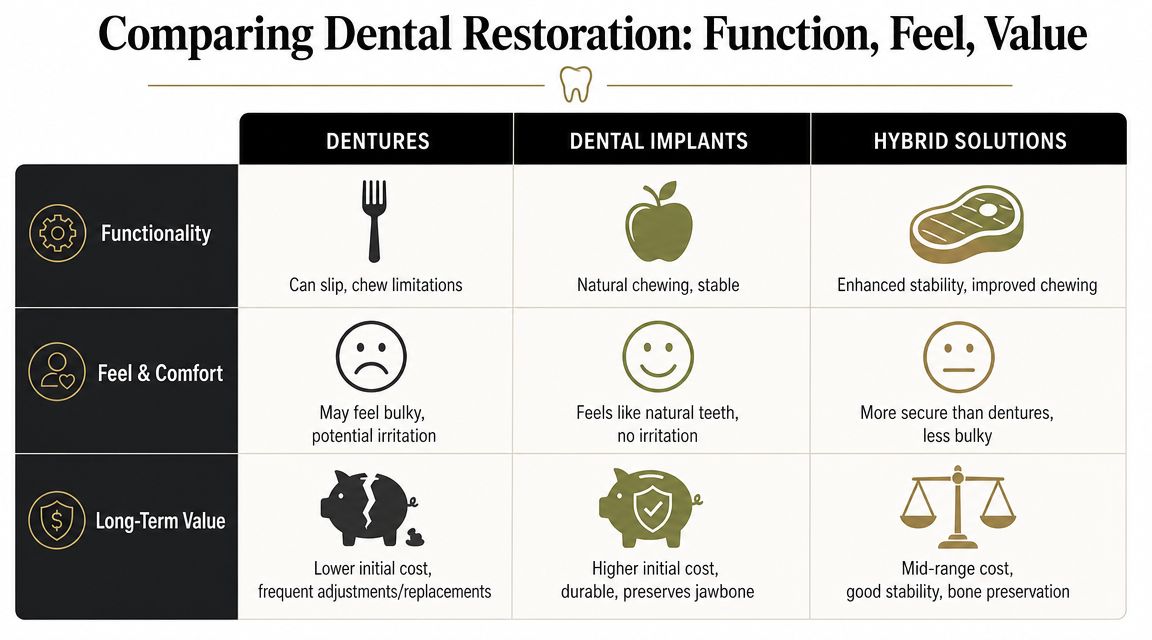
| Daily concern | Traditional dentures | Dental implants | Implant-supported dentures |
|---|---|---|---|
| Stability | Most likely to shift | Most stable | Usually much more secure than conventional dentures |
| Chewing | Often limited by movement | Closest to natural function | Improved over conventional dentures |
| Speech | May click or move during certain sounds | Usually very natural once adapted | More stable speech than loose dentures |
| Comfort | Can create sore spots on gums | No gum-borne rocking from the tooth replacement itself | Better retention, though attachments and fit still matter |
| Appearance | Can look good, but fit changes affect support | Strong support for a natural-looking result | Often very attractive when designed well |
| Bone support | Doesn't load bone like a tooth root | Bone-anchored support | Implant support may help preserve bone where implants are placed |
| Cleaning | Remove and clean daily | Brush and clean around restorations | Depends on whether it's fixed or removable |
Function and chewing
Chewing power is one of the clearest differences. A technical comparison notes that dental implants can restore up to about 95% of natural chewing force, while conventional dentures provide roughly 10%, which helps explain why patients often notice a major difference in food choices, speech stability, and confidence while eating, based on this clinical comparison of implants and dentures.
Functional reality: When a restoration moves under pressure, patients naturally avoid harder, denser, or more fibrous foods. Stability changes diet.
That doesn't mean every denture wearer can barely eat. Many adapt well. But adaptation isn't the same as normal function. Implant support reduces the need to "work around" your teeth.
Feel and comfort
Traditional dentures rest on soft tissue. Over time, that can mean rubbing, pressure points, or a sensation that the denture is always present in your mouth. Lower dentures are especially challenging because the tongue and floor of the mouth compete for space.
Implants change the experience because the support is deeper and steadier. An implant crown often feels closest to a natural tooth. Implant-supported dentures don't disappear the way individual teeth do, but they usually feel far more secure than conventional dentures.
Quality of life and satisfaction
The patient experience isn't just anecdotal. A systematic review and meta-analysis found statistically significant improvements in oral-health-related quality of life and satisfaction for implant-supported removable partial dentures compared with conventional dentures, with pooled quality-of-life scores of 30.9 ± 18.1 versus 65.5 ± 16.3 and satisfaction scores of 41.3 ± 8.9 versus 20.5 ± 8.7. The review also reported a mean difference in satisfaction of -20.79, with significant findings at p < .05, as detailed in this systematic review of implant-supported removable dentures.
That aligns with what many dentists see in practice. When a denture stops floating, people stop thinking about it all day. They eat more confidently. They speak more freely. They smile without bracing.
Long-term value is more than price
Value isn't only the initial bill. It's also whether the restoration works with your daily habits, whether it protects appearance over time, and whether maintenance feels manageable.
Consider these practical trade-offs:
- Traditional dentures can be a reasonable choice if you want a non-surgical path and accept the limits of a gum-supported appliance.
- Single or multiple implants make the most sense when you want the most natural support and you're replacing selected teeth.
- Implant-supported dentures are often the sweet spot for full-arch cases where you want much more security without placing an implant for every tooth.
A treatment can be cheaper on day one and still feel expensive if it limits what you eat, how you speak, or how often you need adjustments.
The right long-term value is the option that fits your mouth and your life, not just your first invoice.
The Treatment Journey for Each Option
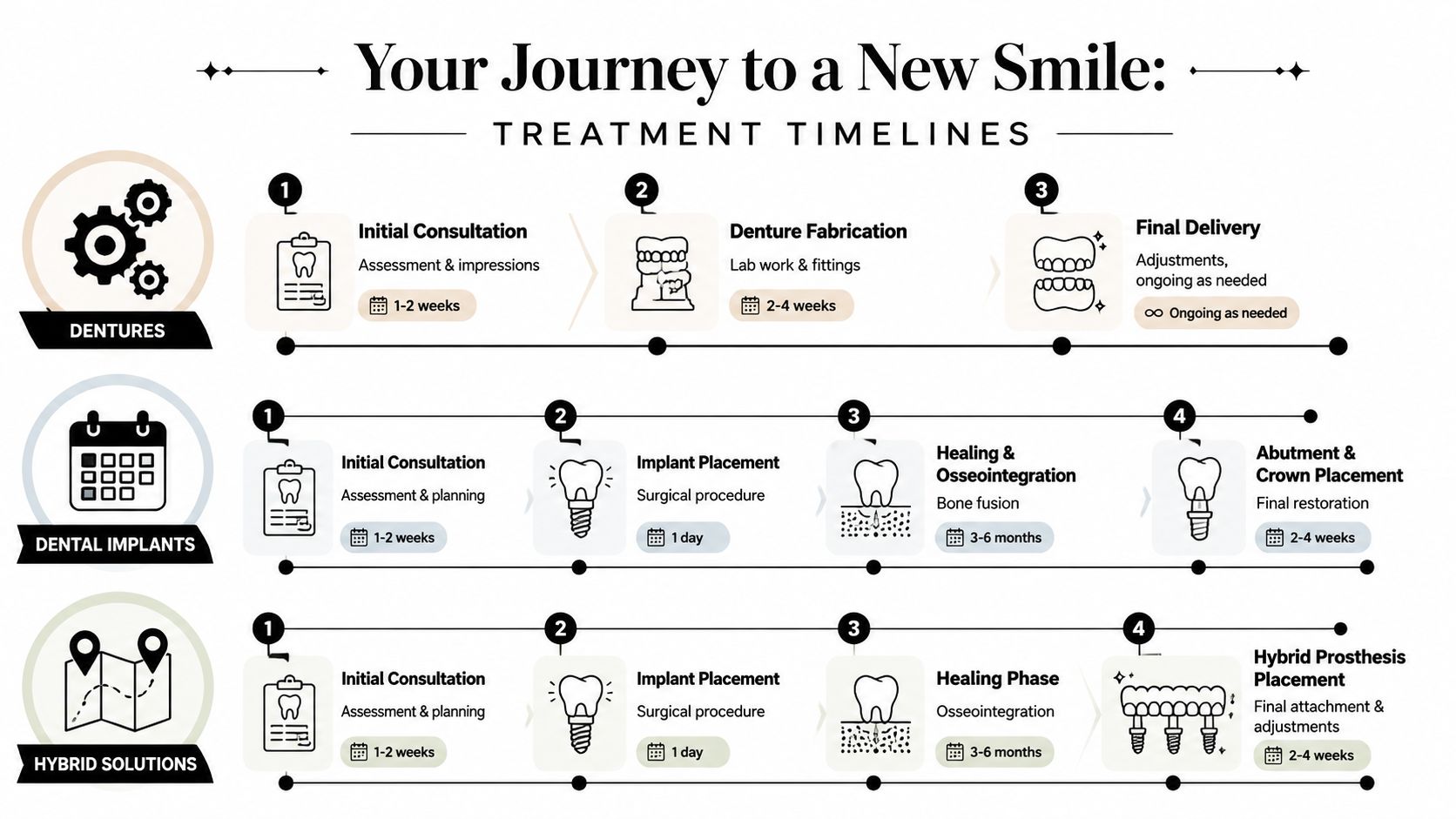
Individuals often feel better once they know the sequence. The process isn't identical for dentures, implants, and hybrid prostheses, and knowing the steps helps you prepare for healing, temporary teeth, and follow-up visits.
Traditional dentures from start to finish
For conventional dentures, the path is usually the simplest. Records are taken. The dentist evaluates the shape of the gums, bite relationship, smile line, and how much lip support you need for a natural appearance. Impressions or digital scans are made, then the laboratory fabricates the denture.
After that come try-ins and adjustments. This stage matters more than many patients expect. A denture can look polished in the hand and still need refinement in the mouth. Small bite corrections and pressure adjustments often determine whether it feels tolerable or frustrating.
Dental implants in stages
Implants are more involved because bone has to heal around the implant body. The first visit focuses on diagnosis, imaging, and planning. If a tooth needs removal, the timing of extraction and implant placement depends on the condition of the bone and surrounding tissue.
Once implants are placed, healing begins. The goal is stable integration between implant and bone before the final crown or bridge is attached. During this period, many patients wear a temporary restoration so they aren't without teeth.
A typical implant sequence includes:
- Consultation and imaging to assess bone, bite, gum health, and restoration goals.
- Surgical placement of the implant or implants.
- Healing and integration while the bone bonds to the implant.
- Restorative phase when the visible tooth or teeth are attached.
Full-arch and implant denture workflows
Full-arch treatment has more than one version. In some cases, teeth are removed, implants are placed, and a temporary prosthesis is delivered quickly so the patient leaves with a functional smile the same day. In others, the timeline is staged more cautiously depending on bone quality, infection, bite complexity, and medical history.
What patients often don't realize is that the prosthesis delivered first may not be the final one. Temporary full-arch teeth are often designed to guide healing, function, and aesthetics before the definitive version is made.
A fast transformation can still be a staged treatment. Immediate teeth and final teeth aren't always the same appliance, and that isn't a setback. It's part of careful planning.
Why the timeline differs
The timeline isn't only about technology. It's about biology. Soft tissue has to heal. Bone has to stabilize. The bite has to be balanced so the restoration isn't overloaded.
That means the "quickest" option isn't automatically the smartest. A well-paced plan usually leads to a more comfortable result, fewer complications, and a restoration that looks right when you smile and works right when you chew.
Candidacy Cost and Long-Term Upkeep
These are the questions people ask when the consultation gets real. Am I a candidate. What will this cost me over time. And what will I need to do to keep it working.
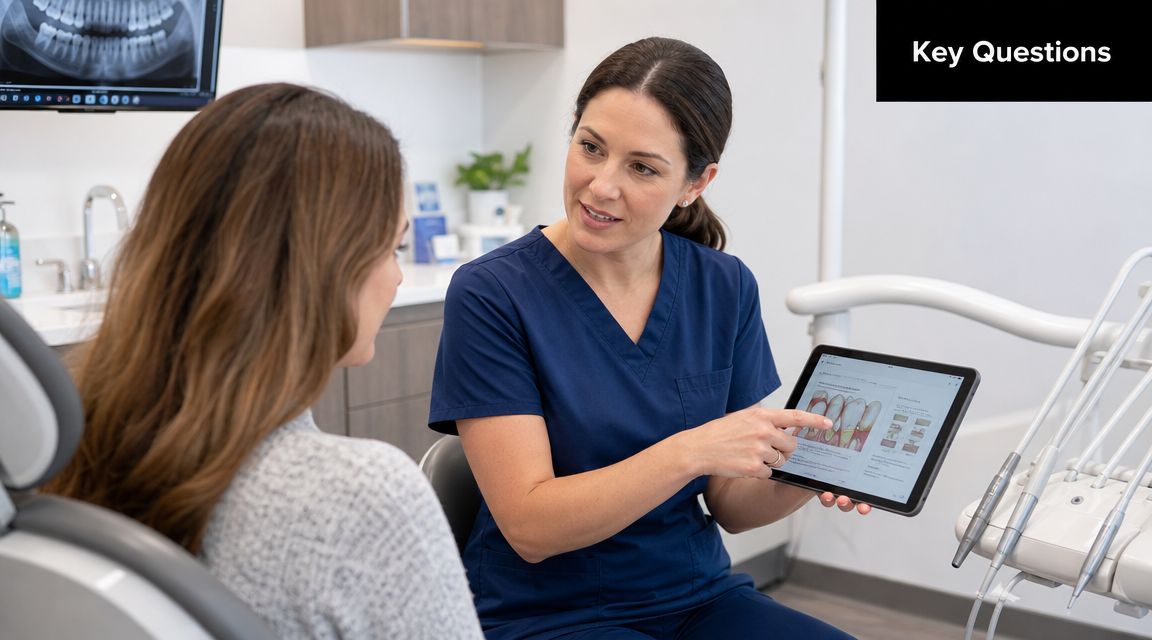
Candidacy isn't as simple as having bone or not
Many patients assume they've been ruled out forever if they've been told they have severe bone loss. That's not always true. Advanced solutions such as zygomatic and pterygoid implants can often provide a stable foundation for a full-arch restoration without extensive bone grafting by anchoring into denser facial bones, expanding options for patients previously told they had none, as described in this discussion of advanced implant options for missing teeth.
That doesn't mean everyone qualifies for those approaches. Medical history, bite force, sinus anatomy, gum condition, and treatment goals still matter. But "not enough bone" is no longer the end of the conversation in many full-arch cases.
Cost means first cost and ownership cost
Precise fees vary too much by diagnosis, materials, surgical complexity, and whether you're replacing one tooth or a full arch, so a personalized exam matters more than online averages. What you can compare meaningfully is the pattern.
- Traditional dentures usually have the lowest initial entry point, but they often come with ongoing adjustments and fit changes.
- Implants usually require a larger upfront investment because surgery, planning, and custom restoration are involved.
- Implant-supported dentures often land in the middle to upper range depending on how many implants are used and whether the prosthesis is removable or fixed.
If you're weighing financial trade-offs, a page on how much dentures cost can help frame the denture side of the discussion before you compare it to implant-based treatment.
Upkeep is where many articles fall short
Maintenance is where fixed versus removable becomes personal. Patients considering implant-retained dentures often have practical questions that aren't answered clearly, such as whether they will remove the denture themselves or whether only a dentist can remove it, and how often clips or attachments may need replacement over time.
That distinction matters because the cleaning routine changes with the design:
- With conventional dentures, you remove them, clean them outside the mouth, and keep up with fit-related visits if they loosen or rub.
- With individual implants, care is closer to caring for natural teeth, but professional monitoring still matters because tissue health around implants matters.
- With removable implant overdentures, you clean both the denture and the attachment areas. Wear parts such as clips or inserts can need replacement as they loosen.
- With fixed full-arch prostheses, daily hygiene becomes more technique-sensitive because food and plaque can collect beneath the restoration.
The wrong prosthesis for a patient isn't always the one with weaker function. Sometimes it's the one with a cleaning routine the patient won't realistically maintain.
A useful consultation should cover not just what the teeth look like on delivery day, but what your evenings, travel, cleaning tools, and maintenance visits will look like after that.
Your Personalized Solution in Katy TX
No single answer fits every mouth. The best option for one patient may be a poor fit for another, even if both are missing the same number of teeth. Some people prioritize maximum stability. Others want a removable solution that's easier to clean. Others need a path that accounts for bone loss, anxiety about surgery, or a staged budget.
The most productive consultation is one where you can compare these choices clearly and ask the practical questions patients often miss. Is the prosthesis fixed or removable. Who removes it. How will you clean underneath it. What happens if an attachment wears. How will the restoration affect facial support and appearance over time. Those details shape long-term satisfaction just as much as the surgery itself.
A strong planning process should also give you room to participate in the decision. Resources that explain how to improve medical visits with shared decision making are valuable because this kind of treatment works best when the patient understands the trade-offs and helps choose the path forward.
For patients in Katy, one local option is Grand Parkway Smiles, a full-service practice that provides implant care, snap-in dentures, All-on-4 treatment, advanced imaging, sedation options, and more complex full-arch planning under one roof. That matters because implant denture cases often involve surgical, restorative, and maintenance decisions that work better when they're planned together.
The right next step isn't choosing a product from a webpage. It's getting an exam that answers four things clearly:
- What your mouth can support
- Which design matches your daily habits
- What level of maintenance you're willing to manage
- How to balance appearance, function, and budget
If you're looking into dental implants dentures, don't settle for a vague promise that "implants are better" or "dentures are cheaper." Ask how the restoration will function on a normal Tuesday. Ask how you'll clean it. Ask what happens years later.
If you're ready to discuss missing teeth, implant dentures, full-arch options, or whether bone loss limits your choices, schedule a consultation with Grand Parkway Smiles. A personalized exam can show which solution fits your health, appearance goals, and daily life.