So, you're wondering, how much do dental implants really cost? It’s the number one question we get, and for good reason. In the U.S., a single dental implant usually runs between $2,000 to $4,500 per tooth, while a full-arch restoration can cost anywhere from $15,000 to $30,000 per jaw.
Yes, that’s a significant investment. But it’s an investment in your long-term dental health, your appearance, and the confidence that comes with a complete smile.
Your Quick Guide to Dental Implant Costs
Thinking about a dental implant is about more than just filling a gap in your smile. It's about restoring your ability to eat your favorite foods, speak clearly, and feel confident in your appearance. Dental implants aren’t a temporary fix; they are designed to look, feel, and function just like your natural teeth and can last a lifetime with good care, making them a premier choice for dental health.
This investment does more than just restore your smile. It protects the health of your jawbone, prevents neighboring teeth from shifting out of place, and provides a level of stability and comfort that other options just can't match.

Understanding the Investment in Your Smile
Why the price tag? The cost of dental implants comes down to the high-quality, biocompatible materials, the detailed surgical skill involved, and the custom lab work needed to create a replacement tooth that’s both strong and incredibly natural-looking.
To help you get a clearer picture, here’s a quick rundown of the most common implant solutions and their benefits for your appearance and health:
- Single Tooth Implant: This is the go-to for replacing one missing tooth. It includes the implant post (the new "root"), an abutment (the connector), and a custom-made crown that restores your smile seamlessly.
- Implant-Supported Bridge: If you're missing several teeth in a row, this is a fantastic option for both function and aesthetics. It uses two or more implants to securely anchor a dental bridge, avoiding the need to grind down healthy adjacent teeth.
- Full-Arch Restoration (All-on-4): This is a game-changer for anyone missing all of their upper or lower teeth. It uses as few as four carefully placed implants to support a full, permanent set of teeth, completely transforming your smile and oral health.
The price isn't just for a product; it’s for a long-term health solution. A dental implant is the only tooth replacement that actually stimulates your jawbone, preventing the bone loss that can lead to a sunken, aged facial appearance over time.
This commitment to durable, lifelike solutions is why the field is growing so quickly. The U.S. dental implant market was valued at nearly $2.1 billion and is expected to hit around $3.1 billion by 2031. It shows that more and more people understand the incredible long-term benefits implants offer for both health and appearance.
Of course, some people look at options outside the U.S. where prices can be different. For a detailed breakdown of costs in another market, you might check out this 2025 cost guide for dental implants in Tijuana for comparison.
To give you a clearer idea of the numbers at a glance, we've put together a simple table.
Estimated Dental Implant Costs at a Glance
This table provides a quick summary of typical price ranges for common dental implant procedures in the U.S.
| Implant Procedure | Average Cost Range (Per Arch or Tooth) |
|---|---|
| Single Dental Implant | $2,000 – $4,500 (per tooth) |
| Implant-Supported Bridge | $5,000 – $16,000 (depending on size) |
| Full-Arch Restoration (All-on-4) | $15,000 – $30,000 (per arch) |
Remember, these are ballpark figures. The final cost will depend on your specific health needs, the materials chosen for the best aesthetic outcome, and any preparatory procedures required. We'll break down all those factors next.
Decoding Your Dental Implant Bill
Trying to make sense of a dental implant treatment plan can feel like reading a foreign language. But once you know what each line item actually means, you can make confident decisions about your smile. The total cost isn't just one big number; it’s a combination of several critical pieces, and each one plays a huge part in getting your dental health and appearance back on track.
Think of it like building a custom home. You don't just pay for the finished house. You pay for the foundation, the framework, and all the beautiful finishing touches. In the same way, the real answer to "how much do dental implants cost?" is found by looking at these individual parts that come together to create a strong, natural-looking tooth.
The Foundation: The Surgical Fee
The first major piece of the puzzle is the surgical fee. This covers the actual placement of the dental implant post itself—that small titanium screw that becomes your new tooth root. This isn’t a simple in-and-out procedure; it's a precise surgical act that requires a skilled clinician to ensure the best health outcome.
This fee wraps up several key elements that are all about a safe and successful outcome for your smile:
- Clinician’s Expertise: You're investing in your dentist's or oral surgeon's years of specialized training and hands-on experience. Their skill is what ensures the implant is placed in the perfect spot for long-term stability and a beautiful final appearance.
- Surgical Suite and Sterilization: Part of the cost goes toward the use of a sterile, fully equipped surgical environment. This is absolutely essential for preventing infection and protecting your health.
- Technology and Planning: We often use advanced imaging, like 3D cone-beam computed tomography (CBCT) scans, to map out your jawbone and nerves with incredible precision. This careful planning minimizes risks and leads to a much more predictable and comfortable procedure, safeguarding your health.
This first step is arguably the most important one for the long-term health of your mouth. A perfectly placed implant doesn't just hold up your new tooth; it actually fuses with your jawbone in a process called osseointegration. This fusion is what stops bone loss and maintains your facial structure—a benefit no other tooth replacement option can offer.
The Finishing Touches: The Restorative Fee
After the implant has had time to heal and fuse with your bone, we move on to the restoration phase. The restorative fee covers the visible parts of your new tooth—the parts that let you chew, speak, and smile beautifully. This fee is for the custom-made components that attach to that implant post in your jaw.
This part of your bill usually breaks down into two main items:
- The Abutment: This is a small connector piece that we secure to the implant post. Think of it as the bridge between the implant deep in your jawbone and the crown you see above your gumline. Abutments can be standard (pre-made) or custom-fabricated to fit the unique shape of your gums for a more seamless, natural appearance.
- The Crown: This is the final, tooth-shaped cap that sits right on top of the abutment. The crown is carefully crafted in a dental lab to match the exact color, shape, and size of your other teeth. Its design is critical for both function (giving you a strong biting surface) and aesthetics, blending flawlessly into your smile.
The choice of materials for your crown and abutment directly impacts both the final cost and how your new tooth looks. While some materials are easier on the wallet, others offer superior strength and aesthetics that many patients find are well worth the investment for a perfect smile.
Material Choices and Their Impact
The materials we use for your restoration play a huge role in the final cost and the long-term success of your implant. It's a bit like choosing between different grades of building materials for your home—some get the job done, while others provide premium durability and beauty.
Here’s a quick comparison:
| Material | Key Benefits | Impact on Cost |
|---|---|---|
| Titanium | The industry gold standard for implant posts. It's biocompatible, incredibly strong, and has a decades-long track record of success for oral health. | Standard, baseline cost. |
| Zirconia (Implant Post) | A metal-free, tooth-colored alternative. It's a great option for patients with metal allergies or thin gums where a dark metal might show through, enhancing the final appearance. | Generally higher cost than titanium. |
| Porcelain-Fused-to-Metal (Crown) | A strong metal base covered with tooth-colored porcelain. It offers good durability and has been a reliable choice for years. | More affordable crown option. |
| All-Ceramic or Zirconia (Crown) | Considered the best for aesthetics. These materials are incredibly strong, resist chipping, and mimic the translucency of natural tooth enamel for the most lifelike look possible. | Higher cost due to advanced materials and fabrication. |
Ultimately, breaking down the bill takes the mystery out of how much do dental implants cost. When you understand the surgical, restorative, and material components, you can have a much more informed conversation with your dentist. This knowledge gives you the power to choose the options that best fit your health goals, aesthetic desires, and budget, making sure your investment leads to a beautiful smile that lasts a lifetime.
Comparing Tooth Replacement Cost Versus Value
When you're faced with a missing tooth, it’s natural to first look at the price tag of a replacement. But the sticker price only tells a small part of the story. The real conversation isn't just about cost—it's about the long-term value you get for your health, your confidence, and your daily life.
Thinking about how much do dental implants cost means shifting your mindset from a simple purchase to a permanent health solution. An implant isn't just a patch; it's a foundational investment in your smile that’s designed to last for the rest of your life.
The final price is really a sum of its parts—the expert surgery, high-quality materials, and the custom-made crown—all working together to rebuild your smile from the ground up for optimal health and appearance.
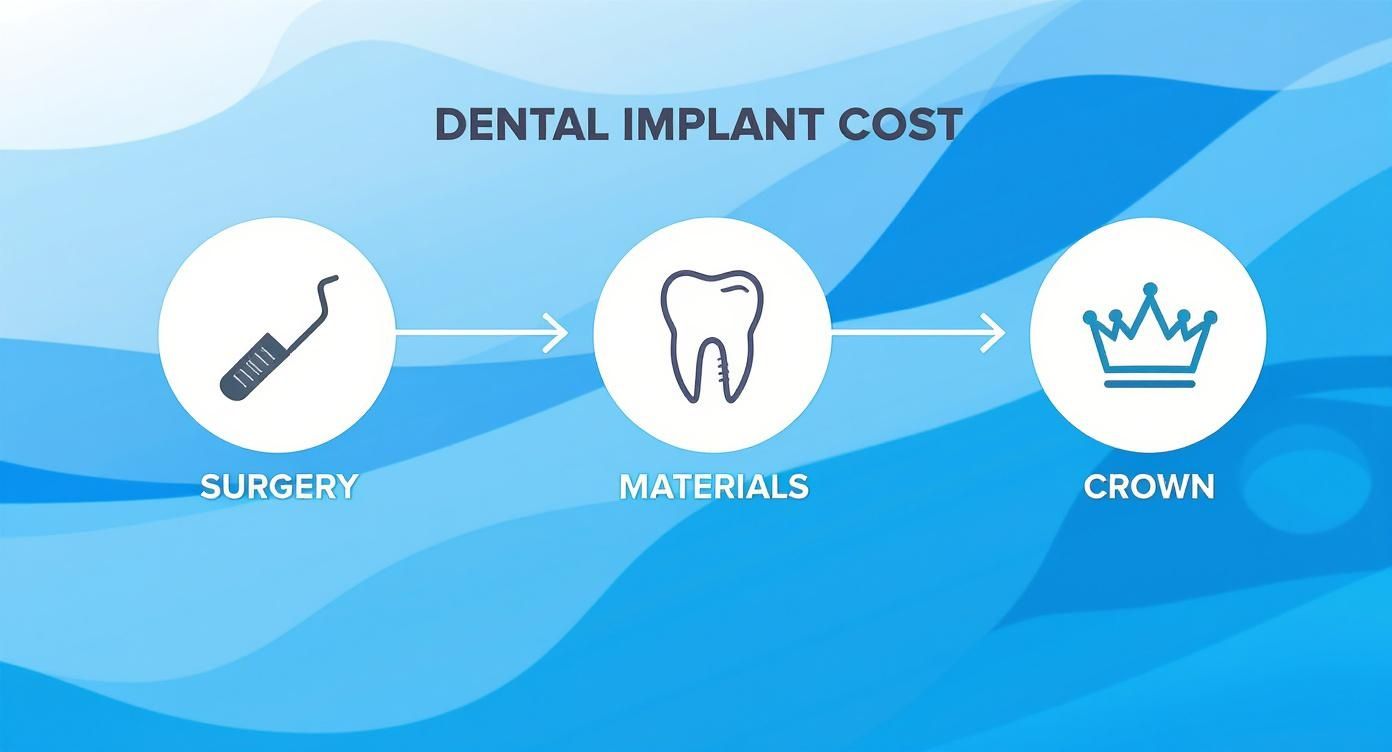
This breakdown helps visualize how each element contributes to a successful, lifelong restoration.
Single Implants: A Lifetime Foundation
For a single missing tooth, a dental implant is hands-down the gold standard for long-term health. A traditional dental bridge might seem cheaper at first glance, but it comes with a hidden health cost: it requires grinding down two perfectly healthy neighboring teeth to serve as anchors. This permanently alters their structure, making them weaker and more prone to problems down the road.
A single implant, on the other hand, is completely self-sufficient. It's placed directly into the jawbone, where it functions just like a natural tooth root.
This gives you two huge health advantages:
- Jawbone Preservation: The implant stimulates the jawbone every time you chew, preventing the bone loss that always happens when a tooth is gone. This is crucial for maintaining your facial structure and avoiding that sunken-in look.
- Neighboring Tooth Health: Your adjacent teeth are left completely untouched and healthy. There’s no need to compromise their integrity for the sake of one missing tooth.
While the initial investment is higher, a single implant can truly last a lifetime with proper care, making it the smarter and healthier choice in the long run.
Implant-Supported Bridges: Securing Your Smile
When you’re missing several teeth in a row, an implant-supported bridge is a fantastic solution that blends stability with beautiful aesthetics. Instead of relying on your natural teeth, this type of bridge is anchored securely by two or more dental implants.
This is a massive upgrade from a removable partial denture, which can feel loose, impact your speech, and limit the foods you can enjoy. An implant-supported bridge is fixed in place. You can eat, speak, and laugh with complete confidence because it feels and functions just like your natural teeth, enhancing your daily life.
Plus, it provides that all-important jawbone stimulation at the anchor points, helping to preserve your oral health for years to come.
By investing in an implant-supported solution, you are choosing stability and function. It’s the difference between a temporary fix that may need frequent adjustments and a permanent restoration that becomes a seamless part of your smile.
All-on-4: A Full Smile Transformation
For anyone missing most or all of their teeth, the All-on-4 treatment is nothing short of life-changing. This technique uses as few as four strategically placed implants to support a full, permanent set of beautiful new teeth. It completely does away with the daily hassles of traditional dentures—no more messy adhesives, no more slipping, and no more avoiding your favorite foods.
The value here goes far beyond just having teeth. It's about restoring your ability to enjoy a steak, speak clearly in a meeting, and smile without a second thought. The boost in quality of life and appearance is truly profound.
Globally, the cost for this kind of restoration can vary quite a bit. Many people look into dental tourism because of these differences. In countries like Mexico or Hungary, an All-on-4 procedure might range from $3,000 to $6,000. That’s a fraction of the $12,000 to $28,000 you might see here in the United States.
To help put everything in perspective, let’s compare these options side-by-side.
Cost and Benefit Comparison of Tooth Replacement Solutions
This table breaks down the typical costs, longevity, and key benefits of the most common tooth replacement solutions, so you can see how they stack up against each other.
| Solution | Initial Cost Estimate | Typical Lifespan | Key Health & Appearance Benefit |
|---|---|---|---|
| Dental Implant | $1,999 – $6,000 | Lifetime | Preserves jawbone health and facial structure; doesn't damage adjacent teeth. |
| Traditional Bridge | $1,500 – $5,500 | 10–15 years | Fills the gap quickly; non-surgical. |
| Partial Denture | $1,500 – $2,800 | 5–10 years | Replaces multiple teeth affordably; removable. |
| All-on-4 Implants | $12,000 – $28,000+ per arch | Lifetime | Full-arch restoration that looks and functions like natural teeth, boosting confidence. |
Ultimately, choosing a tooth replacement option means looking past the initial price tag. By focusing on long-term health, function, and appearance, you can see that dental implants are not just a cost, but a powerful, lifelong investment in your well-being.
For a deeper dive into the numbers, you can check out our guide on the costs of replacing a missing tooth and exploring your options.
Where You Live and Who You Choose Matters
When you start researching the cost of dental implants, you'll quickly realize that the price tag isn't the same everywhere. Just like a house in downtown Houston costs more than one in a small town, the price for complex dental work changes based on your location and, more importantly, the dentist you trust with your smile. This isn't just about overhead; it's about the level of skill and technology you're getting for your health investment.
A practice here in a major hub like Katy or Houston will naturally have higher operating costs—from rent to highly-trained staff—and that does play a role in the final price. But this is also where you’ll find specialists who have poured their entire careers into perfecting the art and science of implant dentistry. Suddenly, it’s less about "cost" and more about the "value" for your smile and health.
Why Paying for Expertise is a Smart Move
Picking a dentist for your implant isn't a decision to take lightly. While it’s always tempting to hunt for the lowest price, the dentist's experience is the single biggest factor in how well your implant will look, feel, and last. A true implant specialist isn't just screwing a post into your jaw; they're architects of your smile, planning every single detail for a result that's both beautiful and built to last.
Here's where that expertise really pays off for your health and appearance:
- Serious Training: The best implant dentists have years of extra training after dental school, mastering everything from complex surgical placement to the fine art of making a prosthetic tooth look completely natural.
- No Surprises: An experienced pro has done this hundreds, if not thousands, of times. They know what to expect, how to handle tricky situations, and how to make the whole process go smoothly for a better outcome.
- Fewer Complications: Skill and precision are your best defense against problems like nerve damage, a misplaced implant, or outright failure. Getting it right the first time saves you from far more expensive and painful fixes down the road.
Investing in a specialist is really an investment in your own peace of mind. You're paying for the confidence that comes from knowing your new tooth is perfectly positioned for a lifetime of healthy function.
When you choose a dentist based on their expertise, you're putting the long-term health of your smile first. That upfront investment is what prevents costly corrections later, saving you money and headaches over the life of your implant.
How Technology Shapes Your Final Result
Modern implant dentistry has come a long way, and today's technology makes the process safer and the results more stunning than ever before. Practices that invest in these tools often deliver a higher standard of care, which can be reflected in the cost. Take guided surgery, for example. We use 3D imaging to create a perfect digital map of your jaw, then use a custom guide to place the implant with pinpoint accuracy.
This isn't just a gimmick; it has a direct impact on your health and appearance. Precise placement means the final crown fits flawlessly, looks completely natural, and won't give you trouble when you chew. It also helps us steer clear of critical anatomy like nerves and sinuses, making the surgery itself much safer. While this tech adds to the initial investment, it dramatically improves the outcome, ensuring your new smile isn't just beautiful but is built on a rock-solid, healthy foundation.
Navigating Insurance and Financing for Your Smile
Seeing the final number on your treatment plan is one thing, but figuring out how to pay for it is what really turns the dream of a new smile into a reality. The investment can feel intimidating at first, but a beautiful, healthy smile is often more attainable than you might think.
There are several ways to make dental implants affordable. We want to make sure cost doesn't stand between you and the confidence that comes with a complete, healthy set of teeth.
Most people start by looking at their dental insurance. While it’s true some plans still consider implants a purely cosmetic procedure, that’s quickly changing. More and more PPO plans are recognizing the massive health benefits—like preserving your jawbone and stopping other teeth from shifting—and now offer partial coverage.
Making the Most of Your Dental Insurance
It's rare for an insurance plan to cover the entire cost of a dental implant from start to finish. However, it can still make a huge difference in your out-of-pocket expenses by covering specific parts of the process that contribute to your oral health.
- Covering the Crown: Many plans will help pay for the final crown that attaches to the implant, treating it just like a crown on a natural tooth, which is essential for proper function.
- Contributing to Related Procedures: Your benefits might also apply to necessary steps like extractions or bone grafting, which are crucial for your overall oral health.
The key is getting a detailed breakdown of what your plan covers. Our team is here to help you get a pre-authorization from your insurance company. This clears up exactly what they will contribute, so there’s no guesswork involved.
Understanding your insurance is the first step toward unlocking affordability. Even partial coverage can make a significant difference in the overall investment, bringing a permanent solution for your smile well within reach.
Exploring Your Financial Pathways
Beyond insurance, there are a few other tools designed to make the cost of dental implants manageable. These options are built to help you fit this life-changing treatment into your budget without straining your finances.
In-House Dental Savings Plans
If you don't have dental insurance or your coverage is limited, our in-house savings plan is a fantastic alternative. This isn't insurance; it's a membership program we offer directly. For a simple annual fee, you get significant discounts on major procedures, including dental implants. This straightforward approach gets rid of deductibles, waiting periods, and annual maximums, making your path to a new, healthy smile clear and predictable.
Third-Party Financing Options
Breaking up the total cost into smaller, predictable monthly payments is one of the most popular ways to finance dental care. Companies like CareCredit specialize in healthcare financing and offer plans that can fit almost any budget.
Many of these plans even have no-interest periods, which means you can pay for your treatment over time without any extra cost. This kind of flexibility allows you to move forward with your procedure right away, getting you back to eating, speaking, and smiling with complete confidence much sooner.
To make the best financial decision for your family, it's helpful to understand how to compare health insurance plans, as some may offer better dental benefits. For a deeper look at the specific options available right here at our practice, check out our guide on understanding dental insurance and financing options at Grand Parkway Smiles.
Our goal is simple: to give you a clear roadmap and remove financial barriers so you can invest in a healthy, beautiful smile that will last a lifetime.
Your Dental Implant Journey From Start to Finish
It's one thing to talk about how much do dental implants cost, but it's another thing entirely to understand the process. Knowing what the journey actually entails is what builds real confidence. This isn't just a quick procedure; it's a carefully planned path toward regaining your smile, enjoying the foods you love, and improving your overall dental health.
Every step is designed to make sure your new tooth looks, feels, and works just like a natural one. And the whole transformation starts not in a surgical room, but with a simple conversation about your goals for your smile.
Step 1: The Consultation and Planning Phase
Your journey kicks off with a detailed consultation. This is our chance to sit down, talk about your aesthetic goals, and determine the best way to achieve a healthy, functional smile. We use advanced 3D imaging, like a CBCT scan, to get a crystal-clear picture of your jawbone, nerves, and surrounding structures.
Think of this as creating a digital blueprint for your new smile. It lets us map out the exact placement for your implant, ensuring everything is safe, predictable, and leads to a beautiful result. From there, we build out your personalized treatment plan, which breaks down every step and cost so there are no surprises.
Step 2: The Implant Placement
Next up is the actual placement of the small titanium implant post. This biocompatible post is the workhorse of the whole system, acting as a new tooth root that we gently place into your jawbone. With modern techniques and sedation options, most of our patients are surprised by how comfortable and straightforward the procedure is.
This surgical step is the cornerstone of your new smile. It creates the rock-solid, healthy foundation needed for a restoration that can truly last a lifetime.
The real magic happens after the implant is placed. It’s a natural process called osseointegration, where your jawbone literally grows around and fuses with the titanium implant. This creates an incredibly strong bond, the same way your body anchors your natural teeth.
This healing period is absolutely crucial for long-term success and usually takes a few months. During this time, the implant essentially becomes a part of you. This is what stops the bone loss that happens with missing teeth and helps maintain your facial structure—a huge benefit for both your health and appearance.
Step 3: Crafting and Placing Your New Tooth
Once the implant has fully integrated with your bone, we get to the exciting part: creating your beautiful new tooth. We take precise digital impressions of your mouth to design a custom abutment (the piece that connects the implant to the crown) and your permanent crown.
This final crown is meticulously crafted to match the color, shape, and size of your other teeth, so it blends in perfectly with your smile. The result isn't just a replacement tooth; it's a complete restoration that lets you eat, speak, and smile with total confidence all over again.
Common Questions About Dental Implant Costs
Thinking about the investment in your smile naturally brings up a few practical questions. Getting straight answers is the best way to feel confident about your decision to get your dental health and appearance back on track.
How Long Do Dental Implants Last?
With the right care, dental implants are absolutely a permanent solution for your oral health. The magic is in the titanium post, which actually fuses with your jawbone, becoming a solid, lasting part of your own anatomy. This is why we consider them a lifetime investment in your smile.
While the implant post itself is built to last forever, the crown on top might need a refresh after 10-15 years due to normal wear and tear from chewing. But the healthy foundation? That's not going anywhere.
Why Are Implants a Better Investment Than Dentures?
It's true that dentures have a lower price tag upfront, but implants deliver far superior long-term health and aesthetic benefits. Here's the key difference: implants are the only tooth replacement option that stimulates the jawbone. This prevents the bone loss that can lead to that sunken facial appearance over time.
By preserving your facial structure and providing rock-solid stability for eating and speaking, they become a much smarter investment in your overall quality of life and long-term appearance.
The real value of an implant is its unique ability to protect your jawbone health. This foundational benefit prevents future problems and keeps you looking like you for decades.
Can I Get an Implant if I Have Bone Loss?
Yes, absolutely. In the past, significant bone loss could be a real roadblock to a healthy smile, but modern dentistry has fantastic solutions for this.
A routine procedure called bone grafting allows us to rebuild the lost bone, creating the strong, healthy foundation an implant needs to succeed. This has opened the door for more people than ever to enjoy the life-changing benefits of dental implants for their health and confidence.
Ready to see how dental implants can permanently restore your smile and your confidence? The expert team at Grand Parkway Smiles is here to map out a personalized treatment plan just for you. Schedule your consultation today!