That startling crack or the sudden, sharp edge your tongue finds is always a shock. When you realize you've cracked a tooth, it's easy to panic, but what you do in those first few moments can make a huge difference for your dental health. Staying calm and taking the right steps can stop the crack from worsening, ease your pain, and ultimately help us save your tooth, preserving your complete, healthy smile.
The goal right after it happens is to stabilize the situation and prevent bacteria from invading the vulnerable, deeper layers of the tooth, which is crucial for your long-term dental health.
What To Do Immediately After Cracking a Tooth
Your immediate action plan at home should be simple and focused on protecting your oral health. The first thing you'll want to do is gently rinse your mouth with warm salt water. This isn't just an old wives' tale; it helps clean out any food particles and acts as a natural disinfectant, which is crucial for preventing infection and promoting a clean environment for healing. Just mix about half a teaspoon of salt into a glass of warm water and swish it around carefully.
If your cheek starts to swell, grab a cold compress and apply it to the outside of your face near the cracked tooth. This will help reduce inflammation and numb the area for some temporary pain relief, improving your comfort. Just be sure to wrap the ice pack in a towel and only apply it for about 20 minutes at a time. Over-the-counter pain relievers can help manage discomfort, but never put aspirin directly on your gums—it can burn the tissue.
Your Immediate Action Plan at Home
You might be surprised to learn how common cracked teeth are. We see them all the time in our Katy practice. One major study showed that about 1 in 22 people visiting a dental clinic had a cracked tooth. Your back molars are especially at risk since they take on up to four times more biting force than your front teeth.
If a crack is not examined quickly, it can deepen and reach the sensitive pulp inside the tooth. This happens in about 15-29% of cases, which often requires more complex treatments like a root canal to save the tooth and restore your health.
Key Takeaway: While home care is essential for immediate relief and protection, it is not a permanent solution. The primary goal of at-home first aid is to manage symptoms and prevent further damage until you can receive professional care from a dentist to ensure the health and appearance of your tooth.
This quick guide can help you figure out just how urgent your situation is based on your pain level.
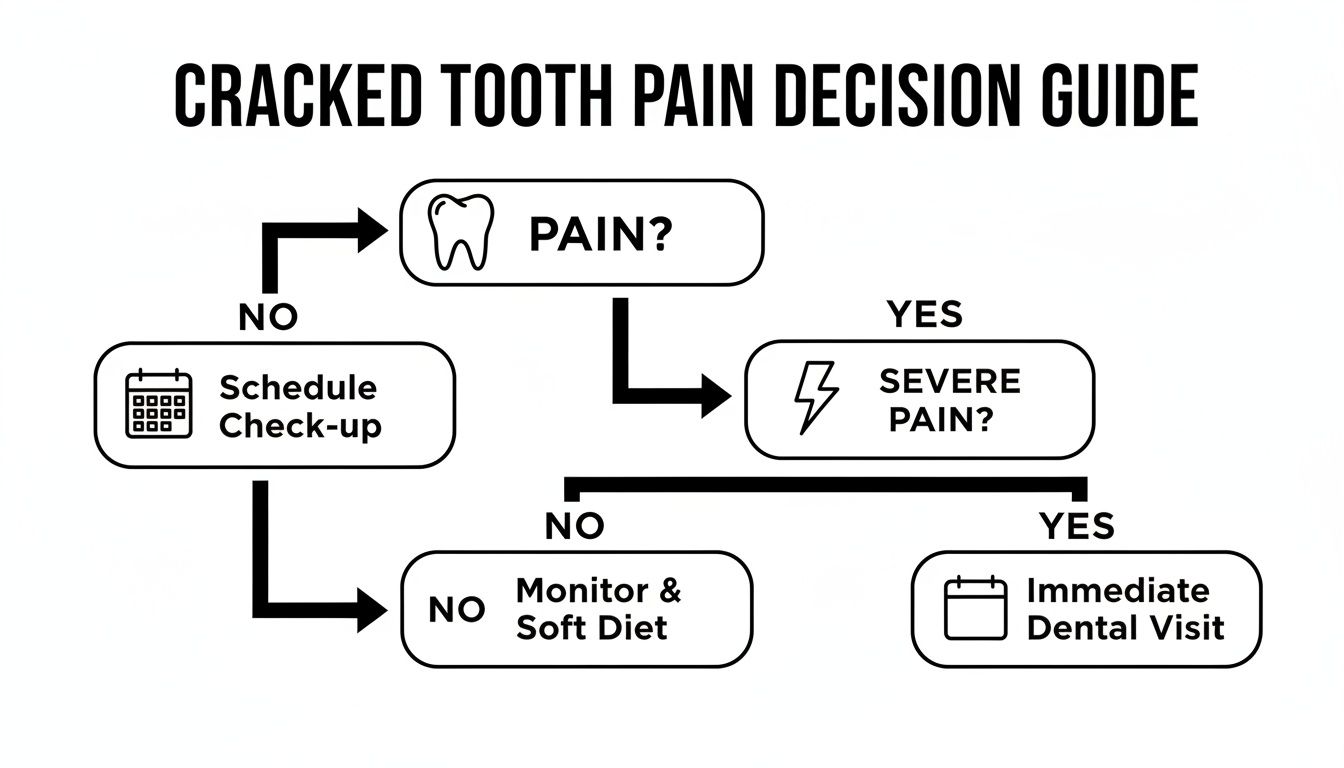
As the chart shows, any level of pain means you need to see a dentist. But if the pain is severe, it's a clear signal to get emergency help right away to avoid serious complications and preserve your dental health.
Is It a Dental Emergency?
Knowing when to make that urgent call is key. Not every cracked tooth is a five-alarm fire, but some situations are absolutely dental emergencies that need immediate attention to save the tooth and protect your overall well-being.
We've created a simple table to help you assess your symptoms on the spot.
Cracked Tooth Triage Guide: When to Seek Emergency Care
| Symptom | Urgency Level | Recommended Action |
|---|---|---|
| Severe, throbbing, or constant pain | HIGH | Call for a same-day emergency appointment. |
| Visible swelling of gums, face, or jaw | HIGH | Call for a same-day emergency appointment. |
| A fever develops alongside the crack | HIGH | Call for a same-day emergency appointment. This signals infection. |
| A large piece of the tooth broke off | HIGH | Call for a same-day emergency appointment to protect the inner tooth. |
| Extreme, lingering sensitivity to hot/cold | MEDIUM-HIGH | Call our office immediately. This could indicate nerve exposure. |
| Minor crack with little to no pain | MEDIUM | Schedule a non-emergency appointment as soon as possible. |
If you're experiencing any of the "High" urgency symptoms, call our Katy office for a same-day emergency appointment. These are clear signs that the crack is severe and may have reached the nerve or caused an infection. For a more detailed breakdown, you can check out our guide on what to do in a dental emergency.
Even if you only have a minor crack with no pain, it’s still important to book an appointment. Ignoring it gives the crack a chance to spread, turning a small, easily fixable problem into a major threat to your tooth's health. Acting fast is the best way to get the right care and keep your smile healthy and beautiful.
How Your Dentist Diagnoses a Cracked Tooth
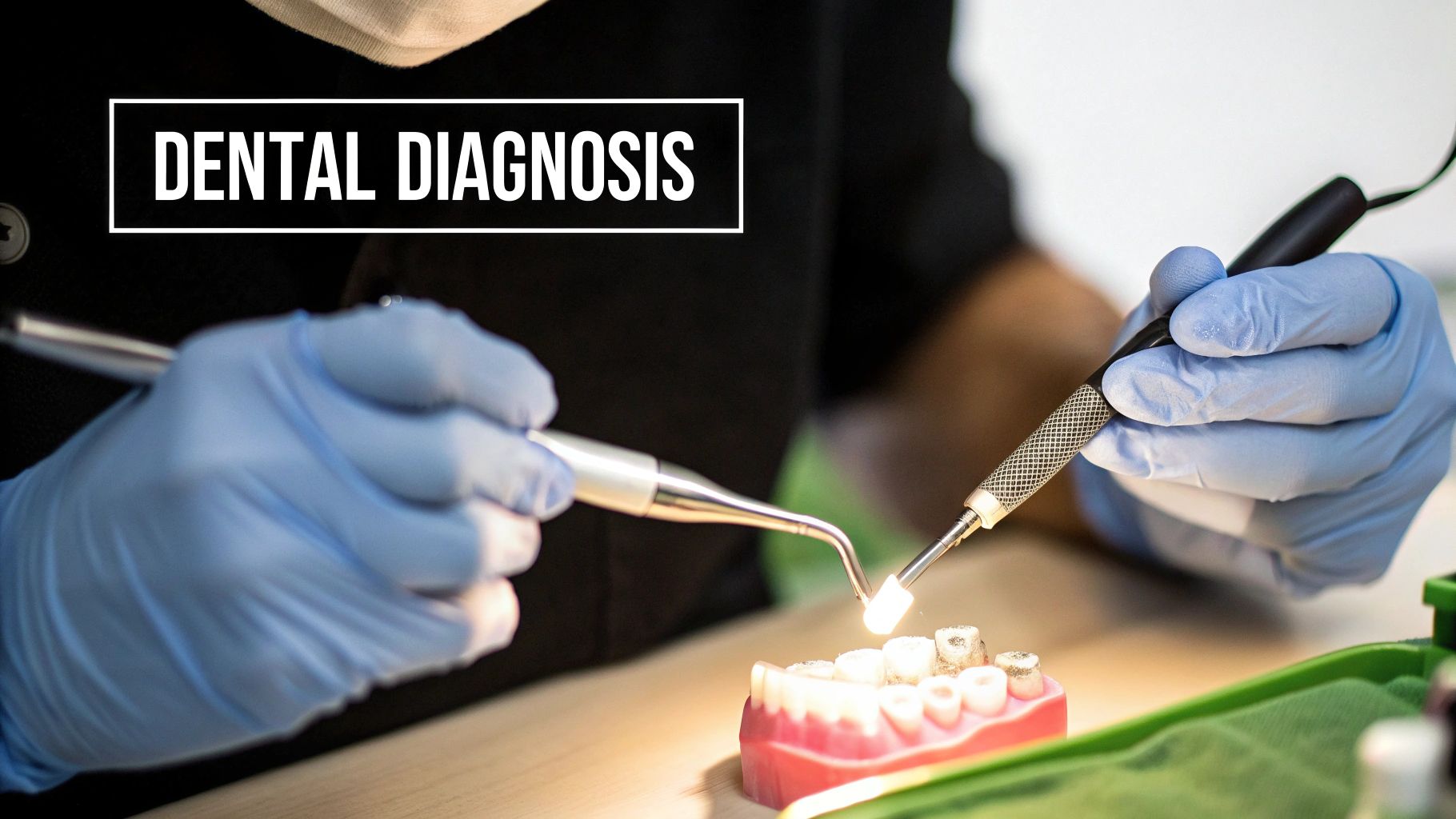
When you come into our Katy office worried about a cracked tooth, our first job is to become a detective. These cracks can be sneaky. Some are obvious, but many are microscopic or hiding just below the gumline, completely invisible to the naked eye.
Getting the diagnosis right is the foundation for a successful outcome. It ensures we fix the problem correctly the first time, restoring your tooth's health and appearance without any guesswork. The whole process starts with a simple conversation about your symptoms—when the pain started, what makes it worse, and what it feels like. This history gives us the first clues we need to restore your comfort and health.
The Initial Physical Examination
We'll begin with a detailed visual check of the tooth and the gums around it. Using a bright light and magnification, we’re looking for any visible fracture lines. Sometimes, the only clue is a bit of localized inflammation in the gum tissue around one specific tooth, which can point us toward the source of the problem.
From there, we often use a special tool called a dental explorer. Its fine point lets us gently trace the grooves on your tooth's surface. If it catches on a specific spot, that’s a red flag for a crack that could compromise your tooth's health.
Another classic diagnostic tool is the bite stick. We’ll ask you to bite down on this small plastic tool, focusing the pressure on one part of the tooth at a time. If you feel a sharp pain when you bite down—or, more commonly, when you release the pressure—it’s a very strong indicator of a crack. This “rebound pain” happens because the cracked pieces of the tooth move just enough to irritate the sensitive pulp inside, a clear sign your tooth needs attention.
Advanced Diagnostic Tools and Imaging
When a physical exam isn't giving us the full story, we bring in more advanced technology to see what’s happening beneath the surface, ensuring a precise treatment plan.
- Transillumination: This is a fancy way of saying we shine a very bright, focused light through the tooth. A healthy tooth will glow uniformly. But if there’s a crack, it will block the light and show up as a dark line, revealing the problem area.
- Dental Dyes: In some situations, we might apply a special colored dye to the tooth. After a minute or two, we rinse it off. Any dye that has seeped into a crack will remain, making the fracture line pop so we can address it effectively.
Understanding the diagnostic process helps you trust that your treatment is based on solid evidence. Our goal at Grand Parkway Smiles is to pinpoint the exact nature of the crack, so we can recommend a solution that not only alleviates your pain but also preserves the long-term health and beauty of your smile.
Finally, imaging is often the key to understanding a crack's depth. A standard digital X-ray can sometimes reveal larger fractures, especially if they’ve caused changes in the nearby bone. But hairline cracks often won't show up on a 2D image.
For those really tough cases, a Cone Beam Computed Tomography (CBCT) scan gives us an incredibly detailed 3D image of your tooth, jaw, and all the surrounding structures. This advanced view is invaluable for assessing cracks that run down into the root, helping us determine if the tooth can be saved. This technology ensures your treatment plan is perfectly matched to your specific needs, leading to the best possible outcome for your dental health.
Exploring Your Cracked Tooth Treatment Options
Once we've pinpointed the exact nature of the crack, we can sit down and talk about the best way to fix it. Our approach always has two main goals: get your tooth healthy again and restore its natural, beautiful appearance. Thankfully, we have several fantastic ways to repair a cracked tooth, and the right one for you will depend on the crack's size, location, and how deep it goes.
Getting a handle on these options is the best way to feel confident in the treatment plan we map out together. Whether we're dealing with a minor surface line or a more serious fracture, there’s a solution ready to protect your tooth and enhance your smile for years to come.
For Minor Surface Cracks: Dental Bonding
Think of a tiny chip on a car's windshield. Dental bonding is a lot like that, but for your smile. It's the go-to solution for small, superficial cracks—often called craze lines—that are more of a cosmetic concern and haven't weakened the tooth's structure.
The process is quick and simple, usually wrapped up in a single visit to our Katy office. We apply a tooth-colored composite resin, the same durable material we use for modern fillings, right onto the tooth. We then carefully shape and polish it until it blends in perfectly with your natural enamel, making the crack seem to disappear.
- Key Benefit: Dental bonding is a fast, minimally invasive, and affordable way to restore your tooth's smooth surface and beautiful appearance.
- Best For: Small craze lines or minor chips, especially on front teeth where appearance is everything.
For Deeper Cracks: A Dental Crown
When a crack is more serious and puts the tooth's strength at risk, a dental crown is usually the best answer. A crown is like a custom-made helmet that covers the entire visible part of your tooth, right down to the gumline. This isn't just about aesthetics; it's about pure protection and function.
By encasing the tooth, a crown acts like a brace, holding the cracked sections together and stopping them from flexing when you bite down. This structural support is crucial for preventing the crack from getting worse and causing a catastrophic break. A crown brings back the tooth's original shape, size, and strength, letting you eat, speak, and smile with total confidence again.
When the Crack Reaches the Pulp: Root Canal Therapy
If a crack is ignored, it can creep deeper and deeper until it reaches the tooth's sensitive inner core, called the pulp. This area is full of nerves and blood vessels. When bacteria from the crack get in, it can lead to severe pain and infection, threatening your overall health.
In these situations, a root canal is what we need to do to save the tooth. During the procedure, we gently remove the infected pulp, clean the inside of the tooth thoroughly, and then seal it up to keep any new bacteria out. The primary purpose of a root canal is to relieve pain and eliminate infection, not cause it. Afterwards, we'll place a crown on the tooth to give it the long-term protection and strength it needs to function like a healthy tooth.
One of the best developments in modern dentistry is a more conservative mindset. We now know it's often better to place crowns on living, cracked teeth first, saving root canals only for when the pulp is clearly infected or painful. This helps preserve as much of your natural tooth as possible, which is always the best outcome for your dental health.
Over the past decade, treatment strategies have become much less invasive without sacrificing success. For example, data from 2009 to 2019 shows that doing a root canal before crowning a cracked tooth became much less common. This conservative approach works, with long-term survival rates for treated teeth holding strong between 86-97%. You can learn more about these modern cracked tooth treatment outcomes and see how this benefits patients like you.
For Severe, Untreatable Fractures: Extraction and Dental Implants
Sometimes, a crack is just too severe. It might run vertically down the root, extending below the gumline. This is called a split tooth, and unfortunately, it's almost never salvageable. Trying to save a tooth with a vertical root fracture just doesn't have a good long-term outlook for your dental health.
When we're faced with this, the healthiest and most predictable path forward is to extract the tooth. While hearing you need a tooth pulled can be tough, it opens the door to the absolute best replacement option available today: a dental implant.
A dental implant is a small titanium post that acts as an artificial tooth root. We place it in the jawbone, and once it's secure, we top it with a beautiful, natural-looking crown. This solution doesn't just restore your smile's appearance—it preserves your jawbone health and stops the neighboring teeth from shifting out of place, protecting your entire dental alignment.
To help you visualize these options, we've put together a simple comparison.
Comparing Your Cracked Tooth Repair Options
Here's a side-by-side look at the common treatments for a cracked tooth. This table breaks down what each procedure is for, how long it typically takes, and its main advantage, giving you a clearer picture of the path ahead toward a healthier smile.
| Treatment | Best For | Procedure Timeline | Key Benefit |
|---|---|---|---|
| Dental Bonding | Small, cosmetic surface cracks (craze lines) or minor chips. | 1 Visit (30-60 minutes) | A fast, affordable, and minimally invasive way to restore your tooth's appearance. |
| Dental Crown | Deeper cracks that weaken the tooth but haven't reached the pulp. | 2 Visits (approx. 2-3 weeks apart) | Protects the tooth from further damage and restores full function and a natural look. |
| Root Canal + Crown | Cracks that have reached the tooth's inner pulp, causing pain or infection. | 2-3 Visits (over several weeks) | Saves the natural tooth by removing infection, relieving pain, and restoring its health. |
| Extraction & Implant | A crack that splits the tooth or extends deep below the gumline. | Several Months (for healing and integration) | The most durable, long-term solution for replacing a lost tooth and preserving jaw health. |
Ultimately, the best choice depends on your unique situation. During your visit, we'll go over our findings and recommend the solution that will give you the best, most lasting results for your smile's health and appearance.
Why a Dental Crown Is Often the Best Solution
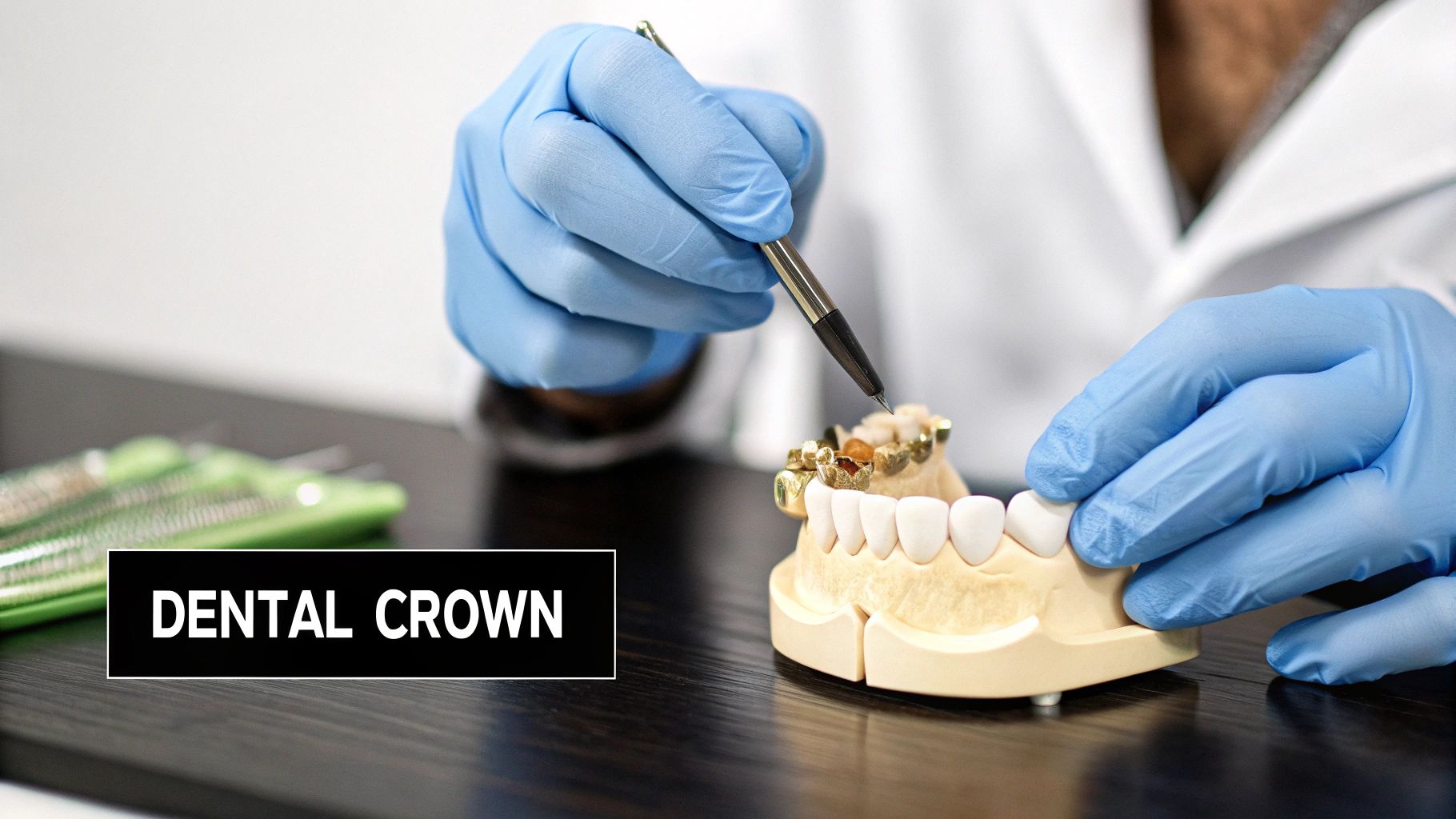
When we see certain types of cracked teeth, a dental crown is more than just a quick fix—it’s a long-term strategy to save the tooth. It's a custom-made shield that completely encases the compromised tooth, giving it back its strength, function, and natural look.
Think of it as a protective helmet. This total coverage is what makes a crown so effective. It physically holds the cracked pieces together, stopping them from flexing and separating when you chew. By spreading out biting forces evenly, it prevents the fracture from getting deeper, which is essential for avoiding severe pain or even tooth loss.
The Protective Power of Cuspal Coverage
The real genius behind a dental crown is something we call cuspal coverage. Your cusps are the pointy parts of your molars and premolars that do all the heavy lifting during chewing. When a crack forms, these cusps can act like wedges, forcing the crack to spread with every bite.
A crown completely covers these cusps. This simple but critical design neutralizes those damaging forces. Instead of pressure focusing right on the fracture line, it’s absorbed and redistributed by the strong material of the crown, keeping the natural tooth underneath safe and stable.
The difference this makes for a tooth's survival is staggering. When it comes to cracked teeth, research shows that a full crown is a game-changer. One pivotal study found that cracked teeth treated with a root canal but without a crown had a 2-year survival rate of just 20%. That number skyrocketed to 94% when a crown was placed, demonstrating its immense benefit to dental health.
Other studies back this up, showing impressive survival rates of 86% to 97% for cracked teeth properly restored with a crown.
Restoring Both Function and Aesthetics
Beyond just protecting the tooth, a modern dental crown is a work of art designed to bring back the natural beauty of your smile. The days of obvious metal caps are long gone. Today, we work with advanced materials that look and feel just like your own teeth.
At Grand Parkway Smiles, we craft crowns from several high-quality, tooth-colored materials, each with its own aesthetic and functional advantages.
- Porcelain: This material is fantastic for its translucency, which perfectly mimics the way light reflects off natural tooth enamel. It’s an ideal choice for front teeth, where a beautiful appearance matters most.
- Zirconia: Think of this as the powerhouse material. It offers incredible strength and can handle the immense chewing forces on back molars. We can even layer modern zirconia with porcelain for a beautiful, natural finish.
- Porcelain-Fused-to-Metal (PFM): This is a time-tested classic, combining the strength of a metal base with the cosmetic appeal of a porcelain exterior for a reliable, durable solution.
Key Insight: Choosing to place a crown isn't just about patching up a problem. It’s an investment in your future dental health, preventing a small crack from turning into a major issue that might require an extraction and implant.
We take great care to match the shade and shape of your crown to the surrounding teeth. Using digital impressions and precise color-matching, we create a restoration that blends in so seamlessly, no one will ever know it’s not your original tooth.
This attention to detail ensures your repaired tooth doesn't just feel strong—it looks completely natural, restoring your confidence along with your smile. To see how these restorations work in our practice, you can learn more about the dental crowns we provide in our Katy office. A crown truly offers the best of both worlds: robust protection for the long-term health of your tooth and a beautiful restoration for your smile.
How to Prevent Future Cracks and Protect Your Teeth
Getting a cracked tooth fixed is a huge relief. You can finally eat comfortably again and feel confident in your smile. But the story doesn't end there. Now, the focus shifts to making sure it doesn't happen again to maintain your great dental health.
Think of it this way: you just invested time and money into a beautiful repair. A few simple, protective habits can safeguard that investment and keep the rest of your teeth strong for the long haul. Most cracks aren't from some major, dramatic event; they're the result of forces and habits we can absolutely control.
The Critical Role of a Custom Nightguard
One of the biggest culprits we see behind cracked teeth is bruxism—the fancy term for grinding or clenching your teeth. The real kicker? Most people have no idea they're doing it because it happens in their sleep. Night after night, that incredible pressure slowly wears down and weakens your enamel, eventually leading to fractures and jaw pain.
The single best line of defense is a custom-fitted nightguard from your dentist. Forget the bulky, boil-and-bite options from the drugstore. A professionally made guard is crafted from a precise mold of your teeth, so it fits perfectly and comfortably. It acts as a protective cushion, absorbing all those grinding forces so your teeth don't have to.
Wearing a custom nightguard is more than just a preventive step—it's an insurance policy for your dental work and your natural teeth. It protects your newly repaired tooth while reducing stress on your entire jaw system, promoting better overall oral health.
Smart Lifestyle Adjustments for a Stronger Smile
Beyond what happens at night, small tweaks to your daily habits can make a massive difference in your dental health. Many fractures come from seemingly innocent actions that, over time, weaken the tooth structure.
Take a second to think about what you ask your teeth to do every day. Are they just for chewing food, or have they become your go-to multi-tool? Keeping your smile safe is often as simple as making a few conscious choices.
Here are some of the most practical tips we give our patients to protect their teeth:
- Avoid Chewing on Hard Objects. This is probably the number one cause of cracked teeth we see. Try to break the habit of chewing on ice, hard candy, and un-popped popcorn kernels. Anything that puts a sudden, intense force on a single tooth is a gamble against your dental health.
- Stop Using Your Teeth as Tools. It's tempting to use your teeth to open a stubborn package, rip tape, or hold a few nails, but it's a recipe for a chip or crack. Your teeth are designed for one job: eating. Let them do it well.
- Be Mindful During Meals. Simple awareness goes a long way. Cut tougher foods into smaller, more manageable pieces. Be cautious with things that might have hidden surprises, like olive pits, cherry pits, or small bones in meat, to prevent an unexpected fracture.
Protective Gear for Active Lifestyles
For all the active families here in the Katy and Houston area, protecting your teeth during sports is non-negotiable. Whether it's soccer, basketball, or martial arts, a stray ball, an accidental elbow, or a simple fall can easily crack or even knock out a tooth. This is where a professionally made sports mouthguard becomes an essential piece of gear.
A custom mouthguard from our office offers a world of difference in protection compared to generic store-bought ones. It fits snugly and securely, which means it won’t fall out during a critical moment. This allows for easier breathing and talking while providing maximum shock absorption to shield teeth from direct impact. It’s a simple, powerful tool to keep your family’s smiles healthy, safe, and in the game.
Common Questions About Fixing a Cracked Tooth
When you're dealing with a cracked tooth, it's natural to have a lot of questions. We see it all the time with our patients here in Katy. Feeling a bit uncertain or anxious about what's next is completely normal. At Grand Parkway Smiles, we believe the best way to move forward is with clear, honest answers so you feel confident and in control of your dental health journey.
Here are a few of the most common questions we hear, along with the straightforward answers you deserve.
Will Fixing My Cracked Tooth Hurt?
This is usually the very first thing people ask, and for good reason. Let me be clear: our absolute top priority is your comfort. Before we do anything—whether it's a simple bonding procedure or preparing a tooth for a crown—we use a local anesthetic to completely numb the area.
You won't feel pain during the procedure. We make sure of it.
For those who feel extra nervous about dental work (and many people do!), we also offer sedation options like nitrous oxide, or "laughing gas," to help you feel totally relaxed. The benefit of modern dentistry is a comfortable experience. It’s common to feel some mild sensitivity for a day or so afterward as things heal, but that's easily managed. Think of it as a very small step on the path back to a healthy, pain-free tooth.
How Much Does It Cost to Fix a Cracked Tooth?
The honest answer is: it depends entirely on what your tooth needs to be strong and healthy again. Every crack is unique, and so is the right solution. For example, a minor cosmetic fix with dental bonding is going to be a smaller investment than a custom-milled porcelain crown designed to protect a back molar from chewing forces for years to come.
During your visit, we'll give you a completely transparent, detailed breakdown of the treatment plan and all associated costs. No surprises, ever.
We're committed to making great dental care fit into your budget. Our team works with most major PPO dental insurance plans to help maximize your benefits. For any remaining costs, we also offer flexible financing through partners like CareCredit. Our goal is to make a healthy, beautiful smile an affordable reality for your family.
Can a Cracked Tooth Heal on Its Own?
This is a really important question with a very direct answer: unfortunately, no. Unlike a bone that can knit itself back together, the enamel and dentin that make up a tooth can't regenerate or fuse back together once they've fractured.
Leaving a cracked tooth alone won't make it better. In fact, the daily pressures from chewing and biting will almost certainly cause the crack to spread, deepen, or get worse over time, threatening the tooth's health.
That’s precisely why getting professional care quickly is so critical. Catching it early often means we can use a more conservative fix, like bonding or a crown. Waiting too long can lead to infection, serious pain, and the need for more involved treatments like a root canal or even pulling the tooth. Early treatment is the key to a better health outcome.
How Long Will My Cracked Tooth Repair Last?
Thinking about durability and longevity is smart. How long your repair lasts really comes down to two things: the type of treatment you get and, just as importantly, how you take care of it afterward. Your daily habits play a huge role in the long-term success of your dental work.
Here's a general idea of what you can expect from our most common treatments:
- Dental Bonding: This is a fantastic fix for smaller cracks. With good care, it can last for several years, providing a beautiful aesthetic result right away.
- Dental Crowns: A high-quality porcelain or zirconia crown is a true long-term solution. These are engineered for strength and are designed to last for 15 years or even longer, preserving your smile's health and function.
The real key to making any dental work last is excellent oral hygiene. That means consistent brushing, flossing, and coming in for your regular check-ups and cleanings. And if we recommend something preventive—like a custom nightguard because you grind your teeth—following that advice is the best way to protect both your natural teeth and your beautiful new restorations for many years to come.
At Grand Parkway Smiles, our team is ready to answer any other questions you have about fixing a cracked tooth. We use our decades of combined experience and modern technology to get your smile back to feeling and looking its best. If you're in the Katy or Houston area, schedule your consultation today.