When you hear the term bone graft dental procedure, it might sound a bit intimidating. But in reality, it's a very common and safe surgery designed to restore and rebuild the bone in your jaw. It's often the single most important step we take to create a solid foundation for dental implants, paving the way for a successful, long-lasting, and beautiful smile.
This restorative procedure becomes necessary when bone loss occurs, a natural consequence of losing a tooth or battling gum disease, which can compromise both your dental health and facial appearance.
Building the Foundation for a Perfect Smile
Think of your jawbone like the foundation of a house. For a house to stand strong for decades, its foundation has to be solid and unyielding. The same exact principle applies to your smile; a healthy, dense jawbone is absolutely essential for supporting your teeth and maintaining your natural facial shape.
When a tooth is lost, that foundation can start to weaken. The bone in that specific spot is no longer getting the stimulation it needs from the daily forces of chewing. In response, your body begins to resorb it, basically taking the bone material away because it thinks it’s no longer needed. This is similar to how a muscle shrinks when it goes unused.
Left unchecked, this bone loss can have a significant impact on both your appearance and your overall dental health, leading to a less confident smile.
Why a Strong Jawbone Matters for Your Health and Appearance
Having enough quality jawbone is critical for several reasons, and a bone graft dental procedure is the direct solution to these problems. Without it, your oral health and even the way your face looks can be compromised, affecting your confidence.
Here’s why maintaining that strong foundation is so important for your smile:
- Supporting Dental Implants: Implants need a solid base of bone to fuse with. This process, called osseointegration, is what gives them the incredible stability to look, feel, and function just like natural teeth, restoring your smile completely.
- Preserving Facial Structure: Jawbone loss can cause a sunken or collapsed look in the cheeks and around the mouth, which can prematurely age your face. A bone graft helps support your natural facial contours, maintaining a more youthful appearance.
- Preventing Further Dental Issues: Rebuilding the bone stops nearby teeth from drifting into the empty space, which can cause bite problems. It stabilizes the entire dental arch, protecting your long-term oral health and the alignment of your smile.
A successful bone graft isn't just about adding material. It acts as a scaffold that masterfully encourages your own body to generate new, healthy bone tissue. You can think of it as a proactive investment in the future health and beauty of your smile.
This procedure isn't just a technical prerequisite for implants; it's a truly restorative one. It sets the stage for a fully functional and confident smile, giving future treatments like dental implants the highest possible chance of success. By rebuilding what was lost, you're restoring your ability to eat, speak, and smile without hesitation.
Why Your Jawbone Might Need a Bone Graft
Your jawbone is the unsung hero of your smile. It’s the foundation, the critical support structure holding every single tooth in place. And just like a muscle needs exercise to stay strong, your jaw needs the daily stimulation from chewing and biting to maintain its density and shape, which is key to a healthy appearance.
But what happens when a tooth is lost? That vital stimulation disappears. In response, your body starts a natural process called resorption. It’s your body’s way of being efficient—it senses the bone in that area is no longer needed to support a tooth, so it begins to break it down. This causes the jawbone to gradually shrink in both height and width, which is the number one reason your dentist might bring up a dental bone graft—to rebuild what’s been lost and restore your jaw's original strength and form for optimal health and aesthetics.
Counteracting Bone Loss After a Tooth Extraction
One of the most common times a bone graft is needed is right after a tooth is pulled. The moment a tooth comes out, the clock on bone loss starts ticking. This is where we can be proactive with a procedure called a socket preservation graft, which is all about setting you up for future success and preserving the aesthetics of your smile, especially if a dental implant is in your plans.
A socket preservation graft is a straightforward step where we place bone grafting material directly into the empty socket immediately after the extraction. It's a simple move that accomplishes several big things for your long-term dental health and appearance:
- Prevents Jawbone Collapse: It acts like a placeholder, stopping the bony walls of the socket from caving in and preserving the natural contours of your jaw and gums, which is crucial for a natural-looking tooth replacement.
- Keeps Your Options Open: By saving the bone now, you ensure you’ll be a great candidate for a dental implant later, which is the best long-term solution for a missing tooth. This avoids the need for a more involved grafting procedure down the road.
- Supports Your Other Teeth: It provides stability and prevents neighboring teeth from tilting or drifting into the empty space, which can negatively affect your bite and the look of your smile.
Rebuilding a Foundation for Dental Implants
For a dental implant to work, it has to physically fuse with the jawbone. This process, called osseointegration, creates an incredibly strong, stable anchor that lets an implant function just like a natural tooth root. But here’s the catch: this fusion can only happen if there's enough healthy bone to completely surround and support the implant post, ensuring a beautiful and lasting result.
If a lot of time has passed since you lost a tooth, the resorption we talked about can leave the jawbone too thin or too short to place an implant safely. This is where a dental bone graft becomes absolutely essential. It rebuilds that lost volume, creating the solid foundation needed for an implant that will be secure and look natural for years to come.
Think of it like this: you wouldn't try to set a fence post in soft, shallow dirt and expect it to be sturdy. A bone graft is like adding and compacting dense, new soil to make sure the post—your dental implant—has a rock-solid base to anchor into for decades of confident smiles.
When your natural bone just isn't enough, a dental bone graft is the key to success. It helps implants achieve incredible success rates of 95-98%, putting them on par with implants placed in naturally dense bone. Without that extra support, some studies have shown implant failure rates in the softest bone types can jump as high as 35%. You can find more details about bone quality and implant success online if you're curious.
Restoring Bone Damaged by Gum Disease
Severe periodontal (gum) disease is another major culprit behind bone loss. The chronic bacterial infection that comes with advanced gum disease doesn’t just harm the gums; it actively destroys the bone that supports your teeth. This can lead to loose teeth, an unhealthy appearance, and eventual tooth loss.
Before we can even think about stabilizing the remaining teeth or replacing the lost ones with implants, we have to repair the damage. A bone graft is used to regenerate the bone structure that the infection has eaten away. This step is fundamental to stopping the disease, restoring stability, and rebuilding a healthy and attractive smile.
Understanding Different Bone Graft Materials
If we've recommended a bone graft dental procedure, one of the first things we'll discuss is the type of material we'll use to rebuild your jaw. This isn't a one-size-fits-all situation. The choice depends entirely on your specific needs, how much bone we need to build, and your body's own unique healing abilities to achieve the best outcome for your smile.
Think of these materials as different kinds of scaffolding. Each one is expertly designed to give your body a framework to build new, strong bone right where you need it most. The end goal is always the same: creating a solid foundation for your long-term dental health, whether that's for a future dental implant or to restore your natural facial contours for a more youthful look.
Autografts: Using Your Own Bone
An autograft is often called the "gold standard" in bone grafting, and for a very simple reason—it uses your own bone. We typically harvest a small amount of bone from another spot, like your chin, the back of your jaw, or occasionally the hip.
Because the bone comes directly from you, it's packed with your own living cells, growth factors, and proteins. This makes it perfectly compatible with your body, promoting the most predictable and fastest healing with virtually zero risk of rejection, leading to a superior health outcome.
Allografts: A Safe and Proven Alternative
While using your own bone is highly effective, it does mean creating a second surgical site. An allograft provides a fantastic alternative. This is bone from a human donor that has been meticulously screened, sterilized, and prepared by a licensed tissue bank to ensure safety and effectiveness.
This material acts as a perfect framework, guiding your own body to grow new bone cells into the graft site. It’s incredibly safe and has been used successfully in millions of medical and dental procedures. We often use allografts for procedures like socket preservation, which helps maintain the aesthetics of your smile after an extraction and prepares the site for a future implant.
This infographic breaks down the main reasons a graft might be necessary, from replacing a lost tooth to supporting your facial structure and providing a solid base for implants.
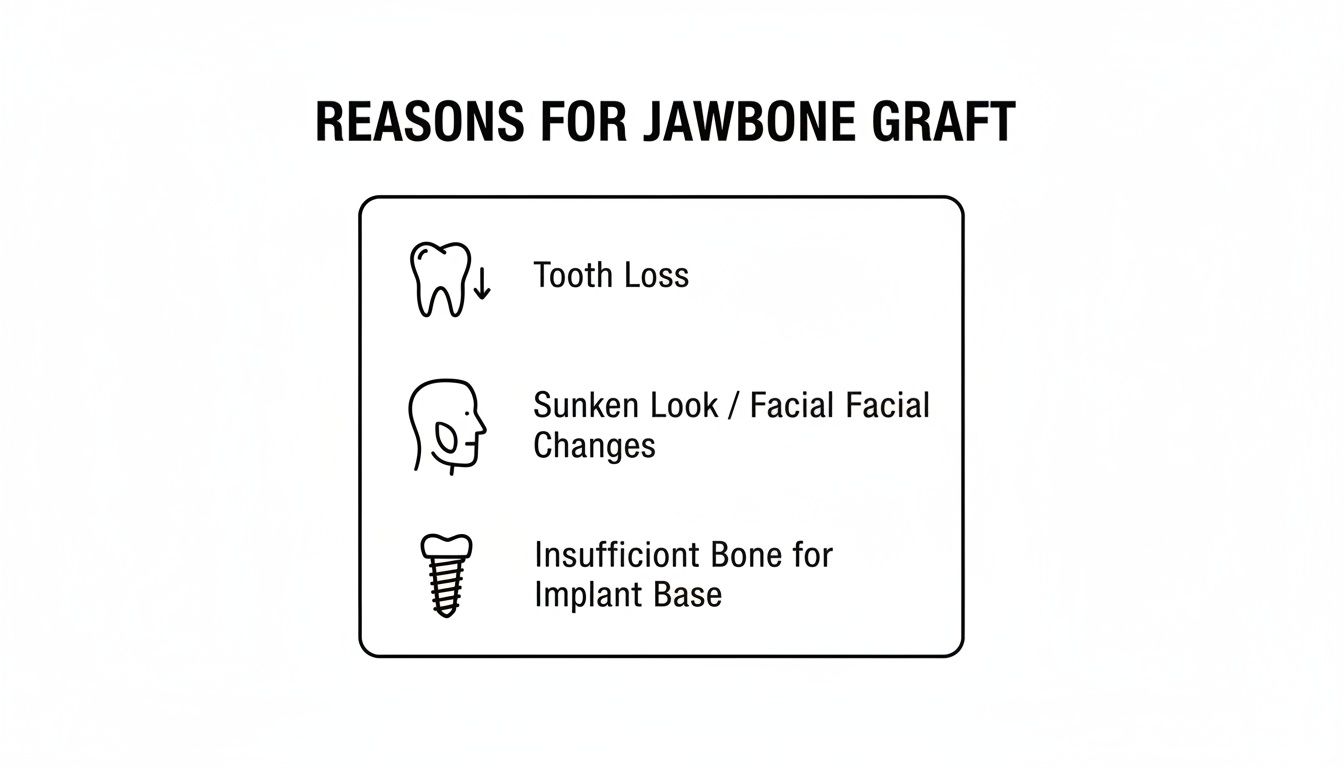
As you can see, a bone graft is a versatile tool that addresses both functional needs, like securing an implant, and aesthetic concerns, like preventing the sunken look that can happen after tooth loss and detract from your appearance.
Xenografts and Alloplasts: Expanding the Possibilities
Beyond autografts and allografts, there are a couple of other highly successful materials we can use to improve your dental health.
- Xenografts: This type of graft material comes from an animal source, most often bovine (cow). The bone goes through an intense purification process that removes all organic material, leaving only the mineral framework. This structure is remarkably similar to human bone and serves as an excellent scaffold for your own bone cells to populate and build upon, restoring your jaw's strength.
- Alloplasts: These are synthetic materials engineered in a lab. They’re usually made from biocompatible substances like hydroxyapatite or calcium phosphate—the very same minerals found in your natural bone. Alloplasts are completely sterile, have zero risk of disease transmission, and provide a reliable structure that your body gradually replaces with its own bone over time.
To make these choices clearer, here’s a simple breakdown of the different graft materials.
Comparison of Dental Bone Graft Materials
| Graft Type | Source | Primary Advantage | Commonly Used For |
|---|---|---|---|
| Autograft | Your own body (chin, jaw, hip) | Contains living cells, fastest healing, no rejection risk | Large defects, complex reconstructions |
| Allograft | Human donor (tissue bank) | Avoids a second surgical site, readily available | Socket preservation, ridge augmentation |
| Xenograft | Animal (usually cow) | Excellent scaffold, resorbs slowly, maintains volume | Sinus lifts, preserving space for implants |
| Alloplast | Synthetic (lab-made) | 100% sterile, no risk of disease transmission | Filling smaller voids, ridge preservation |
Each of these materials has a specific job, and we choose the one that will give you the most successful, predictable, and comfortable outcome for your dental health.
The PRF Advantage: Supercharging Your Recovery
Here at our practice, we can also give your body’s healing process a major boost using a technique called Platelet-Rich Fibrin (PRF). It sounds complex, but it's quite simple: we draw a small amount of your own blood right here in the office and spin it in a centrifuge. This isolates a powerful concentration of your body's own platelets and growth factors.
This process creates a golden, gel-like membrane of PRF that we can place directly over the bone graft. Think of it as a super-charged, natural bandage. It slowly releases growth factors that dramatically speed up tissue regeneration, calm inflammation, and lower the risk of infection. The result? A faster, more comfortable healing experience and an even better health outcome for your bone graft dental procedure.
The long-term success of these materials is incredibly well-documented. A retrospective analysis that followed 80 bone grafts for up to 10 years found a 100% success rate for the grafts themselves. This strong foundation then supported a 97.2% implant survival rate, with both autografts and allografts showing perfect success. You can read the full study about bone graft success rates to see the detailed data. We'll work with you to decide which material is the perfect fit to restore your jaw’s strength and get your smile ready for the future.
What to Expect During Your Bоnе Graft Procedure
Knowing exactly what happens during a bone graft dental procedure is the best way to feel confident and prepared. We find that when patients understand the process, any anxiety they might have melts away. The whole thing is carefully planned and designed for your comfort, ensuring you're relaxed from start to finish.
Think of it as a straightforward construction project for your jaw, paving the way for a healthy, beautiful smile for years to come.
It all starts with a detailed consultation. This first step is so much more than just a quick look at your teeth. We use advanced 3D imaging, specifically a Cone Beam Computed Tomography (CBCT) scan, to get a precise, three-dimensional picture of your jawbone. This amazing technology lets us see the exact height, width, and density of your bone, allowing us to plan your procedure with incredible accuracy for the best aesthetic and functional result.
This detailed planning leaves nothing to chance. We can map out exactly where the graft is needed and determine the precise amount of material required to rebuild your jaw’s foundation, setting you up for the best possible outcome for your smile.
Comfort and Care on Procedure Day
Your comfort is our top priority. On the day of your bone graft dental surgery, our main goal is to make the entire experience free of pain and worry. We always start with local anesthesia, which completely numbs the area so you won't feel any discomfort during your treatment.
For patients who feel a little nervous (which is completely normal!), we offer various sedation options to help you relax completely. From mild oral sedatives to IV sedation for a deeper state of calm, we will find the best option for you. This focus on comfort allows you to rest peacefully while we meticulously restore your jaw, improving your oral health.
The procedure itself is quite simple. Once you’re comfortable and the area is numb, your surgeon makes a small incision in the gum tissue to get to the bone underneath. The grafting material is then carefully placed in the spot where the bone has been lost.
This isn’t just about filling a space; it’s about signaling your body’s own healing powers to get to work. The graft material acts as a biological scaffold, encouraging your own bone cells to grow and regenerate, eventually becoming a solid, integrated part of your jaw to support a healthy smile.
Finally, a protective membrane is often placed over the graft. This little barrier shields the new material and can even be enhanced with techniques like PRF to speed up healing. If you're curious about this, check out our guide on what PRF is in dentistry to learn how we use your body’s own growth factors. The incision is then closed with a few small stitches, and just like that, the procedure is complete.
The Surgical Process and Initial Healing
Every step is methodical and precise, focused on one thing: rebuilding your jaw’s foundation for future dental work that will enhance your smile, like implants. As soon as the graft is placed and secured, the initial healing phase begins. We’ll send you home with clear, easy-to-follow instructions to guide you through the first few days for a smooth recovery.
It’s normal to have some mild swelling and discomfort as the anesthesia wears off, but this is typically well-managed with the medication we prescribe. Following the aftercare instructions closely—like sticking to soft foods and being gentle with your oral hygiene—is the key to a smooth and uneventful recovery for your dental health.
The long-term success of this procedure is incredibly high. For instance, one long-term study on guided bone regeneration found that the grafts had a 100% success rate. This led to a 97.2% survival rate for the dental implants placed afterward. This data highlights just how reliable a bone graft dental procedure is for creating the strong foundation a lasting, beautiful smile needs. You can even read the full research about these excellent outcomes to see the science behind this trusted treatment.
Ensuring a Smooth Recovery and Lasting Success
A successful dental bone graft is really a partnership between our surgical team and you. Our work happens here in the chair, but your role during the recovery period is absolutely critical to making sure that graft heals perfectly. The goal is to create a strong, lifelong foundation for your new, healthy smile.
Think of the newly grafted area like a garden where you've just planted new seeds. It needs to be protected, kept clean, and given the right conditions to grow strong. Following your post-op instructions to the letter is the best way to guarantee your new bone integrates successfully, paving the way for a beautiful, functional implant down the road.
Your Post-Operative Care Checklist
That first week is the most important part of the healing process. Your body is working overtime to accept the new graft material and kickstart the regeneration process. Your main job is to create a peaceful, undisturbed environment to promote optimal healing for your dental health.
Here’s a simple checklist to help you sail through recovery:
- Manage Discomfort: It’s totally normal to have some mild swelling and discomfort for the first couple of days. Use ice packs on the outside of your cheek—20 minutes on, 20 minutes off—and take any prescribed anti-inflammatory or pain medication as directed. Staying ahead of the discomfort is key to a comfortable recovery.
- Stick to a Soft Diet: For at least the first week, you’ll want to avoid anything hard, crunchy, or spicy that could irritate the surgical site. Think smoothies, yogurt, mashed potatoes, and lukewarm soups. This protects the delicate graft and promotes healing.
- Prioritize Gentle Oral Hygiene: Keeping your mouth clean is essential for preventing infection and ensuring good dental health. You can gently brush your other teeth, but you'll want to avoid the surgical area entirely for the first few days. We’ll likely send you home with a special antimicrobial rinse to keep the site clean without disturbing it.
The whole point of these instructions is to protect the graft site from being disturbed. Simple things like smoking, drinking through a straw, or rinsing too aggressively can actually dislodge the graft. This can unfortunately lead to complications that compromise the health and success of the procedure.
Signs of Healthy Healing vs. Potential Complications
Knowing what to expect can give you a lot of peace of mind as you heal. Healthy healing is a gradual process. You'll probably notice that swelling and discomfort peak around day three and then get a little better each day after that. The site itself should look progressively better, without any severe pain or signs of infection.
It’s also important to know the warning signs of a potential issue affecting your dental health. While complications are rare, catching them early is everything.
Give our office a call right away if you experience:
- Pain or swelling that gets worse, not better, after the first few days.
- Heavy or persistent bleeding that doesn’t stop with gentle pressure.
- A foul taste or smell coming from the surgical site.
- A fever or chills, which could be a sign of infection.
Proper aftercare is the single most important factor in achieving the incredibly high success rates—often over 95%—that make a dental bone graft so reliable. For more helpful tips, you can check out our detailed guide on the dental bone graft healing process and what to expect week by week. By taking these simple steps, you're an active partner in the success of your treatment and investing in a future full of confident, healthy smiles.
How Bone Grafts Open the Door to Top Implant Solutions
Think of a bone graft dental procedure as more than just a preliminary step. It’s the key that unlocks some of the most incredible, life-changing smile restorations available today. Its main job is to build a strong, stable foundation for dental implants, whether you're replacing one missing tooth or a whole arch, ultimately improving your appearance and quality of life.
A dental implant has to be anchored securely into the jawbone to handle the intense force of chewing. If the bone is too thin or soft, placing an implant would not be successful. The bone graft rebuilds that foundation, giving the implant a dense, solid structure to fuse with. This is absolutely critical for its stability and long-term success, ensuring your new tooth looks and feels natural. That restored bone volume is the difference between a permanent tooth replacement and a failed one.
From a Single Missing Tooth to a Full New Smile
Once a solid bone structure is in place, you become a great candidate for a whole range of implant solutions that can completely restore how your smile works and looks. A bone graft dental procedure makes these advanced, aesthetically pleasing treatments a real possibility.
Here’s a look at what a strong foundation can support for your smile:
- Single Tooth Implants: The go-to solution for a single missing tooth. An implant gives you a durable, natural-looking replacement that preserves the health of neighboring teeth.
- Implant-Supported Bridges: For a few missing teeth in a row, a couple of well-placed implants can support a bridge, restoring multiple teeth for a complete and beautiful smile.
- All-on-4® Treatment Concept: This amazing solution replaces an entire upper or lower arch of teeth with just four strategically angled implants. A bone graft makes sure the jaw is strong enough to support a full set of beautiful, functional teeth right away.
A well-done bone graft doesn't just get you ready for an implant; it gives that implant the best possible shot at lasting a lifetime. It’s the essential first step toward eating, speaking, and smiling with total confidence again, enhancing your appearance and well-being.
The final result is a smile that not only looks fantastic but feels completely natural. The stability you get from implants anchored in healthy, grafted bone lets you enjoy all your favorite foods without a second thought, protecting your dental health and appearance for years to come.
What About Severe Bone Loss?
But what if the jawbone loss is so bad that even a standard bone graft might not cut it? In these really complex cases, modern dentistry still has some incredible solutions that can often sidestep the need for major grafting altogether, opening up paths to a restored smile. We call these graft-less options.
For patients with significant bone loss in the upper jaw, we can use specialized implants that anchor into other facial bones for support. These include:
- Zygomatic Implants: These implants are much longer than traditional ones. They anchor directly into the dense zygomatic bone (your cheekbone), completely bypassing the weak upper jawbone to provide a secure foundation.
- Pterygoid Implants: These are placed in the pterygoid plates of the sphenoid bone, way at the back of the upper jaw. This is another area of very dense, reliable bone for implant support.
These techniques really show how far dental science has come to restore health and appearance. Even if you’ve been told in the past that you don't have enough bone for implants, there is almost always a path forward. Whether it’s through a bone graft dental procedure or an advanced graft-less solution, we have the tools to restore your smile, your ability to eat, and your quality of life, no matter where you're starting from.
Your Bone Graft Questions Answered
It's completely normal to still have a few questions, even after learning about what a bone graft involves. Getting straightforward answers is the best way to feel confident and comfortable with your treatment plan. Here are some of the most common questions our patients in Katy and Houston ask us every day.
We want you to see this procedure not as a hurdle, but as a vital step toward getting back a healthy, functional, and beautiful smile.
Is a Dental Bone Graft Painful?
Making sure you're comfortable is our absolute highest priority. The procedure itself is done under effective local anesthesia, which numbs the area completely—you won’t feel any pain during the surgery. For anyone who feels a bit anxious, we also offer a range of sedation options to help you feel totally relaxed and at ease.
Afterward, any discomfort is usually mild and feels more like soreness than sharp pain. This is easily managed with the medication we prescribe. Most of our patients are pleasantly surprised by how quickly they start feeling better, usually within just a few days, allowing them to return to their normal lives with minimal disruption.
How Long Does a Dental Bone Graft Take to Heal?
Healing really happens in two stages. The first part is pretty quick—your gums, where the incision was made, will typically heal in about one to two weeks. Any swelling or tenderness you have will fade during this time.
The most important healing, however, happens below the surface as the graft material integrates with your jaw. This process, called osseointegration, is your body’s natural way of building new, strong bone to support your dental health. This can take anywhere from three to nine months. We'll use 3D imaging to check in on your progress and know exactly when the new bone is solid enough to support a dental implant for a beautiful, long-lasting smile.
What Is the Success Rate for a Dental Bone Graft?
Dental bone grafting is one of the most predictable and successful procedures in all of restorative dentistry. The success rates are consistently well over 95%, making it an incredibly reliable way to rebuild the jaw for better health and appearance.
This high success rate is the result of combining precise 3D-guided planning, advanced sterile graft materials, and meticulous surgical techniques. Of course, following all of your post-op instructions carefully is also a crucial part of making sure the graft heals perfectly, ensuring the best possible health outcome.
How Much Does a Dental Bone Graft Cost?
The cost of a dental bone graft can vary a bit because it depends on the specific type of graft material we use and the complexity of your particular situation. When you come in for your consultation, we’ll give you a completely transparent and detailed cost breakdown so there are zero surprises.
Many dental PPO insurance plans do offer at least partial coverage for bone grafts, especially when they're considered medically necessary to improve your dental health and prepare for a follow-up procedure like a dental implant. Our financial coordinators are experts at helping you understand and maximize your benefits. We can also talk about flexible financing options to make sure this essential care fits comfortably into your budget.
Ready to take the next step toward a stronger, healthier smile? The expert team at Grand Parkway Smiles is here to guide you through every part of the process with compassion and skill. Schedule your consultation today to find out if a dental bone graft can restore your smile’s foundation for improved health and appearance.
Learn more and book your appointment at https://dentistkatytx.com.